

Factsheet, model back tested
Nifty 50 Equal Weight factsheet
Nifty 50 Equal Weight is a RupeeCase index that holds 50 stocks from the Nifty 50, held at equal weight, rebalanced every 4 weeks. Model CAGR 16.4% (back tested, as of 27 Apr 2026), minimum about ₹2,49,000 (as of 8 Aug 2026), moderate risk band. The Nifty 50 Equal Weight factsheet puts its model, back tested record on one printable page.
All 50 Nifty names, equal weight. The simplest card on the lineup.

RupeeCase strategy factsheet
Nifty 50 Equal Weight
Equal weight, Nifty 50. All 50 Nifty names, equal weight. The simplest card on the lineup.
- CAGR
- 16.35%Nifty 50 TRI line 9.8%
- Max drawdown
- −15.71%peak to trough, model
- Sharpe ratio
- 1.13Nifty 50 0.69
- Minimum capital
- ₹2.49Labout ₹2,49,000
Model, back tested. As of 27 Apr 2026. After charges. Not a promise of future returns.
₹100 became ₹214, Jul 2021 to Jul 2026 (Nifty 50 TRI line ₹160). Log scale.
Performance, risk, efficiency
- MetricNifty 50 Equal WeightNifty 50
- Performance
- CAGR16.35%9.8%
- Cumulative return+94.73%+55.09%
- Sharpe ratio1.130.69
- Sortino ratio1.110.67
- Calmar ratio1.030.54
- Risk
- Max drawdown−15.71%−16.92%
- Volatility, a year14.23%14.15%
- Best week+5.50%+6.36%
- Worst week−6.48%−6.33%
- Efficiency
- Weeks up56.70%56.32%
- Average up week+1.66%+1.53%
- Average down week−1.50%−1.57%
Model, after charges; weekly, rolling 5 years to 13 Jul 2026. CAGR, Sharpe and max drawdown as of 27 Apr 2026.
Configuration
- Universe
- Nifty 50
- Sleeves
- Equity 100
- Holdings
- 50, equal weight in the equity sleeve
- Rebalance
- Every 4 weeks, 13 a year
- Tier
- Starter
- Benchmark
- Nifty 50
- Minimum as of
- 8 Aug 2026
- Back test from
- 9 Jul 2021
- Metrics window
- Rolling 5 years
Calendar year returns
- 2021from Jul+11.3%
- 2022+9.2%
- 2023+34.1%
- 2024+17.7%
- 2025+11.8%
- 2026to Jul−1.0%
Model, back tested, after charges, 2021 to Jul 2026.
Deepest falls
- −15.71%4 Oct 2024 to 10 Oct 2025371 days
- −13.86%15 Apr 2022 to 29 Jul 2022105 days
- −10.28%21 Jan 2022 to 1 Apr 202270 days
- −9.94%9 Dec 2022 to 19 May 2023161 days
- −8.91%22 Oct 2021 to 7 Jan 202277 days
Daily model record, rolling 5 years: peak to low, days to recover.
Monthly returns
- 2021no datano datano datano datano datano data−0.45.04.80.0−2.74.5+11.3%
- 2022−2.0−1.83.60.7−3.5−4.410.51.9−1.35.91.4−1.2+9.2%
- 2023−4.0−2.81.35.84.35.73.1−0.63.5−1.75.710.4+34.1%
- 20241.84.91.61.73.43.94.22.72.8−7.0−0.7−2.1+17.7%
- 2025−1.5−5.35.54.72.63.8−3.4−0.10.35.00.7−0.6+11.8%
- 2026−3.31.4−8.99.6−1.30.81.8no datano datano datano datano data−1.0%
Model, after charges; one calendar month per cell, in percent.
44 holdings
- Equity100%
- ADANIENT
- MAXHEALTH
- SHRIRAMFIN
- ADANIPORTS
- BAJFINANCE
- ICICIBANK
- GRASIM
- ASIANPAINT
- TITAN
- AXISBANK
- SUNPHARMA
- NESTLEIND
- HINDALCO
- SBIN
- CIPLA
- KOTAKBANK
- DRREDDY
- COALINDIA
- LT
- JSWSTEEL
- ETERNAL
- BHARTIARTL
- BEL
- TECHM
- TATACONSUM
- NTPC
- M&M
- BAJAJFINSV
- POWERGRID
- TATASTEEL
- HDFCBANK
- SBILIFE
- HINDUNILVR
- RELIANCE
- JIOFIN
- ONGC
- ITC
- HDFCLIFE
- WIPRO
- HCLTECH
- INFY
- TCS
- TRENT
- INDIGO
Equal weight across the 44 names on the published list of 3 Jul 2026. Model portfolio, not a recommendation to buy or sell any stock.
Sector allocation
- Other, not yet mapped68.2%
- Capital Goods6.8%
- Banking & Financial6.8%
- FMCG & Consumer4.5%
- Metals & Mining4.5%
- Energy & Oil & Gas4.5%
- Power & Utilities4.5%
7 sectors in the equity sleeve.
How it works
- 1Universe
The Nifty 50.
- 2Screen
No ranking screen: every stock in the universe qualifies.
- 3Weight
All 50 names at equal weight, about 2% each.
- 4Rebalance
Every 4 weeks the book is reset to equal weights and the full list is published.
Costs
- Platform fee
- 0.2% of traded value per rebalance; no AUM or performance fee, no lock in
- A year on the minimum, under
- ₹250 (under 0.1% of capital): 14 rebalances in the year to 3 Jul 2026, no name left the list (3 added, funded by trimming the rest, a weight reset), model record
- Inside the back test
- Gross +115.10%, costs −2.77 pts, net +112.33%, rolling 5 years to 13 Jul 2026
- Broker side
- Brokerage, STT, exchange charges, GST
Rebalance record
- Published rebalances
- 65, 6 Aug 2021 to 3 Jul 2026
- Names on the latest list
- 44 (target 50)
Every list is public, with the names in and out.
RupeeCase is a technology platform, not a fund, a PMS or a SEBI registered investment adviser. Model figures are back tested, after estimated charges, and are not actual client returns or a promise of future returns; capital can be lost. Prices: NSE BhavCopy; the back test deducts brokerage, STT, exchange charges and GST. https://www.rupeecase.com/strategies/factsheets/nifty-50-equal-weight
02The PDF
Email me the PDF.
No sign up to read; Print saves a PDF. Leave an email for a copy and a note when Nifty 50 Equal Weight rebalances. Two emails a month at most.
Noted on this device. Print saves the PDF any time.
In the app
How a strategy is chosen.
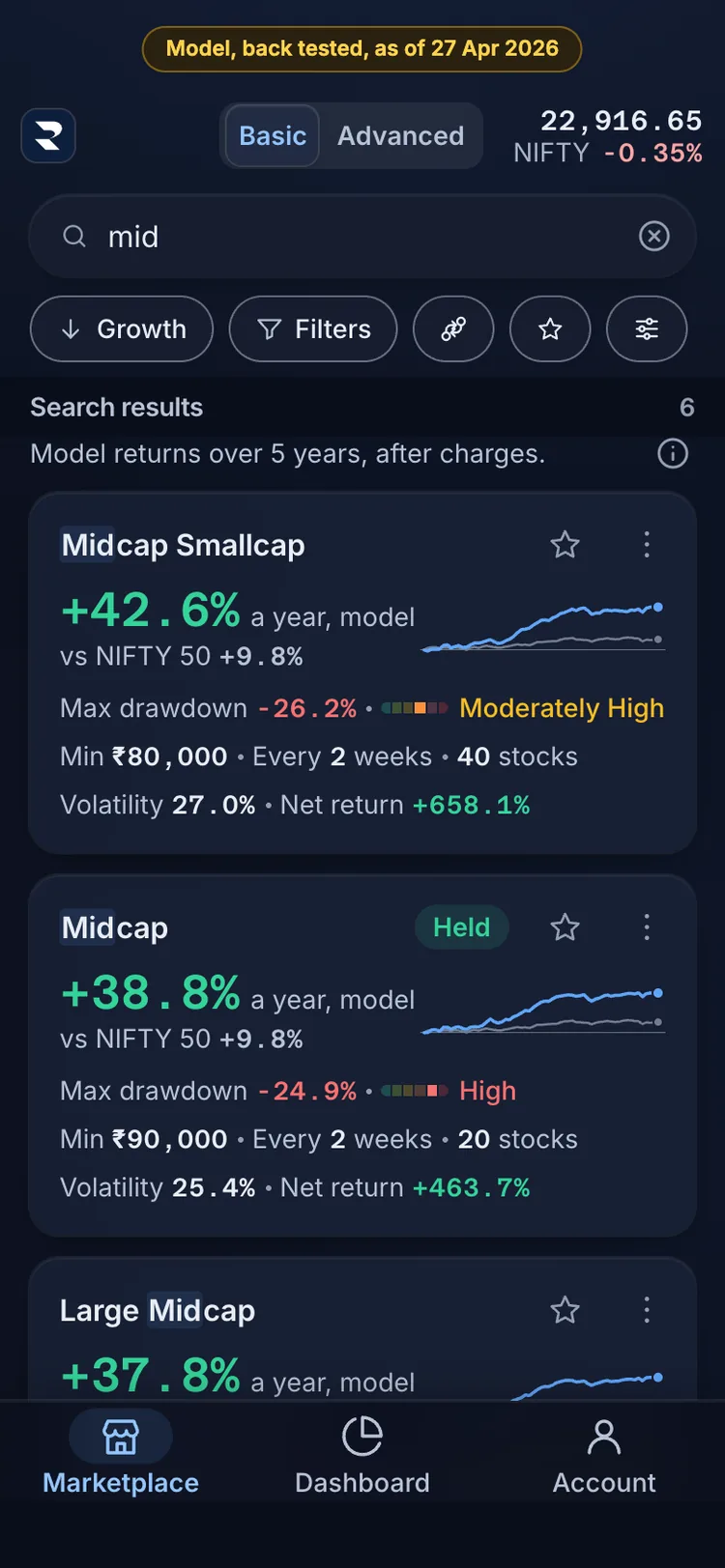
1Search finds strategies by name, theme or type: here, mid. 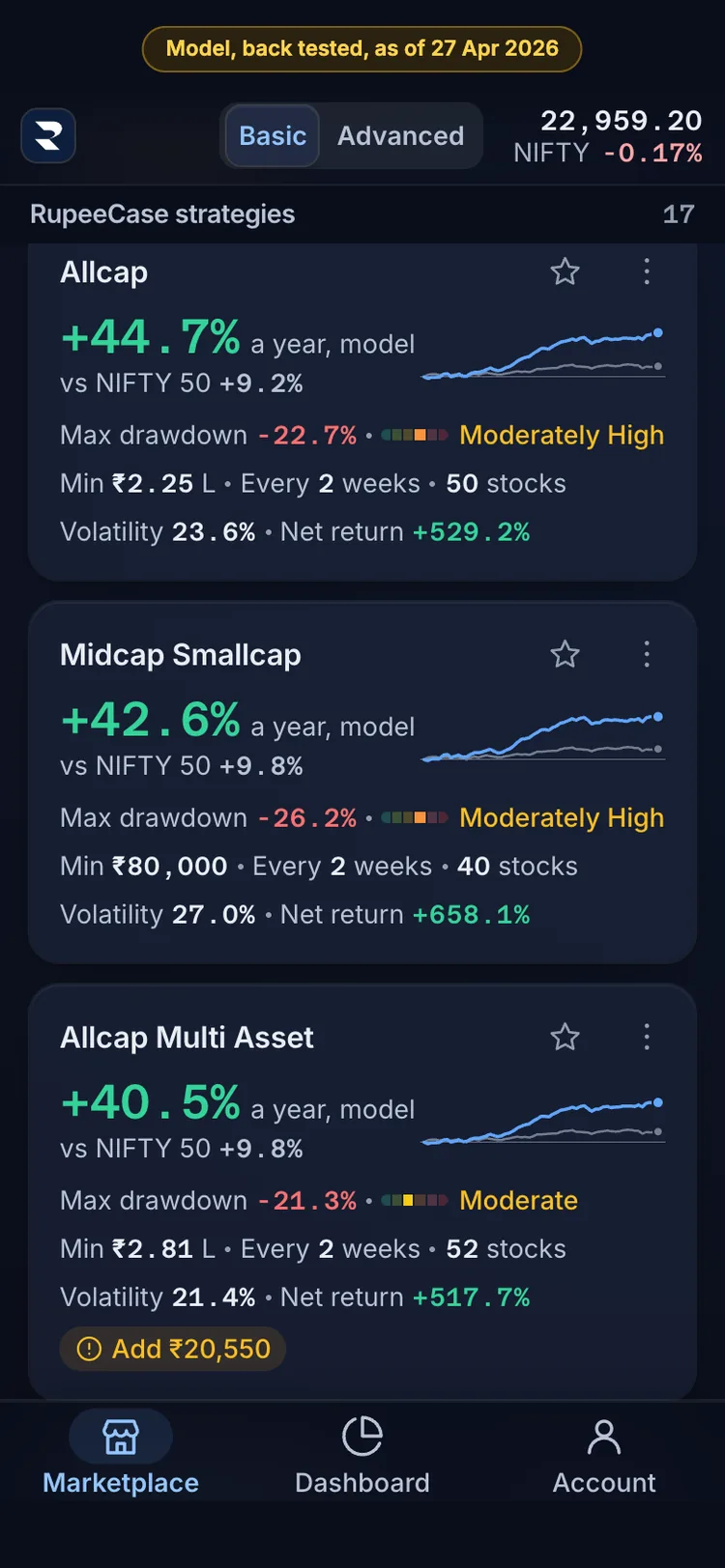
2Each card: growth per year beside the NIFTY 50, max drawdown, risk band, minimum, rebalance and stocks. 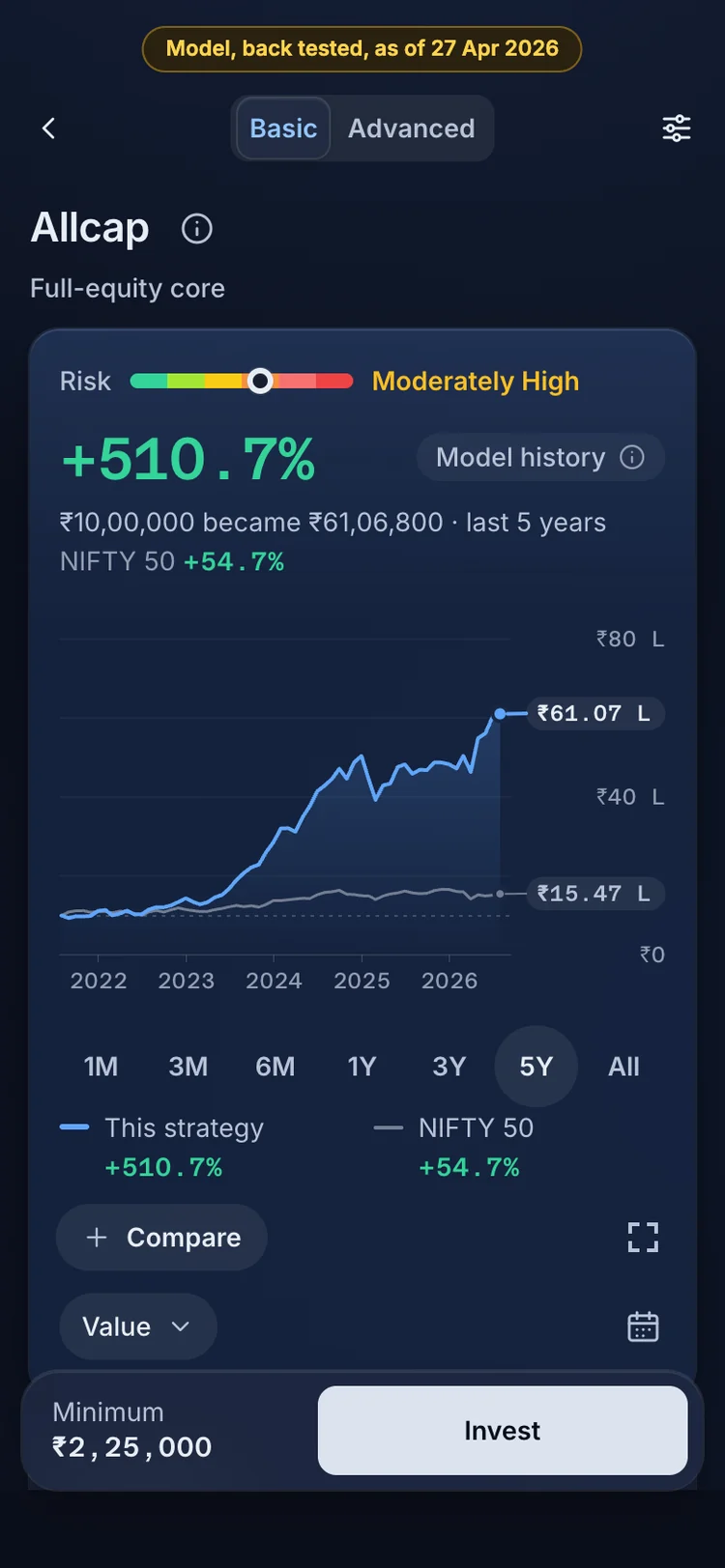
3The strategy page: model history after charges, the NIFTY 50 beside it, and the risk band. 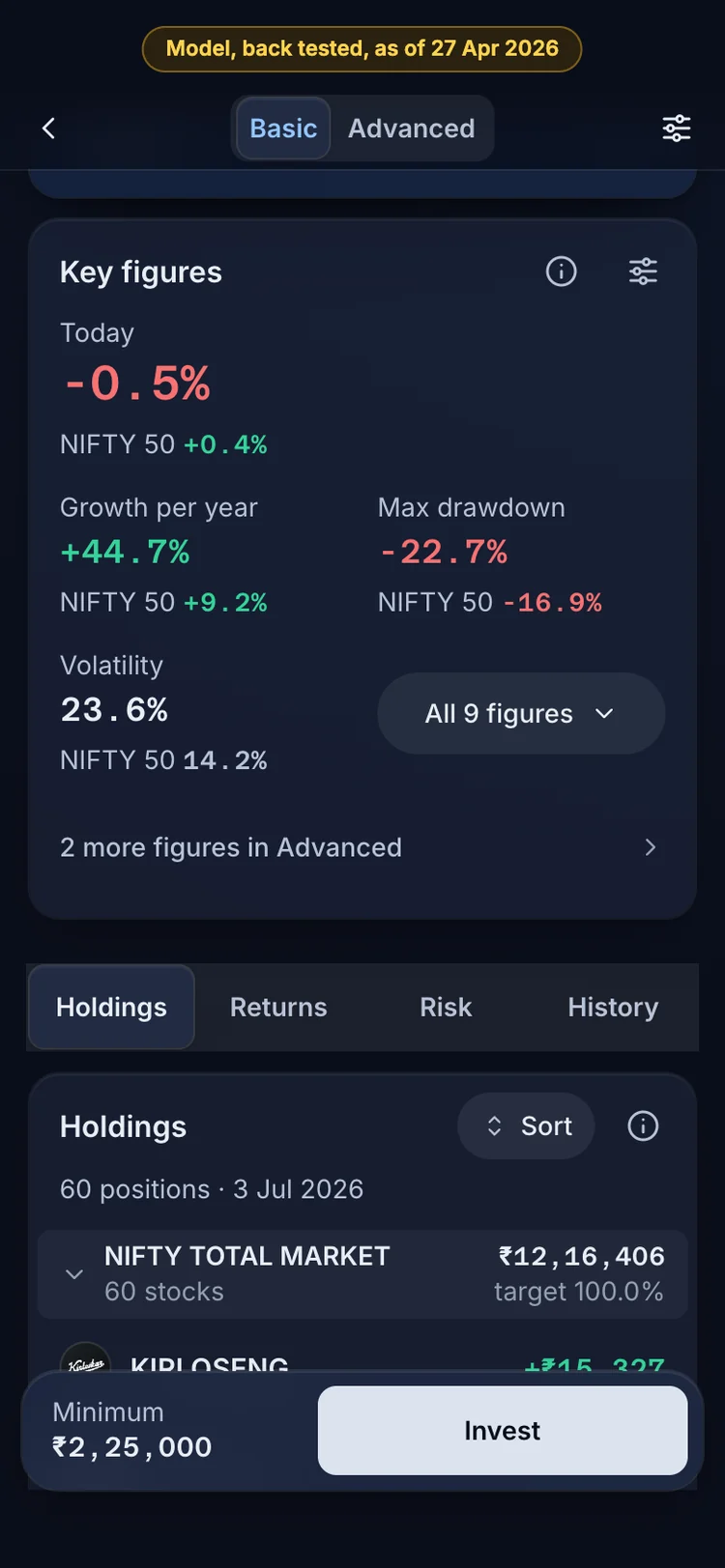
4Key figures: today, growth per year and max drawdown, each beside the NIFTY 50. 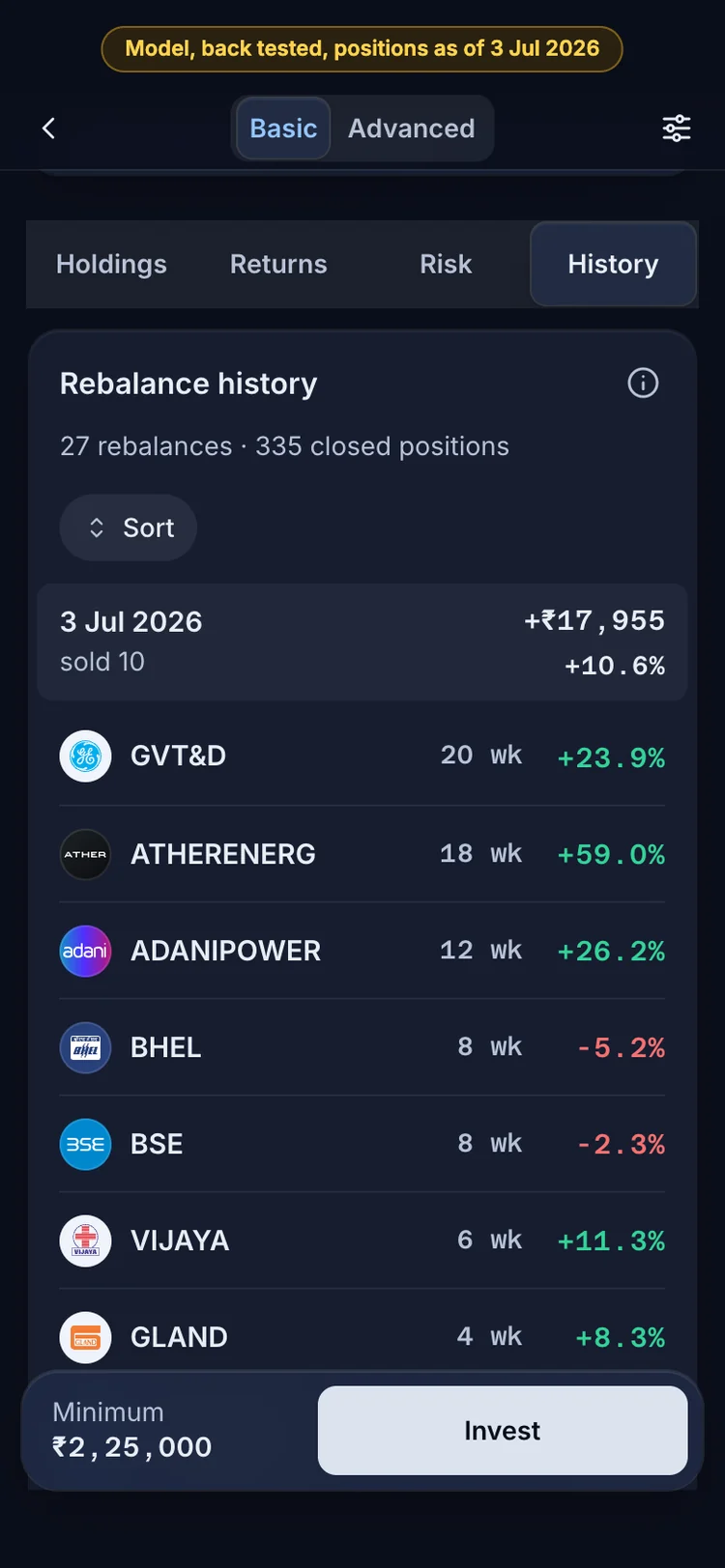
5The History tab: every rebalance in the model record, with the stocks sold and how each did.
Screens from the RupeeCase app, shown with Allcap. Model, back tested. As of 27 Apr 2026. Watch the walkthrough
03Documents
Everything behind the sheet.
- Nifty 50 Equal Weight strategy page
- Rebalance history65 rebalances
- Rebalance history, CSV
- Nifty 50 Equal Weight as plain text
- Starter tier
- Disclaimers
Compare Nifty 50 Equal Weight with
Other factsheets
- higher CAGRLargecap HybridCAGR 22.7%
- lower CAGRHealthcare BasketCAGR 15.2%
- LargeFocused Largecap 20
- LargeLarge Cap Multi Asset
CAGR on the cards: Model, back tested. As of 27 Apr 2026.
04Questions
The Nifty 50 Equal Weight factsheet,
in plain words.
What does the Nifty 50 Equal Weight factsheet show?
The model, back tested record of Nifty 50 Equal Weight: a CAGR of 16.35%, a deepest fall of −15.71% and a Sharpe ratio of 1.13 as of 27 Apr 2026, with 50 holdings rebalanced every 4 weeks. Every figure is after estimated charges and names its date.
What does it cost to run Nifty 50 Equal Weight?
0.2% of traded value per rebalance, nothing else: no subscription, no AUM fee, no performance fee and no lock in. Under 0.1% of capital a year at 0.2% of traded value, from the published rebalance record: 14 rebalances in the year to 3 Jul 2026, no name left the list (3 added, funded by trimming the rest, a weight reset). Weight resets and broker side charges (brokerage, STT, exchange charges, GST) are not included. Turnover varies year to year. On the minimum capital of ₹2,49,000 that is under ₹250 a year, an estimate from the model record, not a promise.
How much capital does Nifty 50 Equal Weight need?
About ₹2,49,000, enough to hold one share of every name at recent prices, as of 8 Aug 2026. More capital tracks the model weights more closely.
Are these actual returns?
No. RupeeCase is a technology platform, not a fund, a PMS or a SEBI registered investment adviser. Model figures are back tested, after estimated charges, and are not actual client returns or a promise of future returns; capital can be lost.
Explore next
Read the record behind the factsheet.
- GuideEqual weight vs market cap: what the NSE record shows for the same 100 companiesThe same 100 companies held two ways since 2013: returns, falls and costs.
- Free module 1.3Indices & Benchmarks13 min read
- CalculatorSIP calculatorFree, with the formula and a worked example
- Blog noteThe Nifty 50 is 10 stocks plus 40 footnotesPortfolio construction, a short note
- SectorFinancial Services stocksNSE sector across the 18 index algos
- Free module 2.4How Backtesting Works8 min read
Nifty 50 Equal Weight.
Read the rules, then decide.
About ₹2.49L to start. 0.2% of traded value per rebalance, no lock in.