



Personal finance and tax..12 min read
All in now, or drip it in
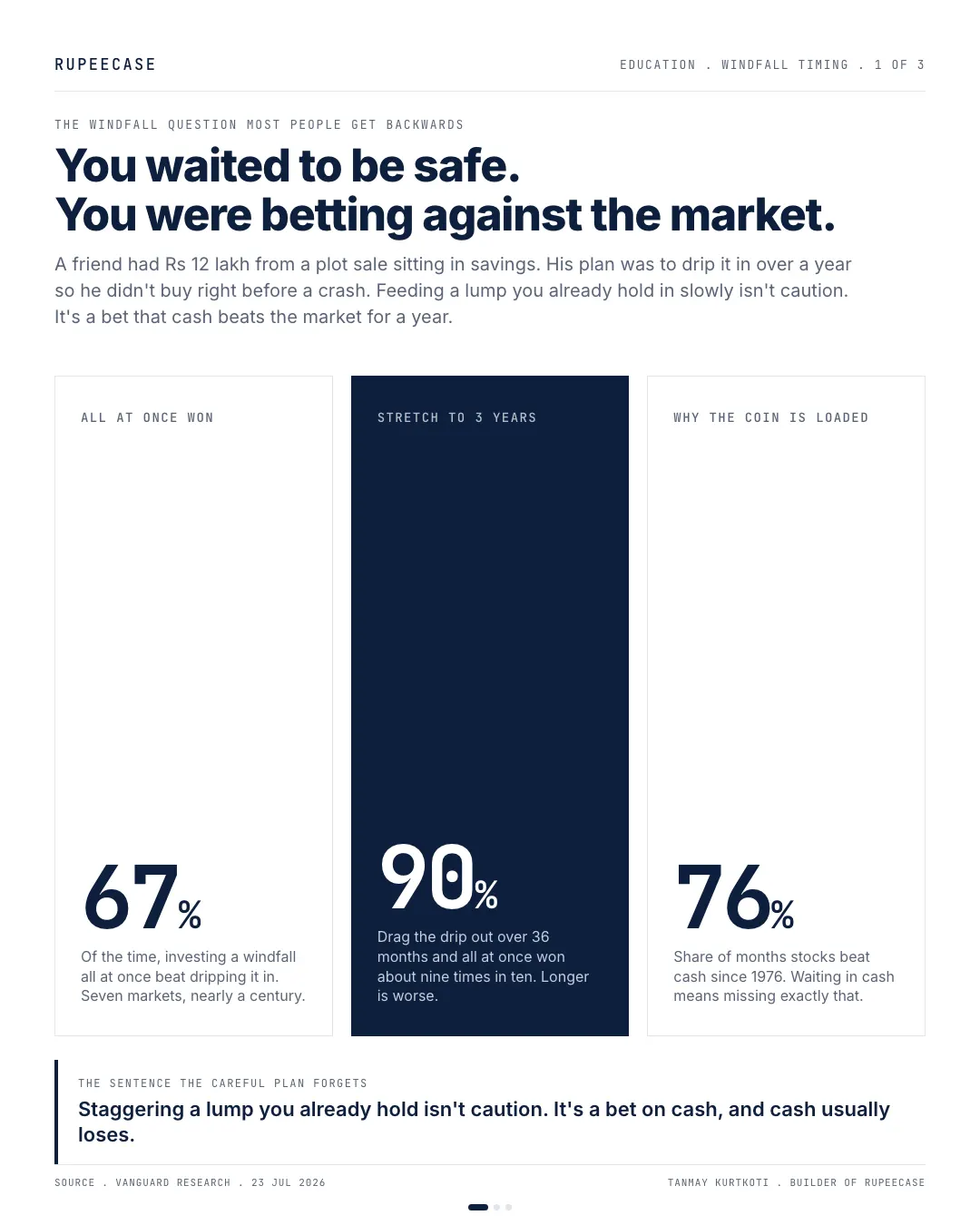
Vanguard's 1926 to 2022 data across seven markets shows a lump sum beat a three month drip about two times in three, and stretching the drip lowers the odds.
By Tanmay Kurtkoti, founder of QC Alpha and builder of RupeeCase
A message landed on Tuesday afternoon. A friend had finally sold a small plot he'd been trying to offload for two years, and about Rs 12 lakh had hit his savings account back in March. It had been sitting there ever since. Doing nothing.
His plan, when he finally told me, was tidy. "I'll move it in slowly. Maybe a lakh a month for a year, so I don't put it all in right before a crash."
The market had handed him every reason to feel careful. Ten years up in a row, and then this year the index slipped off its January high and started chopping sideways. Dropping a big slug of equity into that felt reckless. Spreading it out felt like the grown up thing to do.
I get the instinct. Nobody wants to be the person who put their plot money in on a Thursday and watched it fall 8 percent by the following Friday. The fear is real, and it has a name, and we'll get to who should actually listen to it.
Here's the part that turns the whole thing over. Feeding a lump you already hold into the market slowly is not the careful move. It's a bet that cash will beat the market over the next year. And somebody has checked, across nearly a century of data, how often that bet actually pays off. It lost about two times out of three.
So what he was really choosing between
Strip the feeling out and there are two options, not ten. Option one, put the whole Rs 12 lakh in now, at whatever blend of equity and debt he'd already decided suits him. Option two, park it in the savings account and shift a slice in every month until it's all deployed. Cost averaging, the textbooks call it. Dripping, if you want the plainer word.
Both roads end at the same place. Same portfolio, same holdings, same weights, once the money is fully in. The only thing that differs is how long the cash sits on the bench on the way there.
That wait is the entire question. Every month a rupee spends in the savings account is a month it isn't earning the thing you're investing for, and that is the opportunity cost of holding cash that almost nobody bothers to price.
Somebody already ran this, twice, on almost a hundred years of numbers
I'm not working off a hunch. Vanguard published this study in 2012, under a title that gives away the ending: "Dollar-Cost Averaging Just Means Taking Risk Later." They ran United States data back to 1926, plus the United Kingdom and Australia. Then they ran it again in 2023 with a fresh team, adding Canada, Europe, emerging markets and a global index through 2022.
Same answer both times. Putting the lump in all at once beat dripping it in roughly two-thirds of the time. Here's how it held up market by market, comparing an immediate investment against a three month drip, measured one year out.
| Market | Rolling windows where the lump sum finished ahead |
|---|---|
| United States | 66.4 pct |
| United Kingdom | 68.1 pct |
| Canada | 67.2 pct |
| Australia | 67.5 pct |
| Emerging markets | 61.6 pct |
| Global index | 67.7 pct |
Seven markets, different currencies, decades that barely overlap. And the answer hardly moves off two in three. That is the tell that this isn't a quirk of one long American bull run. It's the same force showing up everywhere anyone bothered to look.
Why the coin is weighted the way it is
The reason is almost boring. Markets go up more often than they go down. Over 1976 to 2022, United States stocks finished ahead of cash in 76 percent of months. So the money you hold back, waiting for a cleaner entry, spends most of its waiting time missing exactly the returns you were trying to capture. You didn't dodge the risk by waiting. You postponed it, and paid rent to a savings account while you did. That is what Vanguard meant by taking risk later.
Put a rupee on it, just to feel the size. Feed Rs 12 lakh in evenly over a year and, on average, a little more than half of it spends that year sitting in the savings account. In a normal up year, the gap between what equity earned and what the savings account paid, on that idle half, works out to something like 3 percent of the pile. Call it Rs 36,000, gone to caution. That number is illustrative, not a promise, and in a bad year the same caution hands the money back to you. The catch is that the average year is an up year. That is the whole point, and it's the part the careful plan quietly forgets.
Here is that estimate as a calculator. The cash rate and the equity return are assumptions, so move them and see how quickly the cost of caution changes.
Our own market says it louder, if anything. The Sensex has closed the year higher in roughly three of every four calendar years across four decades, ten of them back to back through 2025. Cash has been the losing seat here more reliably than almost anywhere. I can't tell you which years the drip would have won. I can only tell you the count has run hard against it.
The part that surprised me the first time I saw it
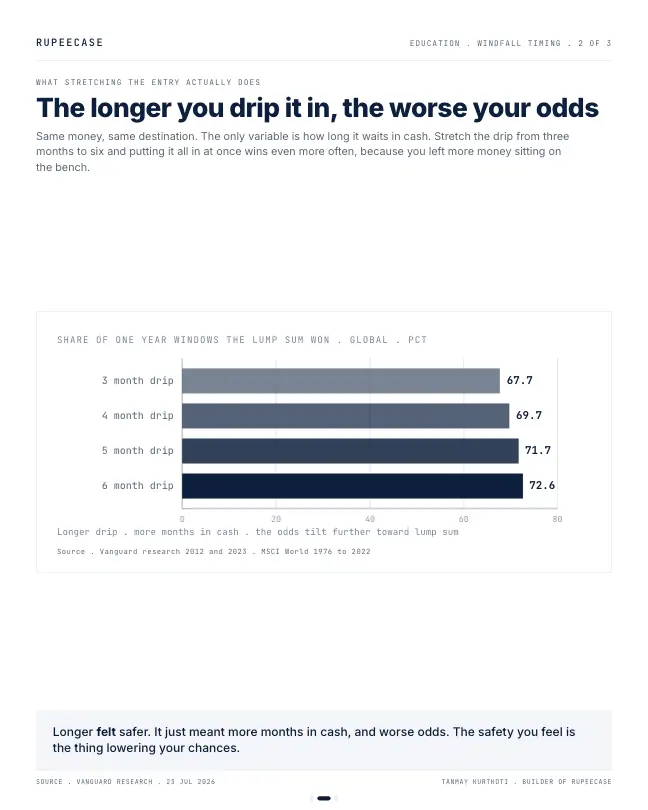
You'd think a longer drip is a safer drip. Spread the same money over two years instead of one and you feel even more protected. The data says the opposite, and it isn't subtle.
The longer you stretch the entry, the more often the all at once approach wins, because you've simply left more money in cash for longer. Stretch a United States drip out to 36 months and the lump sum won about 90 percent of the ten year spans. The safety you feel from spreading it thin over a year or two is the exact mechanism quietly lowering your odds. That one took me a while to swallow, because it runs so hard against instinct.
Here's the part nobody selling you discipline will mention
Now the honest half, because a piece that only argues one side is a brochure. Dripping is not stupid. In the bad case, it genuinely helps.
Across more than a thousand rolling one year windows in the United States, a lump sum finished underwater about 22 percent of the time. The drip, only about 18 percent. And when the drip did lose, it lost less, because half its money was still parked in cash cushioning the fall. So cost averaging is real insurance. Insurance against buying the day before a slide, and insurance against the worse thing, the panic that makes people sell at the bottom and swear off equity for a decade. The drip hands back a little expected return and buys you a smaller worst case. Whether that trade is worth it isn't a math question. It's a you question.
Our own market handed us the bad case recently. Take Rs 12 lakh on 31 Dec 2025, with the Nifty 50 at 26,129.60. Put it all in that day, or in four slices of Rs 3 lakh at the end of each quarter to 30 Sep 2026, when the index closed at 22,620.45.
- All in on 31 Dec 2025-13.4%
- Four quarterly slices-4.3%
NSE, Nifty 50 closes on 31 Dec 2025, 30 Mar, 30 Jun and 30 Sep 2026. Price index, no costs, dividends or interest on the waiting cash. Value on 30 Sep 2026: Rs 10,38,843 against Rs 11,47,940.
That is about Rs 1.09 lakh in favour of caution, in a nine month window. It is real, and it is also exactly what the studies say happens roughly one time in three. The insurance paid out this time. The premium is what it costs in the other two.
So who should actually stagger it in
If a lump sum going in the day before a 15 percent drop would make you panic and dump the whole lot, then dripping is cheap insurance that keeps you in your seat. That isn't weakness. That's knowing yourself. Vanguard modelled exactly this case and found that for a genuinely loss averse, conservative investor, the drip can be the better fit even though it earns less on average. This is the moment your own risk profile makes the call, not the ninety year average. If you know you'll flinch, buying yourself the calm to stay invested is worth a fraction of a percent.
The mistake I keep seeing is the person who is not actually that investor, but tells themselves they are. They aren't afraid of the drop. They just want to feel clever about timing the entry, and the drip lets them dress that up as prudence. If your honest reason for staggering is that you think the market is about to fall and you want to buy lower, that is not risk management. That is a forecast, and it belongs in the open where you can be wrong about it, not hidden inside a word like caution.
The choice is easier to make once both sides are written down with their honest costs.
Higher expected outcome
- Won about two windows in three in the studies cited
- Ended a year underwater about 22 percent of the time
- Asks you to sit through a fall in month one
Smaller worst case
- Ended underwater about 18 percent of the time
- Lost less when it lost
- Pays for that with cash drag in the average year
The SIP you already run is not the thing this study is about
Here is where people grab the wrong lesson, so read it twice. The penalty in these studies is about a lump you already hold in cash and choose to feed in slowly. Your monthly SIP out of salary is a completely different animal.
That money never existed as a lump. It arrives in slices, month by month, so investing it in slices is the only sound thing to do with it. It's the opposite of market timing. Do not read "lump sum wins" and cancel your SIP, because the two look alike and are nothing like each other. A systematic plan that deploys and rebalances on a schedule is doing the right thing with the money it has, when it has it.
The picture is the whole distinction on two lines. Money already in your hand is one question. Money still arriving is a different one. Answer them the same way and you'll get one of them wrong.
Three rules I'd actually hand him
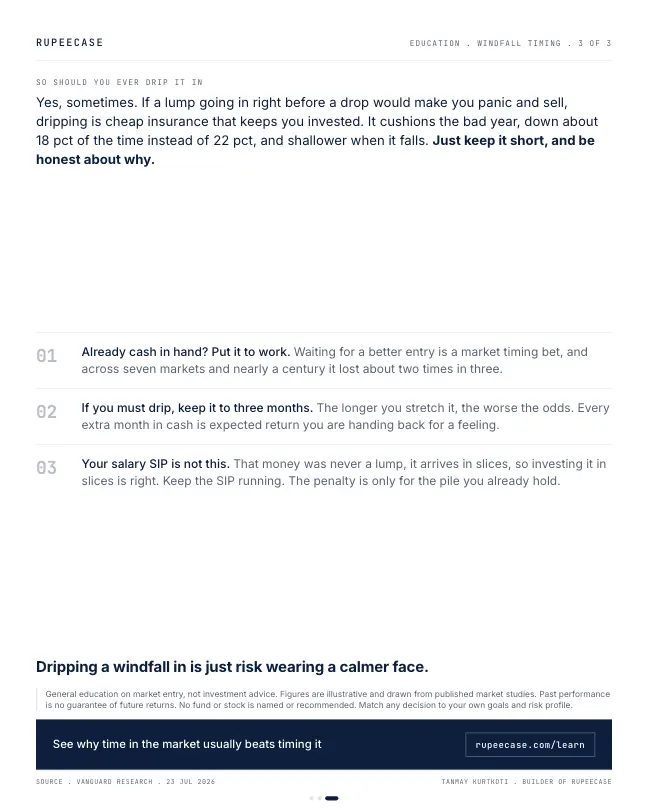
One. If it's already cash in your hand and you're happy with your target mix, put it to work now. Waiting is a market timing bet, and it's the bet that usually loses.
Two. If you truly can't sleep unless you drip, keep it short. Three months, not three years. Every extra month in cash is odds you're handing away for a feeling.
Three. Your salary SIP is not the windfall drip. Keep it running exactly as it is. The study is about the pile you're sitting on, not the paycheck you haven't earned yet.
Dripping a windfall in isn't caution. It's a bet that cash beats the market, and history has been settling that bet against you about two times in three.
He asked what I'd do with his Rs 12 lakh. Honest version. If the money's already there and the mix is right, I'd put it in and stop watching the ticker. The waiting feels like safety. The record says it's just risk wearing a calmer face.
The free Learn module on loss aversion and prospect theory explains why the drip feels so much safer than the numbers say, and the note on SIP against lump sum covers the salary case in full.
Questions readers ask
Is it better to invest a lump sum at once or spread it over months?
Across the long studies cited here, investing a lump at once finished ahead about two times in three, because markets rise more often than they fall. Spreading it in lowers the chance and size of an early loss, as 2026 showed, at the cost of a lower average outcome.
Should I stop my SIP if lump sum investing wins more often?
The studies answer a different question. They are about money you already hold in cash. A salary SIP invests money as it arrives, so there is no idle lump to put in earlier.
The cards
3 cards. Swipe, or tap to open.
Explore next
Learn it properly, then see it applied.
- Free module 11.1Equity Taxation After July 2024: The New Rules10 min read
- Free module 8.2Loss Aversion and Prospect Theory11 min read
- CalculatorLump sum vs SIPFree, with the formula and a worked example
- StrategyNifty 50 Equal Weight strategyNifty 50, 50 stocks, every 4 weeks
- Blog topicPersonal finance and tax notes24 notes
See the idea in an index: Nifty 50 Equal Weight. Model, back tested figures and the rules are on its page.
Related
- SIP vs lump sum: time in the marketPutting Rs 12 lakh in at once beat dripping it over a year in about two of every three historical windows, because markets rise roughly two years in three.Personal finance and tax . . 5 min
- A nominee is not an heirThe Supreme Court held in 1983 and 2023 that a nominee only receives; without a will, Rs 80 lakh to a sole nominee wife is owned one quarter each by four Class I heirs.Personal finance and tax . . 5 min
- A loss you do not book is a rebate you do not claimBooking a Rs 60,000 short term loss against a Rs 1 lakh short term gain cuts the tax from Rs 20,000 to Rs 8,000, and unused losses carry eight years if you file on time.Personal finance and tax . . 10 min
Educational content only. Figures are illustrative and computed on historical or representative data for teaching purposes, not investment advice. Past performance does not guarantee future returns. Sourced from NSE, BSE, SEBI, AMFI and RBI public data.
Community
Join my WhatsApp group.
Scan the code, fillFill one short form, and join my WhatsApp group. Slides, sources, factsheets and the rebalance logs live there, and members join a daily Google Meet with me.
New to RupeeCase? Getting started See the terminal