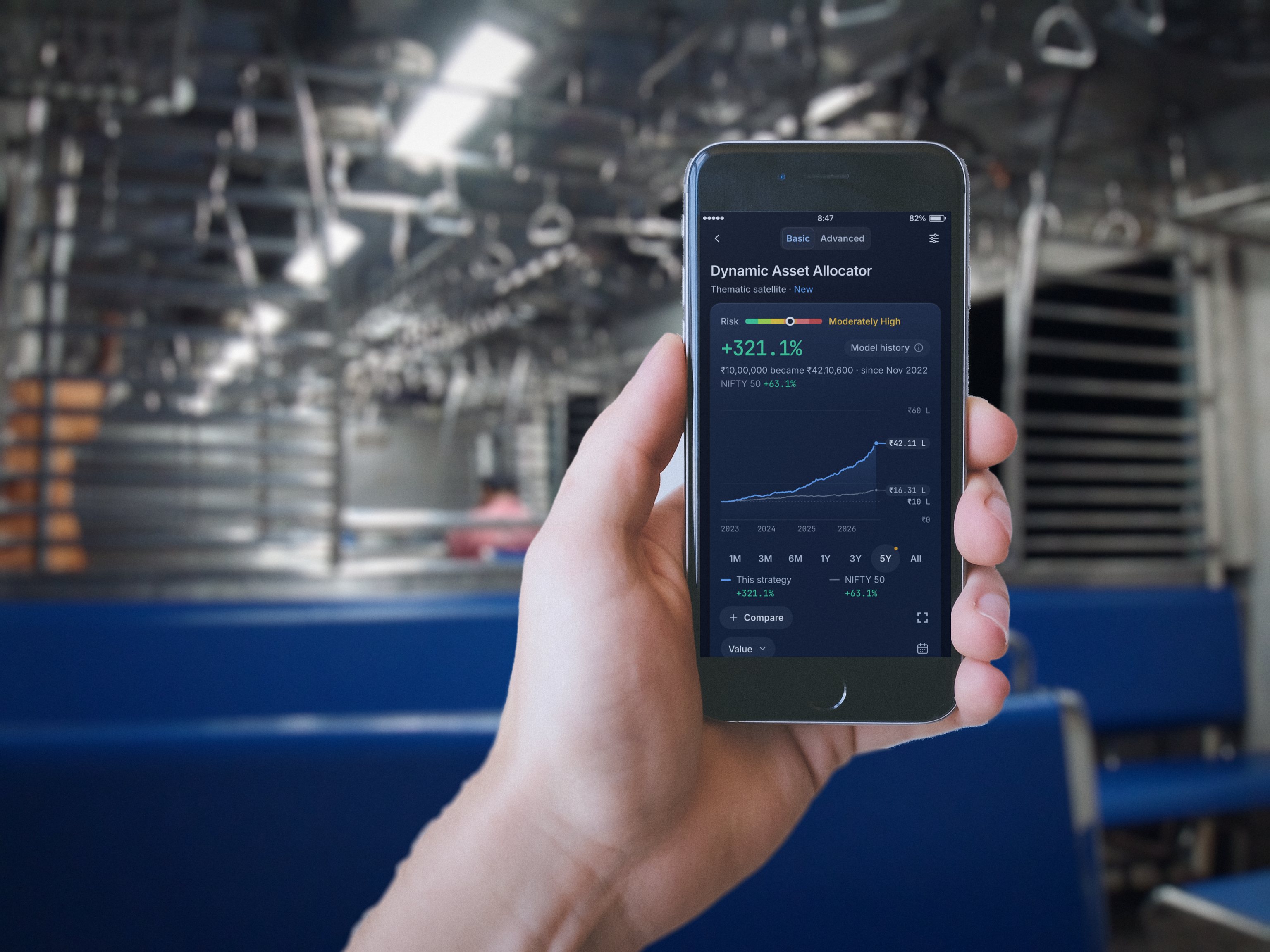
A mutual fund and RupeeCase both build long term wealth on NSE and BSE. One charges on everything, every year. The other charges 0.2% of what trades, in your own demat.
A fund takes its fee from the NAV every day, on the whole amount. RupeeCase charges 0.2% of traded value, per rebalance, and nothing else.
Move to zoom in
02Cost over 20 years
Fees compound too.
The same return before costs, ₹10 lakh, 20 years. The only difference between the lines is the fee.
₹14.1 lakhmore left after 20 years with RupeeCase than with a mutual fund at 1.8%, on ₹10 lakh at 12% a year before costs, rebalancing every 4 weeks.
Illustration, not a forecast: one return before costs for every option, minus each option's typical fee, compounded. Brokerage and taxes left out for all. Pick a return or a cadence, or move along the chart. Illustration: ₹10.0 lakh for 20 years at 12% a year before costs ends at RupeeCase ₹83.9 lakh; a mutual fund at 1.8% ₹69.8 lakh (RupeeCase at 13 rebalances a year, 30% turnover; at 26 rebalances it ends at ₹72.9 lakh).
03Ownership
A unit of a fund. Or the shares, by name.
The same kind of basket, held two ways. A fund keeps the shares and gives you units. RupeeCase places them in your own demat, where you can see every name.
Mutual fundYou hold units of the scheme
STLTECH
AEGISLOG
CUPID
HFCL
PARAS
MSTCLTD
CARTRADE
CPPLUS
ASTRAMICRO
AVALON
BALAMINES
KIRLOSENG
RATEGAIN
SYRMA
RRKABEL
ACUTAAS
LLOYDSENGG
APOLLO
INOXINDIA
ARVIND
TEJASNET
WELCORP
MARKSANS
SANSERA
Unitsthe scheme owns the shares
RupeeCaseYou hold the shares, in your demat
STLTECH
AEGISLOG
CUPID
HFCL
PARAS
MSTCLTD
CARTRADE
CPPLUS
ASTRAMICRO
AVALON
BALAMINES
KIRLOSENG
RATEGAIN
SYRMA
RRKABEL
ACUTAAS
LLOYDSENGG
APOLLO
INOXINDIA
ARVIND
TEJASNET
WELCORP
MARKSANS
SANSERA
Names: a few of the holdings in the Allcap model on 3 Jul 2026, from the published rebalance record. Model record, not a recommendation of any stock.
04The rest, in four lines
Ticket, lock in, cash and tax.
Minimum
RupeeCaseFrom ₹26,000 per strategy
Mutual fundFrom ₹500 by SIP
RupeeCase holds whole shares at published weights.
Lock in
RupeeCaseNone
Mutual fundNone, except ELSS (3 years)
Some funds charge an exit load if you redeem early.
Time to cash
RupeeCaseT+1, sell in your broker
Mutual fundWithin 3 working days
Equity schemes, after a redemption.
Tax
RupeeCaseIn your hands, at each rebalance sale
Mutual fundOnly when you redeem units
STCG 20%, LTCG 12.5% above ₹1.25 lakh a year for listed equity.
05The honest part
When a mutual fund can make sense.
A fund is often the better tool. Pick the one that fits the job.
You are starting small. A SIP starts at ₹500. RupeeCase strategies need their published minimum, from ₹26,000.
You want tax deferred. Trades inside a fund are not taxed in your hands until you redeem. Each RupeeCase rebalance that sells at a profit is a taxable event for you.
You want the lowest cost on a plain index. A direct index fund or ETF can sit near the bottom of the 0.3% to 2.5% range, below RupeeCase on a strategy that rebalances every two weeks.
You want debt, hybrid or global funds in one product, or you would rather a manager decides.
06Questions
RupeeCase or a mutual fund?
Straight answers, written to be quoted.
Is RupeeCase a mutual fund?
No. RupeeCase is a technology platform operated by QC Alpha Technologies Pvt Ltd. It publishes rule based strategies, packaged like an index, and sends the model portfolio to your own broker. You hold every share in your own demat. It is not a mutual fund, a PMS, an AIF or a SEBI registered investment adviser.
How does the cost of RupeeCase compare with a mutual fund?
A mutual fund typically charges 0.3% to 2.5% of your assets every year, deducted from the NAV, whether or not it trades. RupeeCase charges 0.2% of traded value each time a strategy rebalances, and nothing else. At 30% turnover that is about 0.78% a year at 13 rebalances, or about 1.56% at 26. Brokerage and statutory charges go through your broker in both cases.
What is the minimum investment?
A mutual fund SIP can start at ₹500. RupeeCase strategies hold whole shares at published weights, so each one has a minimum, from ₹26,000 to ₹3,02,000 in the lineup published on 17 Jul 2026.
How is tax different?
With a mutual fund you pay capital gains tax only when you redeem units. With RupeeCase you own the shares, so each rebalance that sells at a profit is a taxable event in your hands: STCG at 20%, and LTCG at 12.5% above ₹1.25 lakh a year for listed equity.
Can I exit any time?
Yes. There is no lock in. You sell in your own broker account and the cash settles the next trading day. Mutual funds also have no lock in, except ELSS (3 years), though some charge an exit load if you redeem early.
Which is better for long term wealth?
It depends on your amount, your tax position and how much you want to see and control. Compare first, validate the strategy's model back test, then decide. The risk profile on RupeeCase helps you find the strategies within your risk envelope. This is not investment advice.
Typical fee levels: mutual funds 0.3% to 2.5% of assets a year, PMS 2% of assets plus a 20% profit share, as stated on the current RupeeCase pricing page; AIF Category III about 2% plus 20%; PMS minimum ₹50 lakh and AIF minimum ₹1 crore under SEBI rules. Every product differs; read its own documents.
RupeeCase is a technology platform operated by QC Alpha Technologies Pvt Ltd. It is not a mutual fund, a PMS, an AIF or a SEBI registered investment adviser. Research by QC Alpha Research Pvt Ltd, SEBI research analyst registration pending. Trades execute through your own SEBI registered broker. Investments in securities markets are subject to market risks. Nothing here is investment advice.
Photography: Rare empty local train of Mumbai by Dharmadhyaksha, CC BY-SA 3.0; A night in Mumbai by Siddharth Shah, CC BY-SA 4.0; other photographs CC0, public domain or our own, regraded; device screens show the RupeeCase app on sample data. Full list: credits.