RupeeCase | Systematic Quantitative Investing Terminal by QC AlphaRupeeCase | Systematic Quantitative Investing Terminal by QC AlphaRupeeCase | Systematic Quantitative Investing Terminal by QC AlphaRupeeCase | Systematic Quantitative Investing Terminal by QC Alpha
Start free

Momentum, Nifty 100

Focused Largecap 20 momentum strategy

Focused Largecap 20 is a RupeeCase index that holds 20 stocks from the Nifty 100, ranked by price momentum, rebalanced every 4 weeks. Model CAGR 26.3% (back tested, as of 27 Apr 2026), minimum about ₹1,00,000 (as of 8 Aug 2026), moderately high risk band.

20 largecap stocks, 4-week rotation. Pure equity on the Nifty 100.

Moderately High risk band

Runs in your own 5paisa, Zebu or Arrow demat. The shares stay in your name.

01At a glance

Focused Largecap 20 in four numbers.

CAGR
26.29%Model, back tested
Max drawdown
−23.56%Model, back tested
Minimum investment
₹1LAbout ₹1,00,000
Fee per rebalance
0.2%Of traded value, nothing else
Focused Largecap 20, model₹321Nifty 50 TRI, 9.80% CAGR line₹160
150 200 300

₹100 in Jul 2021 became ₹321 by Jul 2026 (Nifty 50 TRI line ₹160). Model, back tested. As of 27 Apr 2026. After charges, log scale.

02Three steps

Compare. Validate. Invest.

  1. Compare

    Against the other 17 strategies, and funds, PMS and AIF.

    Compare strategies
  2. Validate the back test

    Every year, fall, holding and rebalance, in the factsheet.

    Open the factsheet
  3. Invest

    Link your broker and approve each rebalance. Stocks stay in your own demat; RupeeCase never holds your money.

    Invest in Focused Largecap 20

Invest, screen by screen

Watch the walkthrough, 0:46
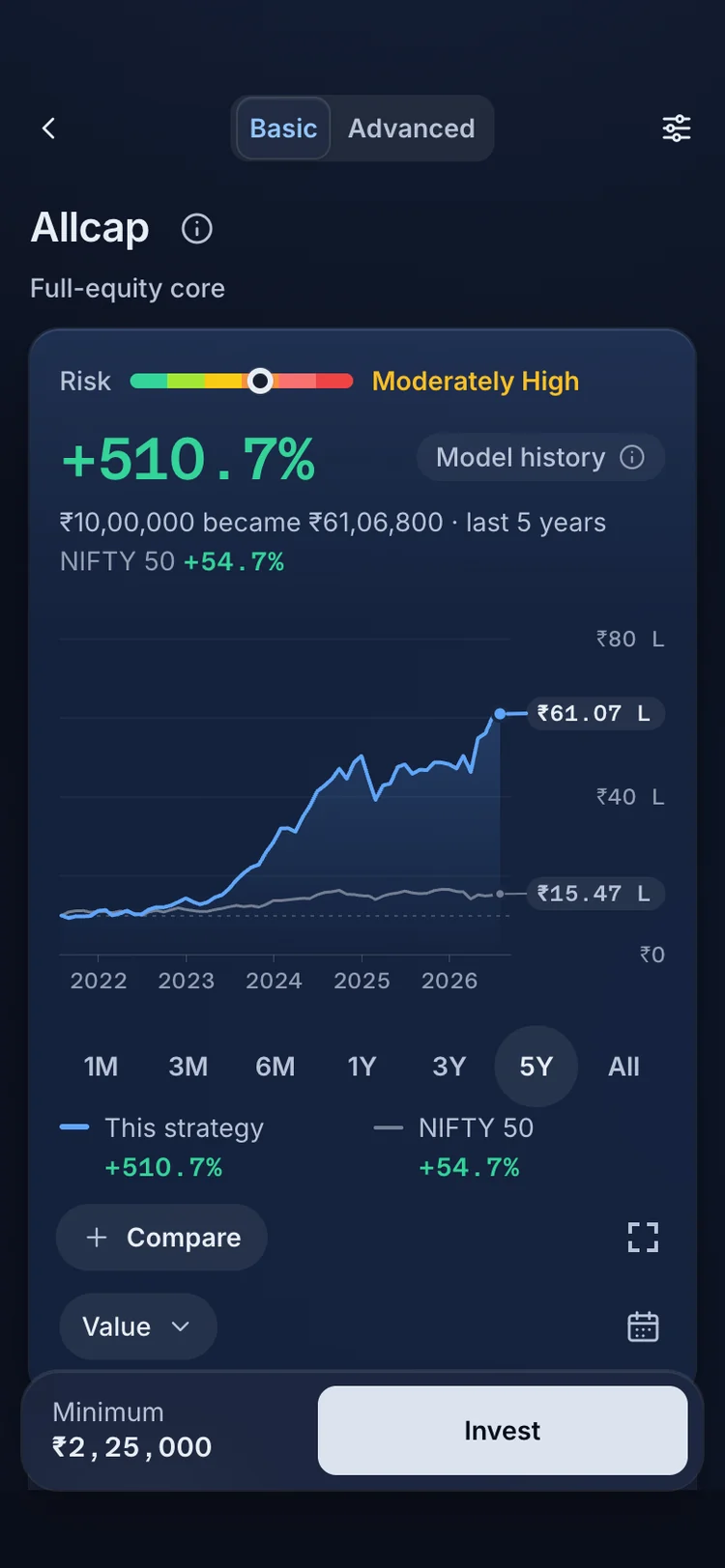
  1. The RupeeCase app on a phone. Each strategy page shows its model history and the Invest bar with the minimum.
    1Each strategy page shows its model history and the Invest bar with the minimum.
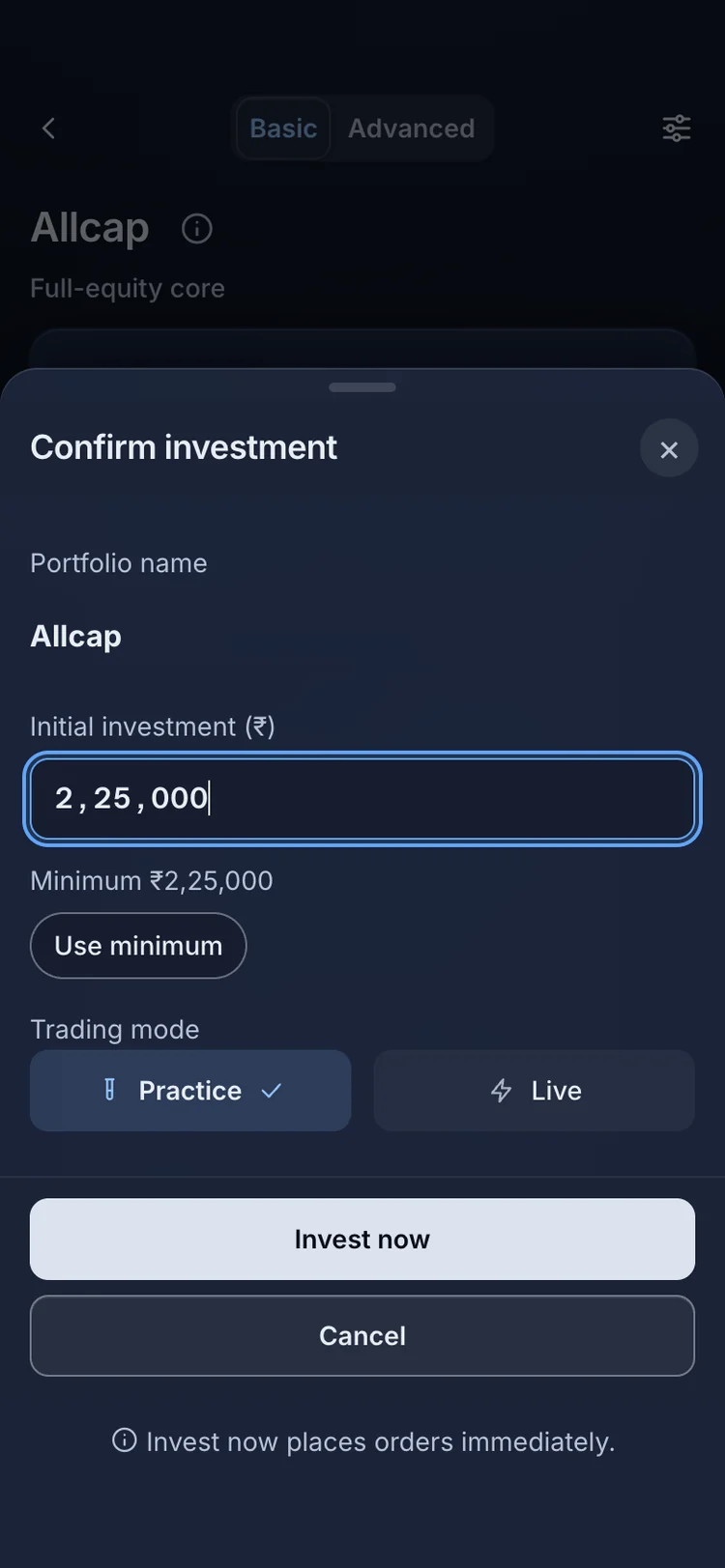
  2. The RupeeCase app on a phone. The sheet opens with the minimum as the amount; Use minimum puts it back.
    2The sheet opens with the minimum as the amount; Use minimum puts it back.
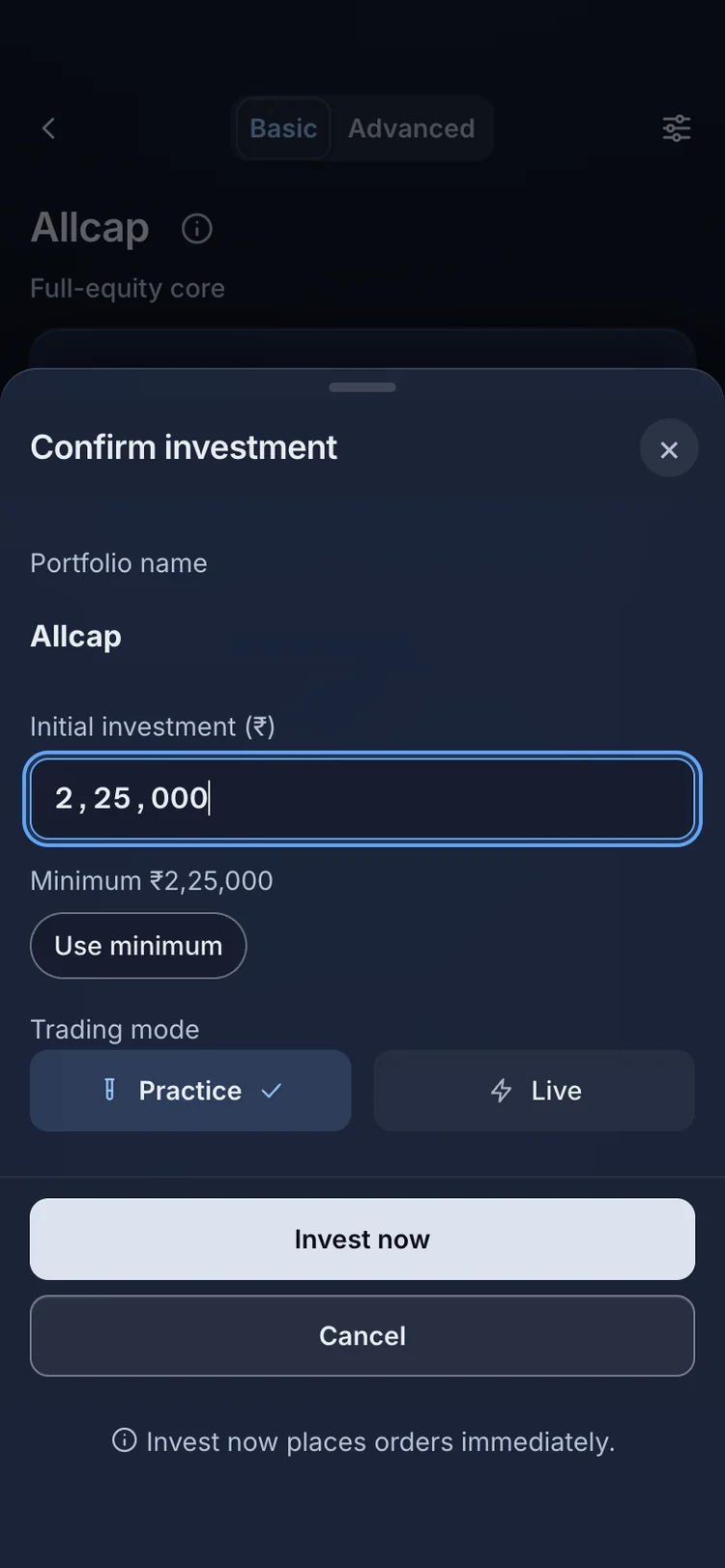
  3. The RupeeCase app on a phone. Practice follows the strategy with no real broker order.
    3Practice follows the strategy with no real broker order.
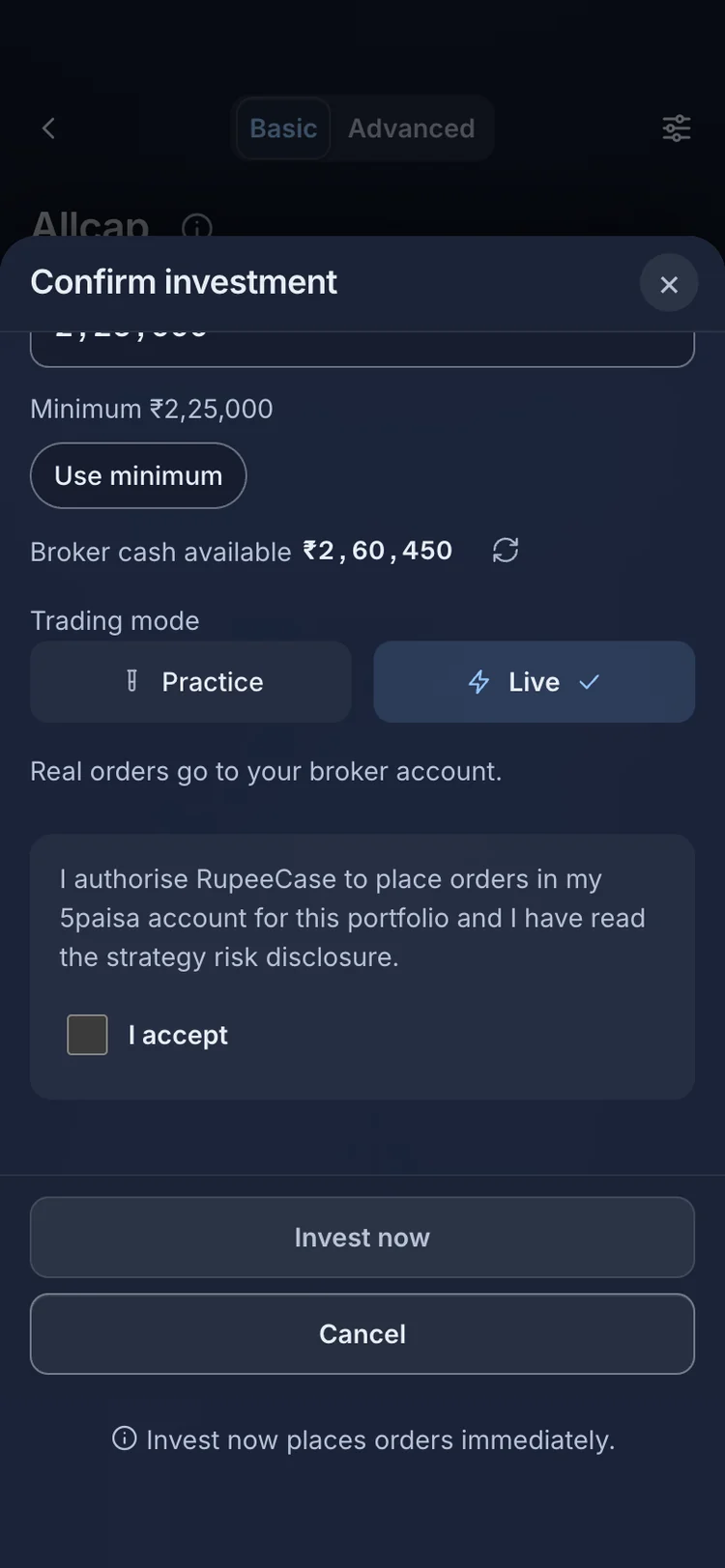
  4. The RupeeCase app on a phone. Live shows your broker cash and asks for your consent before any order.
    4Live shows your broker cash and asks for your consent before any order.

Screens from the RupeeCase app. Model, back tested figures as of 27 Apr 2026; portfolio screens are a sample for illustration.

Get the next rebalance by emailThe names in and out, on the morning Focused Largecap 20 rebalances. Every 4 weeks. Free, one click to stop.

03Factsheet

Focused Largecap 20 factsheet

Model, back tested, after charges; each block names its date.

Performance

Calendar year returns

  • 2021from Jul+17.7%
  • 2022+31.7%
  • 2023+58.7%
  • 2024+29.2%
  • 2025−3.5%
  • 2026to Jul+4.3%

Model, back tested, after charges, 2021 to Jul 2026.

What an amount would have become

You put in
₹1,00,000
Model value
 
Gain
 

Model, back tested monthly returns after charges, Jul 2021 to Jul 2026 (61 months).

Stress test: drag through the falls

MonthFeb 2025
Below the last peak−20.5%
Back to the peak 
Model value, log scaleBelow the last peak
Deepest falls, daily record
Exact dates of the deepest falls
  1. −19.16%15 Apr 2022 to 5 Aug 2022112 days
  2. −15.37%16 Dec 2022 to 2 Jun 2023168 days
  3. −10.86%22 Oct 2021 to 25 Mar 2022154 days
  4. −7.28%15 Sep 2023 to 3 Nov 202349 days
  5. −5.81%23 Sep 2022 to 21 Oct 202228 days

Daily model record over rolling 5 years: peak to low, and days until back at that peak.

Model, back tested. As of 27 Apr 2026. Month end values, Jul 2021 to Jul 2026, so falls read shallower than the daily figures on the buttons. Falls this deep can happen again.

Monthly returns

Focused Largecap 20: monthly model returns, percent, after charges
YearJanFebMarAprMayJunJulAugSepOctNovDecYear
2021no datano datano datano datano datano data−0.47.45.54.4−3.63.6+17.7%
2022−0.2−1.25.37.9−9.4−4.214.46.20.16.93.40.7+31.7%
2023−7.1−5.20.17.13.110.98.1−0.49.5−4.011.316.7+58.7%
202411.45.90.12.711.11.54.6−3.61.8−9.61.60.3+29.2%
2025−6.6−5.94.02.32.11.1−4.7−1.11.95.3−1.1−0.1−3.5%
2026−2.88.4−13.414.90.2−2.11.3no datano datano datano datano data+4.3%

Model, back tested, after charges; one calendar month per cell, in percent.

Rolling returns

Any 1 year, return
Worst
−16.8%
Median
+26.2%
Best
+119.6%
Positive
78%of 49 windows
Any 3 years, CAGR
Worst
+20.9%
Median
+31.1%
Best
+52.3%
Positive
100%of 25 windows

Model, back tested, month end values, Jul 2021 to Jul 2026.

Holdings and sectors

20 holdings

  • Equity87%
  • VEDL5.0%
  • ADANIPOWER4.9%
  • TATASTEEL4.9%
  • HAL4.8%
  • HINDZINC4.8%
  • NTPC4.8%
  • SHRIRAMFIN4.8%
  • VBL4.6%
  • NESTLEIND4.6%
  • TATAPOWER4.6%
  • PFC4.6%
  • LODHA4.5%
  • HINDALCO4.4%
  • ADANIGREEN4.3%
  • CGPOWER4.3%
  • ADANIENSOL4.1%
  • SIEMENS3.7%
  • ADANIPORTS3.6%
  • ENRIN3.2%
  • ADANIENT2.6%

Live quantities and prices are in the app. Sign up for RupeeCase

Weights on the rebalance day, 6 Jul 2026; they drift with prices until the next rebalance. Model portfolio, not a recommendation.

Sector allocation

  • Power & Utilities25.7%
  • Other, not yet mapped24.9%
  • Metals & Mining21.9%
  • Capital Goods11.4%
  • Banking & Financial10.8%
  • FMCG & Consumer5.3%

6 sectors in the equity sleeve; 24.9% not yet in the sector map. 20-stock large-cap universe with metals, power, financials, consumer, and industrials concentration.

Sector weight by year

68 rebalances, 8 sectors touched, 7 held now.

Show the year by year sector table
Average sector weight of the equity sleeve in each year, percent, and the weight on the latest published list
Sector202120222023202420252026Now
Other, not yet mapped57566272753746
Power & Utilities131610861414
Metals & Mining1144581714
Capital Goods89923711
FMCG & Consumer5764367
Banking & Financial34644114
Pharma & Healthcare0112134
Energy & Oil & Gas242305out

Average weight of the equity sleeve that year, equal weighted at the stock level; darker is higher. Now: the list of 3 Jul 2026.

Rebalances

The rebalance record

published rebalances
68
first in the record
14 May 2021
13 a year
Every 4 weeks
latest published
3 Jul 2026

A fixed calendar; you approve each rebalance before your broker places the orders.

Latest rebalance, 3 Jul 2026

Against the list of 5 Jun 2026: 8 in, 5 out, 20 held, 28 on the list.

In
  • CHOLAFIN
  • TRENT
  • MAXHEALTH
  • PIDILITIND
  • TORNTPHARM
  • BAJFINANCE
  • INDHOTEL
  • ICICIBANK
Out
  • LODHA
  • TATAPOWER
  • HAL
  • PFC
  • NTPC

The 20 held names are in Holdings.

Model, back tested record. In plus held is the list size, which can differ from the 20 stock target. Not recommendations.

Recent rebalances

The latest 6 rebalances: names on the list, names in and names out
DateOn the listInOut
3 Jul 202628+8−5
5 Jun 202625+5−11
8 May 202631+9−4
10 Apr 202626+6−4
13 Mar 202624+2−6
13 Feb 202628+7−5

Sector shifts of 10 points or more

17 such shifts in 68 rebalances.

Show the latest six rebalances, what moved
  1. Other, not yet mapped +21 pts
  2. Other, not yet mapped −10 pts
  3. Other, not yet mapped −11 pts
  4. Other, not yet mapped −10 pts
  5. Other, not yet mapped +11 pts
  6. Banking & Financial +11 pts, Other, not yet mapped −10 pts

Equity sleeve, between two consecutive lists.

Get the next rebalance by email

The names in and out, on the morning Focused Largecap 20 rebalances. Every 4 weeks. Free, one click to stop.

Risk metrics

Focused Largecap 20 against the Nifty 50

Risk and efficiency figures, model, back tested, against the Nifty 50
MetricFocused Largecap 20Nifty 50
Sharpe ratio1.200.69
Sortino ratio1.190.67
Calmar ratio1.110.54
Volatility, a year21.22%14.15%
Max drawdown−23.56%−16.92%
Best week+7.94%+6.36%
Worst week−6.75%−6.33%
Weeks up57.85%56.32%
Average up week+2.49%+1.53%
Average down week−2.31%−1.57%

Model, back tested, after charges. Weekly, rolling 5 years to 13 Jul 2026; Nifty 50 over the same window.

Risk band

Moderately High, Low to Very High

Deepest model fall
−23.56%
Time horizon
5 years or longer. Drawdowns of 24% have happened in the backtest and can happen again. Capital you might need within 12 months should not be here.
Walk the risk band

Card figures: Model, back tested. As of 27 Apr 2026. Take the risk profile to find your band.

Methodology

How it works

  1. 1
    Universe

    Start from the Nifty 100, filtered to stocks priced under ₹5,000.

  2. 2
    Rank

    Score every stock by a risk adjusted momentum composite over several look backs.

  3. 3
    Select

    Hold the top 20 names by score, equal weighted so no single name dominates.

  4. 4
    Rebalance

    Every 4 weeks the model reruns: names out of the top 20 are sold, new entrants bought, and the full list is published.

Configuration

Universe
Nifty 100
Sleeves
Equity 100
Holdings
20, equal weight
Rebalance
Every 4 weeks, 13 a year
Max stock price
₹5,000
Benchmark
Nifty 50 (charts: Nifty 50 TRI CAGR line)
Back test from
9 Jul 2021
Metrics window
Rolling 5 years
Prices
NSE BhavCopy, after brokerage, STT, exchange charges and GST
Written for
Investors who want growth but read a 25% drawdown as opportunity, not panic

Why Focused Largecap 20

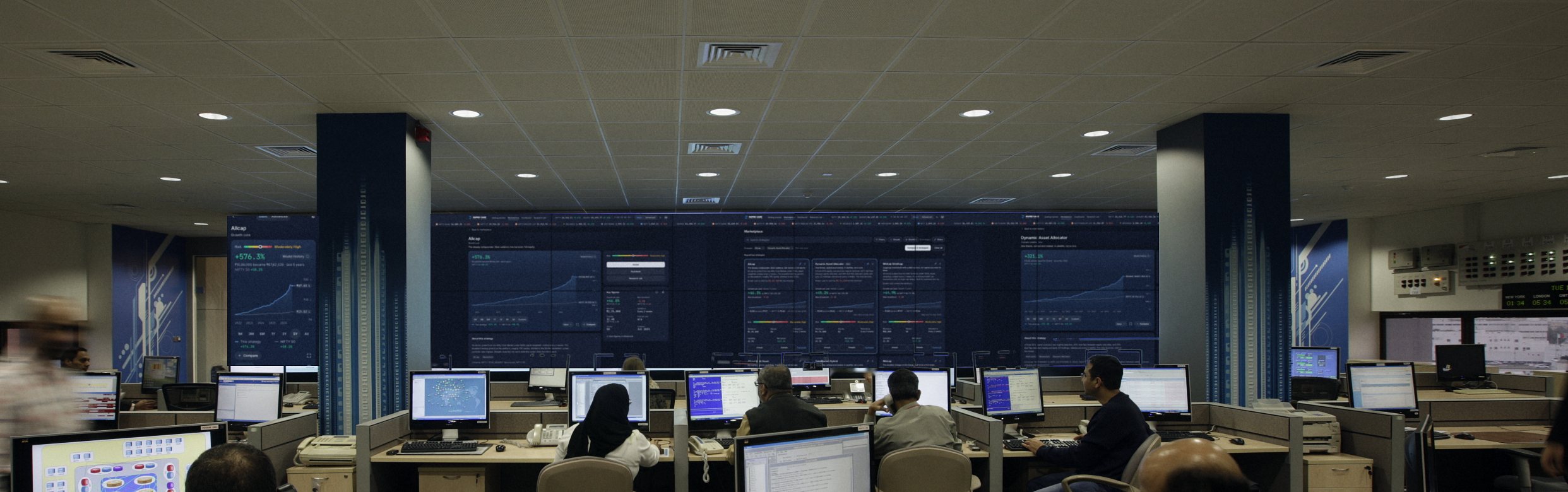
An institutional operations floor seen from behind the desks, with RupeeCase strategy screens across the video wall
An operations floor, RupeeCase on sample data
  • Largecap momentum on the Nifty 100 universe
  • 20 stocks equal-weighted, rebalanced every 4 weeks
  • The slowest-rebalancing pure-equity momentum card, so costs stay light
  • Pure largecap equity for capital that stays invested through cycles
Read 4 more paragraphs, 99 words

The pure-equity twin of LargeCap Multi Asset. Same 20-stock Nifty 100 momentum sleeve, same 4-week rebalance, but no debt overlay, no gold overlay. 100% equity.

Twenty large-cap names, equal-weighted, re-screened every 4 weeks. Nothing here is exotic. The edge is discipline applied to the most liquid shelf of the market.

The trade you accept is lower momentum capture, the screen reacts monthly rather than fortnightly.

This is the pure-equity largecap slot. For a moderately aggressive investor who wants the equity engine without the turnover friction or thematic concentration, 20 largecap names rotated every 4 weeks is the direct expression.

A description, not a recommendation. Decide your own allocation, or ask a SEBI registered investment adviser.

How the rule was built

Machine learning tested the signals, the number of names and the cadence out of sample. The rule that ships is frozen and published: a fixed, readable algorithm, not a black box.

The engine and the audit trail

Costs

One fee per rebalance

0.2%of traded value, charged only when a rebalance trades

No subscription, AUM or performance fee; broker charges are separate. Fee calculator Pricing

A year on the minimum

Minimum capital
₹1,00,000
Rebalances, year to 3 Jul 2026
14
Traded, about
6.2 timesthe portfolio
Platform fee a year, about
₹1,2401.2% of capital

Estimate from the model rebalance record at 0.2% of traded value; weight resets and broker charges excluded.

Costs inside the back test

Gross return
+253.96%before costs
Estimated costs
−34.09 ptsbrokerage, STT and taxes
Net return
+219.87%after costs
Nifty 50, same window
+55.09%cumulative

Model, back tested, cumulative, rolling 5 years to 13 Jul 2026. Net is gross minus estimated costs.

RupeeCase is a technology platform, not a fund, a PMS or a SEBI registered investment adviser. Model, back tested. As of 27 Apr 2026. Model figures are after estimated charges and are not actual client returns. Past performance does not guarantee future returns; capital can be lost.

Invest, the walkthrough

Allcap, model history after charges. Model, back tested. Not a promise of future returns.
Steps in this video
  1. Allcap, model history after charges. Model, back tested. Not a promise of future returns.
  2. The Invest bar shows the minimum for this strategy.
  3. Invest opens the sheet with the minimum as the amount.
  4. Type any amount at or above the minimum.
  5. Use minimum puts the minimum back.
  6. Practice is chosen first. It follows the strategy with no real broker order.
  7. Live shows the cash at your broker.
  8. Nothing is sent until you accept the consent text and press Invest now.
  9. Each portfolio shows its mode, broker and status at the top.

04Questions

Before you
commit capital.

What is the Focused Largecap 20 strategy?

20 largecap stocks, 4-week rotation. The conservative core. It selects the top 20 momentum names from Nifty 100 and rebalances every 4 weeks.

What is the minimum investment for Focused Largecap 20?

About ₹1,00,000 (as of 8 Aug 2026), enough to hold one share of every name in the book at recent prices. The figure moves with the prices of the holdings.

How does Focused Largecap 20 compare to the Nifty 50?

Focused Largecap 20 shows a model CAGR of 26.29% against 9.80% for the Nifty 50 TRI CAGR line (Jan 2021 to Jul 2026), with a Sharpe ratio of 1.20. Model, back tested. As of 27 Apr 2026. Past performance does not guarantee future returns.

What is the worst drawdown Focused Largecap 20 has experienced?

23.56% peak to trough in the model record. The deepest period ran 112 days, from 15 Apr 2022 to 5 Aug 2022. Model, back tested. As of 27 Apr 2026. Drawdowns of similar size can happen again, so size the position for it.

What are the fees on Focused Largecap 20?

0.2% of traded value per rebalance. No subscription, no AUM fee, no performance fee. About 1.2% of capital a year at 0.2% of traded value, from the published rebalance record: 14 rebalances in the year to 3 Jul 2026, about 6.2 times the portfolio traded (sales and purchases). Weight resets and broker side charges (brokerage, STT, exchange charges, GST) are not included. Turnover varies year to year. On the minimum capital of ₹1,00,000 that is about ₹1,240 a year, an estimate from the model record, not a promise.

Can I exit Focused Largecap 20 at any time?

Yes. No lock-in. Holdings sit in your own broker demat account and you can sell any name on any market day. Switching strategies or pausing the rebalance is a one-click action on the platform.

Ready when you are

Focused Largecap 20

26.29% CAGR, model, back tested. About ₹1L to start. Every 4 weeks, you approve each one.

0.2% of traded value per rebalance. No AUM fee, no lock in. Line: the model record after charges, as of 27 Apr 2026. Not a promise of future returns.