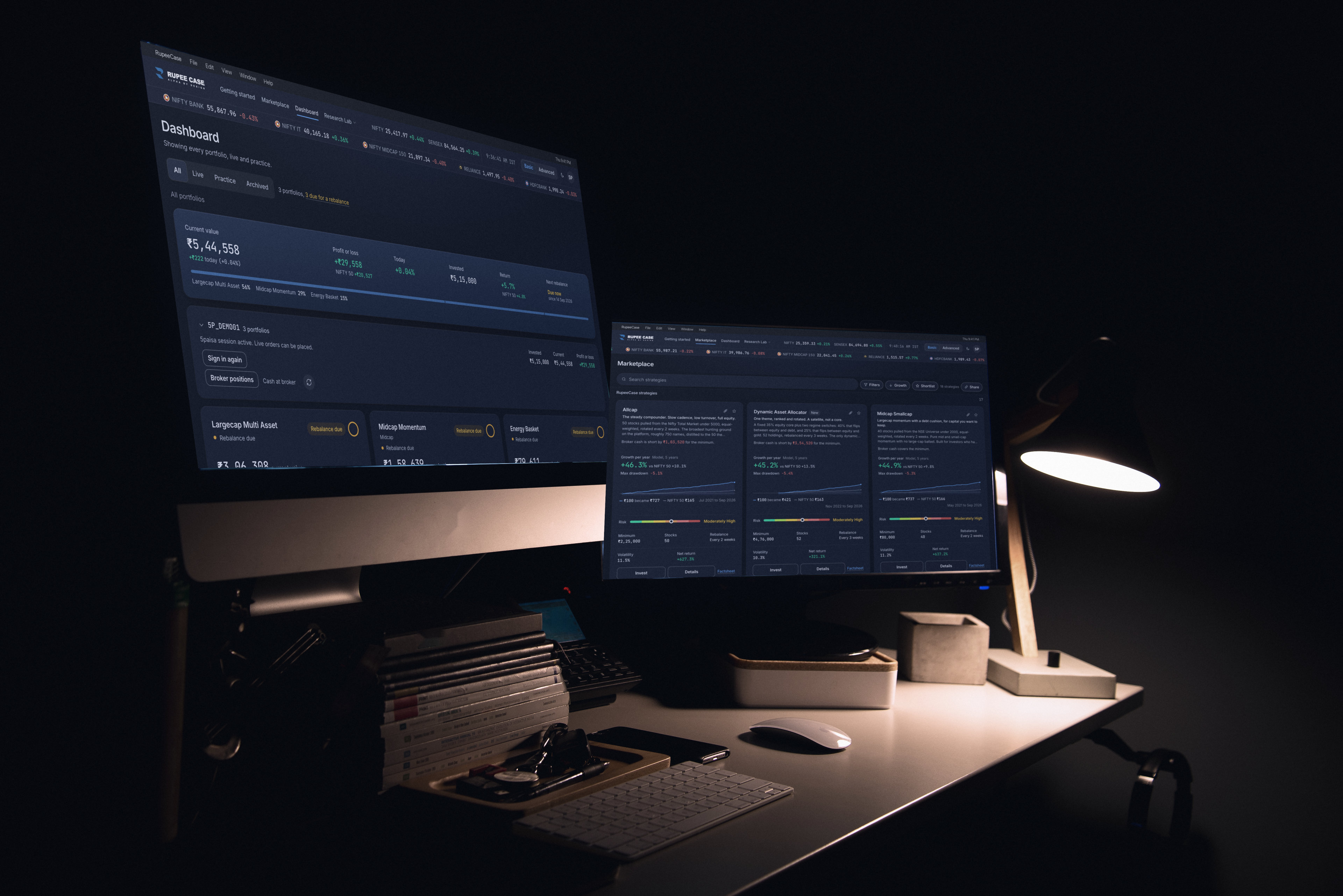
An AIF owns the positions and you own units. With RupeeCase, every share is in your demat, visible on your broker statement.
Move to zoom in
02The gate
₹1 crore is about 385 times ₹26,000.
SEBI sets a ₹1 crore minimum per investor for an AIF. The smallest RupeeCase strategy minimum is ₹26,000. Drawn to scale, by area.
₹1 croreAIF minimum, SEBI
₹26,000smallest RupeeCase minimum, lineup of 17 Jul 2026
₹1 crore₹26,000
03Lock in
Leave any trading day. Or when the scheme says.
RupeeCase holdings sit in your demat: sell in your broker and the cash settles the next day. An AIF follows its scheme terms.
RupeeCase
Any trading day, cash T+1
AIF, open ended
At redemption windows, per scheme
AIF, closed ended
At maturity, a fixed tenure
TodayTimeScheme term
An illustration of the structure, not any scheme's actual terms. Each AIF's documents govern.
04The rest, in four lines
Fee, holdings, access and tax.
Fee
RupeeCase0.2% of traded value, per rebalance
AIF Cat IIITypically about 2% a year plus around 20% of profits above a hurdle
Every fund sets its own terms.
What you hold
RupeeCaseThe shares, in your own demat
AIF Cat IIIUnits of a pooled fund
What you can see
RupeeCaseEvery rule, holding and rebalance, published
AIF Cat IIIPeriodic reports to investors
Tax
RupeeCaseIn your hands, on each sale
AIF Cat IIIGenerally at the fund level
Consult a tax professional.
05The honest part
When an AIF can make sense.
An AIF can do things a long only index algo cannot.
You want long short or hedged equity run inside one pooled vehicle, under Category III rules.
You want private credit, unlisted equity or real assets, which Category I and II funds can hold and listed index algos cannot.
You prefer tax handled at the fund level and a single unit statement, rather than every trade in your own name.
You accept fund terms: lock ins, redemption windows or a fixed tenure, in exchange for those strategies.
06Questions
RupeeCase or an AIF?
Straight answers, written to be quoted.
Is RupeeCase an AIF?
No. RupeeCase is a technology platform operated by QC Alpha Technologies Pvt Ltd. It is not an alternative investment fund, a fund of any kind, a PMS or a SEBI registered investment adviser. Strategies run as model portfolios in your own broker account.
What is the minimum for an AIF?
SEBI sets a minimum of ₹1 crore per investor for an AIF (accredited investors can differ). RupeeCase strategies start from ₹26,000, up to ₹3,02,000 for the largest published minimum (lineup of 17 Jul 2026).
What does a Category III AIF typically cost?
Typically about 2% of assets a year plus around 20% of profits above a hurdle, though every fund sets its own terms. RupeeCase charges 0.2% of traded value per rebalance and nothing else.
How is an AIF taxed compared with RupeeCase?
A Category III AIF is generally taxed at the fund level. With RupeeCase you own the shares, so each sale is taxed in your hands at the listed equity rates: STCG 20%, LTCG 12.5% above ₹1.25 lakh a year. Consult a tax professional.
Can I leave whenever I want?
With RupeeCase, yes: sell in your own broker account any trading day, and cash settles the next day. AIFs follow their scheme terms, which can include lock ins, redemption windows or a fixed tenure.
Does RupeeCase use F&O like some AIFs?
Not today. F&O is planned only as insurance for the portfolio, a hedge, never for speculation. That module is coming; see the hedging page.
Typical fee levels: mutual funds 0.3% to 2.5% of assets a year, PMS 2% of assets plus a 20% profit share, as stated on the current RupeeCase pricing page; AIF Category III about 2% plus 20%; PMS minimum ₹50 lakh and AIF minimum ₹1 crore under SEBI rules. Every product differs; read its own documents.
RupeeCase is a technology platform operated by QC Alpha Technologies Pvt Ltd. It is not a mutual fund, a PMS, an AIF or a SEBI registered investment adviser. Research by QC Alpha Research Pvt Ltd, SEBI research analyst registration pending. Trades execute through your own SEBI registered broker. Investments in securities markets are subject to market risks. Nothing here is investment advice.
Photography: DLF Epitome Tower, DLF Phase 3, Gurugram by Sahil Dhiman, CC BY-SA 4.0; other photographs CC0, public domain or our own, regraded; device screens show the RupeeCase app on sample data. Full list: credits.