

The most common tax mistake I see is not dodging tax. It is paying the wrong amount because two products that look alike are taxed in completely different ways. A debt fund and a listed bond. An equity fund and a hybrid. A gold ETF and a gold bond bought on the exchange. Same shelf in the app, different rules in the Act. Here is every common wrapper on one page, with the rules as they stand in October 2026.
Indian equity a fund needs to be taxed like shares
Equity oriented fund definition
Yearly IDCW from one fund house before 10% TDS applies
Finance Act 2025, from 1 Apr 2025
Yearly interest on Sovereign Gold Bonds, taxed at slab
RBI SGB scheme
Tax audit turnover limit for a mostly digital F&O trader
Section 44AB, 1961 Act; section 63, 2025 Act
3By the end you can
- Say how a gain is taxed in an equity fund, a debt fund, a hybrid, a gold ETF, an SGB and a bond.
- Explain why F&O is business income, how its turnover is counted and when an audit applies.
- Use the purchase date, the wrapper and the 1 April 2026 STT and SGB changes to check a tax bill before you file.
Equity mutual funds and ETFs
A fund that keeps at least 65% in Indian listed equity is an equity oriented fund. Its units are taxed exactly like shares: 20% on short term gains under 12 months, 12.5% on long term gains above the shared ₹1.25 lakh yearly exemption. Equity ETFs traded on NSE or BSE follow the same rules. STT on redeeming or selling equity fund units is a tiny 0.001%.
Worked example: ₹10 lakh in an index fund
You put ₹10,00,000 into an equity index fund, growth option. Fourteen months later it is worth ₹12,00,000. The gain of ₹2,00,000 is long term. With no other long term equity gains that year, the first ₹1,25,000 is exempt and the tax is 12.5% of ₹75,000: ₹9,375, plus cess ₹9,750. You keep ₹11,90,250.
IDCW, the dividend option
Income distributed by a fund under the IDCW option is added to your income and taxed at your slab rate, up to 30% plus surcharge and cess. The fund deducts 10% TDS once your IDCW from that fund house crosses ₹10,000 in a year, a threshold raised from ₹5,000 by the Finance Act 2025. The ₹1.25 lakh exemption does not apply. For anyone in a high slab, the growth option usually keeps more, because you choose when to realise the gain and at what rate.
MythIDCW payouts are free money on top of the fund's return.
FactThe payout comes out of the fund's NAV, which falls by the same amount. You then pay tax on it at your slab rate. Growth units let the same money keep compounding.
The term this section turns on: IDCW
Debt mutual funds
Debt funds changed twice, and the purchase date is what matters.
- Bought on or after 1 April 2023, in a fund that is mainly debt: every gain is treated as short term and taxed at your slab rate, however long you hold. There is no long term rate and no indexation. Since 1 April 2025 this rule covers funds with more than 65% in debt and money market instruments.
- Bought before 1 April 2023 and sold after 23 July 2024: long term after 24 months, taxed at 12.5% without indexation. Short term gains at slab.
- Is it at least 65% Indian equity?Yes: taxed like shares, 20% or 12.5%.
- More than 65% debt and bought from 1 Apr 2023?Yes: slab rate, however long you hold.
- Bought before 1 Apr 2023?Long term after 24 months at 12.5%, no indexation.
- Anything in betweenHybrids and gold or international funds: 24 months for unlisted units, 12 for listed ETFs, then 12.5%.
Read one more paragraph, 92 words
Hybrids sit in between. A fund with 35% to 65% in equity was never inside the slab only rule: its units are long term after 24 months at 12.5%, short term at slab. What changed on 1 April 2025 is the test itself, from "no more than 35% in Indian equity" to "more than 65% in debt and money market instruments", which took gold ETFs, gold funds and fund of funds that do not hold mainly debt funds out of the slab only rule. Read the fund's asset allocation before you assume.
Worked comparison: ₹10 lakh in a debt fund for three years
Bought in May 2023, sold in May 2026 with a ₹2,40,000 gain, investor in the 30% slab. Tax: 30% of ₹2,40,000, ₹72,000, plus cess ₹74,880. The same gain on units bought in March 2023 would be long term: 12.5% of ₹2,40,000, ₹30,000, plus cess ₹31,200. A month's difference in the purchase date, ₹43,680 of difference in tax.
Sovereign Gold Bonds after the Finance Act 2026
Sovereign Gold Bonds pay 2.5% a year on the issue value, taxed at your slab rate, and track the price of gold. For years the headline was simple: hold to maturity and the gain is tax free. The Finance Act 2026 narrowed that from tax year 2026-27.
- Original subscriber, held to maturity: the gain on redemption remains exempt.
- Bought on the exchange, held to maturity: no longer exempt. The gain is taxed as a capital gain.
- Sold on the exchange before maturity: as a listed security, long term after 12 months at 12.5% with no ₹1.25 lakh exemption, short term at slab.
- Early redemption with RBI after year five: from tax year 2026-27 this is no longer exempt, because the amended rule covers only redemption on maturity. The gain is taxed as a long term capital gain.
One practical point: no new SGB tranche has been issued since February 2024, so most investors today meet SGBs only on the exchange, which is exactly the route that lost its exemption.
Worked example. You bought SGBs on the exchange in 2022 at a total cost of ₹5,00,000. At maturity in tax year 2026-27 they redeem for ₹10,00,000. Under the old rule, zero tax. Under the amended rule, a ₹5,00,000 long term gain at 12.5%: ₹62,500 plus cess, ₹65,000. Interest received along the way was always taxable at slab.

Bonds and debentures
| Bond type | Interest | Gain under 12 months | Gain after 12 months |
|---|---|---|---|
| Listed bonds and debentures | Slab rate | Slab rate | 12.5%, no indexation, no exemption |
| Unlisted bonds and debentures | Slab rate | Slab rate | Slab rate: always short term since 23 Jul 2024 |
| Tax free bonds (listed) | Exempt | Slab rate | 12.5% |
| Zero coupon bonds (listed) | None; the discount is the return | Slab rate | 12.5% |
For transfers on or after 23 July 2024. Surcharge and 4% cess apply. Market linked debentures are taxed at slab whatever the holding period.
F&O: business income, not capital gains
Profit and loss from exchange traded futures and options are non speculative business income under section 43(5) of the 1961 Act, a rule carried into section 66 of the Income-tax Act, 2025 from tax year 2026-27. There is no 12 month rule and no 12.5% rate. The net result is added to your other income and taxed at your slab rate. You file ITR-3, keep books, and can deduct real expenses of the activity: brokerage, STT, exchange charges, data and software subscriptions, a share of internet costs, and depreciation on equipment used for trading. STT itself rose on 1 April 2026: 0.15% on an option sale (was 0.10%), 0.15% on an option exercised (was 0.125%) and 0.05% on a futures sale (was 0.02%). The STT question page works the numbers.
Two terms to hold on to from 11.2
Turnover and tax audit
F&O turnover is not the value of the contracts. Under the ICAI guidance note on tax audit (2022 edition, revised again in 2025), it is the sum of the absolute profits and losses on every squared off trade, plus premium received on options sold unless that premium is already part of the net profit. Five trades of plus ₹10,000, minus ₹4,000, plus ₹6,000, minus ₹2,000 and plus ₹1,000 give a turnover of ₹23,000, not the crores of notional value. A tax audit under section 44AB (section 63 of the 2025 Act) applies above ₹1 crore of turnover, or ₹10 crore when cash receipts and payments are no more than 5% of the total, which is the case for almost every online trader. The turnover and audit question page has the method step by step.
Losses
An F&O loss can be set off in the same year against any other income except salary. What remains carries forward for 8 years, but only against business income, and only if you file your return by the due date, which is 31 August for non-audit business cases, starting with the return for FY 2025-26 (AY 2026-27) filed in 2026. Under the 2025 Act the set off sits in section 109, the 8 year carry forward in section 112 and speculation losses in section 113; the F&O loss question page walks through them. Intraday equity trading is different again: it is speculative business, and speculative losses only offset speculative gains, carried forward for 4 years.
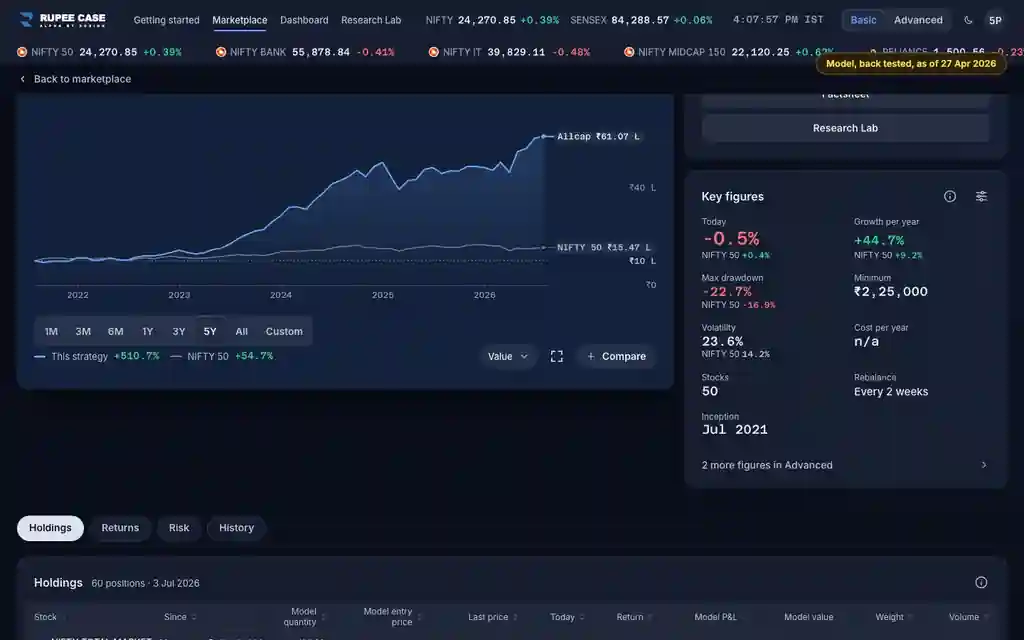
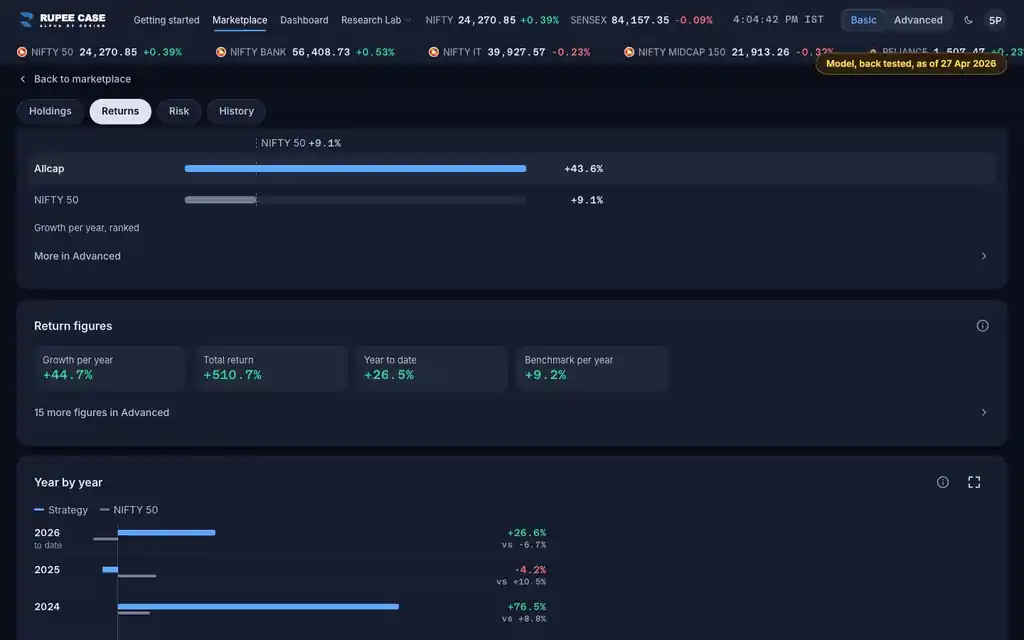
₹100 in Allcap Multi Asset became about ₹131 in the model
Worked example: ₹15 lakh F&O profit
A salaried professional already in the 30% slab makes ₹15,00,000 from options in a year before expenses, and spends ₹3,00,000 on brokerage, STT, data and equipment. Taxable business income is ₹12,00,000. Tax at 30% is ₹3,60,000, plus cess ₹3,74,400, before any surcharge. The same ₹15 lakh as long term equity gains would cost ₹1,71,875 before cess. The wrapper changes the bill by almost ₹2 lakh.
Tax before cess, 30% slab investor, gain held over two years
- SGB, original subscriber₹0
- Equity fund, long term₹14,375
- Listed bond or gold ETF₹30,000
- Debt fund bought before Apr 2023₹30,000
- Debt fund bought after Mar 2023₹72,000
- F&O profit, same amount₹72,000
Rates in force in Oct 2026 for resident individuals. Equity assumes no other long term equity gains that year. Illustration, not tax advice.
The master comparison table
| Product | Short term | Long term | Note |
|---|---|---|---|
| Listed shares, equity funds, equity ETFs | 20% under 12 months | 12.5% above ₹1.25 lakh | STT paid |
| IDCW from any fund | Slab rate, 10% TDS above ₹10,000 a year | No exemption | |
| Dividends on shares | Slab rate, 10% TDS above ₹10,000 a year from one company | Finance Act 2025 | |
| Debt funds bought from 1 Apr 2023 | Slab rate, whatever the holding | More than 65% debt | |
| Debt funds bought before 1 Apr 2023 | Slab under 24 months | 12.5%, no indexation | |
| Hybrids with 35% to 65% equity | Slab under 24 months | 12.5% | Never in the slab only rule |
| Gold ETFs | Slab under 12 months | 12.5% | Listed units |
| SGB, original subscriber, to maturity | Gain exempt; interest at slab | Finance Act 2026 | |
| SGB, bought on exchange | Slab under 12 months | 12.5%, even at maturity | From tax year 2026-27 |
| Listed bonds | Slab under 12 months | 12.5% | Interest at slab |
| Unlisted bonds, market linked debentures | Slab rate always | ||
| F&O | Business income at slab | ITR-3, audit above ₹10 crore turnover | |
Where this section sits in module 11.2
Rates in force in October 2026 for resident individuals. Surcharge and 4% cess apply on top. Education, not tax advice; check your own facts with a tax professional.
Common mistakes
- Assuming any fund held two years is long term. Debt funds bought after March 2023 never are.
- Applying the ₹1.25 lakh exemption to gold, bonds or debt funds. It belongs only to equity shares, equity fund and business trust units.
- Buying SGBs on the exchange for the tax free maturity. From tax year 2026-27 that exemption is for original subscribers only.
- Calling F&O losses capital losses. They are business losses, set off and carried forward under different rules.
- Counting notional value as F&O turnover. It is the sum of absolute profits and losses.
How this shows up in RupeeCase
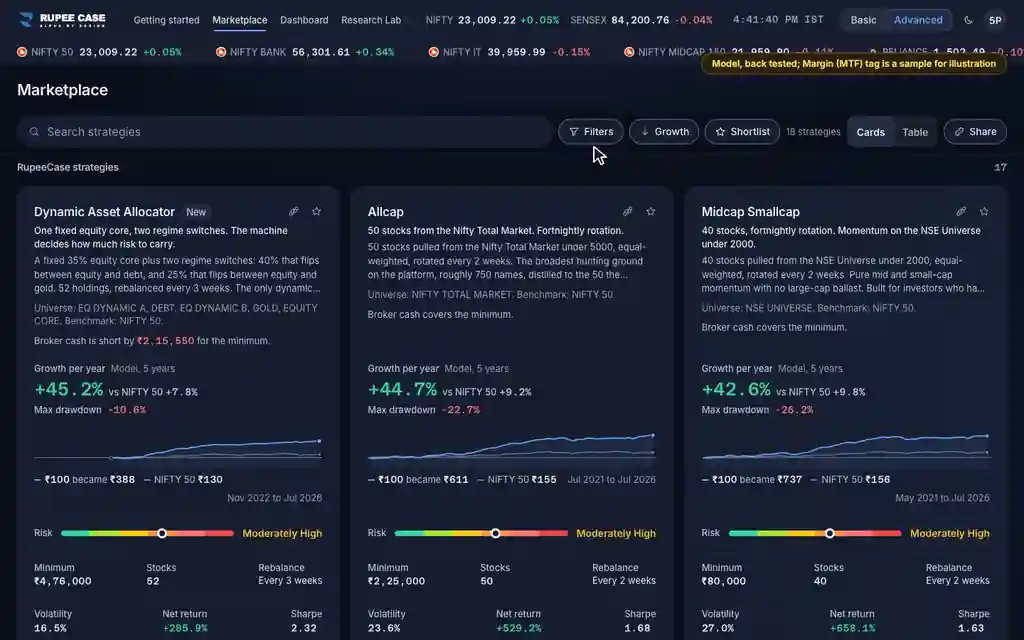
RupeeCase model strategies hold listed shares, and the multi asset and hybrid strategies add listed ETFs, all bought in your own demat through your broker. So the rules that apply are the listed equity and listed ETF rows of the table: 20% or 12.5% depending on how long each holding stayed. See which instruments a strategy uses on its page, for example Allcap Multi Asset or Largecap Hybrid. F&O hedging on RupeeCase is coming; it is not live yet. When it goes live, the F&O rules in this module will apply to that part.
Questions people ask me
Are Sovereign Gold Bonds still tax free at maturity?
Only for the original subscriber who held the bond until it matured. The Finance Act 2026 removed the exemption for bonds bought on the exchange, from tax year 2026-27. Their gain is now taxed as a capital gain.
How are debt mutual funds taxed now?
Units bought from 1 April 2023 in a fund with more than 65% in debt are taxed at your slab rate whatever the holding period. Units bought before 1 April 2023 are long term after 24 months and taxed at 12.5% without indexation.
Can F&O losses be set off against my salary?
No. An F&O loss can be set off against other income in the same year except salary, and the rest carried forward for 8 years against business income only, if you file on time.
What to remember
- Equity funds and ETFs are taxed like shares: 20% and 12.5%.
- IDCW is slab income with 10% TDS above ₹10,000 a year.
- Debt funds bought from April 2023: slab rate forever.
- SGB maturity exemption now only for original subscribers.
- F&O is business income: slab, ITR-3, turnover is profits plus losses.
Rules and figures in this module were last verified on 19 Oct 2026. Tax and regulatory rules change; check the source before acting.