


Personal finance and tax..11 min read
What the lock in costs you
Across ELSS, NPS and PPF the return argument is worth about Rs 54 lakh over twenty years and the NPS annuity clause moves Rs 40 lakh, decided by a paragraph nobody read.
By Tanmay Kurtkoti, founder of QC Alpha and builder of RupeeCase
March, about nine at night. A friend forwards me a screenshot of his office group chat and types one word underneath it. "Settle."
Sixty-odd messages. ELSS against PPF against NPS. Somebody has pasted a five year return chart. Somebody else has answered with the PPF rate and a line about how equity is lovely right up until the year it is not. A third man, the one who always wins these threads, has pointed out that NPS carries an extra deduction and declared the matter closed.
I built the sheet while the tea went cold. Rs 1,50,000 a year, the full Section 80C slot, going in at the start of every year for twenty years. Three assumed rates held constant, purely as an illustration. Twelve percent, eleven percent, and 7.1 percent, which is what PPF actually pays this quarter.
Four minutes. And it settled nothing, because the thing they were arguing about is not the thing that decides the money.
The return argument in that group is worth about Rs 54 lakh. The exit clause none of them had opened is worth about Rs 40 lakh. Sixty messages went to the first one.
The part everybody argues about, in one chart
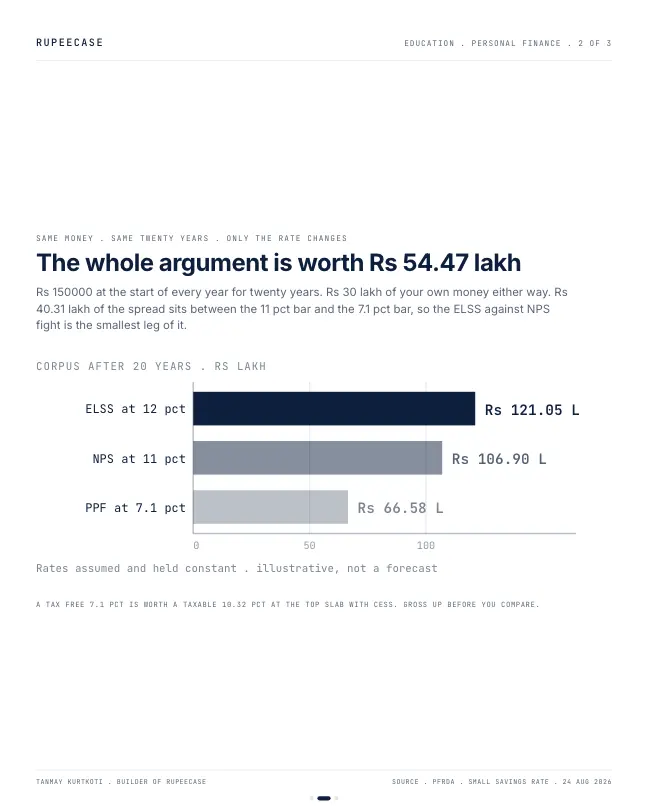
Same contributions, same twenty years, same person keeping the same discipline. Rs 30 lakh of your own money goes in either way. Only the assumed rate changes, and I have mapped the three rates onto the three products the way the argument usually assumes they map. These are assumptions I picked to match how the fight is normally framed. They are not forecasts.
Rs 54.47 lakh separates the top bar from the bottom one, on Rs 30 lakh of contributions. Nearly twice the money you put in, which is why charts like this get forwarded. Here is what the picture cannot tell you on its own. Rs 40.31 lakh of that Rs 54.47 lakh sits between the eleven percent bar and the 7.1 percent bar. Only Rs 14.15 lakh of it separates twelve from eleven. So the fight that consumed the thread, ELSS against NPS, is the smallest leg of the whole thing. The leg that matters is whether you hold real equity at all.
The comparison in that thread was not the comparison they thought
There is a second problem with the chart, and it is the one PPF defenders reach for. A 7.1 percent PPF return arrives with no tax on it. A 12 percent equity return does not. Putting those two numbers next to each other and declaring a 4.9 point gap is comparing two different currencies.
Do the conversion properly. For a saver at the top slab grossed up for cess, 31.2 percent, a tax free 7.1 percent is worth the same as a fully taxable 10.32 percent.
The honest gap is 1.68 points, not 4.9. And the reason I am showing this is not to rescue PPF. It is to show that even after you hand PPF its strongest available argument, the corpus gap is still Rs 54.47 lakh, because 1.68 points compounded across twenty years is enormous. One wrinkle I should name rather than hide. Equity gains are taxed as capital gains, not at slab, so the true conversion for ELSS sits somewhere between 7.1 and 10.32, and I cannot pin it without knowing your redemption pattern. Tax treatment moves the answer more than fund selection does, which is itself the point.
Then I opened the exit clauses, and that is where the evening went
Nobody in the thread had quoted a single line from any of the three scheme documents. So I read them. The rates are the column everyone stares at. The middle two columns are the ones that decide what you can actually do with the money.
| Product | Lock in | Exit rule at the end | Tax on the way out | Corpus at 20 years |
|---|---|---|---|---|
| ELSS | 3 years, counted separately on each instalment | Each instalment redeemable once its own three years clear | Long term capital gains above the annual exemption | Rs 121.05 L at 12 pct assumed |
| NPS | Effectively until 60, with narrow exceptions | Part lump sum, the balance must buy an annuity | Up to 60 pct of the corpus is tax free | Rs 106.90 L at 11 pct assumed |
| PPF | 15 years | Full exit at maturity, a defined partial window before that | Nil | Rs 66.58 L at 7.1 pct current |
Look at the ELSS row and the NPS row next to each other. The corpus difference between them is Rs 14.15 lakh over twenty years. The exit difference between them is the whole of your sixties. One lets you take everything on a Tuesday afternoon three years after each instalment. The other decides, on your behalf, what a large slice of your money will be doing for the rest of your life.
Forty lakh rupees, decided by a clause nobody in that group had read
I went to check the NPS split before publishing it, and it had moved under me. The rule I had carried in my head, sixty percent as a lump sum and forty percent compulsorily into an annuity, is now only the government sector rule. PFRDA amended the exit regulations, notified at the end of 2025, and for all citizen and corporate subscribers the compulsory annuity dropped to twenty percent above a corpus threshold. The tax exemption did not move with it. Only sixty percent of the corpus is tax free either way, so the extra twenty percent you are now allowed to take comes out at your slab.
Read the navy boxes, not the outlined ones. On the government track, Rs 40 lakh of a Rs 1 crore corpus stops being capital and becomes an income stream of Rs 20,000 a month, and the Rs 40 lakh behind it is no longer yours to redirect, to lend to a child, to put into a business or to leave anywhere you choose. That is the number worth sitting with. The entire return argument, across three genuinely different products, over twenty years, on Rs 30 lakh of contributions, is worth Rs 54.47 lakh. The exit clause on one of them moves Rs 40 lakh. Seventy three percent of the size of the whole debate, decided by a paragraph nobody in that group chat had read, on a day none of them had thought about yet.
The other track is not free either. Taking the extra twenty percent as cash means Rs 20 lakh landing in a single year at slab, roughly Rs 6.24 lakh of tax at 31.2 percent, on an illustrative basis.
What happens when a few crore people all have to buy the same thing
Second order effects are where this gets interesting. A compulsory annuity does not just constrain you. It creates a pool of buyers who must transact regardless of what is on offer. Demand with no choice does not negotiate. It cannot walk away, cannot wait for a better quarter, cannot go elsewhere. A market with captive demand on one side has never priced in favour of the captive side.
Which reframes the 2025 amendment. Cutting the compulsory annuity from forty percent to twenty for non government subscribers did not just give individuals flexibility. It halved the captive pool. If that pool was ever holding annuity rates down, a smaller one should push them up, and the people who benefit most are the government subscribers still buying at forty percent.
Then the third order. That released money has to go somewhere. Twenty percent of a lifetime's retirement corpus arriving as cash, in a year when markets are doing whatever they are doing. The forced annuity was a bad deal that was also a guardrail. Removing it is a real improvement and it will also produce a set of retirement disasters that the old rule would have prevented.
The lock-in is not only a cost, and pretending otherwise would be dishonest
Everything above prices illiquidity as a tax. For a large number of people that is exactly backwards.
If your genuine risk is your own hand on the redeem button in month four of a drawdown, then the lock-in is not the price of the product. It is the product. PPF's fifteen years has quietly protected more household wealth in this country than fund selection has ever created, because it removed the decision entirely from people who would have made it badly. A commitment device that costs you 1.68 points a year and stops you destroying half your corpus in one panicked afternoon is not expensive. It is cheap.
The problem is that the same fifteen years, in the year your business needs working capital or a parent needs surgery, is the reason you take a loan at fourteen percent while sitting on your own money. A lock-in helps every year until the year it hurts, and you do not get to choose which year that is.
What I do not know, and what would change my mind
The three rates are assumptions I chose, not forecasts. Change twelve to nine and the ELSS bar drops below the NPS one, and every conclusion about which corpus is larger reverses. The corpus figures are arithmetic, the rates behind them are opinion.
The 6 percent annuity assumption is illustrative. Annuity rates move, and they differ sharply by whether the purchase price is returned to your family. I have not quoted a live rate because it would be stale by the time you read this.
The NPS rule changed while I was writing this, which is a fair warning about the whole exercise. Every one of these products is defined by circular, and a spreadsheet built on this year's clause has an expiry date on it.
Here is the falsification. If you have held an equity SIP through two full drawdowns without stopping it, the commitment device is buying you nothing, and you should price every lock-in purely as a cost with no offsetting benefit. Everything I said about PPF's fifteen years being protective simply does not apply to you.
Three rules I would give the group chat
Read the exit clause before the return chart. The return chart is a projection of an assumption. The exit clause is a rule someone will apply to you whether you agree with it or not, on a day you cannot postpone. One of those two is a fact.
Price the lock-in against your own behaviour, not against a benchmark. The right question is not which product returns most. It is which product you will still be holding in year nine when something goes wrong in your life, and the honest answer differs from person to person. That is a question about you, and a risk profile answers it better than a fund fact sheet does.
Never compare a tax free rate with a taxable one. Gross up first, then argue. A systematic framework built on the wrong comparison is still built on the wrong comparison. If you want the arithmetic laid out properly rather than argued at nine at night, start here.
They are still arguing in that group, as far as I know. Somebody will win it on returns in the next few days and everyone will feel the matter is settled.
The forty lakh sitting inside that exit clause will not care who won.
Questions readers ask
What is the short answer?
Across ELSS, NPS and PPF the return argument is worth about Rs 54 lakh over twenty years and the NPS annuity clause moves Rs 40 lakh, decided by a paragraph nobody read.
Where can I learn personal finance and tax properly?
In the free RupeeCase Learn library: Personal finance and tax, learn it free, no sign up needed. Modules come with quizzes, calculators and a path test.
Is this note investment advice?
No. It is an educational note by Tanmay Kurtkoti. RupeeCase is a technology platform, not a fund, a PMS or a SEBI registered investment adviser.
The cards
3 cards. Swipe, or tap to open.

Related
- A loss you do not book is a rebate you do not claimBooking a Rs 60,000 short term loss against a Rs 1 lakh short term gain cuts the tax from Rs 20,000 to Rs 8,000, and unused losses carry eight years if you file on time.Personal finance and tax . . 8 min
- The Rs 1.25 lakh you forget every AprilBooking about Rs 1.25 lakh of long term gains each year and rebuying cuts the exit tax on a Rs 96 lakh corpus from Rs 10.65 lakh to Rs 7.68 lakh.Personal finance and tax . . 5 min
- NPS, PPF, ELSS: the order matters more than the rateThe Rs 50,000 NPS slot under 80CCD(1B) sits on top of the 80C ceiling, so a rate led picker leaves Rs 15,600 a year of saved tax on the table at the 30 percent slab.Personal finance and tax . . 5 min
Educational content only. Figures are illustrative and computed on historical or representative data for teaching purposes, not investment advice. Past performance does not guarantee future returns. Sourced from NSE, BSE, SEBI, AMFI and RBI public data.