

Personal finance and tax..11 min read
Prepay or invest: the schedule decides
A Rs 5 lakh prepayment in month 12 of a Rs 50 lakh loan kills Rs 21.04 lakh of interest, and investing it still wins by about Rs 6 lakh at a post tax 9.36 percent.
By Tanmay Kurtkoti, founder of QC Alpha and builder of RupeeCase
Sunday morning, a coffee place off Church Street, and Rohit is stirring a flat white he has no intention of drinking. His company paid out a bonus. Five lakh, after tax, sitting in his savings account since Friday. He has a home loan. He also has a demat account that has been mostly aspirational since 2023.
"Prepay or invest," he says. "Just tell me."
The table answered before I could. Loan is at 8.5. Equity does 12. Twelve is bigger than eight and a half. Put it in the market. Next question, pass the sugar.
I went home and built the actual amortisation schedule, because that answer has bothered me for about a decade.
They had the direction right. They had the size so wrong that the direction stopped being the interesting part of the question.
The number on the sanction letter is not the number you pay
Take the loan Rohit actually has. Rs 50 lakh, 8.5 pct floating, 20 years. The EMI works out to Rs 43,391. Nothing exotic about it. Roughly the loan every salaried thirty something in a metro is carrying.
Run it to the end of all 240 months and you hand the lender Rs 104.14 lakh. Rs 50 lakh of that is the flat. Rs 54.14 lakh is rent on the money. The interest alone comes to 108.3 pct of what you borrowed, which is a sentence worth reading twice. You buy the house once, then you buy it again for the bank, and the second one costs slightly more.
The chart is doing one job. The bar for the flat is shorter than the bar for the interest, which is the whole scandal of a twenty year loan in one picture. And that last small bar is what a single Rs 5 lakh cheque written in month 12 takes off the interest pile. Not five lakh off. Twenty one lakh off. Roughly two fifths of the entire interest bill, bought with one tenth of the loan.
Twelve months of paying and the loan had barely moved
Here is the part nobody tells you when they hand you the keys.
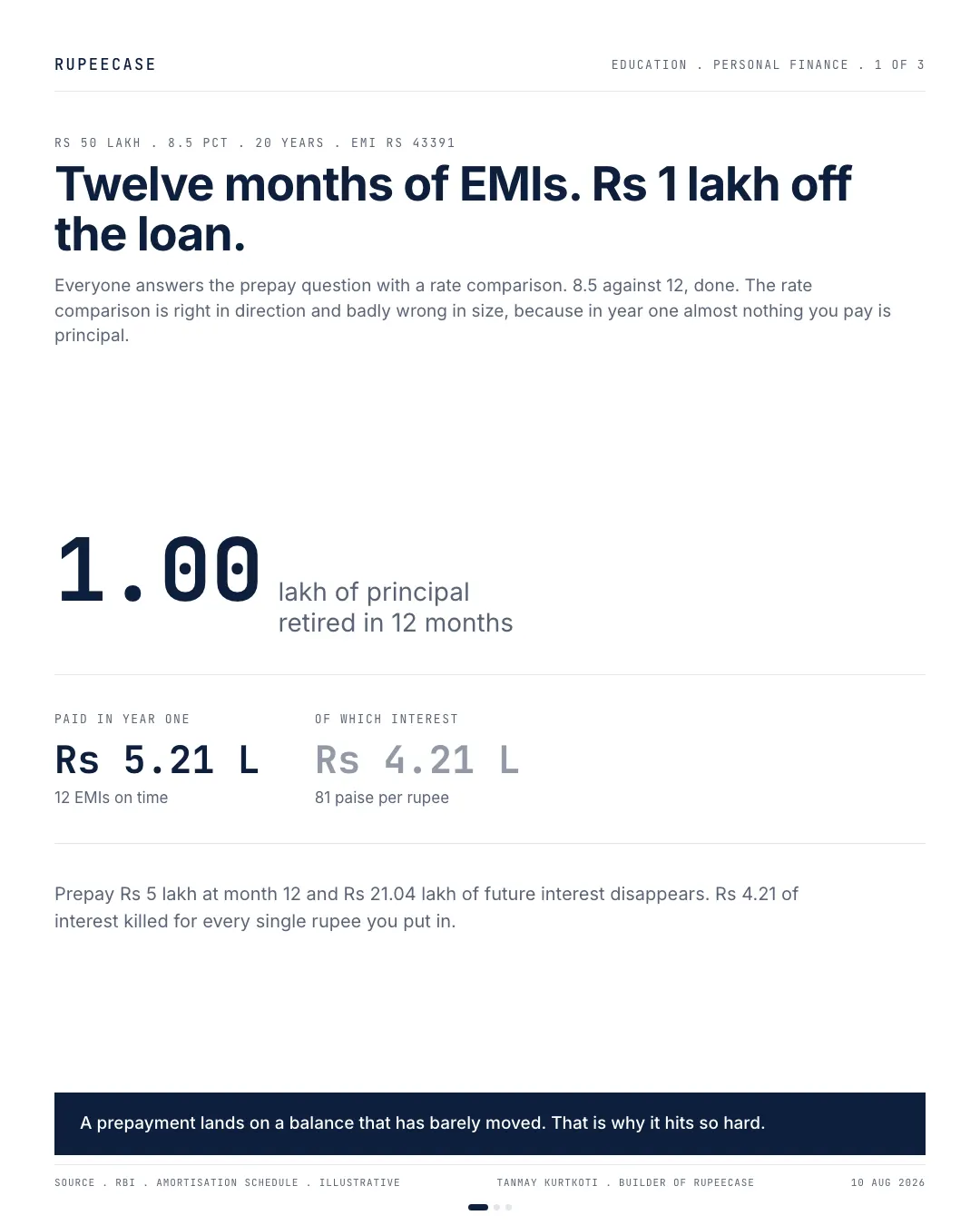
In his first twelve months Rohit pays Rs 5.21 lakh. Twelve EMIs, every one of them on time, a standing instruction he never thinks about. At the end of those twelve months his outstanding has gone from Rs 50 lakh to Rs 49.00 lakh.
One lakh. A full year of payments retired one lakh of principal. The other Rs 4.21 lakh went to interest, which is about 81 paise in every rupee.
In year one you are not repaying a loan. You are renting money and rounding down.
That is not the bank being sneaky. It is just what a level EMI does. The payment is flat, the interest is charged on the outstanding balance, and the balance at the start is the entire loan. The split only tips towards principal somewhere in the second half of the term, which is exactly when most borrowers have already refinanced, moved, or stopped opening the statement.
So a prepayment lands on a balance that has not gone anywhere
This is the mechanism the coffee table answer skips right over.
Prepay Rs 5 lakh at month 12 and keep the EMI unchanged. The loan now runs 179.5 more months instead of 228. It finishes 48.5 months early, a little over four years. The interest never paid comes to Rs 21.04 lakh.
Rs 4.21 of future interest killed for every rupee prepaid.
The reason it is that violent is that the Rs 5 lakh is not settling the tail of the loan. It is removing principal from the front, principal that would otherwise have sat on the books accruing 8.5 pct for another fifteen years. Push the same Rs 5 lakh in at year fifteen and you get a fraction of this, because by then there is barely any term left for interest to pile up on it. Same rupees, different position in the schedule, completely different outcome.
Then I ran the other side and the market still wins
Which is where I have to be honest, because I wanted the amortisation math to win and it does not.
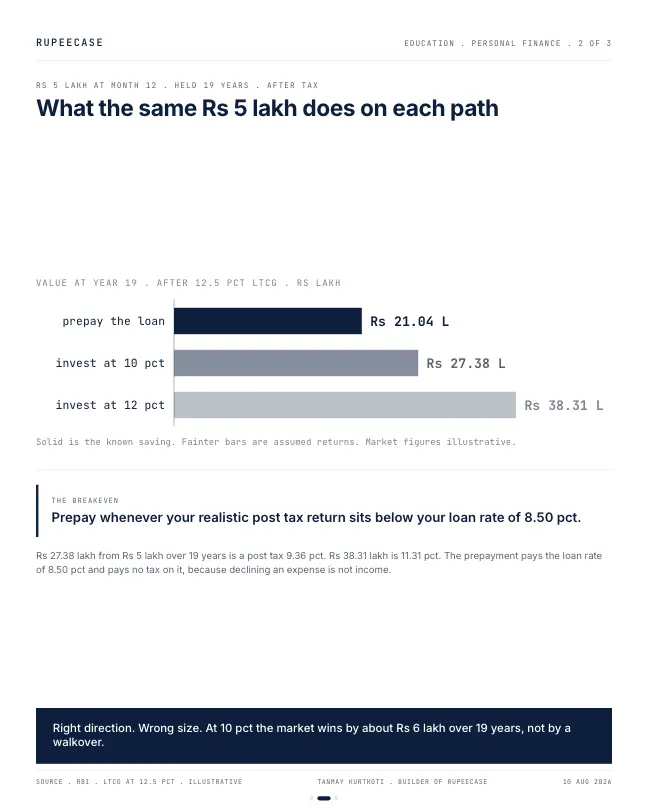
If Rohit puts the Rs 5 lakh into equity instead and leaves it alone for the remaining 19 years of the loan, then at a 10 pct illustrative return it becomes Rs 30.58 lakh, or Rs 27.38 lakh after 12.5 pct long term capital gains tax. At a 12 pct illustrative return it becomes Rs 43.06 lakh, or Rs 38.31 lakh after the same tax.
| What the Rs 5 lakh does | Before tax at year 19 | After 12.5 pct LTCG | Effective post tax rate |
|---|---|---|---|
| Prepays the loan at month 12 | . | Rs 21.04 lakh of interest never paid | 8.50 pct |
| Invested at 10 pct, illustrative | Rs 30.58 lakh | Rs 27.38 lakh | 9.36 pct |
| Invested at 12 pct, illustrative | Rs 43.06 lakh | Rs 38.31 lakh | 11.31 pct |
Against the Rs 21.04 lakh the prepayment saves, the market case clears it by about Rs 6 lakh at 10 pct and by about Rs 17 lakh at 12 pct. So invest. The coffee table was right, and I owe them a coffee.
They were right by a much thinner margin than "12 beats 8.5" makes it sound, and the thinness is the entire point. A rate comparison of 8.5 against 12 feels like a three and a half point walkover. What it actually buys, on five lakh, across nineteen years, at the more sober of the two assumptions, is six lakh. Real money. Not a walkover.
Stated as a rate instead of a pile of rupees it gets simpler
Convert those post tax outcomes back into an annual rate and the whole thing fits in your head. Rs 27.38 lakh grown from Rs 5 lakh over 19 years is a post tax 9.36 pct. Rs 38.31 lakh is a post tax 11.31 pct. The prepayment pays exactly the loan rate, 8.50 pct, and nothing is taken out of it, because you are not earning income, you are declining to pay an expense.
So the rule is one line. Prepay whenever your realistic post tax return sits below your loan rate.
The curve is worth sitting with, because it shows where this decision actually lives. The 12 pct path only clears the flat prepayment saving somewhere in year fourteen. The 10 pct path does not clear it until year seventeen. For more than a decade the three lines are close enough that the choice hardly matters. Which means this was never a decision about returns. It is a decision about whether you will still be holding in year nineteen.
What the number does to behaviour, then what it does when everyone sees it
Once you know a prepayment in month 12 is worth Rs 4.21 for every rupee, the sensible move stops being "prepay someday when I have more" and becomes "prepay now, small if you must". The option decays. Every year you wait, the same cheque buys less relief, because there is less remaining term for it to chew through.
That option is not free, by the way. It is just already paid for. RBI's Pre-payment Charges on Loans Directions, applying to loans sanctioned or renewed from 1 January 2026, bar lenders from levying a prepayment fee on floating rate loans to individuals. So the right to do exactly what Rohit is contemplating is now a standard feature of the product. Standard features get priced. A lender writing a twenty year loan that a good share of borrowers will close in year sixteen is not writing a twenty year asset, and the spread on the sanction letter already carries that assumption. Your free option came out of the rate you were quoted.
Push it one step further. If an entire cohort acted on this at once, the floating rate book shortens, and lenders respond the way lenders always respond, by widening the spread on floating or steering people towards products where the option costs something. The individual edge here is real. The collective one closes itself.
Where this falls apart, and it does
Three places, and the first one is the one that matters.
The arithmetic favours investing. The arithmetic also assumes a discipline most people do not have. A prepayment is irreversible. Once the money is inside the loan it is gone, the schedule shortens, and there is no bad month in which you quietly undo it. An SIP is cancellable in two taps and nobody calls you about it. The prepayment enforces itself. The SIP asks you to enforce it, every month, for nineteen years, through at least two bear markets.
So the person this argument is wrong for is the one whose real alternative to prepaying is not investing. It is spending. If the honest counterfactual for that five lakh is a car upgrade in month eight and a holiday in month fourteen, then the 9.36 pct never happens and the 8.50 pct does. For that person the worse trade on paper is the better trade in life, and it is not close.
Second, I have not modelled what happens to the freed EMIs. In the prepay path the loan closes four years early and Rs 43,391 a month comes back into his hands for those four years. Put that to work and the prepay column is worth more than the flat Rs 21.04 lakh I have credited it with. I left it out because it needs assumptions I would then have to defend, but it narrows the gap and you should know it is missing.
Third, and this is what would change my mind: if the loan rate rose above a realistic post tax equity expectation, the whole case flips and prepaying becomes the better trade on the numbers as well as on the nerves. At 8.50 pct against a post tax 9.36 pct the margin is under a single percentage point. A couple of repo hikes passed through to a floating loan and the arithmetic changes sides. This is a conclusion with a hinge in it, and the hinge is the rate on your own sanction letter, not the one I modelled here.
Three rules I gave Rohit before the bill came
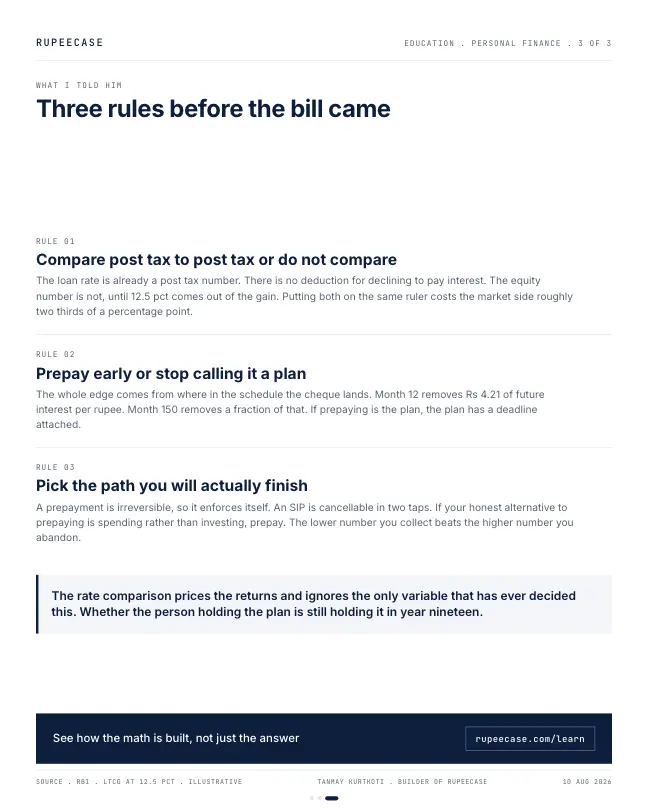
Compare post tax to post tax or do not compare at all. The loan rate is already a post tax number, because there is no deduction for declining to pay interest. The equity number is not, until 12.5 pct comes out of the gain. Putting both on the same ruler costs the market side roughly two thirds of a percentage point, and on a decision this tight, two thirds of a point is not a rounding error.
Prepay early or stop calling it a plan. The entire edge in a prepayment comes from where in the schedule it lands. Month 12 is worth Rs 4.21 of interest per rupee. Month 150 is worth a fraction of that. If prepaying is the plan, the plan has a deadline attached to it, and the deadline is sooner than you think.
Pick the path you will actually finish. This is the rule that decides it for most people and it appears nowhere in the rate comparison. A systematic framework with a fixed rebalancing calendar exists because the distance between 9.36 pct on a spreadsheet and 9.36 pct in your account is nineteen years of not touching it. If you cannot honestly say you will, prepay. The lower number you collect beats the higher number you abandon.
Rohit prepaid. Not because the math told him to, it told him the opposite, but because he has watched himself cancel two SIPs in four years and he has stopped arguing with the evidence.
The rate comparison is a fine place to start this conversation and a terrible place to end it. It prices the returns and ignores the only variable that has ever decided the outcome, which is whether the person holding the plan is still holding it in year nineteen.
Questions readers ask
What is the short answer?
A Rs 5 lakh prepayment in month 12 of a Rs 50 lakh loan kills Rs 21.04 lakh of interest, and investing it still wins by about Rs 6 lakh at a post tax 9.36 percent.
Where can I learn personal finance and tax properly?
In the free RupeeCase Learn library: Personal finance and tax, learn it free, no sign up needed. Modules come with quizzes, calculators and a path test.
Is this note investment advice?
No. It is an educational note by Tanmay Kurtkoti. RupeeCase is a technology platform, not a fund, a PMS or a SEBI registered investment adviser.
The cards
3 cards. Swipe, or tap to open.
Related
- The minimum due trapPaying only the minimum on a Rs 1 lakh card balance takes 341 months and Rs 3,72,861 of interest, because 3.5 percent a month plus GST is 4.13 percent a month.Personal finance and tax . . 6 min
- The flat rate trapA 10 percent flat car loan on Rs 6 lakh over five years costs Rs 1,35,000 more than a 10 percent reducing balance loan, a true rate near 17.3 percent.Personal finance and tax . . 4 min
- Rent vs buy: the two numbers the dead money line skipsMore than 80 paise of a first year EMI rupee is interest, rent runs about 3.5 percent of price against an 8.5 percent loan, and the down payment has an opportunity cost.Personal finance and tax . . 5 min
Educational content only. Figures are illustrative and computed on historical or representative data for teaching purposes, not investment advice. Past performance does not guarantee future returns. Sourced from NSE, BSE, SEBI, AMFI and RBI public data.