



Personal finance and tax..8 min read
The flat SIP shrinks
Rs 10,000 a month buys about Rs 7,473 of 2021 purchasing power after five years at 6 percent inflation, and a 10 percent annual step up doubles the twenty year corpus.
By Tanmay Kurtkoti, founder of QC Alpha and builder of RupeeCase
Saturday morning a friend pinged me a screenshot. His SIP summary. Five years running, Rs 10,000 a month, not a single miss. The green streak on his app looked like a medal. He was proud of it and he should have been. Discipline like that is rare.
I asked one question. Has the amount changed since you started? He said no, that is the whole point. Same amount, same date, same fund. Consistency.
Here is the part nobody told him. His Rs 10,000 in 2021 bought roughly Rs 10,000 worth of units. His Rs 10,000 today, at roughly 6 percent annual inflation, buys about Rs 7,473 worth in 2021 rupees. Same debit. Shrinking contribution.
The SIP was consistent. Its purchasing power was not. Five years of discipline rewarded with a contribution that quietly lost a quarter of its weight.
The flat line that falls
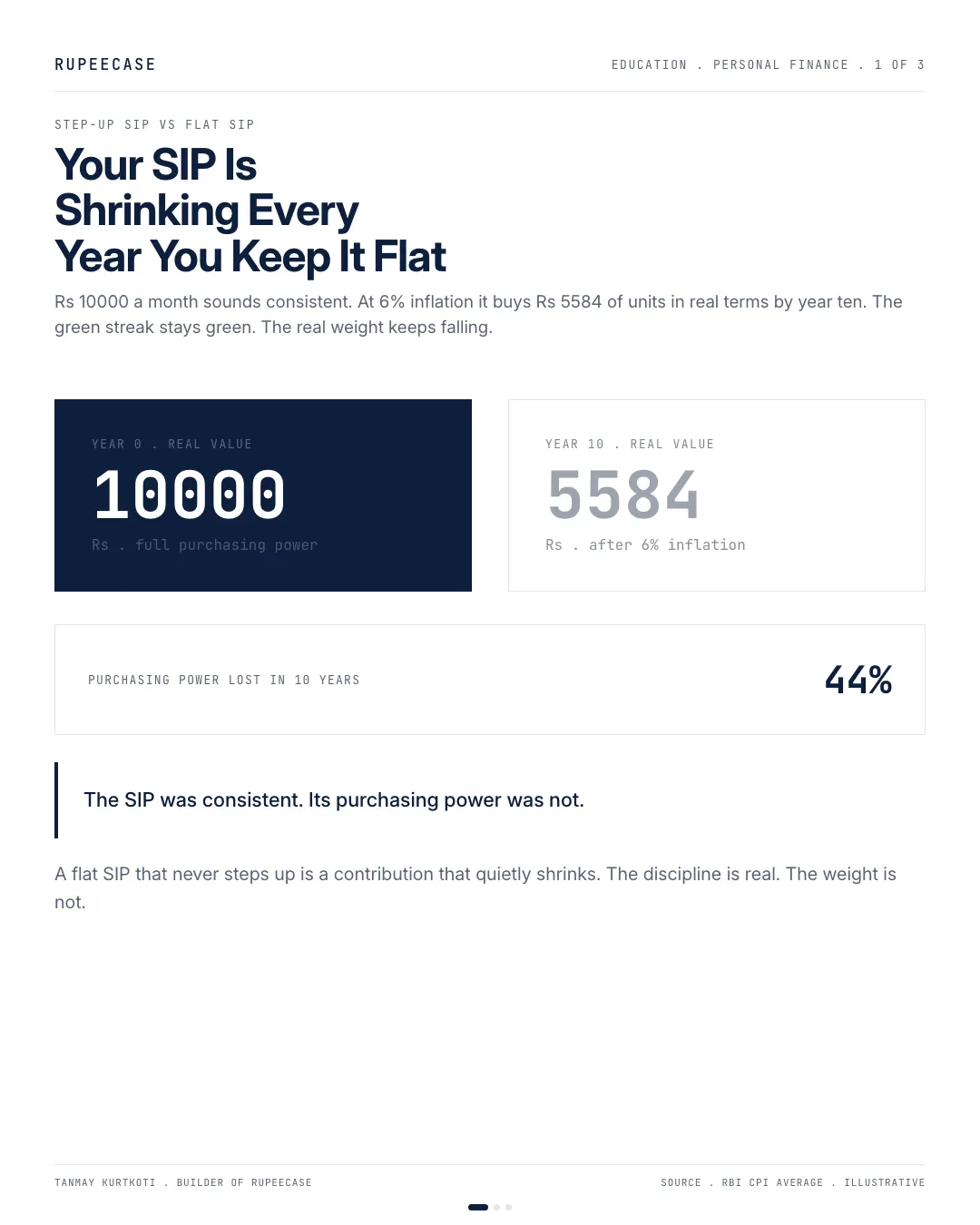
Inflation does not care about your streak. At 6 percent a year, Rs 10,000 is worth roughly Rs 7,473 in real terms after five years, Rs 5,584 after ten, and Rs 3,118 after twenty. That last number is not a rounding error. Two decades of the same debit and the real contribution has fallen by more than two thirds.
The chart makes it concrete. By year ten the contribution is doing about half the work it did at the start. By year twenty it is doing less than a third. The green streak on the app stays green. The real weight of each instalment keeps falling.
Six percent is an assumption, and a fairly high one right now. MOSPI put all India CPI inflation at 4.82 percent for Aug 2026. Use that instead and the erosion is slower, not absent: Rs 10,000 is worth about Rs 7,903 after five years and Rs 3,900 after twenty.
The salary that grew while the SIP stood still
There is a second way this shows up and it might be the more honest one. Assume a starting salary of Rs 50,000 a month with 8 percent annual raises, a rough average for an Indian professional who stays employed. At year zero the Rs 10,000 SIP is 20 percent of take-home. A real commitment.
By year five the salary has climbed to about Rs 73,466. The flat SIP is now 13.6 percent. By year ten, salary Rs 1,07,946, the SIP is 9.3 percent. By year twenty, salary Rs 2,33,048, that same Rs 10,000 is 4.3 percent of income. What started as a fifth of the pay cheque became a rounding error. The lifestyle absorbed the raises. The SIP did not.
- Year 0, pay Rs 50,00020.0%
- Year 5, pay Rs 73,46613.6%
- Year 10, pay Rs 1,07,9469.3%
- Year 20, pay Rs 2,33,0484.3%
Rs 10,000 SIP as a share of monthly pay, with 8 percent yearly raises. Worked example from this post.
What a 10 percent annual step-up actually does
The fix is boring. Step the SIP up by a fixed percentage every year. Match it to the raise or match it to inflation. Either works. The numbers change dramatically.
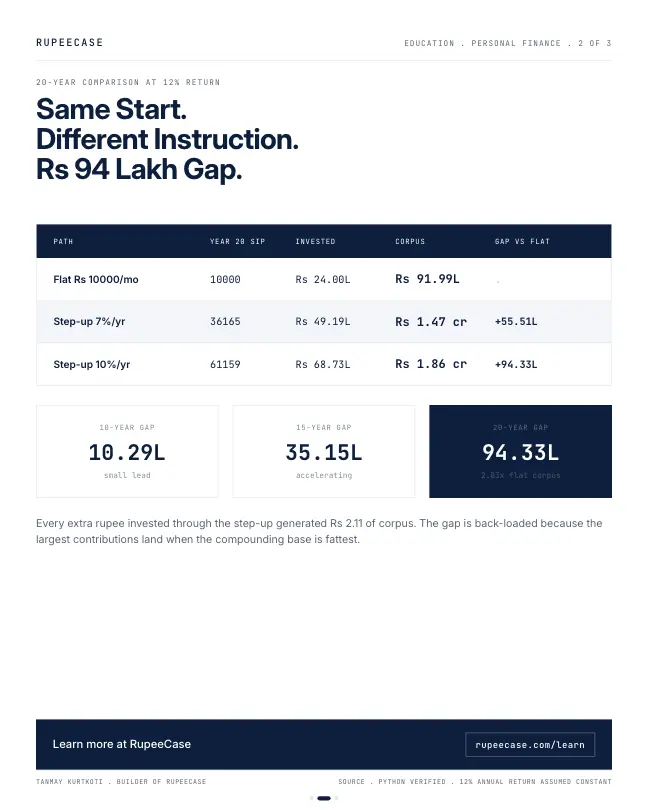
I ran three paths on Rs 10,000 a month starting today at 12 percent annual return, compounded monthly.
| Path | Year 20 SIP | Total invested | Corpus at 20Y | Gap vs flat |
|---|---|---|---|---|
| Flat Rs 10,000/mo | 10,000 | Rs 24.00L | Rs 91.99L | . |
| Step-up 7%/yr | 36,165 | Rs 49.19L | Rs 1.47 cr | +Rs 55.51L |
| Step-up 10%/yr | 61,159 | Rs 68.73L | Rs 1.86 cr | +Rs 94.33L |
The flat SIP reaches Rs 91.99 lakh. The 10 percent step-up reaches Rs 1.86 crore. That is 2.03 times the flat corpus. The gap is Rs 94.33 lakh on an extra Rs 44.73 lakh invested. Every extra rupee invested through the step-up generated Rs 2.11 of corpus. Compounding rewarded the additional capital generously because it arrived early enough in the journey to multiply.
MythA 10 percent step-up just means putting in more, so the corpus grows by the same multiple.
FactIn this example you put in 2.86 times as much (Rs 68.73 lakh against Rs 24.00 lakh) and end with 2.03 times the corpus. The later, larger instalments have less time to compound.
The 7 percent step-up, which roughly matches inflation and asks for no lifestyle sacrifice, still reaches Rs 1.47 crore. More than 60 percent above flat.
The gap is back-loaded and that is the point
At year ten the step-up (10 percent) leads by about Rs 10.29 lakh. At year fifteen the lead widens to Rs 35.15 lakh. At year twenty it is Rs 94.33 lakh. The gap is not linear. It accelerates because the later years are when the stepped-up contributions are largest and the compounding base is fattest.
This is not a small difference in the early years growing into a large one. It is an almost invisible lead that explodes in the final third. The same mechanic that makes compounding feel slow in year three makes the step-up feel transformative in year seventeen. But by year seventeen you need to have been stepping up for sixteen years already. The decision lives at the start.
The honest caveat
A 10 percent annual step-up assumes your income rises at least that fast, every year, for two decades. Not everyone gets consistent raises. Not everyone stays employed continuously. A job loss in year eight does not care about the step-up schedule.
The step-up also means real money leaving real accounts. By year twenty the monthly SIP at 10 percent step-up is Rs 61,159. That is six times the starting amount. The discipline is not just remembering to invest. It is committing a larger absolute sum every single year and not pulling back when the number on the debit mandate starts looking uncomfortable.
And the 12 percent return assumption is a modelled constant. Real markets deliver that 12 percent as 30 in one year and minus 15 in the next. The step-up lands its largest contributions into whatever the market happens to be doing that year. Sometimes that is a gift. Sometimes it is not. Sequence of returns matters here too.
A 7 percent step-up, matching inflation, is the gentler version. It asks for no lifestyle sacrifice. It simply prevents the SIP from shrinking in real terms. That alone closes more than half the gap.
Why most people never step up
The practical problem is not the math. The math is obvious. The problem is that nobody sends a reminder. Most fund platforms let you set a step-up instruction when you register the SIP. One field. One time. But the default is flat. And the default wins.
A salary hike lands in the account. The SIP stays the same. The difference between the old salary and the new one flows into spending within three months. Thaler called it mental accounting. I call it the leak. The raise showed up. The SIP did not notice.
The step-up instruction is the one form field that compounds. Fill it once and the discipline is automated. Skip it and the decision falls to willpower every April, and willpower has a losing record against lifestyle inflation.
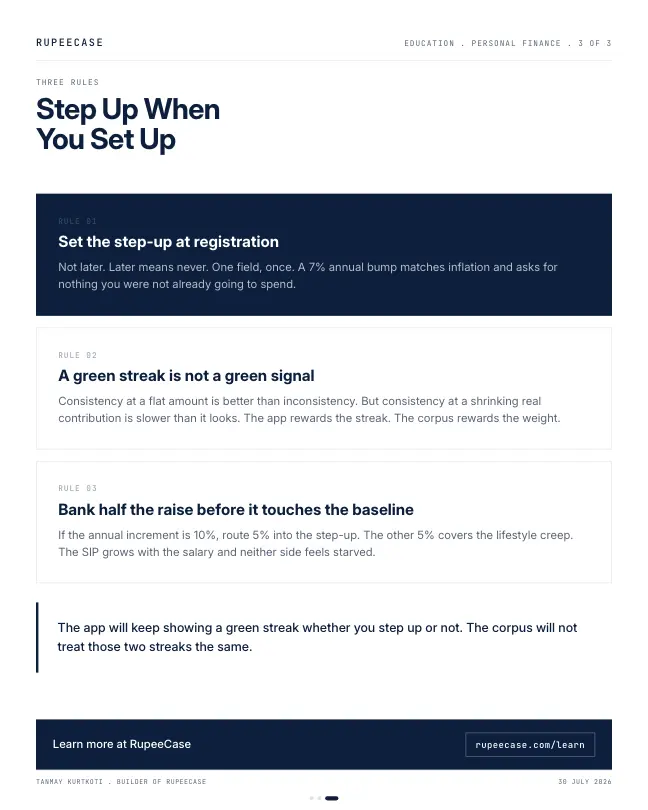
Three rules
Set the step-up when you set the SIP, not later. Later means never. One field, once, at registration. A 7 percent annual bump matches inflation and asks for nothing you were not already going to spend.
Do not read a green streak as a green signal. Consistency at a flat amount is better than inconsistency. But consistency at a shrinking real contribution is slower than it looks. The app rewards the streak. The corpus rewards the weight.
Bank half the raise before it touches the baseline. If the annual increment is 10 percent, route 5 percent into the step-up. The other 5 percent covers the lifestyle creep. The SIP grows with the salary and neither side of the ledger feels starved.
The app will keep showing a green streak whether you step up or not. The corpus will not treat those two streaks the same. One grew with you. The other stood still while everything around it moved.
How big is a typical SIP today
It helps to know where the average sits. AMFI's monthly data for Aug 2026 shows Rs 32,297 crore collected through SIPs from 1,001.79 lakh contributing accounts. Divide one by the other and the average instalment is about Rs 3,224 a month. Small instalments are where a flat amount shrinks fastest in relevance, because the raise that would cover a step-up is a few hundred rupees a year.
The free Learn module on inflation and its investment impact shows how CPI is measured and why your own inflation can differ from the headline, and the note on the step-up SIP runs more step-up paths.
Questions readers ask
How much does inflation reduce the value of a fixed SIP?
At 6 percent inflation a Rs 10,000 SIP is worth about Rs 7,473 in today's rupees after five years and Rs 3,118 after twenty. At the Aug 2026 CPI print of 4.82 percent the same figures are about Rs 7,903 and Rs 3,900.
What step-up percentage keeps a SIP constant in real terms?
A yearly step-up equal to the inflation rate holds the real value of each instalment level. With CPI at 4.82 percent in Aug 2026, that is a step-up of about 5 percent a year; the 7 percent path in this post also grows the real contribution a little each year.
The cards
3 cards. Swipe, or tap to open.
Explore next
Learn it properly, then see it applied.
- GuideBest SIP date: does the day of the month matter? A test of every date from the 1st to the 28thEvery date from the 1st to the 28th, tested on the Nifty 50 from 2013 to 2026.
- Free module 11.1Equity Taxation After July 2024: The New Rules10 min read
- CalculatorRule of 72Free, with the formula and a worked example
See the idea in an index: Energy Basket and Nifty 50 Equal Weight. Model, back tested figures and the rules are on each page.
Related
- The lever you control beats the one you chaseTwo extra points of return over 25 years adds Rs 82 lakh to a Rs 10,000 SIP; stepping the same SIP up 10 percent a year adds Rs 2.35 crore.Personal finance and tax . . 4 min
- Lifestyle creep: the raise that never reaches the portfolioBanking half of every increment lifts a savings rate from 20 to 35 percent without a felt cut and ends Rs 21.5 lakh ahead over a decade on the same income and returns.Personal finance and tax . . 5 min
- A loss you do not book is a rebate you do not claimBooking a Rs 60,000 short term loss against a Rs 1 lakh short term gain cuts the tax from Rs 20,000 to Rs 8,000, and unused losses carry eight years if you file on time.Personal finance and tax . . 10 min
Educational content only. Figures are illustrative and computed on historical or representative data for teaching purposes, not investment advice. Past performance does not guarantee future returns. Sourced from NSE, BSE, SEBI, AMFI and RBI public data.
Community
Join my WhatsApp group.
Scan the code, fillFill one short form, and join my WhatsApp group. Slides, sources, factsheets and the rebalance logs live there, and members join a daily Google Meet with me.
New to RupeeCase? Getting started See the terminal