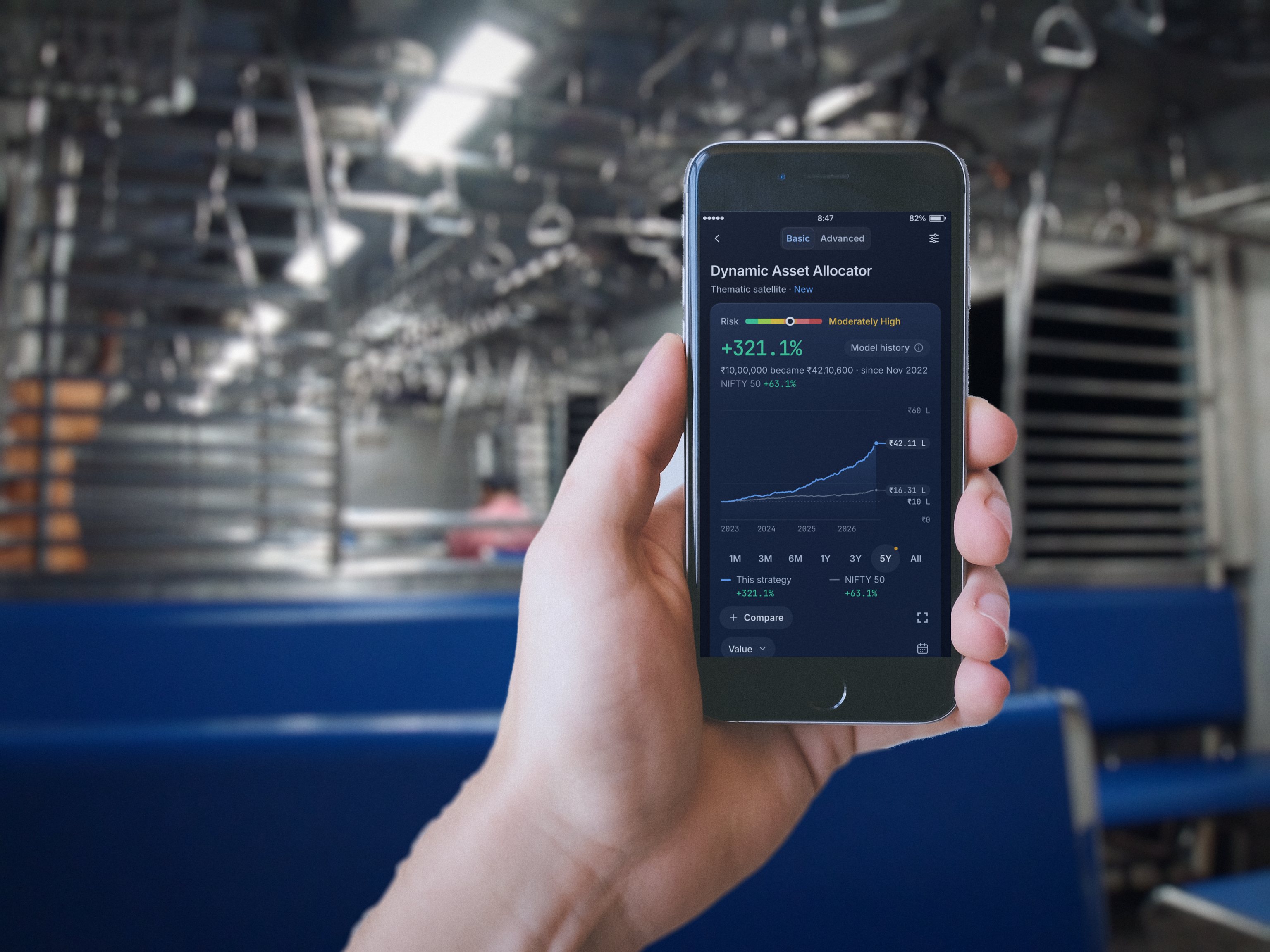
Put every option side by side, read the model back test of the strategy you like, then own it in your account.
Move to zoom in
02Cost over 20 years
Four fees. One race.
The same return before costs for all four, ₹10 lakh, 20 years. The lines part only because of fees.
₹21.3 lakhmore left after 20 years with RupeeCase than with a PMS at 2% plus 20%, on ₹10 lakh at 12% a year before costs, rebalancing every 4 weeks.
Illustration, not a forecast: one return before costs for every option, minus each option's typical fee, compounded. Brokerage and taxes left out for all. Pick a return or a cadence, or move along the chart. Illustration: ₹10.0 lakh for 20 years at 12% a year before costs ends at RupeeCase ₹83.9 lakh; a mutual fund at 1.8% ₹69.8 lakh; a PMS at 2% plus 20% ₹62.5 lakh; an AIF Category III at 2% plus 20% ₹62.5 lakh (RupeeCase at 13 rebalances a year, 30% turnover; at 26 rebalances it ends at ₹72.9 lakh).
03Access
Getting in, holding, getting out.
01Minimum ticketFrom ₹500 to ₹1 crore.
02Who holds the sharesUnits of a fund, or shares in your name.
03LiquidityTime to cash.
Minimum ticketLog scale
What it takes to get in.
RupeeCaseper strategy, as published₹26k to ₹3.02 L
Mutual fundSIP, or a lump sum₹500 to ₹5,000
PMSSEBI minimum₹50 lakh
AIFSEBI minimum₹1 crore
₹100₹1k₹10k₹1 L₹10 L₹1 cr
RupeeCase minimums are per strategy (whole shares at published weights), from the published lineup of 17 Jul 2026. Mutual fund: SIP or lump sum, typical. PMS and AIF: SEBI minimums.
CustodyWhose name is on the shares
Own the shares, or own a unit.
RupeeCase
YouYour demat, your brokerShares in your name
Every share sits in your own demat, in your name. RupeeCase sends the model; it never holds money or shares.
Mutual fund
YouUnits of the schemeThe fund holds the shares
You own units. The scheme owns the shares, held by its custodian.
PMS
YouA demat the manager operatesShares in your name
Typically held in your name, in an account the portfolio manager runs and trades.
AIF Cat III
YouUnits of the fundThe fund holds the assets
You own units of a pooled fund. The fund owns the positions.
Typical structures. Check each product's own documents.
LiquidityTime to cash, indicative
How fast your money comes back.
RupeeCaseT+1Sell in your broker any trading day. Cash settles the next day.
Mutual fundWithin 3 working daysEquity schemes pay out within days of a redemption.
PMSDays, per agreementAsk the manager to redeem; exit load may apply.
Short answers to the questions people actually ask.
How does RupeeCase compare with mutual funds, PMS and AIFs?
All four aim at long term wealth on Indian markets. Mutual funds and AIFs pool money and give you units; a PMS and RupeeCase keep shares in your name. RupeeCase runs rule based strategies packaged like an index in your own broker account, for 0.2% of traded value per rebalance, against typical costs of 0.3% to 2.5% a year for mutual funds, 2% plus 20% for a PMS and about 2% plus 20% for a Category III AIF.
What does "an algo like an index" mean?
An index is a rule for choosing what to hold and when to change it. A plain index uses company size. Every RupeeCase strategy is an algorithm with a published rule (momentum, factor or multi asset), a fixed universe and a fixed rebalance calendar, so it behaves like an index you can read, test and own.
Which option has the lowest minimum?
A mutual fund SIP from ₹500. RupeeCase strategies from ₹26,000 (published lineup, 17 Jul 2026). A PMS needs ₹50 lakh and an AIF ₹1 crore under SEBI rules.
Is RupeeCase regulated like a fund?
RupeeCase is not a fund. It is a technology platform operated by QC Alpha Technologies Pvt Ltd; trades execute through SEBI registered brokers in your own account. Research is by QC Alpha Research Pvt Ltd, whose SEBI research analyst registration is pending.
How do I choose?
Compare first, validate the back test, then invest in the index. Look at cost over your horizon, the minimum, who holds the shares, lock in, liquidity and tax. Then read each RupeeCase strategy's rule and model back test. Nothing here is investment advice.
Typical fee levels: mutual funds 0.3% to 2.5% of assets a year, PMS 2% of assets plus a 20% profit share, as stated on the current RupeeCase pricing page; AIF Category III about 2% plus 20%; PMS minimum ₹50 lakh and AIF minimum ₹1 crore under SEBI rules. Every product differs; read its own documents.
RupeeCase is a technology platform operated by QC Alpha Technologies Pvt Ltd. It is not a mutual fund, a PMS, an AIF or a SEBI registered investment adviser. Research by QC Alpha Research Pvt Ltd, SEBI research analyst registration pending. Trades execute through your own SEBI registered broker. Investments in securities markets are subject to market risks. Nothing here is investment advice.
Photography: Coastal road, Mumbai, in the evening light. November 2025 by Qiw007, CC BY 4.0; Rare empty local train of Mumbai by Dharmadhyaksha, CC BY-SA 3.0; Mumbai skyline at 1830 by pronzz97 from Mumbai, India, CC BY 2.0; DLF Epitome Tower, DLF Phase 3, Gurugram by Sahil Dhiman, CC BY-SA 4.0; Marine Lines Mumbai 2021 by Dr Vikramjit Kakati, CC BY-SA 4.0; other photographs CC0, public domain or our own, regraded; device screens show the RupeeCase app on sample data. Full list: credits.