



The question every Indian investor eventually asks: should I pay a fund manager to pick stocks, or just buy the index? The evidence on that question is about as consistent as anything in finance, and the industry still markets active funds hard, because active fees are many times passive ones.
Here is the evidence, the arithmetic behind it, the narrow places where active management has a better case, and where rules based strategies sit, which is neither simply passive nor active.
- No cost at allRs 96.5 lakh
- 0.05% a year, a large ETFRs 95.6 lakh
- 0.2% a year, an index fundRs 93.1 lakh
- 1.0% a year, active directRs 80.6 lakh
- 1.8% a year, active regularRs 69.8 lakh
Arithmetic with a fixed 12% yearly return before costs. Fee levels are typical examples, not any scheme's actual figures. Real returns vary every year.
3By the end you can
- Show in rupees what a yearly fee does to ₹10 lakh over 20 years.
- Choose between an index fund and an ETF on cost, tracking and liquidity.
- Say where rules based strategies sit between passive and active, and what risk they add.
The evidence on active funds
Independent scorecards that compare Indian active funds with their benchmarks have been published twice a year for more than a decade. Their pattern barely changes: over five and ten years, after fees, most active large cap funds in India have lagged their benchmark index, and the share that lags tends to rise as the horizon lengthens. Funds that beat the index in one period are, on the whole, not the same funds that beat it in the next. Performance persistence is weak.
AMFI, scheme performance against benchmark TRI2 terms this section turns on
Read one more paragraph, 50 words
You can check this yourself without trusting anyone's scorecard. SEBI requires every scheme to show its return next to its benchmark's Total Return Index in the factsheet and on AMFI's website. Pick your own fund, pick five and ten years, compare the direct plan's return with the TRI, and count.
Why active underperforms: the arithmetic
The argument needs no data at all. Before costs, the average actively managed rupee must earn the market return, because active managers together own the market. After costs, the average active rupee must lag the market by exactly its costs. It is not a claim about skill. It is accounting.
| Product | Typical yearly cost | Cost a year on ₹10 lakh | ₹10 lakh after 20 years at 12% before costs |
|---|---|---|---|
| Large Nifty 50 ETF | about 0.05% | about ₹500 | ₹95.6 lakh |
| Index fund, direct | about 0.2% | about ₹2,000 | ₹93.1 lakh |
| Active large cap, direct | about 1.0% | about ₹10,000 | ₹80.6 lakh |
| Active large cap, regular | about 1.8% | about ₹18,000 | ₹69.8 lakh |
Read one more paragraph, 65 words
For an active fund in its direct plan to match the index fund here, the manager must beat the index by about 0.8 percentage points every year, before you get anything for the extra risk of being different. In the regular plan, it is about 1.6 points every year for 20 years. A few managers do that. Picking them in advance is the hard part.
Index fund or ETF?
Deals at NAV, once a day
- No demat account needed
- Easy monthly SIP, any amount
- No spread, no premium to pay
- Slightly higher expense ratio
Trades all day on NSE and BSE
- Needs a demat and a broker
- Usually the lowest expense ratio
- You pay the spread and any premium
- Liquidity varies a lot by ETF
For a monthly SIP into a broad index, an index fund's direct plan is usually the simplest choice: no spread, no premium, no order to place. For a larger lump sum into a liquid ETF, the lower expense ratio can win, provided you buy near the iNAV. Module 6.4 shows how to check that.
- Pick the indexBroad and liquid first; the index matters more than the fund.
- Compare costsDirect plan expense ratio, or ETF expense ratio plus spread.
- Check trackingTracking difference over one and three years against the TRI.
- Check liquidityFor ETFs, daily traded value and the gap to iNAV.
- AutomateA monthly SIP or a fixed rebalance date, then leave it.
What you actually own in an index
Passive does not mean neutral. The Nifty 50 weights its 50 companies by free float market capitalisation, so the largest names carry the most money, and NSE reviews the constituents twice a year. When you buy the index you buy its sector mix and its valuation at that moment, whatever they are.
Read one more paragraph, 104 words
Valuation moves a lot even inside a short window. The Nifty 50's price to earnings ratio was 23.6 on 13 September 2024, 24.4 at its peak two weeks later and 19.5 on 15 September 2026, its lowest in those two years, on NSE's published index data. Same index, about a sixth cheaper on earnings two years later. An index fund removes the manager from the decision; it does not remove the price you pay. That is why many investors pair an index core with a steady SIP: the monthly amount buys more units when the index is cheaper and fewer when it is dearer.
When might active win? The narrow cases
The case against active management is strongest in large cap Indian equity, the most researched and most liquid part of the market. It is somewhat better in:
Two terms to hold on to from 6.5
- Mid and small caps: less analyst coverage, wider information gaps and more mispricing. A skilled manager has more room, although benchmarks in these segments are also harder to trade cheaply.
- Credit: corporate bond analysis is specialised, and a careful credit team can add value, or avoid losses, in ways an index cannot.
- Specialist strategies: special situations, deep value and concentrated mandates that no index replicates.
The honest summary: in large caps, the index is very hard to beat after costs; elsewhere the evidence is less one sided, but the cost hurdle never goes away.
Where rules based investing sits: the third option
Systematic strategies are neither passive nor active in the usual sense:
| Dimension | Passive index | Active fund | Systematic rule |
|---|---|---|---|
| Rules based? | Yes, the index rules | No, manager judgement | Yes, a published rule |
| Aim | Match the index | Beat the index | Earn a documented factor premium |
| Who decides | The index provider | The fund manager | The rule, fixed in advance |
| Main risk | Market risk | Market plus manager risk | Market plus factor risk: long stretches behind the index |
| What to check | Cost and tracking | Cost and persistence | Out of sample evidence, costs and drawdowns |
MythIndex funds are for people who cannot pick good funds.
FactOwning the index at low cost beats most professional managers in large caps over ten years after fees. Choosing it is a decision about costs, not a lack of skill.
₹100 in Large Cap Multi Asset became about ₹235 in the model
Worked example: a core and satellite portfolio
A common structure blends the three. Take ₹20 lakh: ₹12 lakh in a Nifty 50 index fund as the core, ₹5 lakh in a rules based factor strategy, ₹3 lakh in one active mid cap fund you have researched. At the example costs above, the yearly fee bill is about ₹2,400 on the core and ₹3,000 on the active fund. The factor sleeve's cost depends on how often it trades; at 0.2% of traded value it is charged only on rebalances. The core keeps you at the market's return; the satellites are where you accept tracking error in the hope of more. Size the satellites so that their worst year does not make you abandon the core.
Common mistake: choosing funds on last year's return
The common mistake is buying last year's top fund. Rankings churn, and a top quartile year says little about the next one. Investors who chase the leaders tend to buy after the good run and sell after the bad one, which is the exact opposite of what compounding needs.
The second mistake is paying active fees for an index. Compare your active fund's top holdings and sector weights with its benchmark. If they look nearly the same, you are paying active fees for a closet index fund.
Where this section sits in module 6.5
How this shows up in RupeeCase
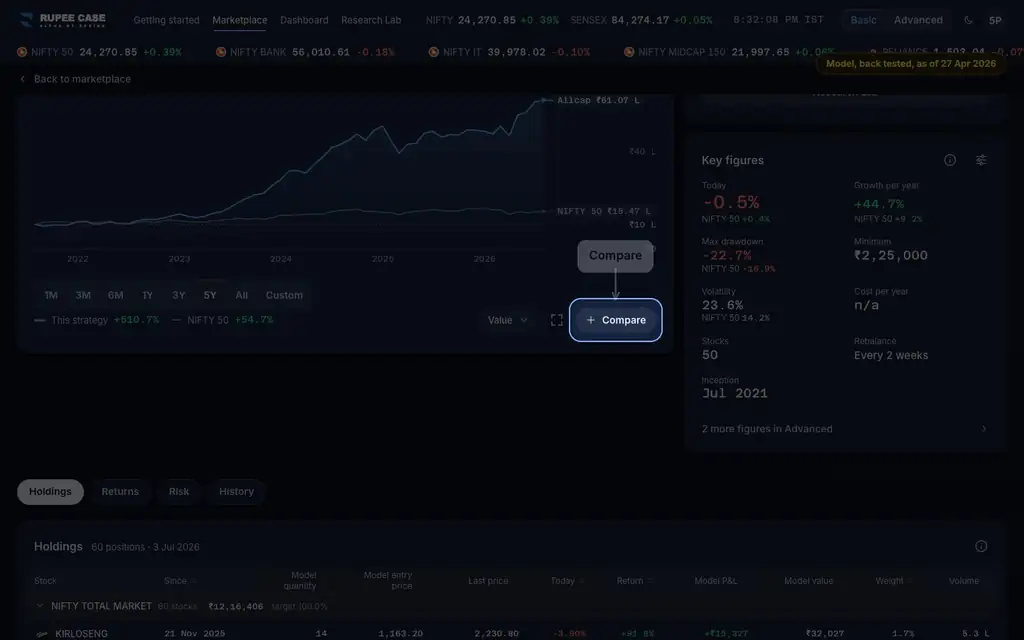
RupeeCase strategies are rules based like an index and aim for a factor premium like an active fund. Each one is a published algorithm: the universe, the ranking, the number of names and the rebalance calendar are fixed and visible, so the result does not depend on a manager's judgement on the day. The stocks sit in your own demat, and the RupeeCase fee is 0.2% of traded value per rebalance; your broker's charges, STT and other levies come on top, as on any trade. Every strategy page draws a benchmark line beside the model; the tutorial The benchmark line: what is the strategy compared with? explains it. The strategies take on factor risk for the chance of more than an index return. See how they line up against mutual funds, PMS and AIFs on the compare page. All strategy figures are model, back tested.
Key takeaways
- After costs, the average active rupee must lag the market by its costs. That is accounting, not opinion.
- A 1.8% fee against 0.05% is about ₹26 lakh on ₹10 lakh over 20 years at 12%, before tax. Illustrative rates.
- An index fund suits a SIP; a liquid ETF can be cheaper for a lump sum bought near iNAV.
- An index still has a price: Nifty 50 P/E was 24.4 on 26 Sep 2024 and 19.5 on 15 Sep 2026.
- Rules based strategies add factor risk: long stretches behind the index.

Questions readers ask
Is an index fund safer than an active fund?
Not safer from the market; both fall in a crash. An index fund removes manager risk and keeps costs low, so its return stays close to the index. An active fund can do better or worse than the index.
Which index should a beginner own?
A broad, liquid index such as the Nifty 50 or a broader index such as the Nifty 500 is the usual starting point. The choice of index matters more than the choice between two funds that track it.
Are smart beta funds active or passive?
They are passive vehicles that track a rules based factor index. The factor tilt itself is an active bet against the broad market, so expect years when they lag it.