


Almost every Indian family owns gold in some form: jewellery, coins, something in a locker. Very few treat it as a portfolio asset with a target weight and a reason. And fewer still have thought about the rupee itself as a risk they carry, which is what international diversification is really about.
2026 made both points loudly. Gold traded near ₹1.56 lakh per 10 grams at the end of August, Indian investors put ₹68,868 crore of net new money into gold ETFs in FY26 alone, and the rupee weakened to around 95 to 96 to the dollar by August. Here is how to own gold sensibly in India, what the commodity market is for, and how international exposure works within Indian rules.
Indicative 24 carat gold (999), per 10 grams, 31 Aug 2026
IBJA benchmark rate, 31 Aug 2026, before GST
Crore rupees of net inflows into gold ETFs in FY26
AMFI data, FY26
Yearly limit per resident under RBI's Liberalised Remittance Scheme
RBI
3By the end you can
- Compare jewellery, gold ETFs, gold funds and Sovereign Gold Bonds on cost and on the 2025 and 2026 tax rules.
- Work out what a fixed gold weight does when you rebalance after a rally.
- Split an overseas return into the asset's return and the rupee's move.
The term this section turns on: Gold ETF
Gold: ways to own it in India
The practical split: for a portfolio allocation, gold ETFs are the simplest and cheapest to buy, rebalance and sell. Existing Sovereign Gold Bonds bought at issue are worth holding to maturity for the tax exemption. Physical gold is for weddings and family reasons, which are real reasons; just do not count the making charges as an investment.
RBI, Sovereign Gold Bond scheme notices and redemption pricesRead one more paragraph, 59 words
One more product is sold hard online: "digital gold". On 8 November 2025 SEBI said such products are neither securities nor regulated commodity derivatives, operate entirely outside its purview, and carry none of the securities market's investor protection. The SEBI regulated routes it names are gold ETFs, exchange traded commodity derivatives and Electronic Gold Receipts on the stock exchanges.
Gold in a systematic multi asset portfolio
Gold's job in a portfolio is not to produce the highest return. It is to behave differently from equities when equities are in trouble. In rupee terms gold has two drivers: the global gold price in dollars and the rupee's exchange rate. When global stress hits, the dollar gold price often rises and the rupee often weakens at the same time, and both lift gold in rupees just as Indian equities fall.
- reduced the depth of portfolio drawdowns in equity crashes;
- improved risk adjusted returns over full cycles, through low correlation;
- protected purchasing power when the rupee weakened.
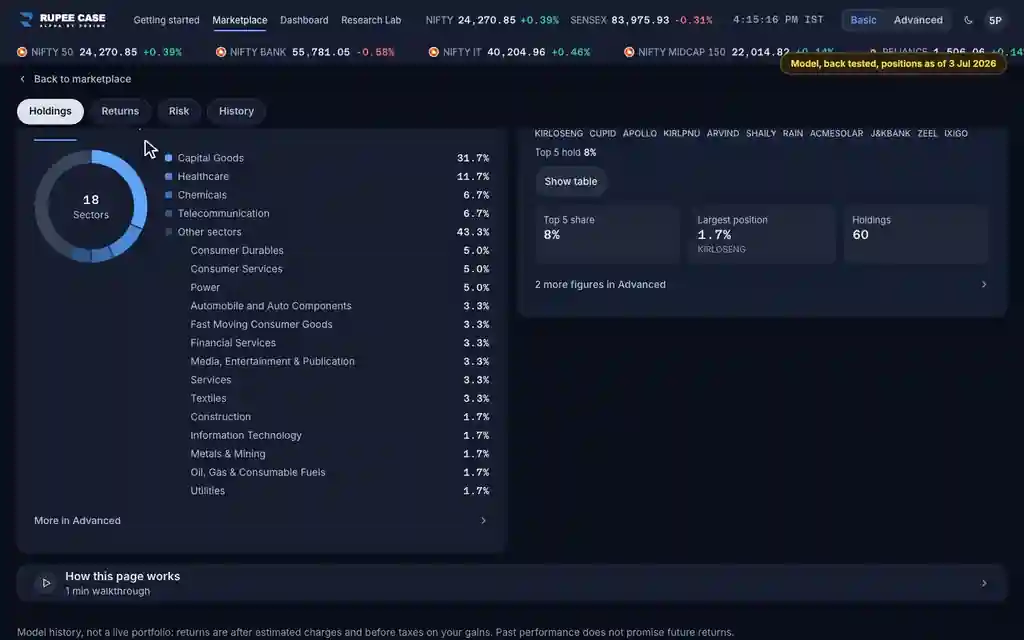
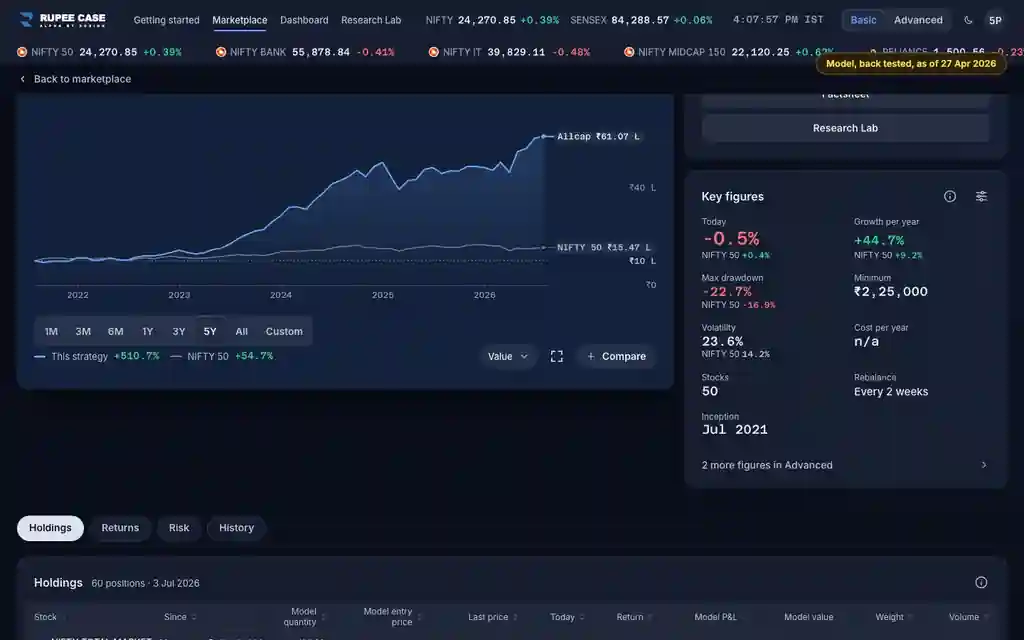
- Equity, 50 stocks80%
- Debt, liquid ETF10%
- Gold ETF10%
Target sleeves of the Allcap Multi Asset strategy, from its published configuration, as of Oct 2026. Weights drift between rebalances.
Read 2 more paragraphs, 64 words
The case made for a modest allocation, often 5% to 15% in practice, rests on three past patterns, none of which holds every time:
It also has long dull stretches, sometimes years, when it goes nowhere while equities run. That is the price of the insurance, and why the allocation should be fixed in advance and rebalanced, not chased after a rally like 2026's.
Worked example: rebalancing a gold sleeve
You hold ₹20 lakh: ₹18 lakh in equity and ₹2 lakh in a gold ETF, a 10% target. In a year when equity falls 10% and gold rises 30%, you end with ₹16.2 lakh of equity and ₹2.6 lakh of gold, ₹18.8 lakh in all, with gold now 13.8% of it. Rebalancing to 10% means selling about ₹72,000 of gold and buying equity after its fall. The rule makes you sell the thing that just worked and buy the thing that just hurt, which is exactly what it is for.
Commodities: access through MCX
MCX is India's main commodity derivatives exchange, and NSE also lists commodity contracts. They trade futures and options on bullion, energy, base metals and some agricultural products.
| Commodity | Why investors watch it | Main driver |
|---|---|---|
| Gold | Crisis and inflation hedge, rupee hedge | Dollar gold price and USD/INR |
| Silver | Part monetary metal, part industrial; far more volatile than gold | Dollar silver price and industrial demand |
| Crude oil | India imports most of its oil; prices feed inflation, the rupee and the current account | Global supply and demand |
| Copper | A read on global industrial activity | Construction and manufacturing demand |
| Natural gas | Energy input for industry and power | Weather and global LNG markets |
Read one more paragraph, 74 words
For an investor, commodity futures are leveraged contracts with daily margin, the same mechanics as Module 6.6 and Futures 101, and are not a way to hold commodities for the long term. Their most useful role for most readers is as information: crude above $100, as from March to May 2026 (PPAC, Indian basket), tells you something about inflation, the rupee and RBI policy before any of it shows up in official data.

International investing from India
Under RBI's Liberalised Remittance Scheme, a resident individual can send up to $2,50,000 a year abroad, including for investment. Remittances for investment above ₹10 lakh in a financial year attract 20% tax collected at source, which you can claim back against your tax. The other route is domestic: mutual funds and ETFs that invest overseas, which do not use your LRS limit but operate within industry wide limits set by SEBI and RBI, so new money into them has at times been paused.
The INR and USD factor: a hidden return driver
An overseas investment held by an Indian investor has two returns: the asset's return in its own currency and the change in the exchange rate. In rupees, your return is (1 + asset return) × (1 + currency change) − 1.
- Sep 2016Rs 66.95
- Aug 2026, aboutRs 95.5
Rupees per US dollar: RBI reference rate of 66.9539 shown on rbi.org.in on 2 Sep 2016 (archived copy: https://web.archive.org/web/20160902050514/https://www.rbi.org.in/), FBIL reference rate of 95.45 on 31 Aug 2026. Roughly 3.6% a year of rupee depreciation over the decade.
₹100 in Large Cap Multi Asset became about ₹235 in the model
MythGold always protects you when stocks fall.
FactIt often has, especially when the rupee weakened at the same time, but not every time. Gold also has long flat stretches and sharp falls of its own.
Read one more paragraph, 66 words
The rupee's long weakening has been a tailwind for Indian investors abroad: a flat overseas year can still be a positive year in rupees. It is not a law of nature. There have been stretches when the rupee held steady or strengthened, and then the currency took away part of the overseas return. Treat the currency as a second, separate risk, not as a guaranteed bonus.
Common mistake: buying gold after a rally
The common mistake is treating gold as a momentum trade. After a strong run, flows pour in, ETF premiums widen and buyers pay above the value of the metal they are buying. Then gold goes sideways for two years and they sell in frustration. A rule that fixes the weight in advance, 10% in the worked example above, and rebalances back to it does the opposite: it trims after rallies and adds after falls.
Read one more paragraph, 42 words
The second mistake is ignoring the costs of the vehicle. Making charges, GST, ETF premiums and the new tax rules on secondary market Sovereign Gold Bonds can each take several percent. Compare vehicles on what you keep, not on the gold price.
How this shows up in RupeeCase
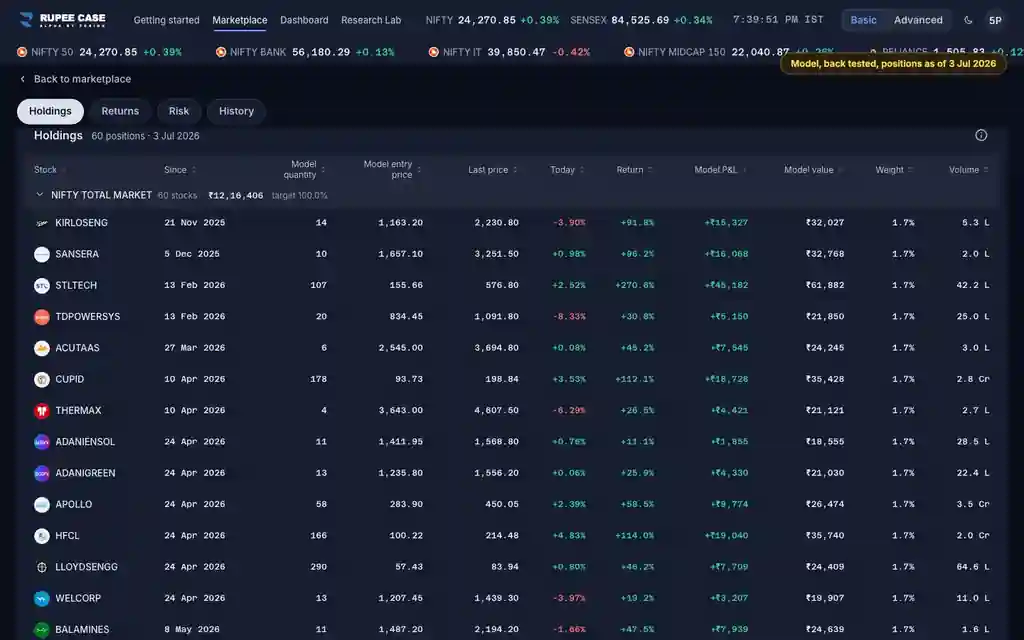
RupeeCase strategies invest in Indian markets only. Gold enters through the multi asset strategies: Allcap Multi Asset holds a fixed 10% gold sleeve and 10% debt sleeve through exchange traded instruments, reset to target at every rebalance, and Dynamic Asset Allocator moves part of its portfolio between equity and gold by regime. Both appear in the published holdings in your own demat. International exposure, if you want it, sits outside RupeeCase, within the LRS rules above. Strategy figures are model, back tested.
Two terms to hold on to from 6.9
Key takeaways
- Making charges and GST mean jewellery must rise about 15% just to break even in the example.
- Gold ETF units held more than 12 months pay 12.5% on long term gains; gold funds need 24 months.
- No new Sovereign Gold Bond since February 2024; the maturity exemption is now for original subscribers only.
- SEBI says digital gold sits outside its regulation and investor protection.
- Rupee return = (1 + asset return) × (1 + currency change) minus 1.
- LRS allows $2,50,000 a year; TCS of 20% applies above ₹10 lakh for investment.
Questions readers ask
How are gold ETFs taxed now?
From 1 April 2025, gold ETF units held for more than 12 months are taxed at 12.5% on long term gains; units sold earlier are taxed at your slab rate. Gold mutual funds that invest through ETFs need 24 months for long term treatment.
Are Sovereign Gold Bonds still tax free?
For original subscribers who hold to maturity, yes. From 1 April 2026, bonds bought in the secondary market, and early redemptions, do not get the exemption. The 2.5% yearly interest has always been taxable.
How much can I invest abroad from India?
Up to $2,50,000 per person per financial year under the Liberalised Remittance Scheme. Remittances for investment above ₹10 lakh a year attract 20% tax collected at source, which counts towards your final tax.
Where this section sits in module 6.9