



SEBI's latest study of equity derivatives found that 87.7% of individual F&O traders lost money in FY26, with net losses of ₹91,685 crore. The year before, after SEBI's revision, it was 90.9% and about ₹1.12 lakh crore. And still NSE runs one of the busiest index options markets in the world. The gap is explained by the same thing that sells lottery tickets: a few visible winners and lakhs of invisible losers.
This module is not about trading derivatives for income. I trade derivatives professionally and I would not teach that as a path for most readers. It is about what futures and options are, how they work in India after the 2024 to 2026 rule changes, and the narrow, genuine way a long term investor can use them: hedging a portfolio around a known risk.
Individual F&O traders with net losses, FY26
SEBI study, Aug 2026
Average net loss per individual trader, FY26; loss makers alone lost Rs 1.47 L on average
SEBI study, Aug 2026
Units in one Nifty 50 lot since Jan 2026
NSE circular, Oct 2025
STT on the option premium when you sell, from 1 Apr 2026
Budget 2026
- FY24Rs 74,812 crore
- FY25, revisedRs 1,11,788 crore
- FY26Rs 91,685 crore
SEBI studies of individual traders in equity derivatives, Jul 2025 and Aug 2026; net of transaction costs.

3By the end you can
- Explain a future and an option, with the lot size, expiry day and settlement that apply in 2026.
- Quote SEBI's FY26 loss figures with the right population and year.
- Work out how many Nifty lots hedge a portfolio, and what the hedge costs.
Futures: the mechanics
A futures contract is an agreement to buy or sell an asset at a set price on a set future date. On NSE, equity futures exist on the main indices and on a list of individual stocks that meet SEBI's eligibility criteria.
The term this section turns on: Futures contract
Options: the mechanics
An option gives its buyer the right, not the obligation, to buy (a call) or sell (a put) at a fixed strike price on or before expiry. The buyer pays a premium and can lose at most that premium. The seller collects the premium and takes on the obligation, which can mean large losses.
| Contract | Buyer's right | Buyer's maximum loss | Buyer profits at expiry when |
|---|---|---|---|
| Call option | Buy at the strike | Premium paid | Price is above strike plus premium |
| Put option | Sell at the strike | Premium paid | Price is below strike minus premium |
Read one more paragraph, 58 words
India's options market is dominated by index options, above all Nifty weekly contracts. Most retail activity is buying cheap, out of the money options close to expiry, which usually expire worthless. The premium is small, so it feels low risk. Repeated every week it is a reliable way to lose money, which is exactly what SEBI's studies show.
The rules changed, 2024 to 2026
- SEBI tightens index derivatives
Minimum contract value raised to ₹15 lakh, one weekly expiry per exchange, option premium collected upfront, extra margin on expiry day.
- NSE expiries move to Tuesday
Weekly and monthly NSE equity derivatives expire on Tuesdays.
- Nifty lot becomes 65
Revised from 75 after NSE's periodic lot size review.
- STT raised on F&O
Futures 0.05% on the sell side, options 0.15% of premium on sale and 0.15% of intrinsic value on exercise.
- SEBI's FY26 study
87.7% of individual traders lost money; active traders fell 18% to 87.5 lakh.
Open interest as a market signal
Open interest is the number of contracts still open. It is not volume: volume counts every trade, open interest counts positions that have not been closed. I read the option chain every morning. It shows where positions are open; it does not show who holds them or why, because every open contract has a buyer and a seller.
Read one more paragraph, 94 words
Rising open interest with a rising price suggests new long positions; with a falling price, new short positions. Open interest, volume and the four build up patterns shows how often those readings held. Falling open interest means positions are closing, which is common near expiry. Many traders read the strike with the most call open interest as a ceiling and the most put open interest as a floor. The Derivatives School tests that idea on Nifty expiries in Pinning and max OI strikes: the evidence. Treat open interest as context, not a forecast.
How systematic investors actually use derivatives
A long only equity portfolio moves broadly with the market. Ahead of a known risk, a Union Budget, an election result, a global shock, an investor who does not want to sell holdings, and pay tax and costs to buy them back, can hedge the market part of the risk instead:
- Sell Nifty futures worth part or all of the portfolio's market exposure. Losses on the stocks are offset by gains on the short futures, and gains are offset too. The portfolio's stock specific return remains.
- Buy Nifty puts. They pay off if the index falls below the strike, and the most you lose is the premium. Upside is kept, at the cost of the premium.
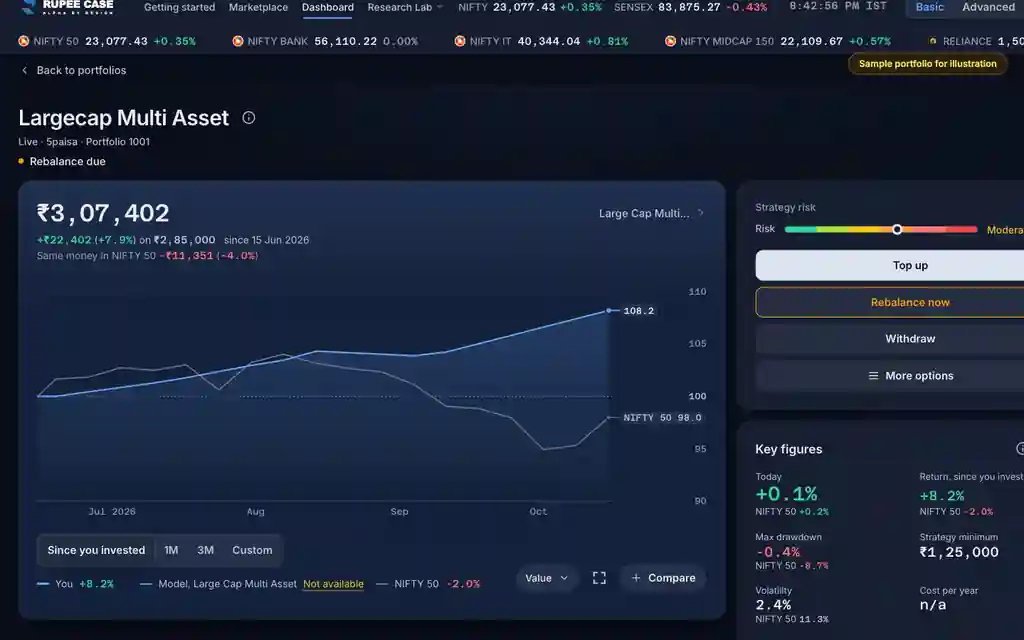
₹100 in Large Cap Multi Asset became about ₹235 in the model
Worked example: a hedge in rupees
Your ₹30 lakh portfolio moves about one for one with the Nifty. The calculator says about two lots; you sell two Nifty futures, about ₹30.05 lakh of exposure at the 15 Sep 2026 close. If the Nifty then falls 10%, your stocks lose about ₹3 lakh and the short futures gain about ₹3.01 lakh. If the Nifty rises 10%, the stocks gain ₹3 lakh and the futures lose about ₹3.01 lakh. The hedge did what a hedge does: it removed the market from your result for that period, both ways. It also cost money: margin blocked, the futures premium or discount, STT of 0.05% on the sell side of futures since April 2026, and charges. A hedge is insurance, and insurance has a premium.
MythBuying cheap options is low risk because you can only lose the small premium.
FactEach trade risks little, but most far out of the money options expire worthless. Repeated every week, small premiums add up to large losses, which is what SEBI's studies keep finding.
Read one more paragraph, 58 words
The same protection with puts: two Nifty puts at a strike about 5% below the market protect against a deeper fall and keep your upside, for a premium you pay upfront and lose entirely if the market does not fall. Which to use depends on whether you want to give up the upside or pay for keeping it.
Common mistake: treating leverage as income
The common mistake is using derivatives to make income from a small account. Leverage makes a ₹2 lakh account feel like ₹15 lakh, and a normal one day move of 1.5% in the index then swings the account by more than 10%. Add STT, charges and the edge of professional desks on the other side, and the average result is the one in SEBI's tables.
Two terms to hold on to from 6.6
Read one more paragraph, 47 words
The second mistake is forgetting physical settlement. A stock futures or in the money stock option position left open at expiry turns into a delivery obligation for the full lot. Close or roll positions before expiry week if you do not intend to take or give delivery.
Go deeper in the Derivatives School
This page is the map. The Derivatives School walks each road with dated NSE data, payoff charts and its own quizzes. If you only want the investor's use, hedging, read the first and the last group.
| If you want | Read next |
|---|---|
| Why so many lose, from SEBI's own data | Read SEBI's loss studies before your first trade |
| Lots, expiry days and the rules as they stand | Contract specs that matter now, SEBI's F&O rules in one page |
| Margin and what one trade really costs | Margins without jargon, The real cost of a trade |
| Futures, step by step | Futures 101: long, short, leverage and daily mark to market |
| Options, step by step | The call option, The put option, Buyer or seller |
| Open interest, read honestly | Open interest, volume and the four build up patterns |
| Hedging what you already own | Why and when to hedge, Hedging with futures, Hedging a stock portfolio with Nifty puts, Hedging mutual fund portfolios |
How this shows up in RupeeCase
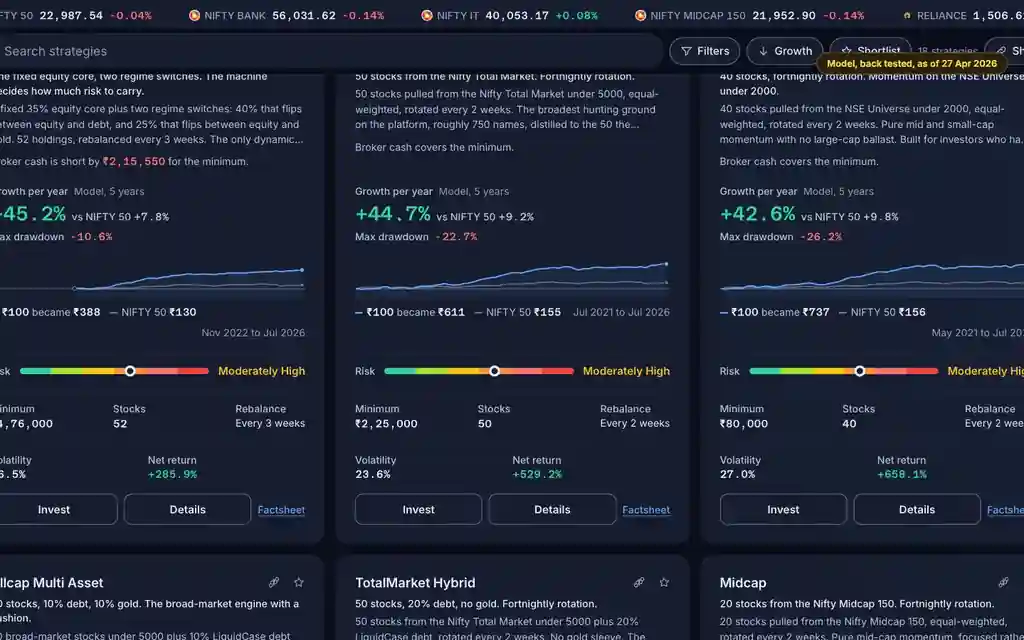
RupeeCase strategies today are long only and unleveraged: no futures, no options, just the stocks, and in multi asset strategies gold and debt instruments, in your own demat. F&O hedging on RupeeCase is coming; it is not live yet. The lots calculator above is the same arithmetic any hedge starts from. Read what is planned on the hedging page, and see how a strategy behaved in past falls on its factsheet, for example Allcap Multi Asset.
Key takeaways
- A future is an obligation settled daily; an option is a right bought for a premium.
- Nifty lot 65 from Jan 2026 contracts; NSE expiries on Tuesdays since 1 Sep 2025.
- SEBI, Aug 2026 study, FY26: 87.7% of individual traders had a net loss.
- Index derivatives settle in cash; stock F&O left open settles by delivery.
- For an investor the honest use is a hedge: lots = value × beta ÷ (Nifty × 65).
- A hedge has a cost: margin, carry, STT and charges, or the put premium.
Questions readers ask
What is the Nifty lot size now?
65 units for contracts from January 2026, after NSE's revision announced in October 2025. Lot sizes are reviewed periodically, so check NSE's contract specifications before trading. The question page What is the Nifty lot size now, and why did it change? keeps the history.
Which day do Nifty options expire?
Tuesday. Since 1 September 2025 NSE's weekly Nifty contracts expire every Tuesday, and monthly contracts on the last Tuesday of the month.
How are F&O profits taxed?
Profits from futures and options are generally treated as non speculative business income and taxed at your slab rate, with books of account and possibly a tax audit depending on turnover. Module 11.2 and the question page How is F&O income taxed? cover the details.
Where this section sits in module 6.6