



Direct real estate in India is illiquid, lumpy, hard to value and slow to sell. A flat in Pune gives you no quarterly report, no audited accounts and no exit button. Real estate investment trusts (REITs) and infrastructure investment trusts (InvITs) were built to fix exactly that: rent and toll income in a listed, regulated, transparent wrapper you can buy one unit at a time.
SEBI created the framework in 2014, the first REIT listed in 2019, and by 2026 five REITs and a larger number of InvITs trade on NSE and BSE. From January 2026 SEBI also treats REITs as equity for mutual fund investment, which opens the door to index inclusion. Here is how they work and how to judge one.
Listed REITs in India: four office, one retail malls
NSE and BSE listings, 2026
Minimum share of net distributable cash flow paid out
SEBI REIT and InvIT Regulations
Unit: the trading lot for listed REITs and InvITs
SEBI, since 2021
3By the end you can
- Explain how a REIT or InvIT turns rent or tolls into distributions, and what SEBI requires of it.
- Split a distribution notice into interest, dividend and repayment, and say how each is taxed.
- Estimate what a rise in bond yields does to a REIT's price, before any change in rents.
2 terms this section turns on
How REITs work: the structure
- SponsorA developer contributes completed buildings to the trust.
- Trust and managerAn independent trustee holds the assets; a manager runs them.
- Property companiesBuildings usually sit in special purpose companies owned by the trust.
- Tenants pay rentLeases, often multi year, with built in escalation.
- Unitholders get distributionsAt least 90% of distributable cash flow, usually every quarter.
SEBI's REIT Regulations require, among other things:
- At least 80% of assets in completed, income producing properties.
- Distribution of at least 90% of net distributable cash flow to unitholders.
- Independent valuation of the properties, with full valuations published regularly.
- Limits on borrowing, and a vote of unitholders for larger borrowing.
India's listed REITs
Four of India's five listed REITs own office parks, leased largely to global companies' Indian technology and service centres in Bengaluru, Mumbai, Pune, Hyderabad, Chennai and the National Capital Region. One owns shopping malls across many cities. There is no listed residential, hospital or data centre REIT yet. Since 2024 SEBI has also allowed small and medium REITs, for assets of ₹50 crore up to ₹500 crore, but their units are priced at a minimum of ₹10 lakh each, so they are not a one unit product. That concentration matters: Indian REIT income is tied closely to office demand, which in turn tracks hiring in technology and global services.

Metrics that replace P/E for a REIT: distribution yield (annual distributions ÷ price), net operating income, occupancy, weighted average lease expiry, rent on renewal compared with the expiring rent, loan to value, and the cost of debt compared with the yield on the properties. Each REIT publishes these in its quarterly investor presentation.
InvITs: infrastructure's answer to REITs
An InvIT applies the same idea to infrastructure: toll roads, power transmission lines, gas pipelines, telecom towers and fibre, renewable energy plants. The cash flows are long dated and often regulated or contracted, which makes them behave in part like a bond. Unlike a bond, the assets wear out, concessions end and traffic or tariffs can disappoint, so part of each distribution is often a return of your capital, not income.
Read one more paragraph, 41 words
Most InvITs are privately placed with institutions; a smaller number are listed and open to individuals. SEBI cut the minimum investment in privately placed InvITs to ₹25 lakh in 2025. For mutual fund purposes InvITs remain a hybrid instrument, not equity.
REITs vs direct real estate: the honest comparison
A slice of many buildings
- Sell any trading day on NSE or BSE
- From one unit, a few hundred rupees
- Quarterly reports and audited accounts
- Price swings with the market every day
One building, one city
- Months to sell, with heavy costs
- Lakhs or crores to enter, plus stamp duty
- No standard disclosure, your own valuation
- No daily price, so the swings stay hidden
Two terms to hold on to from 6.8
REIT taxation in India
REIT units are listed and traded with STT, so capital gains follow the listed equity rules since 23 July 2024: 20% on gains within 12 months, 12.5% on long term gains above the ₹1.25 lakh yearly exemption. Distributions are different, because each payment is split into parts with different tax treatment:
- Interest from the property companies: taxed at your slab rate, with TDS.
- Dividend from the property companies: exempt in your hands if the company has not opted for the concessional corporate tax regime, otherwise taxed at slab.
- Repayment of debt or return of capital: rules changed in 2023 and now tax much of this in many cases; the notice for each payment tells you the split.
- Rental income where the REIT holds property directly: taxed at slab.
Rs 5,00,000 at a 6.5% yearly payout for 15 years: Rs 9,87,500 if every distribution is taken as cash (simple), about Rs 12,85,900 if every distribution is reinvested (compound), with no change in unit price assumed.
Illustration with a fixed yearly rate and no price change or tax. Real distributions and prices vary.
₹100 in Large Cap Multi Asset became about ₹235 in the model
Read one more paragraph, 72 words
Compare the after tax figure with the alternatives. With the 10 year government bond at 6.97% on 31 August 2026, also taxed at slab, a REIT yielding about 6.3% before tax is priced for its rents to grow. That is the bet you make: that rent escalations and new leasing lift distributions over time, which a fixed coupon bond can never do, in exchange for daily price swings and office cycle risk.
Why interest rates move REIT prices
A REIT is valued mostly on its future distributions, and investors compare that income stream with what safe bonds pay. When government bond yields rise, as the 10 year did from 6.77% on 14 August to 6.97% on 31 August 2026, a REIT's distribution yield has to rise to stay attractive, and with distributions fixed in the short run, the only way is for the price to fall. A rough rule: if investors demand the yield spread to bonds to stay the same, a one point rise in bond yields on a REIT yielding 6.5% implies a price fall in the region of 13% to 14%, before any change in rents.
Read one more paragraph, 49 words
Rents rarely stand still, which is the offset. Office leases in India commonly carry escalations every few years, and occupancy recovers after a cycle. That is why REITs sit between bonds and equities in behaviour: rate sensitive like a long bond, with growth in the income like a business.
Worked example: reading a distribution notice
Say you hold 1,000 units and a quarterly notice announces ₹6 per unit, split as ₹3.60 interest, ₹1.80 dividend and ₹0.60 repayment of debt. You receive ₹6,000 before TDS. Under the illustrative split, ₹3,600 is interest taxed at your slab, ₹1,800 is dividend that may be exempt depending on the property company's tax regime, and ₹600 follows the repayment of debt rules. Report each part in its own place in your return. Investors who enter the whole ₹6,000 as one figure usually overpay or underpay.
MythA REIT is as safe as a fixed deposit because it pays regular income.
FactDistributions depend on rents and occupancy, and the unit price moves every day. A REIT can fall sharply when office demand weakens or interest rates rise.
Where this section sits in module 6.8
Common mistake: buying the highest yield
The common mistake is picking the REIT or InvIT with the highest distribution yield. A high yield can mean the market expects distributions to fall, or that much of the payout is your own capital coming back. Check occupancy, lease expiries over the next three years, debt levels and what share of the distribution is true income.
With InvITs especially, ask what happens when the concession or licence ends. A toll road InvIT with eight years left on its concession is a declining asset; its distributions must repay your capital as well as pay a return.
How this shows up in RupeeCase
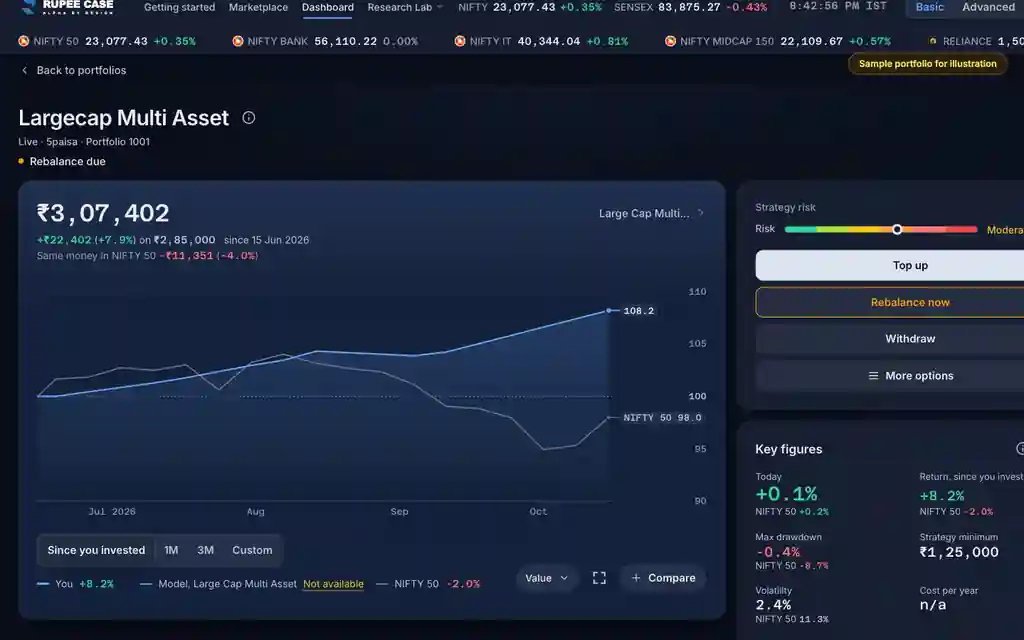
RupeeCase strategies today hold Indian equities and, in the multi asset strategies, gold and debt instruments; they do not hold REITs or InvITs. If you own REITs alongside a strategy, treat them as a separate sleeve with its own sizing, using the drawdown budget from Module 4.5. The sleeves and published holdings of every strategy are on its page, for example Allcap Multi Asset.
Key takeaways
- A REIT must pay out at least 90% of net distributable cash flow, usually every quarter.
- Listed REIT and InvIT units trade in lots of one unit; SM REIT units start at ₹10 lakh.
- Gains on units follow listed equity rules; each distribution is split into parts taxed differently.
- A one point rise in bond yields implies about a 13% fall for a REIT yielding 6.5%, if rents stay flat.
- A high yield can mean falling payouts or your own capital coming back.
Questions readers ask
What is the minimum investment in a REIT?
One unit. Since 2021 listed REITs and InvITs trade in lots of one unit on NSE and BSE, so you can start with the price of a single unit.
How are REIT capital gains taxed?
Like listed shares: 20% on gains within 12 months and 12.5% on long term gains above ₹1.25 lakh a year, under the rules in force since 23 July 2024.
Is a REIT better than buying property?
For most investors it is more liquid, more diversified and more transparent, and it needs far less money. It does not give you a home to live in or control over the asset, and its price moves every day.