



You have a rule you trust: rank stocks on momentum, hold the top 50, reset every fortnight. India gives you five ways to own that one rule, and they are not interchangeable. The vehicle decides the smallest cheque you can write, what you pay, who holds the shares, how the tax falls and how fast you can leave.
The rulebook moved while most people were not looking. SEBI opened the Specialized Investment Fund (SIF) lane in 2025 with a ₹10 lakh minimum, replaced the mutual fund rules on 1 April 2026 and approved a new portfolio manager rulebook on 24 September 2026. Here are the five routes side by side, with the dates.
Crore mutual fund folios (accounts), 31 Aug 2026
Mutual fund industry body monthly report, Aug 2026
Clients of discretionary portfolio managers, 31 Aug 2026
SEBI report of portfolio managers, 31 Aug 2026
Folios are accounts, not people, but the gap is plain: one door is wide, the other is priced for large accounts.
3By the end you can
- Name the five routes to one rule in India and the SEBI minimum for each.
- Convert an expense ratio, a PMS fee and a fee on traded value into rupees on your amount.
- Say who holds the shares, who pays the tax and how fast you can leave in each route.
2 terms this section turns on
Five routes to one rule
- Mutual fund. A SEBI regulated trust pools many investors. You hold units; a custodian holds the shares. An index fund follows a published rule, most other schemes follow a manager's judgement.
- SIF. A Specialized Investment Fund is a mutual fund product for informed investors. It may use limited unhedged short exposure through derivatives and more complex strategies than a regular scheme. SEBI says it bridges regular funds and PMS.
- PMS. A portfolio manager runs a separate account for you under a contract. Discretionary: the manager decides. Non-discretionary: the manager follows your directions.
- AIF. A privately pooled fund for sophisticated investors. Category I and II back start-ups, infrastructure, private equity and similar. Category III runs complex trading strategies and may use leverage.
- Your own demat. The shares sit in your own account and you follow a published rule. RupeeCase is this route: a technology platform, not a fund, PMS, AIF or adviser. The tutorial Marketplace chips: what do New, Partner and the themes mean? explains how its strategies are labelled.
- AIF, per investorRs 1,00,00,000
- PMS, per clientRs 50,00,000
- SIF, per PANRs 10,00,000
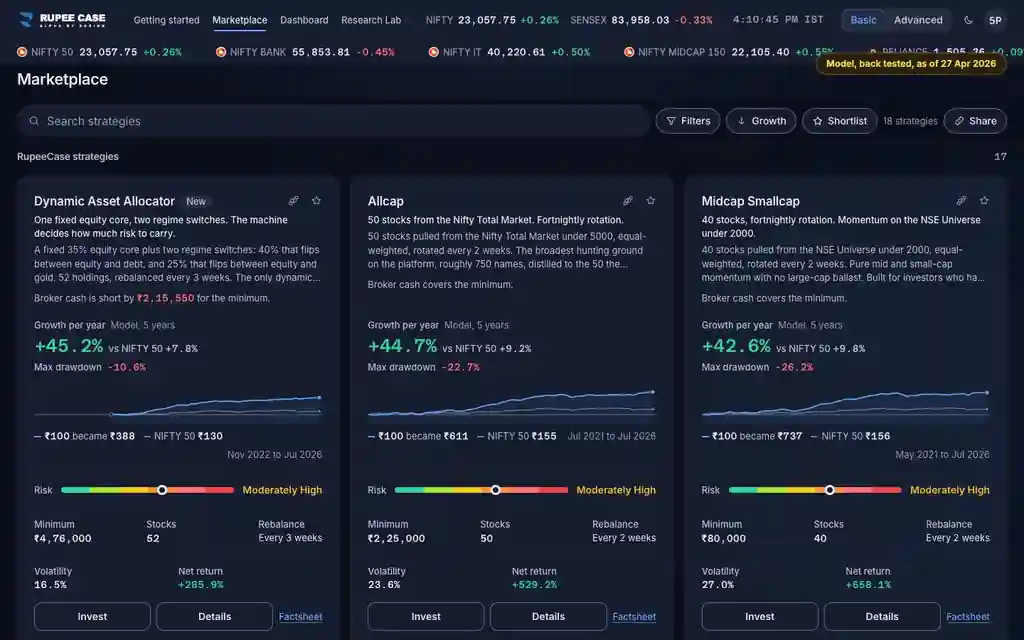
- RupeeCase, highestRs 4,75,912
- RupeeCase, lowestRs 22,000
Smallest amount accepted from a non-accredited investor. SEBI AIF Regulations, regulation 10(c), to 14 Jul 2026; SEBI PMS FAQ, 20 Sep 2024; SEBI Mutual Funds Regulations 2026, regulation 49. RupeeCase: published minimums as of 8 Aug 2026, which move with share prices. A mutual fund scheme has no SEBI floor.
Accredited investors skip all three floors. In the AIF rules that means annual income of ₹2 crore, or net worth of ₹7.5 crore with half of it in financial assets, or ₹1 crore of income with ₹5 crore of net worth, certified by an accreditation agency. On 24 September 2026 SEBI's board also approved a route for people with ₹5 crore of securities market exposure, and let managers accredit investors themselves.
The five routes, row by row
Facts as of 16 October 2026, from the SEBI documents in the sources list. Each cell says what the rules say, not which route to pick.
| Compare | Mutual fund | SIF | PMS | AIF | Own demat |
|---|---|---|---|---|---|
| Minimum | No SEBI floor; the scheme document sets one | ₹10 lakh per PAN, all strategies together | ₹50 lakh per client | ₹1 crore per investor | One share of each holding: ₹22,000 to ₹4,75,912 (8 Aug 2026) |
| What you hold | Units; a custodian holds the shares | Units; a custodian holds the shares | Shares in an account the manager operates for you | Units of a private fund | Shares in your own demat |
| Who decides | Manager, or an index rule | Manager; limited short positions allowed | Manager, or you if non-discretionary | Manager; Category III may use leverage | A published rule; you approve each rebalance |
| Cost | Expense ratio; base cap 0.90% for index funds, 2.10% to 0.95% for other equity funds | Own limits per strategy, in its information document | Fixed, return-based or both; no upfront fee; operating costs capped at 0.5% a year | Set in the placement memorandum | 0.2% of traded value per rebalance, plus your broker's charges |
| Tax | On redemption: equity funds 20% within 12 months, 12.5% above ₹1.25 lakh after | Depends on the strategy | Yours, on each sale | Category I and II pass through to you; Category III generally taxed in the fund | Yours, on each sale |
| What you see | NAV every day; periodic portfolio statements | NAV every day; portfolio every alternate month | Quarterly report with every trade | Category III: NAV at least monthly if open ended | Every holding in your demat; every rebalance published |
| Exit | Redeem at NAV; exit load capped at 3% | Set per strategy: equity can be daily, others weekly or less; notice up to 15 working days | No lock-in; an exit fee is allowed | Category I and II: at least 3 years | Sell on any trading day through your broker |
What each route costs, in rupees
A fund hides its cost inside the NAV: you never see a bill, only a slightly lower price. A PMS and an AIF bill by contract: a fixed fee, a share of returns above a hurdle, or both. SEBI's own PMS worked example uses a 1.5% fixed fee, 0.50% other expenses, an 8% hurdle and a 20% share above it, with a high water mark so you never pay twice for the same gain. Those are SEBI's illustration, not any manager's terms.

The direct route bills in another unit
RupeeCase charges 0.2% of traded value, only on a rebalance that trades, so the yearly bill follows how much the strategy trades. Over the latest record year the fee worked out to 1.2% to 3.3% of capital for the strategies that trade. Nifty 50 Equal Weight shows no exits in its window, so its estimate is nil.
- Focused Largecap 201.24%
- Healthcare Basket1.42%
- Midcap1.77%
- Allcap2.22%
- Allcap Multi Asset3.27%
- TotalMarket Hybrid3.34%
Platform fee at 0.2% of traded value as a percent of capital, over the 365 days to each strategy's latest rebalance (windows ended between 8 May and 3 Jul 2026). RupeeCase published rebalance record, model, back tested. Six of the strategies that trade. Weight resets and broker side charges are not counted. Turnover varies year to year.
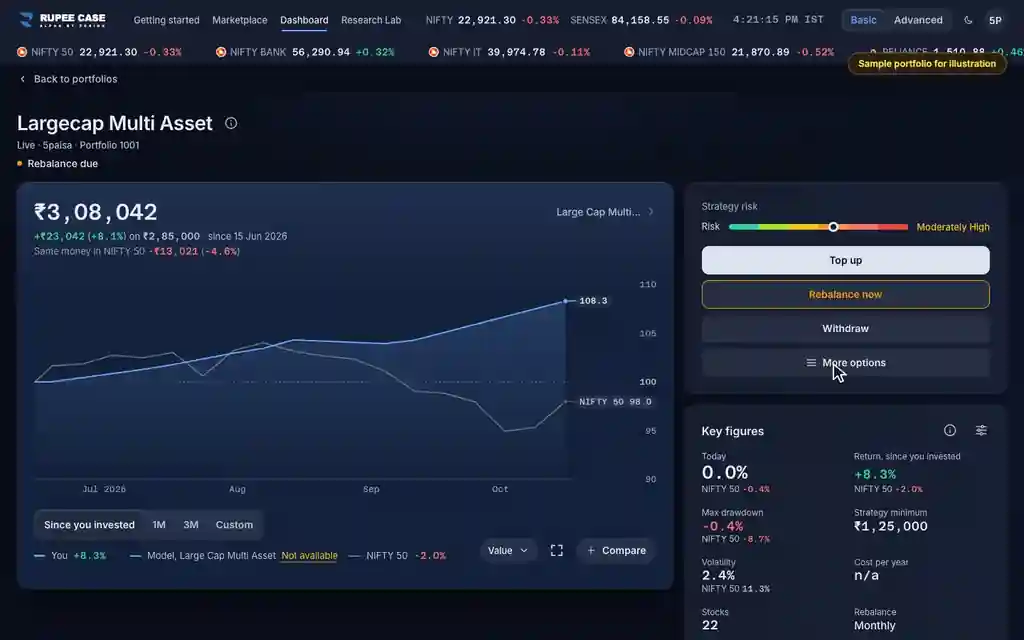
₹100 in Large Cap Multi Asset became about ₹315 in the model
A percentage of assets and a percentage of traded value are different units. At 11 times turnover, 0.2% of traded value is 2.2% of capital. At 4.5 times it is 0.9%. Convert before you compare.
Trading charges come on top
Any route that owns shares pays STT, stamp duty, exchange charges and GST. In a fund they sit inside the total expense ratio. In your demat they appear on the contract note. The same trades cost the same whoever runs them, so the calculator keeps them on their own line.
Tax, custody and exit
Tax
In a PMS and in your own demat each sale is yours: 20% on gains within 12 months, 12.5% on long term gains above ₹1.25 lakh a year (Income-tax Act 2025, sections 196 and 198). A mutual fund defers the tax until you redeem. A Category I or II AIF passes income through to you under section 224. A Category III AIF sits outside that section, so the fund is generally the taxpayer. For a SIF, SEBI's FAQ says only that it depends on the strategy. Rules change; read the tax statement the provider gives you.
Custody
A fund's custodian holds the securities and you hold units. A Category III AIF must appoint a custodian whatever its size. SEBI's new standard PMS agreement, from 1 April 2027, builds the manager's authority to operate your demat into the contract. In your own demat the shares are yours, with your broker's depository participant. RupeeCase holds neither money nor shares; your broker places the orders when you approve a rebalance.
Exit
A mutual fund may charge an exit load of up to 3% of NAV. A PMS cannot impose a lock-in, though an exit fee is allowed. A SIF sets its own redemption calendar. If a redemption takes you below ₹10 lakh, your units freeze and you get 30 days to restore the minimum before the rest is redeemed. A Category I or II AIF runs for at least three years. In your own demat you sell on any trading day, and the app's Withdraw sheet sells every holding in proportion.
The rulebook is moving
- SEBI sets the SIF framework
Circular SEBI/HO/IMD/IMD-I POD-1/P/CIR/2025/26 opens a lane between funds and PMS.
- The ₹10 lakh check gets a method
A circular sets how the minimum threshold is monitored.
- New mutual fund rules start
SIF gets its own chapter, and the expense ratio splits into a base ratio and statutory charges.
- SEBI's board approves new PMS rules
A route into direct mutual fund plans at ₹25 lakh, IPO investing, and new ways to be accredited.
- The new PMS rules take effect
The 2020 rules apply until then.
Common mistake: comparing the headline
The common mistake is setting one fee percentage against another. A 0.9% expense ratio is a share of assets. A 0.2% platform fee is a share of traded value. A 2% fixed fee plus a share of profits is neither. Put each in rupees, on your amount, at the turnover the strategy really has, then add the trading charges to all of them.
Two terms to hold on to from 6.10
The second mistake is reading a minimum as a quality mark. It tells you who may enter, nothing more.
MythA higher minimum means a better product.
FactA minimum decides who may enter. SEBI describes a SIF as suited to informed investors who can bear a loss of capital. It says nothing about higher returns.
How this shows up in RupeeCase
RupeeCase is the direct route and nothing else. It is a technology platform run by QC Alpha Technologies Pvt Ltd, not a mutual fund, SIF, PMS, AIF or investment adviser. Each strategy is a published rule, your own broker places the orders in your own demat when you approve a rebalance, and nothing is pooled. The fee is 0.2% of traded value, charged when a rebalance trades. The minimum is one share of every holding: ₹22,000 to ₹4,75,912 as of 8 Aug 2026; the tutorial Minimum investment: why does each strategy have one? shows where the app states it. Withdrawing works as described in Withdraw: what is sold, and where does the money go? Put your amount through the fee calculator, or read the side by sides against mutual funds, PMS and AIF. This page names no winner. RupeeCase strategy figures are model, back tested.
Where this section sits in module 6.10
Key takeaways
- SEBI floors: SIF ₹10 lakh per PAN, PMS ₹50 lakh, AIF ₹1 crore; accredited investors are exempt.
- A share of assets and a share of traded value are different units; 0.2% at 4.5 times turnover equals 0.9%.
- Trading charges apply in every route that owns shares.
- In a PMS and your own demat each sale is taxed in your hands; a fund defers tax to redemption.
- New PMS rules take effect on 1 April 2027.
- A minimum says who may enter, not how good a product is.
Questions readers ask
Can I put less than ₹50 lakh into a PMS?
Not into a conventional PMS: the floor is ₹50 lakh per client unless you are an accredited investor. The new portfolio manager rules, in force from 1 April 2027, add a route into direct mutual fund plans with a ₹25 lakh floor.
Is a SIF just a mutual fund?
It is a mutual fund product with its own chapter in SEBI's rules: ₹10 lakh minimum per PAN, limited unhedged short positions through derivatives, and a redemption calendar and notice period set per strategy.
Which route costs least?
It depends on your amount and on how much the strategy trades. Put every fee in rupees on the same amount at the same turnover, then add trading charges to each.
Rules and figures in this module were last verified on 19 Oct 2026. Tax and regulatory rules change; check the source before acting.