

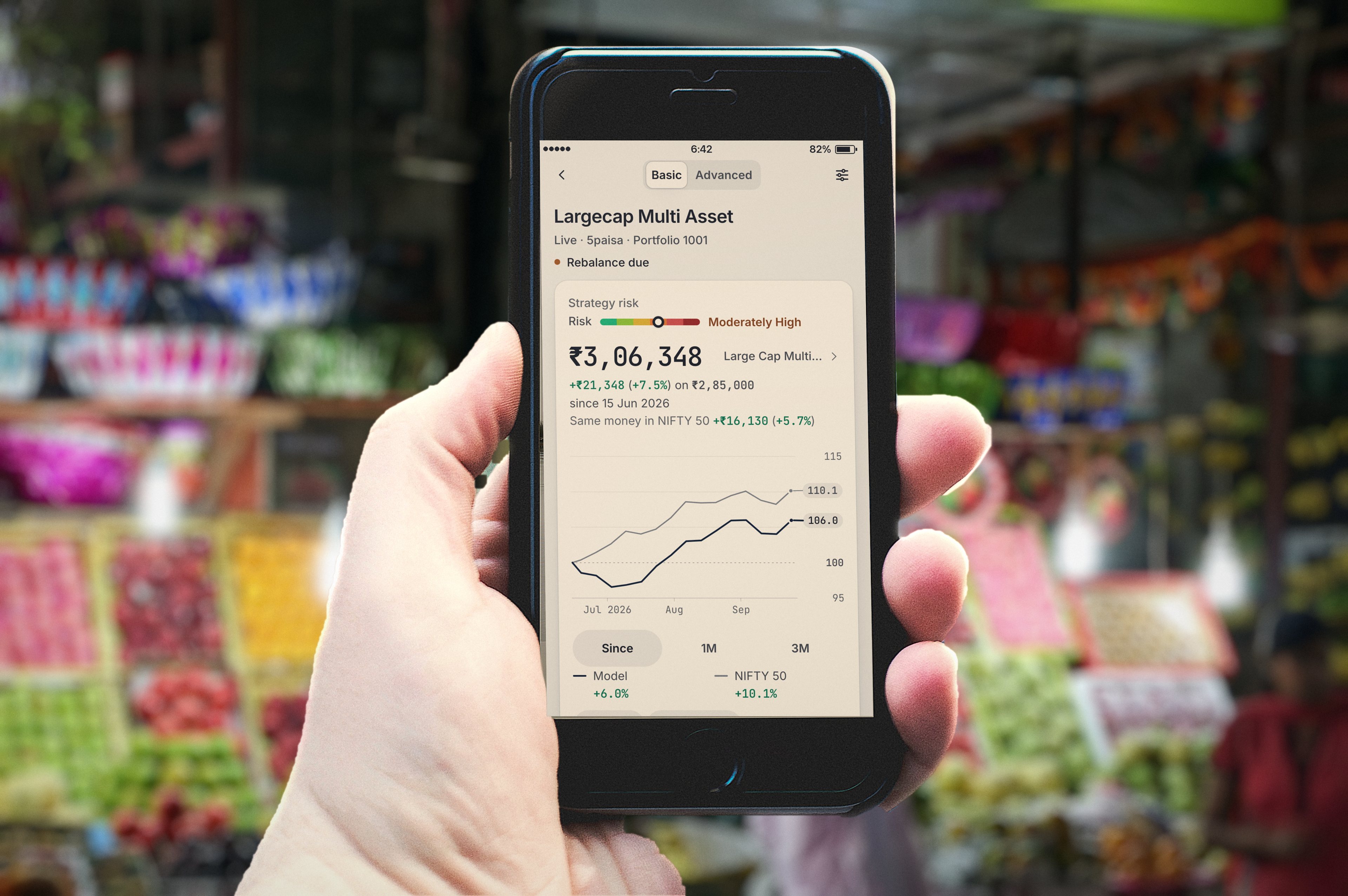
For investors across Bharat
Institutional rules.
From ₹26,000.
The same index algos the institutions get, in your own demat at your own broker. One fee per rebalance, no AUM fee, and 4,752 active users in 3.5 months, as of 12 Oct 2026.
- ₹26,000smallest strategy minimum
- 0.2%of traded value, per rebalance
- 4,752active users in 3.5 months
01Three steps
Compare. Validate.
Then invest.
No tips and no guesswork: every strategy is an algo like an index, with its rule and model back test in the open.
- 01Compare
Put the 18 strategies side by side, or against the Nifty, on one chart. The risk profile shows which sit within your risk envelope.
Compare strategies - 02Validate
Read the rule, every past rebalance and the full model back test after costs. Paper trade first if you like.
See the record - 03Invest
Go live with 5paisa, Zebu or Arrow. The shares land in your own demat, and you approve each rebalance.
How it works
02Your cost, in rupees
A little each month.
What rebalancing costs.
The habit of a SIP, the discipline of a rule: start from a strategy's minimum, add a fixed amount yourself each month, and the rule rebalances on its cadence.
30% of the portfolio trades at each rebalance, as in the pricing example.
First rebalance fee₹16
RupeeCase, first year₹4370.82% of the average balance
A fund at 1.8%, same balance₹963of assets, every year
Put in over 12 months₹86,000
Illustration with no market return assumed: balances grow only by what you add. The fee is 0.2% of the value that trades at each rebalance; brokerage and statutory charges go through your broker. RupeeCase has no automatic monthly debit today: you add money yourself. For pure SIP automation with no attention, an index fund fits better.
03Versus a mutual fund
Fees compound too.
₹10 lakh for 20 years at the same 12% a year before costs. The only difference between the two is the fee.
Illustration, not a forecast, from the RupeeCase vs mutual funds page: RupeeCase at 13 rebalances a year and 30% turnover; at 26 rebalances it ends at ₹72.9 lakh. Brokerage and taxes left out for all. A direct index fund or ETF can cost less; a SIP starts at ₹500.

04Your account
Your demat.
Every name visible.
A fund gives you units. RupeeCase places the shares in your own demat, so every holding sits on your broker statement. RupeeCase never holds your money.
- Paper trade first, then go live
- Risk profile to find your envelope
- 70 free modules to learn from
- Podcast archive, 124 episodes

05Questions
For retail investors, answered.
Minimums, cost, monthly investing and safety.
What is the minimum to start?
There is no minimum to open an account. Each strategy has a published minimum because it holds whole shares at its weights: from ₹26,000 to ₹3,02,000 in the lineup of 17 Jul 2026. Minimums move with the prices of the holdings.
How much does RupeeCase cost a retail investor?
0.2% of traded value each time a strategy rebalances, and nothing else. At 30% turnover that is about 0.78% a year at 13 rebalances, or about 1.56% at 26. Brokerage and statutory charges go through your broker.
Can I invest a fixed amount every month, like a SIP?
You can add money yourself on any schedule you keep, and the rule rebalances on its cadence. RupeeCase has no automatic monthly debit today. If you want pure SIP automation for a long horizon with no attention, an index fund fits better.
Is my money safe with RupeeCase?
RupeeCase never holds your money or your shares. Trades execute through your own SEBI registered broker and the shares sit in your own demat. Markets still carry risk, and the value of any strategy can fall.
Which brokers can I use?
You can paper trade first, then go live with 5paisa, Zebu or Arrow.
Is RupeeCase better than a mutual fund?
It depends on your amount, your tax position and how much you want to see and control. A fund suits hands off SIP building from ₹500; RupeeCase suits investors who want to own the shares and read the rule. Compare first, validate the model back test, then decide. This is not investment advice.
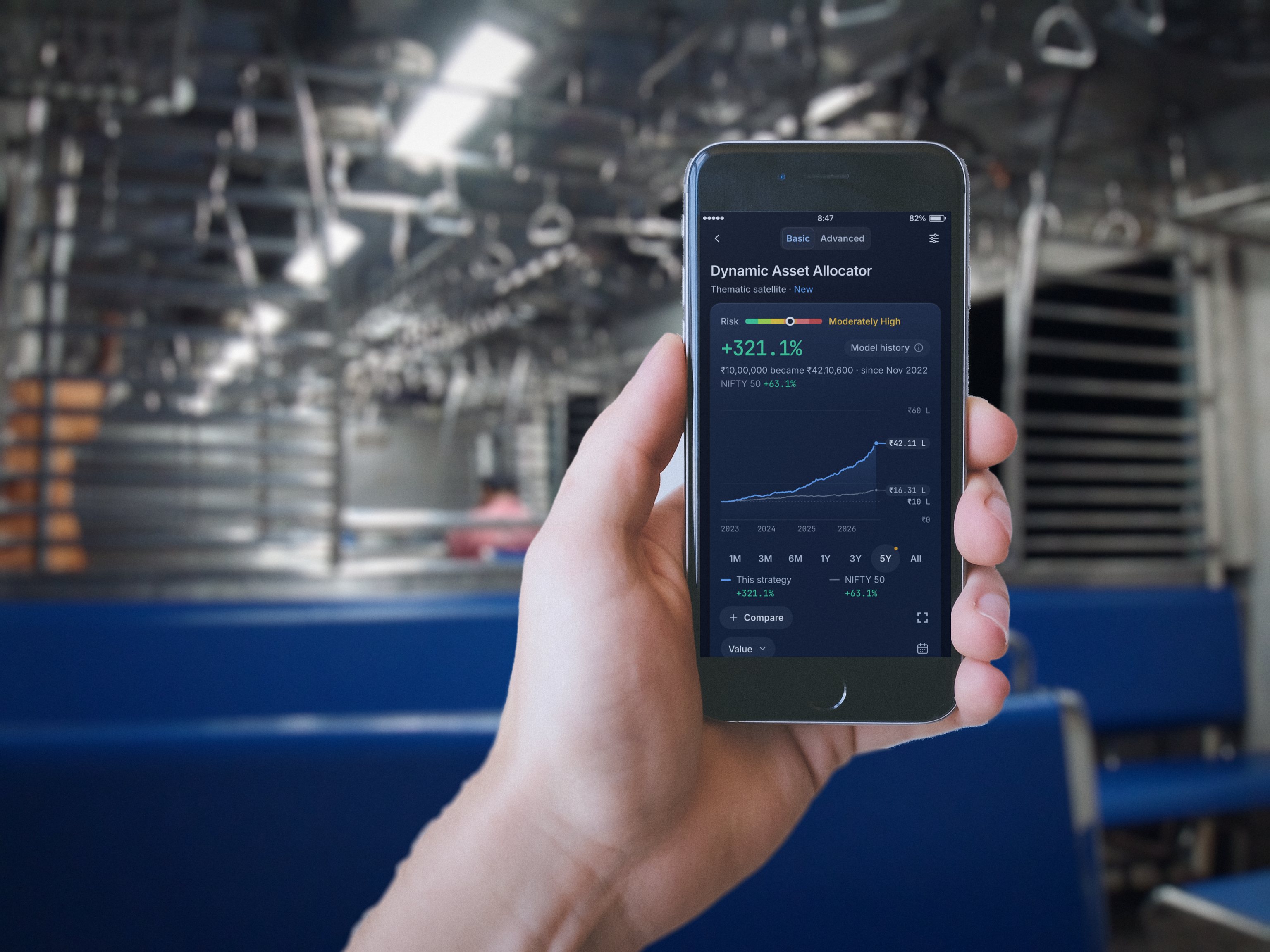
Your phone.
An institutional engine.
Start free, paper trade first, then invest from ₹26,000 in your own demat.
For institutionsFor family officesFor UHNI and HNIAll solutions
Typical fee levels: mutual funds 0.3% to 2.5% of assets a year; the 20 year illustration uses 1.8%. Calculator and race figures are illustrations, not forecasts. User count as reported by RupeeCase for its beta. RupeeCase is a technology platform operated by QC Alpha Technologies Pvt Ltd. It is not a mutual fund, a PMS, an AIF or a SEBI registered investment adviser. Research by QC Alpha Research Pvt Ltd, SEBI research analyst registration pending. Trades execute through your own SEBI registered broker. Investments in securities markets are subject to market risks. Nothing here is investment advice.