

Portfolio construction..9 min read
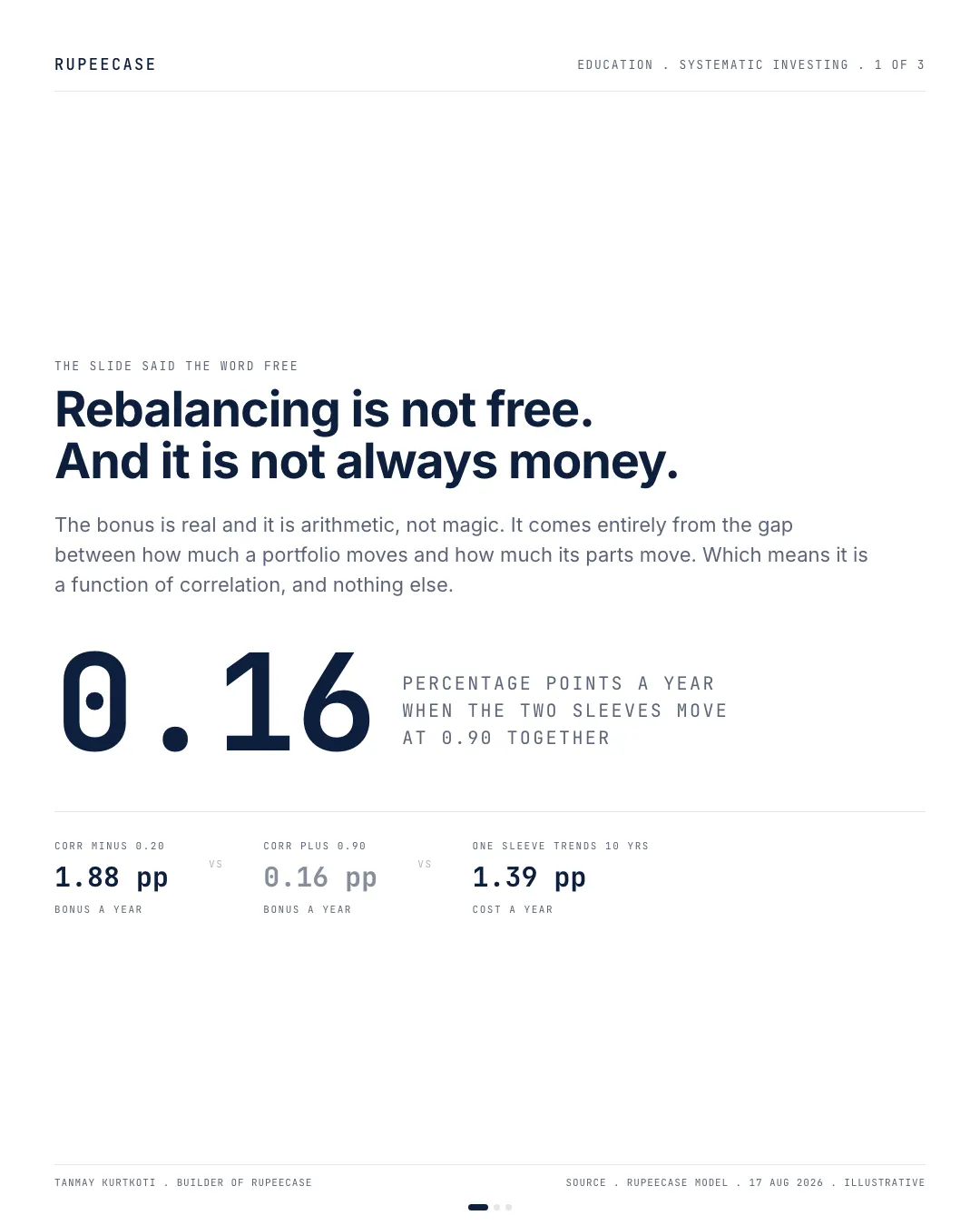
Rebalancing is not free. And it is not always money.
Two 10 percent sleeves at 25 percent volatility earn a 1.88 point bonus at minus 0.20 correlation and 0.16 at plus 0.90, while a trending decade charges 1.39 points a year.
By Tanmay Kurtkoti, founder of QC Alpha and builder of RupeeCase
Monday night, around nine, and a founder I have known since his first raise sends me a photo of a slide. Someone's wealth management deck. One line sitting under a yellow highlighter: "Disciplined rebalancing adds 1 to 2 percent a year. Free."
He asks me one thing. Is that real, or is that brochure copy?
I typed yes. Then I deleted it and typed no. Both answers were honest, which is an uncomfortable place to be at nine at night, so I stopped replying and built the smallest model that could settle it.
Two assets. One rule. The arithmetic took ten minutes and it did not agree with the slide.
The bonus is real and it has nothing to do with discipline
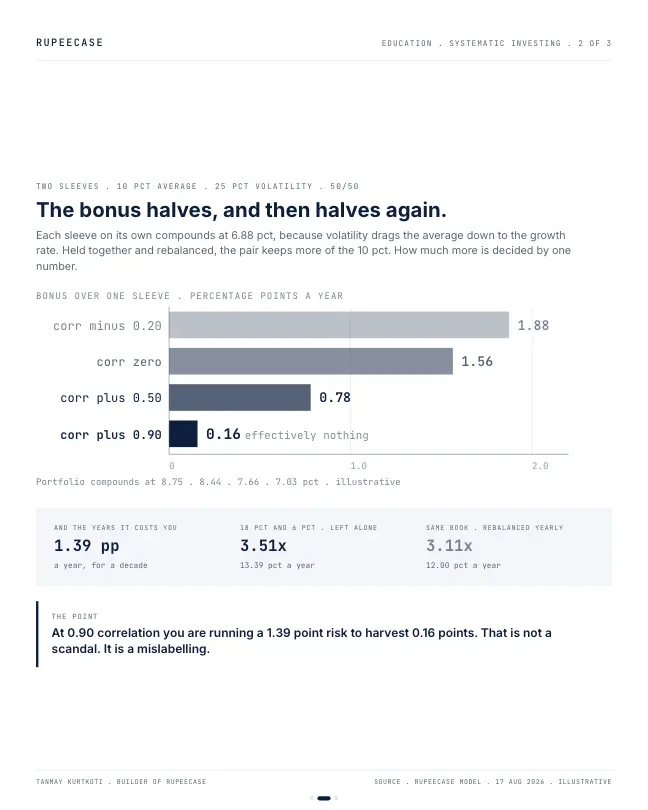
Here is the model in one sentence, and every number below is illustrative output from it rather than a live portfolio. Take two assets that each average 10 percent a year with 25 percent volatility, hold them 50/50, rebalance back to 50/50 on a fixed schedule, and ask what the pair compounds at against what either one compounds at alone.
Start with a single sleeve. An asset averaging 10 percent a year with 25 percent volatility does not compound at 10 percent. It compounds at roughly 6.88 percent. Up 25 and then down 25 leaves you holding 93.75, not 100, and that shortfall is not an accounting quirk. It is the permanent wedge between the average of your returns and the growth of your money, and it widens with the square of how much the thing moves. If you have never sat with what volatility costs a compounding pot, that 3.12 point haircut is the whole idea in one number.
Now hold two of them and rebalance. The average return of the pair is still 10 percent, because the average of two 10s is 10. The volatility of the pair is lower than 25 percent, because the two do not fall on precisely the same days. Lower volatility, smaller wedge, more of the 10 percent surviving into the account.
That is the entire bonus. Not a payment for patience. An arithmetic gap between the drag on one thing and the drag on a basket of things.
Which makes the whole bonus a bet on disagreement
If the bonus comes from the pair moving less than its parts, then its size is decided by exactly one input: how much the two sleeves move together. I ran the model at four correlations, and the pattern is almost embarrassingly clean.
| Correlation between the two sleeves | Portfolio compounds at | Bonus over one sleeve |
|---|---|---|
| Either sleeve held alone | 6.88 pct | . |
| Minus 0.20 | 8.75 pct | 1.88 points |
| Zero | 8.44 pct | 1.56 points |
| Plus 0.50 | 7.66 pct | 0.78 points |
| Plus 0.90 | 7.03 pct | 0.16 points |
Read the last column downward. The bonus halves, and then halves again. Two sleeves that genuinely pull against each other hand you nearly two full percentage points a year for doing nothing clever. Two sleeves that move at 0.90 together hand you 0.16 points, which after brokerage, taxes and one wide fill is a number you would never find in your statement.
Rebalancing does not pay you for being disciplined. It pays you for owning things that disagree.
In a trending market the same rule charges you instead
Now the case the slide left out, and it deserves the same amount of space as the bonus. Two sleeves again, ten years, illustrative. One of them compounds at 18 percent a year and the other at 6 percent. Start 50/50. Leave it completely alone and you finish at 3.512 times your money, a 13.39 percent yearly rate, because the winner grows into most of the book. Rebalance back to 50/50 every year and you finish at 3.106 times, exactly 12.00 percent.
The two lines are indistinguishable for four years and then they separate, which is the cruel part. By the time the cost is visible enough to argue about, you have already paid eight years of it. Annual rebalancing cost 1.39 percentage points a year here, and it cost them by doing precisely what it was designed to do: repeatedly sell the sleeve that kept working to buy the sleeve that kept not working.
The number that stopped me was 1.39 against 0.16
Put the two results side by side and the comfortable story falls apart. The cost in a trending decade is 1.39 points a year. The bonus at a correlation of 0.90 is 0.16 points a year. Same portfolio, same rule, one order of magnitude apart, and the direction is decided by something nobody can forecast.
The stub at the bottom is what most people are actually collecting, and it is worth saying plainly: if your sleeves sit at 0.90, you are running a 1.39 point risk to harvest 0.16 points. I do not think that is a scandal. I think it is a mislabelling. You are being sold a return story for something that is really a risk-control story, and the two need different arguments.
Where the rule stops working and starts transferring
The counter-case is specific, and it is not a hedge. Rebalancing is wrong, on the numbers, for any portfolio whose sleeves have permanently different expected returns. If one sleeve is a 12 percent equity book and the other is a 6 percent debt sleeve, then rebalancing does not harvest anything. It systematically sells the higher-return asset to fund the lower-return one, every single year, forever. The 1.39 point cost in the chart above is exactly this mechanism running for a decade.
Rebalancing earns its keep when the sleeves are different routes to a similar destination. Large cap and mid cap. Equity and gold. A momentum sleeve and a value sleeve that take turns being wrong. Those are cases where the gap between the sleeves is temporary and mean reverting, so selling the one that ran is selling something that got expensive rather than something that got better.
Equity against debt is not that. It is a decision about how much loss you can sit through, and the trim is the price you pay for sleeping. Charge it to the risk budget and stop calling it a bonus.
What happens when the whole street rebalances on the same Friday
Second-order, and this is the part I am least sure about. If the bonus is a function of dispersion between sleeves, then a market where everybody runs the same mechanical rebalance is a market that suppresses the very dispersion it feeds on. Every calendar rebalance is a contrarian order placed at a predictable moment. Quarter end. Financial year end. The last Friday of the month.
Predictable contrarian flow is the easiest kind to trade against, and the more capital that runs it, the more the price adjusts before the order arrives. The bonus does not vanish. It gets thinner, and it gets thinner fastest for whoever rebalances on the most crowded date. Which argues, mildly, for an odd calendar rather than a popular one.
The honest caveat
Three limits worth stating.
The model assumes returns that behave, and real sleeves have fat tails and correlations that spike to nearly one in a crash, which is precisely when you need them apart. Correlation is not a constant, it is a regime.
The model also charges no costs. Real rebalancing pays brokerage, impact and short term capital gains, and on a 0.16 point bonus those costs can eat the whole thing. Any rebalancing rule with a published cadence and threshold has to survive that subtraction before it earns the name.
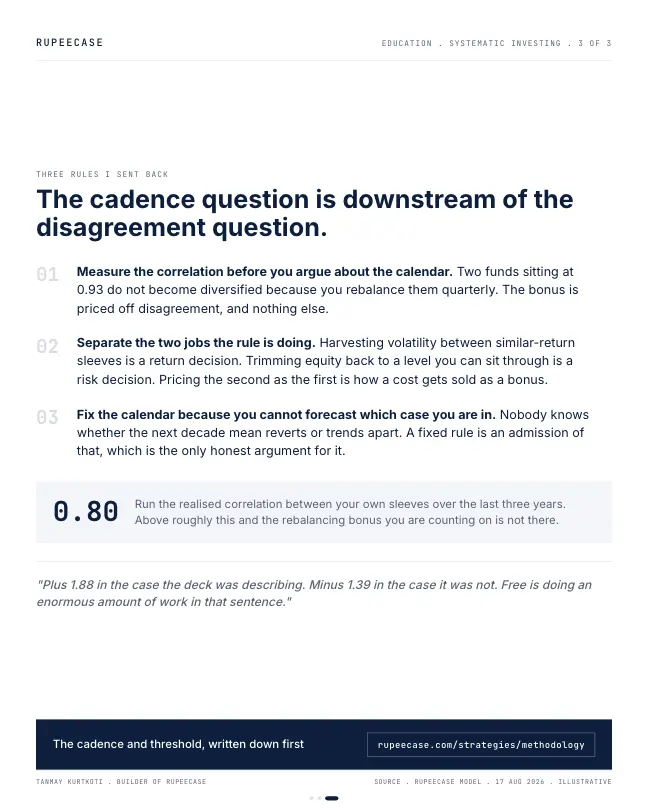
And the falsification, which is the honest bit. Measure the realised correlation between your own sleeves over the last three years. If it comes back above roughly 0.80, the rebalancing bonus you are counting on is not there, and I would want to know that before I defended any of the above.
Three rules I sent back to him
Measure the correlation before you argue about the calendar. The cadence question is downstream of the disagreement question, and almost every conversation gets that order backwards. Two funds with 0.93 correlation do not become diversified because you rebalance them quarterly.
Separate the two jobs the rule is doing. Harvesting volatility between similar-return sleeves is a return decision. Trimming equity back to a target you can live with is a risk decision. Both are defensible. Pricing the second as though it were the first is how a 1.39 point cost gets sold as a 1.5 point bonus.
Fix the calendar precisely because you cannot forecast which case you are in. Nobody knows in advance whether the next decade mean reverts or trends. A fixed rule is not a claim that rebalancing wins. It is an admission that you do not know, which is the strongest argument for it and the only one I find honest. You can see how we publish the cadence and the threshold rather than a view if you want the boring version.
I sent him the two numbers and nothing else. Plus 1.88 in the case the deck was describing. Minus 1.39 in the case it was not. The slide was not lying to him. It was quoting the good half of a two-sided coin and calling it free, and free is doing an enormous amount of work in that sentence.
Questions readers ask
What is the short answer?
Two 10 percent sleeves at 25 percent volatility earn a 1.88 point bonus at minus 0.20 correlation and 0.16 at plus 0.90, while a trending decade charges 1.39 points a year.
Where can I learn portfolio construction properly?
In the free RupeeCase Learn library: Portfolio construction, learn it free, no sign up needed. Modules come with quizzes, calculators and a path test.
Is this note investment advice?
No. It is an educational note by Tanmay Kurtkoti. RupeeCase is a technology platform, not a fund, a PMS or a SEBI registered investment adviser.
The cards
3 cards. Swipe, or tap to open.
Related
- Allocation drift: the risk you didn't chooseAn untouched 60/40 drifts to about 71/29 in ten years at 12 and 6.5 percent, and falls 27.8 instead of 23.2 percent when equity drops 40.Portfolio construction . . 6 min
- Rebalance cadence: the latency nobody readsThe same thirty names rebalanced quarterly and fortnightly landed at 30.2 and 33.8 percent CAGR over five years, because drift is a silent overweight.Portfolio construction . . 6 min
- Rebalancing harvests volatilityAn equal weight five fund SIP drifted to 38/17/16/15/14 in two years, and a two asset napkin shows how rebalancing at the swing turns a flat round trip into a 10 percent gain.Portfolio construction . . 6 min
Educational content only. Figures are illustrative and computed on historical or representative data for teaching purposes, not investment advice. Past performance does not guarantee future returns. Sourced from NSE, BSE, SEBI, AMFI and RBI public data.