

Portfolio construction..10 min read
Size decides more than selection
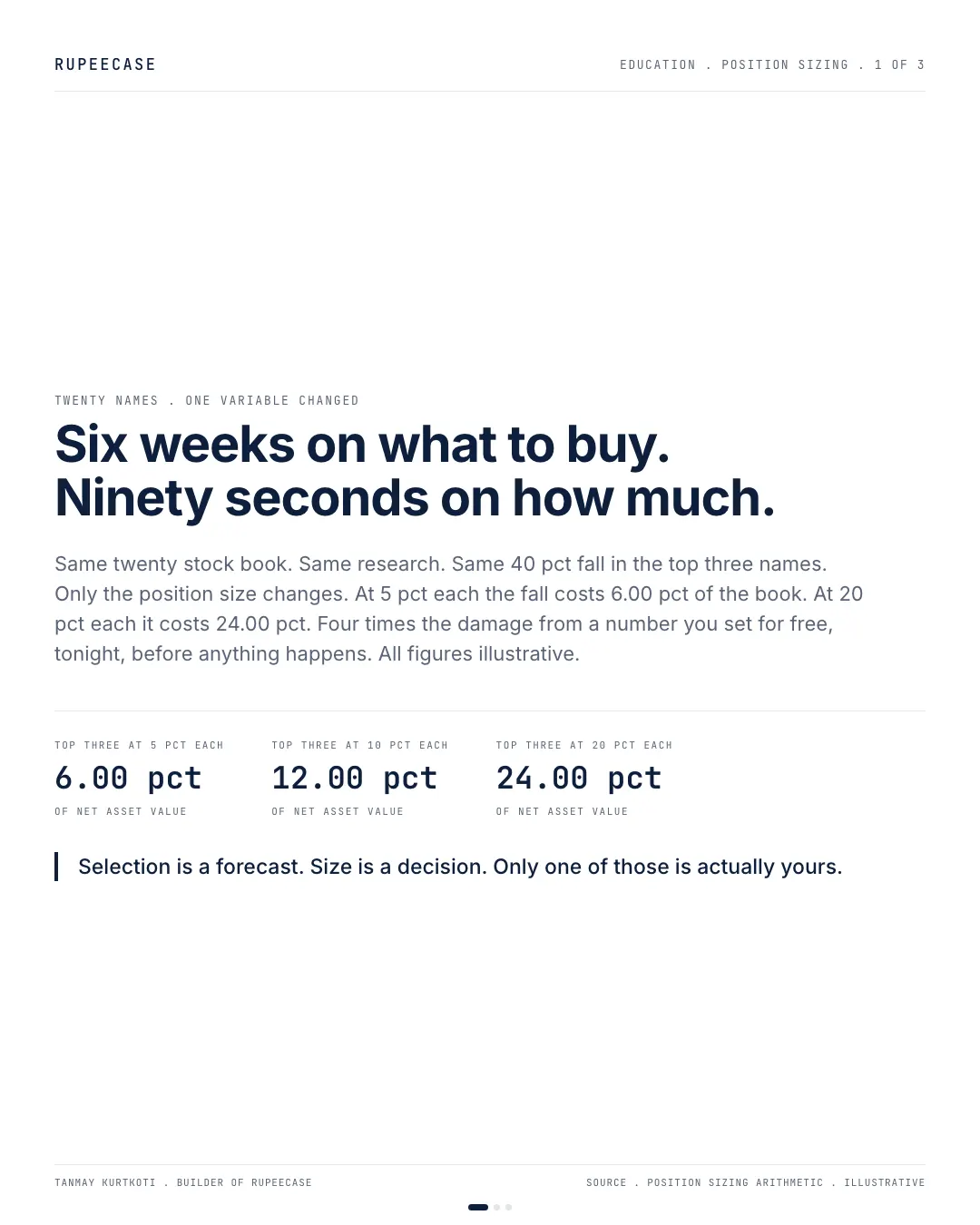
Holding research constant and moving the top three weights from 5 to 20 percent each quadruples a 40 percent shock's damage from 6 to 24 percent of the book.
By Tanmay Kurtkoti, founder of QC Alpha and builder of RupeeCase
Nine in the evening on the first of September and a friend is sharing his screen with me. Twenty names on it. He has been at this for six weeks. He goes through them one at a time, the order book on this one, the promoter pledge on that one, the receivable days that finally stopped stretching on the fourth. It is real work. Better than most of what lands in my inbox.
Then I ask him how much he is putting in each.
Long pause. "Equal, I suppose." Then, quickly, "Except the top three. Those I really like. More in those." How much more? Another pause, shorter this time, and a number arrives with no working behind it. "Twenty percent each?"
Six weeks on the part he cannot control. About ninety seconds on the part he can.
So after the call I did the only thing worth doing. I held his research constant, held the shock constant, and changed nothing except the weights. The damage moved by a factor of four.
Selection is a forecast. Size is a decision. Only one of those is actually yours.
Twenty names, one variable, four times the damage
The model fits in a sentence. Take a twenty stock book, decide what fraction sits in the top three ideas, then ask what a 40 pct fall in those three does to the whole thing.
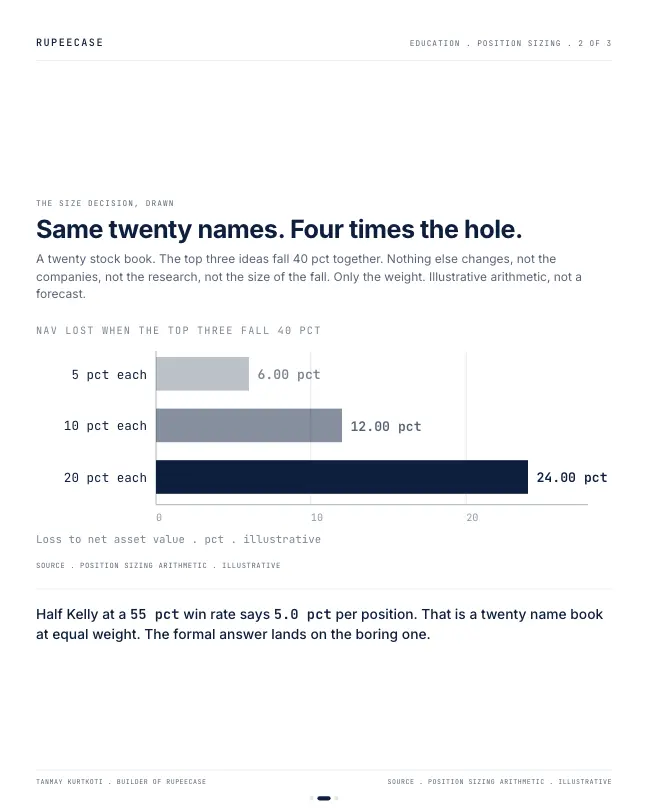
At 5 pct each, the top three are 15 pct of the book, and 40 pct of 15 is 6.00 pct of net asset value gone. That is an illustrative shock, not a forecast about anything. At 10 pct each the top three are 30 pct of the book and the identical fall takes 12.00 pct. At 20 pct each, which is the number my friend produced off the top of his head, the top three are 60 pct of the book and that same fall takes 24.00 pct.
Look at what did not change across those three bars. Not the companies. Not the six weeks. Not the size of the fall. The only input that moved was a number he gave me in ninety seconds, and it quadrupled the hole. His selection work does not appear in this chart at all, and it cannot, because selection is a probability and a weight is a fact. One of them you are estimating. The other you are choosing, tonight, for free.
The formal version of this has a name and it is one line
Kelly criterion. It sounds like something a hedge fund keeps in a drawer. At even odds it is a single line: the fraction of capital you should put on a bet is twice your win rate minus one, and the sizing maths sits inside the education modules if you want to work through where it comes from.
Run it on plausible numbers. With a 55 pct win rate at even odds, full Kelly says risk 10.0 pct of capital per bet, and half Kelly says 5.0 pct. With a 60 pct win rate, full Kelly says 20.0 pct and half Kelly says 10.0 pct. If every position in the book is sized at that fraction, the number of positions you end up holding is one divided by the fraction.
| Win rate | Full Kelly | Half Kelly | Positions at half Kelly |
|---|---|---|---|
| 52.5 pct | 5.0 pct | 2.5 pct | 40 |
| 55.0 pct | 10.0 pct | 5.0 pct | 20 |
| 60.0 pct | 20.0 pct | 10.0 pct | 10 |
| 65.0 pct | 30.0 pct | 15.0 pct | about 7 |
Every row is the same line of arithmetic, applied wider, and all of it is illustrative rather than a claim about anyone's actual hit rate. Read the 55 pct row twice. Half Kelly at a 55 percent hit rate says 5.0 pct per position, which is a twenty name book at equal weight. The formal answer, the one with maths behind it, walks in from a completely different direction and lands exactly on the boring answer.
Then read the 60 pct row and look at the full Kelly column. 20.0 pct. That is the number my friend said out loud, three times over. He was not proposing a modest tilt toward his favourites. He was proposing full Kelly on a 60 percent hit rate, on three positions at once, which is a claim about his own accuracy that he had never made and would not have made if I had asked him for it directly.
Half of a number you cannot measure
Everyone who uses this seriously runs half Kelly or less, and the reason is the interesting part.
Full Kelly maximises the long run growth rate. That is a genuine mathematical result, not a rule of thumb. It also produces drawdowns most people will not sit through, and it assumes you know your edge exactly, which you do not. Overestimating your edge while running full Kelly is ruinous. Underestimating it while running half Kelly merely costs you some growth. The penalty is asymmetric, and that asymmetry is the entire argument for halving.
I am not going to pretend a twenty stock equity book maps cleanly onto a coin toss at even odds. It does not. Positions correlate, payoffs are not symmetric, and nobody on earth knows their true hit rate to one decimal place. Kelly is not a calculator you pour a portfolio into. It is a sanity check on the size of the claim hiding inside a weight, and at that job it is very hard to argue with.
What conviction weighting looks like once you draw it
The word conviction does a lot of quiet work. It makes a bigger bet sound like a considered judgment rather than a bigger bet. Draw the two books side by side, same twenty companies in the same order, and the language stops helping.
Both rows hold the same companies with the same research behind them. The second row is not a better portfolio of ideas. It is the same portfolio with a stronger opinion about itself, and the other seventeen names have been reduced to a decorative strip on the right that no longer changes the outcome either way. That is the honest description. Conviction weighting is usually just concentration wearing a better suit.
The uncomfortable part is that more research does not fix this
Here is the second order point, and it is the one I keep relearning.
Your estimate of your own edge is itself uncertain. You do not know whether your hit rate is 55 percent or 51 percent, and the honest range around it is wider than the gap between two rows of that table. The correct response to uncertainty about edge is smaller size. Not more research. More research feels like the right answer because more research is enjoyable and cutting size is not, but the thing extra work reliably raises is your confidence, and only sometimes your accuracy. Cut the size and you are covered whether the edge was real or imagined.
Now push it one step further, to what happens when everybody responds the way my friend did. Conviction is not randomly distributed. People develop it on the same handful of names at the same time, off the same filings and the same broker notes. So the biggest weights across thousands of books land on the same few tickers, and when those names crack, a great many people hit their pain threshold in the same fortnight and reduce in the same direction. The position that felt like independent thinking turns out to be the most crowded trade in the room. You find that out on the way down, at the worst possible price, alongside everyone who did the same homework.
Where this argument falls apart
Concentration is how large fortunes are actually built. That is not a hedge, it is history. Equal weighting guarantees you dilute your strongest idea down to the same 5 pct as your twentieth, and if that idea really was the strongest, you have paid for comfort with the return.
So name who conviction weighting is right for. Someone with a genuine informational edge, meaning they know something the price does not reflect and can say out loud what it is. Someone with a horizon long enough that a 24.00 pct hole is an inconvenience and not an event. And someone with no external capital that can be redeemed at the bottom, because a redemption in a drawdown converts a paper loss into a permanent one. That is a small group. Most people reading this, me included on plenty of days, are not in it.
The falsification is simple enough to run yourself. If a review of your own book showed your largest positions had systematically outperformed your smallest ones over several years, your conviction is carrying real information and the equal weight argument is weaker for you. That is a weekend with your contract notes, and I would rather you ran it than took my word.
Two limits on my own numbers. The 40 pct fall is illustrative and assumes all three drop together, which is what happens when they share a sector or a factor and is not what happens when they do not. And equal weight is not neutral either, it is an active bet on the smaller names in your list and it costs turnover to hold. There is no weighting rule that has no opinion, which is why the honest move is to state the rule in advance rather than discover it one position at a time.
Three rules I actually use
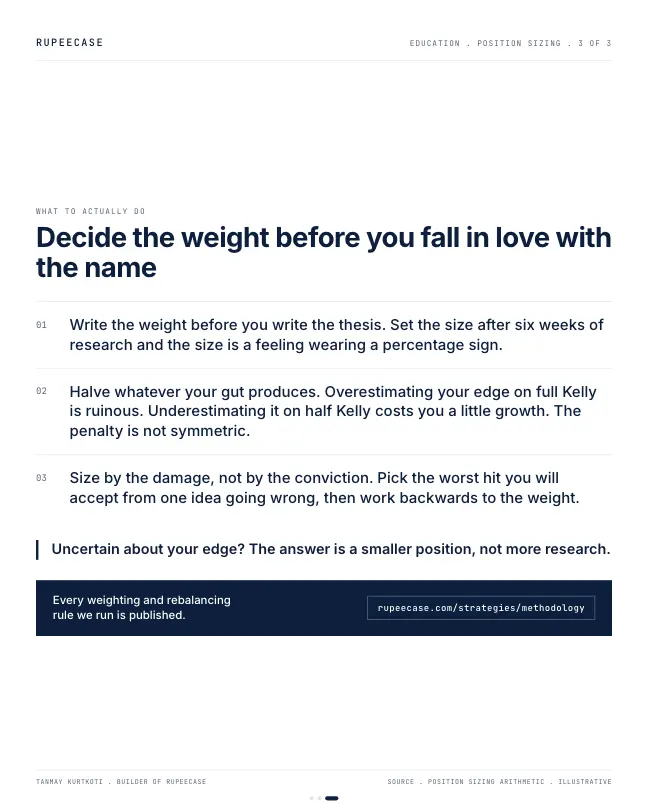
Write the weight before you write the thesis. Decide the size after six weeks of falling for a company and the size is a feeling wearing a percentage sign. Put the number down first, then do the work, then allow the work to move that number by a limited amount. It sounds backwards. It is the only order I have found that keeps the estimate honest.
Halve whatever your gut produces. Your gut is running full Kelly on an edge it cannot measure. Half costs you a little growth in the world where you were right and saves the book in the world where you were not, and you do not get to know in advance which world you are in.
Size by the damage, not by the conviction. Decide the worst hit you are willing to take from one idea going wrong, then work backwards to the weight. A 6.00 pct dent and a 24.00 pct dent are different lives. If you do not know which number is yours, a risk profile questionnaire is a considerably cheaper way to find out than a drawdown is.
When we hung up he asked whether the six weeks had been wasted. Not remotely. The names decide whether there is anything to make. The weight decides whether you are still holding them when it finally arrives.
Questions readers ask
What is the short answer?
Holding research constant and moving the top three weights from 5 to 20 percent each quadruples a 40 percent shock's damage from 6 to 24 percent of the book.
Where can I learn portfolio construction properly?
In the free RupeeCase Learn library: Portfolio construction, learn it free, no sign up needed. Modules come with quizzes, calculators and a path test.
Is this note investment advice?
No. It is an educational note by Tanmay Kurtkoti. RupeeCase is a technology platform, not a fund, a PMS or a SEBI registered investment adviser.
The cards
3 cards. Swipe, or tap to open.
Related
- Position sizing: what Kelly actually saysAt a 60/40 win rate and even money, Kelly says 20 percent of the book and half Kelly says 10, because doubling the bet roughly quadruples the drawdown.Portfolio construction . . 5 min
- Rebalancing is not free. And it is not always money.Two 10 percent sleeves at 25 percent volatility earn a 1.88 point bonus at minus 0.20 correlation and 0.16 at plus 0.90, while a trending decade charges 1.39 points a year.Portfolio construction . . 9 min
- Twenty funds, one betAt the 0.85 correlation Indian diversified equity funds show against each other, twenty funds buy 1.17 effective bets against 1.14 for five.Portfolio construction . . 9 min
Educational content only. Figures are illustrative and computed on historical or representative data for teaching purposes, not investment advice. Past performance does not guarantee future returns. Sourced from NSE, BSE, SEBI, AMFI and RBI public data.