

Costs: MF, PMS, RupeeCase..12 min read
The Rs 1.25 lakh you throw away every year
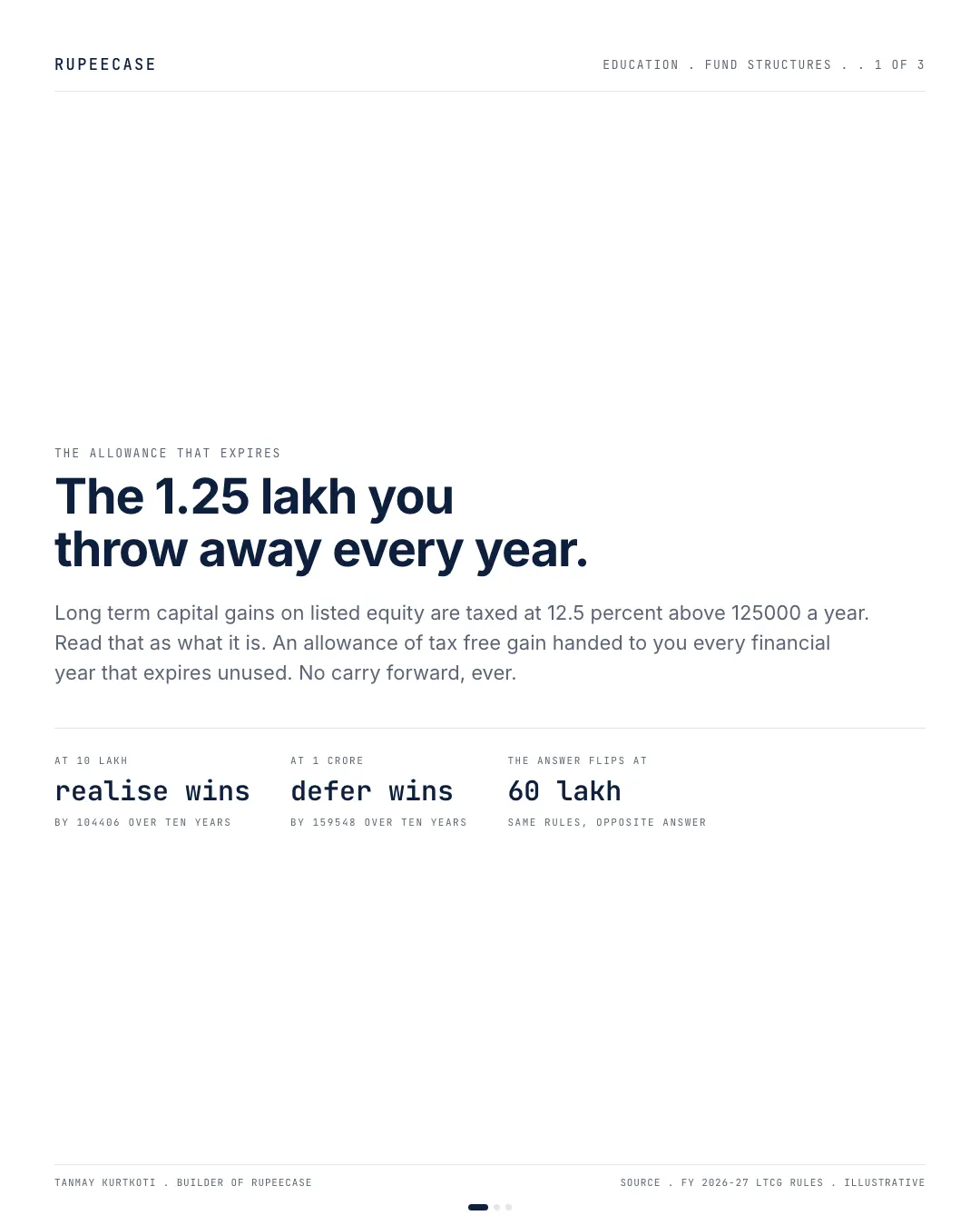
Realising gains yearly in your own name beats deferring to exit up to about Rs 60 lakh of portfolio, because ten shots at the exemption are worth Rs 1,56,250 of tax.
By Tanmay Kurtkoti, founder of QC Alpha and builder of RupeeCase
A friend sent me two documents in June and asked which one was cheaper. A PMS pitch on one side, a fund factsheet on the other. He had highlighted the fee lines in yellow on both.
We spent forty minutes on the fees. It was the wrong forty minutes.
The thing quietly deciding that comparison was not on either page. It was a line in the Income Tax Act that most people treat as a rounding error, and it turns the answer upside down depending on how much money he actually has.
An allowance nobody thinks of as an allowance
Long term capital gains on listed equity are taxed at 12.5 percent, above an exemption of 1.25 lakh a year. Union Budget 2026 left the rate, the exemption and the holding periods untouched for FY 2026-27.
Read that again as what it structurally is. It is 1.25 lakh of tax free gain, handed to you every financial year, and if you do not realise a gain that year it expires. No carry forward, no accrual. The most reliably wasted allowance in Indian personal finance.
Now set it against the structural difference between the two documents on my friend's desk. In a PMS or a direct equity basket, the securities sit in your own name. Every rebalance trade is a taxable event for you. In a pooled fund, the manager's internal churn is invisible to you and you are taxed only when you redeem.
The standard reading of that is: deferral is good, the fund wins, next question. Which is right, and also not right, and the pivot is the exemption.
The size of your portfolio decides which structure is cheaper
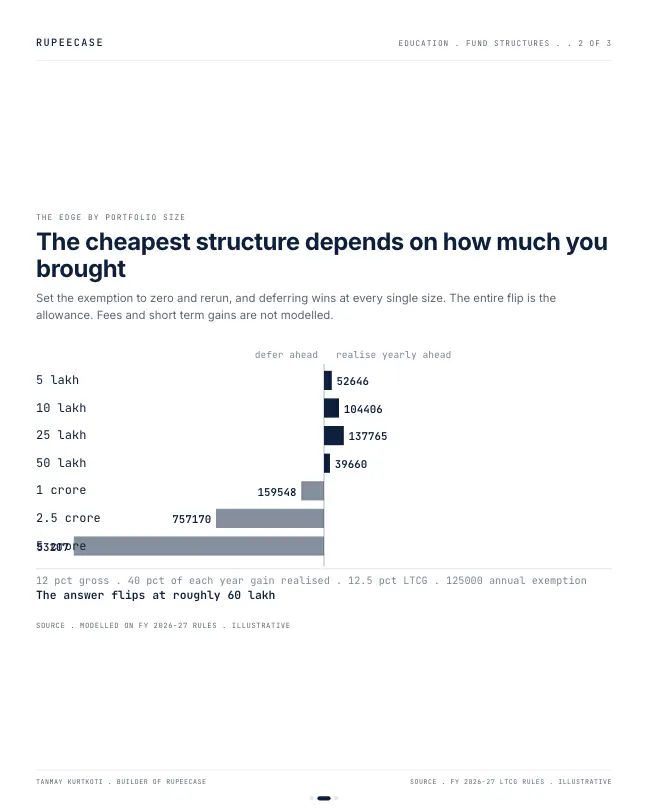
Same assumption on both sides. Twelve percent gross annual return, forty percent of each year's gain realised through rebalancing, ten years, all gains long term, 12.5 percent rate, 1.25 lakh exemption used where available. The only difference is whether the gains are realised in your name each year or deferred to a single exit.
Up to fifty lakh, realising annually ends ahead. At one crore and above, deferring does, and the gap widens fast.
Solve for the exact crossover and it sits at about 60 lakh.
Below that, the annual realised gain is small enough that the exemption absorbs most or all of it, so you are converting taxable gain into tax free gain, once a year, for free. Above it, the exemption stops mattering as a share of the gain and the ordinary logic of deferral takes over.
The numbers under the picture
| Portfolio | Realise yearly, net | Defer to exit, net | Ahead by |
|---|---|---|---|
| 10 lakh | 29,62,648 | 28,58,242 | realise, 1,04,406 |
| 25 lakh | 72,59,933 | 71,22,168 | realise, 1,37,765 |
| 50 lakh | 1,42,68,371 | 1,42,28,711 | realise, 39,660 |
| 1 crore | 2,82,82,249 | 2,84,41,797 | defer, 1,59,548 |
| 5 crore | 14,03,93,277 | 14,21,46,484 | defer, 17,53,207 |
The row worth staring at is 50 lakh, where the edge has collapsed to 39,660 on a 1.4 crore outcome. Two structures that looked ideologically different are, at that size, within a quarter of a percent of each other, and anybody arguing the tax point loudly there is arguing about noise.
Watch the 25 lakh portfolio do it year by year
Year one, the rebalance realises 1,20,000 of gain, which fits inside the allowance whole, so the tax is nothing. Year two it realises 1,34,400, the allowance absorbs 1,25,000, and 9400 is taxed for a bill of 1175. By year ten the realised gain has grown to 3,27,798 and that year's bill is 25,350. Ten years of small bills comes to 1,05,830, and the exit adds 3,63,328.
The man who never harvests pays nothing for a decade and then 6,42,453 in a single line.
So the harvester paid 1,73,295 less tax and ends up only 1,37,765 ahead. The gap is the price of paying early. His portfolio finishes at 76,23,261 against 77,64,621, because the 1,05,830 he handed over along the way stopped compounding and took another 35,530 of growth out with it. Subtract that 1,41,360 shortfall from the 2,79,125 he saved at the exit and you land exactly on the table. The whole thing is two subtractions.
Take the exemption away and it gets boring immediately
The honest test of any finding is to remove the mechanism you think is causing it.
Set the exemption to zero and rerun. At ten lakh, realising annually nets 28,02,776 and deferring nets 28,42,617. Deferral wins by 39,841. At one crore, deferral wins by 3,98,415. The crossover disappears entirely and deferral wins at every size, which is exactly what standard theory says should happen.
So the whole flip is the exemption and nothing else. A path that realises gains ten times gets ten shots at 1.25 lakh of tax free gain, plus one more at exit. A path that defers gets one. Fully used across ten years, the allowance is worth 1,56,250 of tax avoided.
The same logic runs in the other direction on losses
There is a mirror image here, and most people only ever hear about one half of it.
Short term capital losses on listed equity can be set against capital gains, and unabsorbed losses can be carried forward for eight assessment years provided the return is filed on time. That last clause is where people lose the benefit, and they lose it to a filing deadline rather than to the market.
So a structure holding securities in your own name gives you two levers on the same annual cycle, not one. Realise gains up to the exemption and pay nothing. Realise losses and bank them against future gains. A pooled structure gives you neither, because the churn happens inside a vehicle whose tax position is not yours. That is the honest case for direct holding, and it has nothing to do with the manager's skill.
The catch is that it is only an advantage if you use it. Somebody has to look at the realised position each January, decide what to book before March, and file on time. Most people do none of those things, which means the benefit shows up in a model like mine and never shows up in their tax return. A benefit you have to act on annually is worth exactly as much as your willingness to act on it annually.
The version of this that quietly costs you money
Here is where the argument breaks, and it is a specific person rather than a hedge.
The tax you avoid on a full allowance is fixed at 15,625. What it costs to go and get it is not. To realise 1,25,000 of gain you have to sell whatever quantity of stock carries 1,25,000 of embedded gain, then buy it back. A holding sitting 25 percent above cost means selling 6,25,000. A holding only 5 percent above cost means selling 26,25,000 to find the same gain. Transaction tax is 0.1 percent on the sale and 0.1 percent again on the repurchase, stamp duty adds 0.015 percent on the buy, so the round trip runs about 0.215 percent of whatever you move. On 6,25,000 that is 1343.75, roughly nine percent of the benefit, and you would still do it. On 26,25,000 it is 5643.75, more than a third of it, before you pay a paisa of spread. Below about 1.75 percent above cost, the statutory round trip alone costs more than the 15,625 it is chasing.
Then the bill nobody sends you. Selling and rebuying puts you out of the market for a stretch, and 15,625 on a 6,25,000 sale is 2.5 percent of what you stepped out of. One bad session while you are out and the year's benefit is gone.
The free step up in your cost base is also only free while the rules hold still. Above the allowance you are locking in today's 12.5 percent on purpose, and Budget 2026 pulled buyback proceeds into the capital gains net and raised transaction tax on commodity futures, which tells you these parameters get edited every February.
What happens when everyone reaches for it in the same fortnight
Push it one more step. If this is smart, it is smart for everybody holding securities in their own name, and they all remember in the same fortnight, the one before the year closes.
The two sides have different shapes. The benefit is capped at 15,625 a head and does not care what date you take it. The cost is execution, and execution gets worse the more people crowd the same names on the same afternoons. A tax motivated sale carries no information about the company and moves the price anyway, and that 2.5 percent cushion is the first thing crowding eats.
Which points somewhere duller than the March scramble. Spread it across the year, or stop treating it as an errand at all and let the rebalance you were going to do anyway carry the gain over the line. A trade you were making regardless costs you nothing extra. A trade you make only for the tax costs you everything it costs.
Everything I left out, and why it might matter more than what I put in
This model is deliberately narrow, and I would rather flag the holes myself than have them found.
Fees are not in it. A PMS charging a fixed fee plus a performance share against a fund charging a fraction of that can wipe out a 1,04,406 tax edge in the first eighteen months and keep going. If you are deciding between two real products, the fee comparison is still the bigger line, and my friend was not wrong to look there first, only wrong to stop there.
Short term gains are not in it either, and they are the sharpest hole. Everything above assumes the realised gains qualify as long term. A high turnover strategy that churns inside twelve months attracts 20 percent short term tax with no exemption at all, and that reverses the finding so completely that it is not the same comparison any more. Holding period, not structure, is the first thing to establish.
The exemption is also per person per year across all listed equity gains, not per portfolio. If you are already using it on something else, the edge above is already spent and the model does not apply to you.
And the whole thing assumes a smooth 12 percent. Real sequences are lumpy, some years throw off no gain at all, some throw off a loss, and that changes the arithmetic in ways this simple model does not attempt.
So here is what would change my mind, said plainly enough that somebody could go and do it. Run the same model on twenty years of actual year by year index returns instead of a flat 12 percent. If the crossover moves more than about 20 lakh either way, then 60 lakh is an artefact of my smoothing and only the direction survives. I have not run it.
The caveat that ages fastest is the tax itself. The 1.25 lakh and the 12.5 percent are what Budget 2026 left standing for FY 2026-27, not constants of nature, and both were moved inside the last two years. Thresholds and rates get rewritten by Finance Act and clarified by circular, so look up the current year's numbers before you act on any of this. What is above is mechanics, not a plan for you. If you want to compare structures properly rather than by highlighter, the compare view lines up cost, turnover and construction side by side.
Three rules
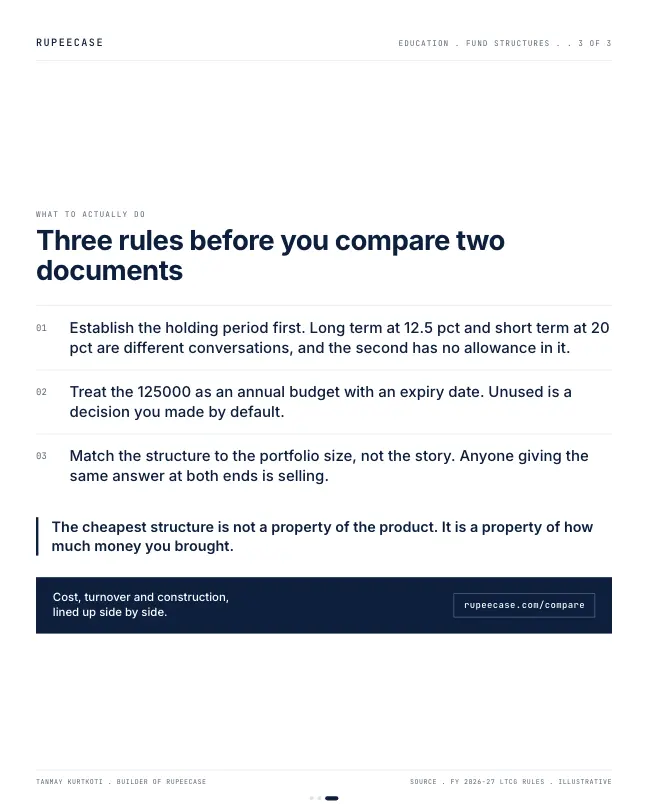
Establish the holding period before you argue about anything else. Long term at 12.5 percent and short term at 20 percent are different conversations, and the second one has no allowance in it.
Treat the 1.25 lakh as an annual budget with an expiry date. If you are sitting on unrealised gains and you have not used it this year, that is a decision you are making by default rather than on purpose.
Match the structure to the portfolio size, not to the story. Below about 60 lakh the allowance does real work and a structure that realises gains in your name can be the cheaper one. Above it, deferral wins and keeps winning. Anyone giving you the same answer at both ends is selling, not advising, and the strategies on the shelf state their turnover so you can run this yourself.
My friend highlighted both fee lines in yellow. Neither document mentioned the number that actually decided it.
The cheapest structure is not a property of the product. It is a property of how much money you brought.
Questions readers ask
What is the short answer?
Realising gains yearly in your own name beats deferring to exit up to about Rs 60 lakh of portfolio, because ten shots at the exemption are worth Rs 1,56,250 of tax.
Where can I learn costs: mf, pms, rupeecase properly?
In the free RupeeCase Learn library: Costs: MF, PMS, RupeeCase, learn it free, no sign up needed. Modules come with quizzes, calculators and a path test.
Is this note investment advice?
No. It is an educational note by Tanmay Kurtkoti. RupeeCase is a technology platform, not a fund, a PMS or a SEBI registered investment adviser.
The cards
3 cards. Swipe, or tap to open.
Explore next
Learn it properly, then see it applied.
Related
- Two week rebalancing and the STCG objectionA 60 percent higher short term tax rate loses to a 192 percent higher gross return, so compare after tax cheques on the same corpus rather than tax brackets.Costs: MF, PMS, RupeeCase . . 6 min
- A 1 percent fee does not cost you 1 percentOn Rs 10 lakh at 12 percent gross for 25 years a 1.00 percent fee costs 20.1 percent of the ending corpus, and more than half of that is charged in the last five years.Costs: MF, PMS, RupeeCase . . 11 min
- The index rewrites itselfThe Nifty 50 made 41 constituent changes from 2009 to 2022, 2.93 a year, with a twenty rank buffer between joining and leaving and a cap of five additions a year.Costs: MF, PMS, RupeeCase . . 8 min
Educational content only. Figures are illustrative and computed on historical or representative data for teaching purposes, not investment advice. Past performance does not guarantee future returns. Sourced from NSE, BSE, SEBI, AMFI and RBI public data.