

Costs: MF, PMS, RupeeCase..11 min read
A 1 percent fee does not cost you 1 percent
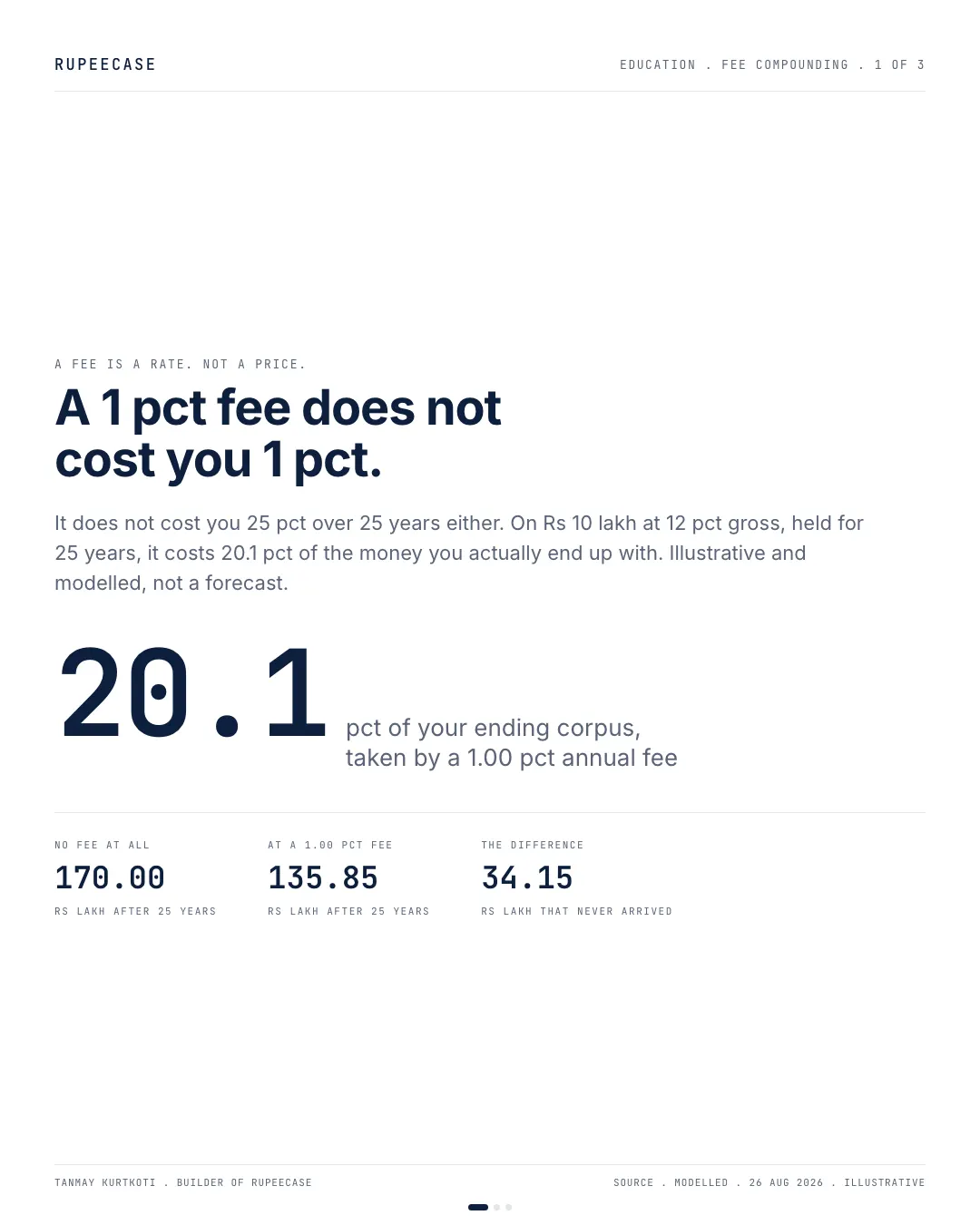
On Rs 10 lakh at 12 percent gross for 25 years a 1.00 percent fee costs 20.1 percent of the ending corpus, and more than half of that is charged in the last five years.
By Tanmay Kurtkoti, founder of QC Alpha and builder of RupeeCase
Tuesday evening, a reader sends me two screenshots. Two fund pages side by side, the expense ratio circled in red on each. One reads 0.20. The other reads 1.00. Underneath, his message is three words.
"Point eight. Whatever."
I did not reply for an hour, because he is right about the arithmetic and wrong about the unit, and that is an awkward thing to type into a chat window.
Here is what I mean by the unit. A fee is quoted as a percentage of assets per year. That looks like a price. It is not a price, it is a rate, and you do not pay it once. You pay it every year, on a base that is supposed to keep getting larger, which is the entire reason you bought the thing in the first place.
So I built the smallest model that could answer him properly. Rs 10 lakh. A gross return of 12 percent a year, held constant. Twenty five years. The fee comes off the return, every year. Everything below is illustrative and modelled, not a forecast and not anybody's track record. With no fee at all, that Rs 10 lakh ends at Rs 170.00 lakh.
Then I ran it again at every fee level I could find on a real Indian product page.
A 1 percent annual fee does not cost you 1 percent. It does not cost you 25 percent over 25 years either. It costs you 20.1 percent of the money you actually end up with.
The number I went back and checked twice
The intuitive answer to "what does a 1 percent fee cost" is 1 percent. The slightly more careful answer, the one people arrive at after ten seconds of thinking, is twenty five lots of 1 percent, so about a quarter of the money. Both are wrong, and interestingly they are wrong in opposite directions.
The real figure sits between them and closer to the second. At a 1.00 percent fee the corpus lands at Rs 135.85 lakh instead of Rs 170.00 lakh. Rs 34.15 lakh gone. That is 20.1 percent of what you would otherwise have had, from a line item that reads like a rounding error on a factsheet.
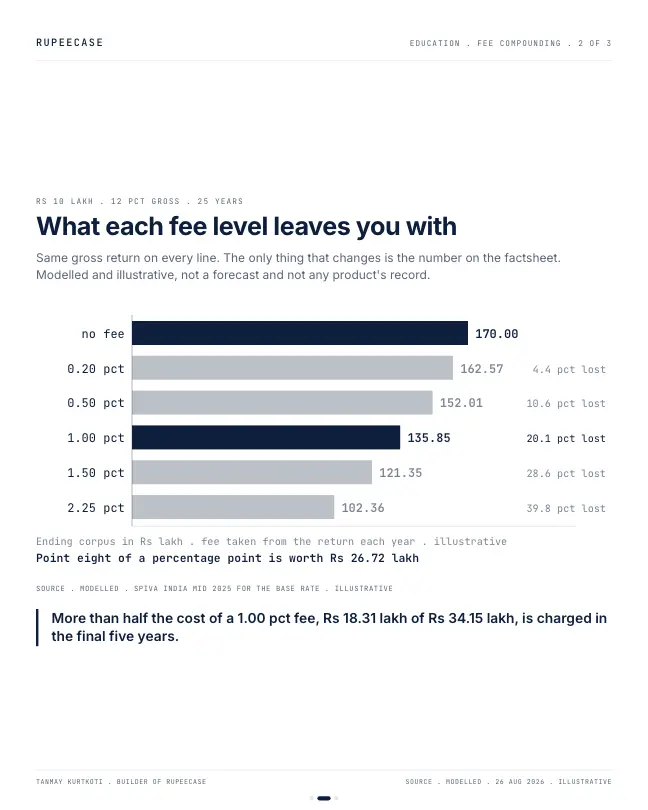
Stack the fee levels and you can watch the money leave.
Read the thin slices, not the tall bars. Every one of those slivers is a fee band that a salesperson would describe as a small step up, and by the time you have taken all five of them the investor has handed over four rupees out of every ten he was going to end up with.
Point eight of a percentage point is worth Rs 26.72 lakh
Back to my reader and his two screenshots. The gap between his two funds is 0.80 of a percentage point a year. In the model, going from the 0.20 fee to the 1.00 fee moves the ending corpus from Rs 162.57 lakh to Rs 135.85 lakh.
Rs 26.72 lakh. For point eight.
| Annual fee | Ending corpus (Rs lakh) | Rupees lost (Rs lakh) | Share of corpus lost |
|---|---|---|---|
| no fee | 170.00 | . | . |
| 0.20 pct | 162.57 | 7.43 | 4.4 pct |
| 0.50 pct | 152.01 | 17.99 | 10.6 pct |
| 1.00 pct | 135.85 | 34.15 | 20.1 pct |
| 1.50 pct | 121.35 | 48.65 | 28.6 pct |
| 2.25 pct | 102.36 | 67.64 | 39.8 pct |
All of it modelled and illustrative on the same 12 percent gross assumption. The column that matters is the last one, because it is the only one denominated in something a human cares about. Nobody thinks in basis points. Everybody understands "four out of every ten rupees."
There is a rough conversion hiding in that table, and I find it useful enough to carry around. Over twenty five years, each percentage point of annual fee costs you somewhere around a fifth of your ending corpus. The 1.50 to 2.25 step alone, three quarters of one percentage point, costs another Rs 18.99 lakh. That is not a fee difference. That is a house deposit.
Almost none of the damage shows up while you are watching
This is the part I find genuinely counterintuitive, and it is the reason people who look at their statements every quarter never notice it happening.
The cost of a fee is not spread evenly across the twenty five years. It is loaded almost entirely into the end, because the fee compounds against you at exactly the same rate your money compounds for you. In the first five years, a 1.00 percent fee opens a gap of Rs 0.77 lakh against the no fee path. Small enough to be noise. In the last five years it opens Rs 18.31 lakh.
More than half the total cost of that fee, Rs 18.31 lakh out of Rs 34.15 lakh, is charged in the final five years alone. Which means the years when the fee is doing real damage are the years when you are least likely to switch, because by then you have held the thing for two decades, you are used to it, and the statement has never once shown you a line saying "this quarter, the fee cost you Rs 91,000 of future money."
The two lines look identical for a decade, and that is the trap
Put the cheapest and the dearest paths on the same axes and the shape of the problem becomes obvious. A 0.20 percent index fund style fee against a 2.25 percent all in cost, which is roughly what a full service managed product looks like once you add the management fee, the performance share and the transaction costs.
Ten years in, the two paths are Rs 5.15 lakh apart on a corpus of about Rs 30 lakh, which any decent quarter of market movement would swamp. Twenty five years in, they are Rs 60.22 lakh apart. The decision that produced that gap was made once, on day one, by somebody skimming a page and deciding point eight was noise.
What the fee is actually meant to be buying
None of this makes a 1.50 percent fee wrong. It makes it a question, and the question is not "is this expensive" but "what does this fee buy that a cheap fund does not."
A fee that buys a genuinely different return stream can be worth 1.50 percent and more. A fee that buys a large cap fund quietly hugging its index is a straight transfer from you to a distribution business. And the number that tells you which one you are holding is not the fee. It is the excess, and it has to clear the fee gap every year, not on average, not in the good years. To match the 0.20 percent path, the 1.00 percent manager has to out earn the index by 0.80 of a percentage point a year for twenty five straight years.
That is a demanding bar, and the base rate is public. S&P Dow Jones Indices publishes the SPIVA India scorecard twice a year, and the mid 2025 edition, on data to 30 June 2025, is where I would start. Over the ten years to that date, 73.27 percent of Indian large cap funds trailed the S&P India LargeMidCap. The equal weighted average fund in that category returned 13.08 percent a year against 14.03 for the index. That shortfall is 0.95 of a percentage point. Which is, near enough, a fee.
Now the second order bit. If enough people learn this arithmetic, cost becomes the thing everyone shops on, and commodity exposure gets very cheap very fast, which is good. The awkward consequence is that price competition does not make managers better, it makes them cheaper, and the ones who genuinely do something different have every incentive to stop explaining it and start competing on the sticker instead. Cheap is the right default. Cheap as the only question is how you end up owning twenty products that are the same product.
Where this argument falls apart
The whole thing rests on one assumption, and I want to be blunt about it. Every path above uses the same 12 percent gross return. Change that and the conclusion changes with it. This breaks completely for anyone whose manager genuinely earns more than the fee, because then the higher cost product wins on the only measure that counts, and the arithmetic above is describing a fund that does not exist. The honest problem is not that such managers are impossible. It is that you have to pick one in advance, and the SPIVA survivorship table is a reminder of how hard that is: of the 101 large cap funds in that ten year window, 76.24 percent were still around at the end. A quarter of the choices available in 2015 have since merged or closed.
The second crack is the holding period. Twenty five years is doing a lot of work here. If you switch products every four years, which is what most people actually do, the fee never gets the runway to compound and the cost lands nowhere near 20 percent. That is not a defence of high fees, it is a warning that your own churn may be the more expensive habit. Worth reading alongside how turnover and construction differ across structures.
So here is what would change my mind. If a fund's returns net of its higher fee beat a comparable low cost index fund across three separate five year windows, the fee was buying something real and none of this applies to it. One window is luck. Three is evidence.
Three things I would do with this
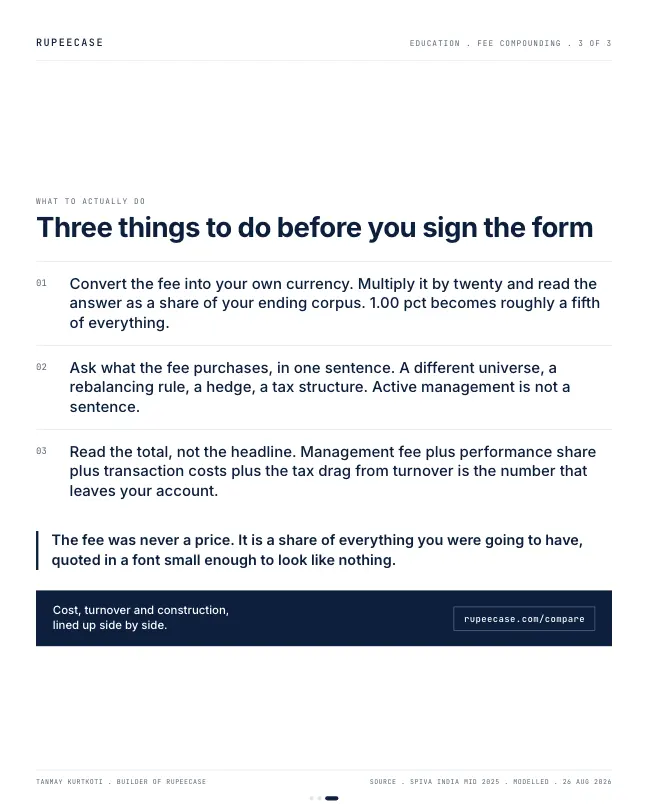
Convert the fee into your own currency before you sign anything. Take the fee, multiply by twenty, and read the answer as a percentage of your ending corpus. 1.00 percent becomes roughly a fifth of everything. 2.25 becomes about two fifths. It is a crude rule and it holds well enough across the range in that table to be useful at a desk with a pen.
Ask what the fee purchases, in one sentence, and refuse to accept "active management" as the sentence. A different universe, a different rebalancing rule, a hedged exposure, a tax structure you cannot get yourself: these are answers. If the honest answer is "a large cap portfolio that looks like the index," you already own that for 0.20. Lining cost against what the cost is buying is the only comparison worth the hour.
Look at the total, not the headline line. The number on the factsheet is rarely the number leaving your account. Add the management fee, any performance share, the transaction costs and the tax drag from turnover, and the honest all in cost of a lot of managed products sits closer to my 2.25 column than the 1.00 one. A plain reading of what each layer costs is worth more than a year of picking.
Point eight, he wrote. Whatever.
Point eight is Rs 26.72 lakh of his own money, on his own assumptions, across his own working life. Same number, different unit. The fee was never a price. It was a share of everything you were going to have, quoted in a font small enough to look like nothing.
Questions readers ask
What is the short answer?
On Rs 10 lakh at 12 percent gross for 25 years a 1.00 percent fee costs 20.1 percent of the ending corpus, and more than half of that is charged in the last five years.
Where can I learn costs: mf, pms, rupeecase properly?
In the free RupeeCase Learn library: Costs: MF, PMS, RupeeCase, learn it free, no sign up needed. Modules come with quizzes, calculators and a path test.
Is this note investment advice?
No. It is an educational note by Tanmay Kurtkoti. RupeeCase is a technology platform, not a fund, a PMS or a SEBI registered investment adviser.
The cards
3 cards. Swipe, or tap to open.
Explore next
Learn it properly, then see it applied.
Related
- The true cost stack of a regular planStated TER, distributor commission and silent churn stack to about 178 basis points a year, and on Rs 10 lakh over five years that is closer to Rs 95,000 than Rs 17,000.Costs: MF, PMS, RupeeCase . . 6 min
- The mutual fund cost stackA 1.65 percent TER is only the visible line; add churn, cash drag and the regular plan commission and the honest annual cost of an active large cap fund is near 178 basis points.Costs: MF, PMS, RupeeCase . . 6 min
- The Rs 1.25 lakh you throw away every yearRealising gains yearly in your own name beats deferring to exit up to about Rs 60 lakh of portfolio, because ten shots at the exemption are worth Rs 1,56,250 of tax.Costs: MF, PMS, RupeeCase . . 12 min
Educational content only. Figures are illustrative and computed on historical or representative data for teaching purposes, not investment advice. Past performance does not guarantee future returns. Sourced from NSE, BSE, SEBI, AMFI and RBI public data.