



Three structures, five questions
| Mutual fund | PMS | Model portfolio | |
|---|---|---|---|
| What you own | Units of the scheme | The securities in an account run for you | The shares, in your own demat |
| Who decides each trade | The fund manager | The portfolio manager (discretionary) or you (non discretionary) | You, following the published basket and its updates |
| Minimum | Set by the scheme, often a few hundred rupees by SIP | ₹50 lakh | Enough to buy each stock in whole shares at its weight |
| How fees are charged | Expense ratio from the NAV, daily | Set in the agreement: fixed, profit share or both | Set by the provider: subscription, or a fee on trades |
| When tax falls due | When you redeem units | On every sale in the account | On every sale you make |
The compare page sets the same rows against an AIF and picking stocks yourself, and the module on mutual fund structure and costs covers the fund side in detail.
Ownership: units or shares
You own units; the scheme owns the shares
- Any amount, fractional units
- The fund's trades are not taxed in your hands
- Holdings disclosed monthly, after the fact
- Exit by redeeming units
The shares are held for you, by name
- A minimum set by whole share prices, or ₹50 lakh for a PMS
- Every sale is your sale, and taxable
- Holdings visible at all times
- Exit by selling, or by keeping the shares
Owning units has real advantages: any amount works, and the tax on the fund's own trading is deferred until you redeem, which helps a high turnover strategy. Owning the shares has others: you see every holding, nothing is pooled with other investors, and you can stop following the basket and simply keep what you hold.
Read one more paragraph, 34 words
The mutual fund vs direct stocks tax guide puts rupee figures on the tax side, and the note the tax you pay for someone else's trades shows how a PMS's turnover becomes your tax.
The rules each one runs under
Mutual funds are regulated end to end by SEBI: the scheme's category, its expense limits, daily NAVs, monthly portfolio disclosure, and the trustees above the asset manager.
the minimum a SEBI registered portfolio manager may accept from a client
PMS Regulations 2020, reg. 23(2)
SEBI's guidelines defining a research analyst's model portfolio
SEBI circular, Annexure A
the date by which model portfolio providers had to comply
Same circular, para xi(c)
RupeeCase's fee on the value traded at each rebalance, with no fee on assets
RupeeCase pricing page
Read 2 more paragraphs and a list, 151 words
Portfolio managers register with SEBI. Regulation 23(2) of the Portfolio Managers Regulations, 2020 bars them from accepting less than ₹50 lakh in funds or securities from a client, with narrow exceptions such as accredited investors. The PMS guide covers how to read a PMS's fees and reported returns, and the note the ₹50 lakh door explains who the minimum keeps out.
Model portfolios became a defined product in January 2025. SEBI's guidelines for research analysts define a model portfolio as "a basket of securities for which a research report is issued" with recommended weightages, and require each one to:
- publish a report and factsheet with its methodology and the universe it picks from;
- be "true to label", named for its type or theme;
- state its investment horizon and, in advance, how often it will be reviewed and updated;
- state its risks; and
- disclose validated performance against an appropriate benchmark index.
Fees: on assets, or on trades
A mutual fund's expense ratio and most PMS fixed fees are charged on everything you hold, every year, whether or not anything trades. A fee on trades is charged only when the portfolio changes. Neither is cheaper by nature: the comparison turns on turnover.
MythA fee only on trades is always cheaper than a fund's expense ratio.
FactIt depends on turnover. At 0.2% of traded value, a rule that trades about 11.1 times its value in a year, as Allcap did in the model record, costs about 2.2%; one that barely trades costs almost nothing.
Read 2 more paragraphs, 174 words
The RupeeCase pages make the point. The Allcap page estimates its fee from the published rebalance record: 27 rebalances in the year to 3 Jul 2026, about 11.1 times the portfolio traded counting sales and purchases, so a 0.2% fee on traded value came to about 2.2% of the portfolio that year, before weight resets. Turnover varies year to year. Nifty 50 Equal Weight changes almost no names from one rebalance to the next, so its fee is mostly the small trades that reset weights. A momentum rule pays for its turnover; an index like rule barely trades.
Then add what each route leaves out of its headline fee. A fund's trading costs sit inside its NAV. A direct portfolio pays brokerage, STT and impact cost on every trade in your account. A PMS may charge a share of profits above a hurdle on top of a fixed fee. The fee drag calculator compounds any of these over your horizon, and the note the mutual fund cost stack lists the layers in a fund.
Tax: when it falls due
The rates are the same in all three for listed equity: 20% on short term gains and 12.5% above ₹1.25 lakh a year on long term gains, under sections 196 and 198 of the Income-tax Act, 2025 (111A and 112A of the 1961 Act).
Read one more paragraph, 55 words
The timing is not. A fund's trades inside the scheme are not taxed in your hands; you pay when you redeem. In a PMS or a model portfolio, each sale is your sale, so a strategy that rebalances often realises short term gains often. The capital gains tax guide has the rules and worked examples.
What to ask any provider
Whichever structure you choose, the same questions separate a careful provider from a sales pitch:
- Is the method written down?
- How is performance measured?
- How often does it trade, and what does that cost?
- What happens when I leave?
- Who is registered with SEBI, and as what?
Read a list, 129 words
- Is the method written down? For a model portfolio, SEBI's guidelines require the methodology and universe in the report. For a fund, read the scheme information document; for a PMS, the disclosure document.
- How is performance measured? Against which benchmark, over which periods, after which costs, and is any of it a back test rather than a live record?
- How often does it trade, and what does that cost? Turnover drives both fees on trades and short term tax.
- What happens when I leave? Redeeming units, transferring securities out of a PMS, or simply keeping the shares of a model portfolio.
- Who is registered with SEBI, and as what? An asset management company, a portfolio manager, a research analyst or an investment adviser each carry different duties to you.
Which structure fits which investor
- A mutual fund
- A PMS
- A model portfolio
Read one more paragraph and a list, 93 words
- A mutual fund fits small amounts, SIPs of any size, a wish to never see individual trades, and strategies with high turnover where deferring tax matters.
- A PMS fits investors above ₹50 lakh who want a named manager's judgement and a fully hands off account, and accept its fee structure.
- A model portfolio fits investors who want to own the shares, see the rule, and approve each change, with enough money to hold every name in whole shares.
None of these is better in general. The choice is which trade offs you accept.
How this shows up in RupeeCase
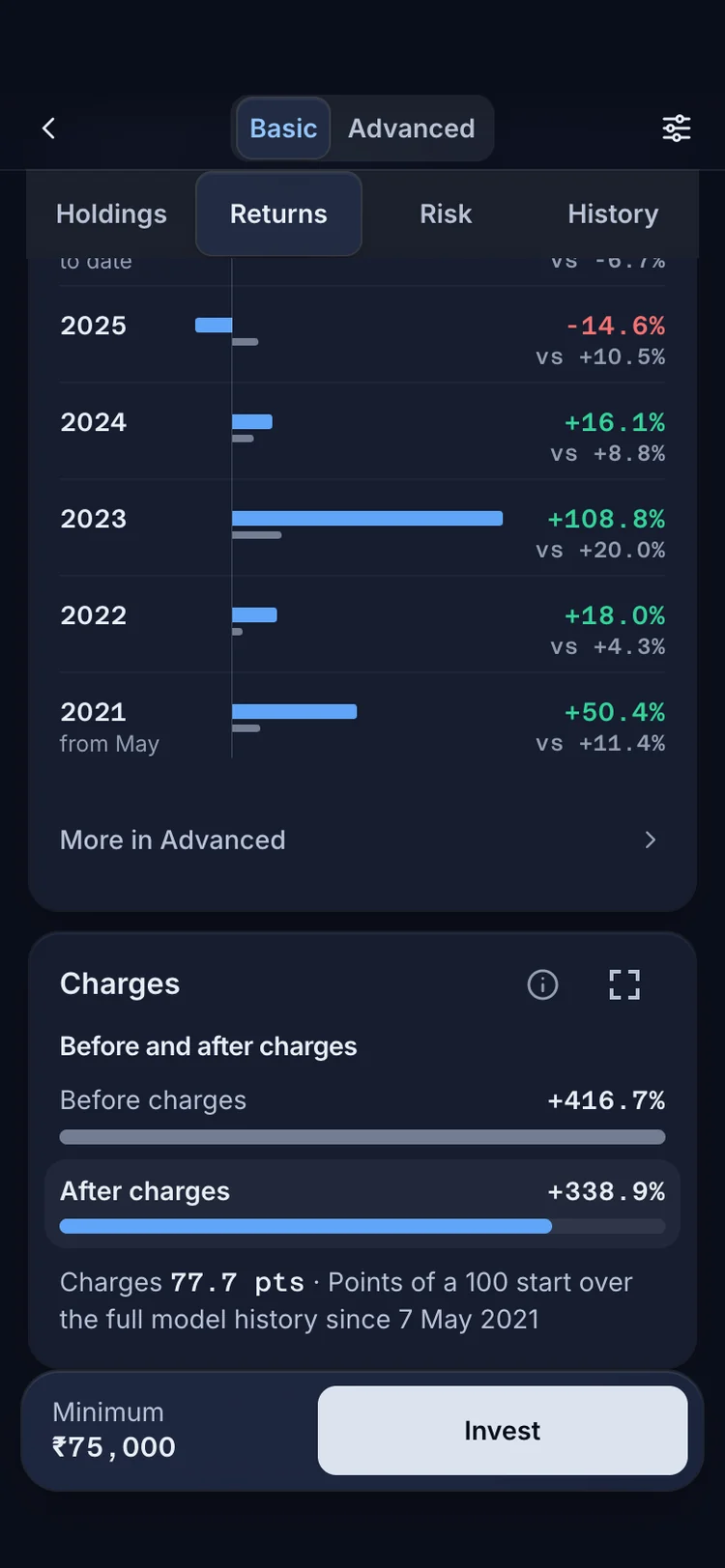
1Model returns are shown after estimated charges: brokerage, STT, exchange fees and GST. 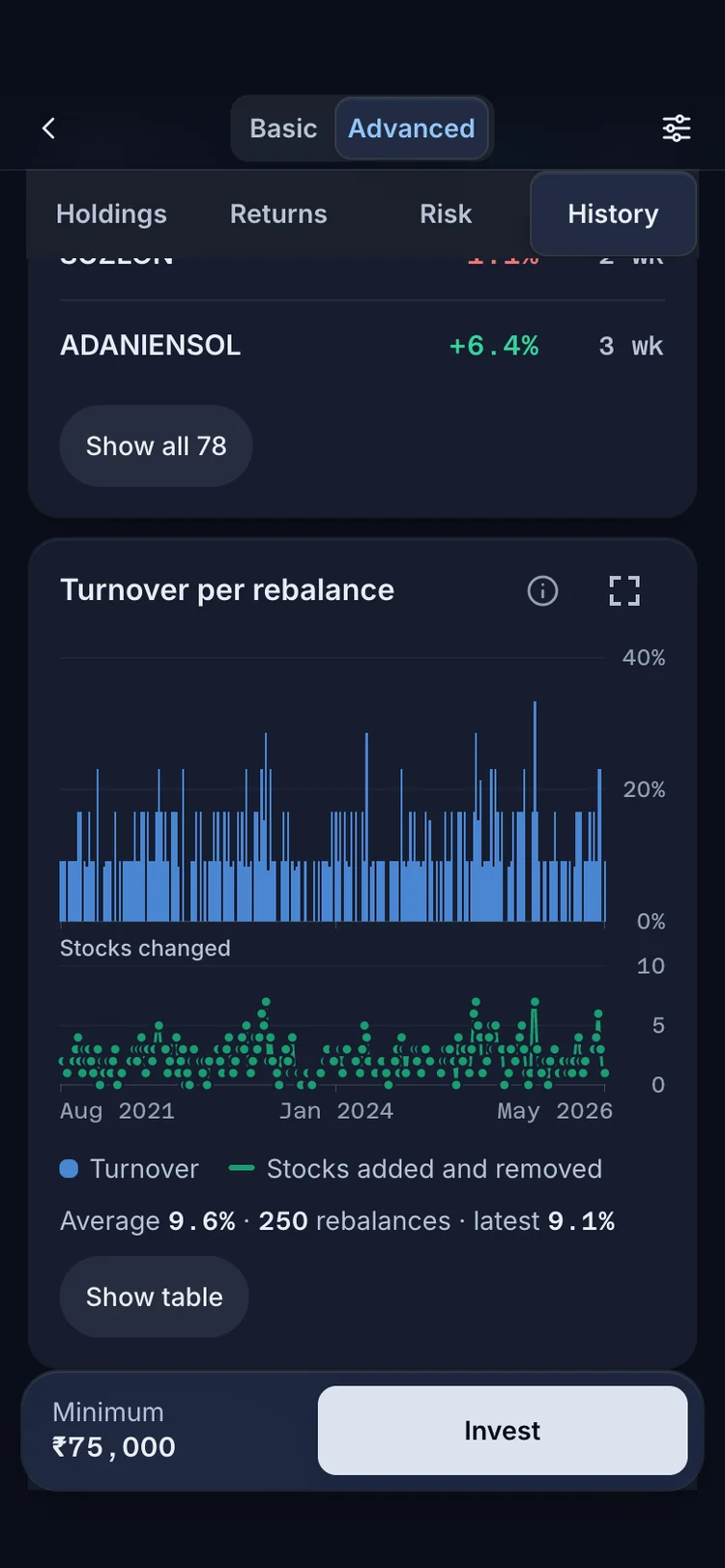
2Turnover per rebalance, from the model record: the fee is charged only on what trades. 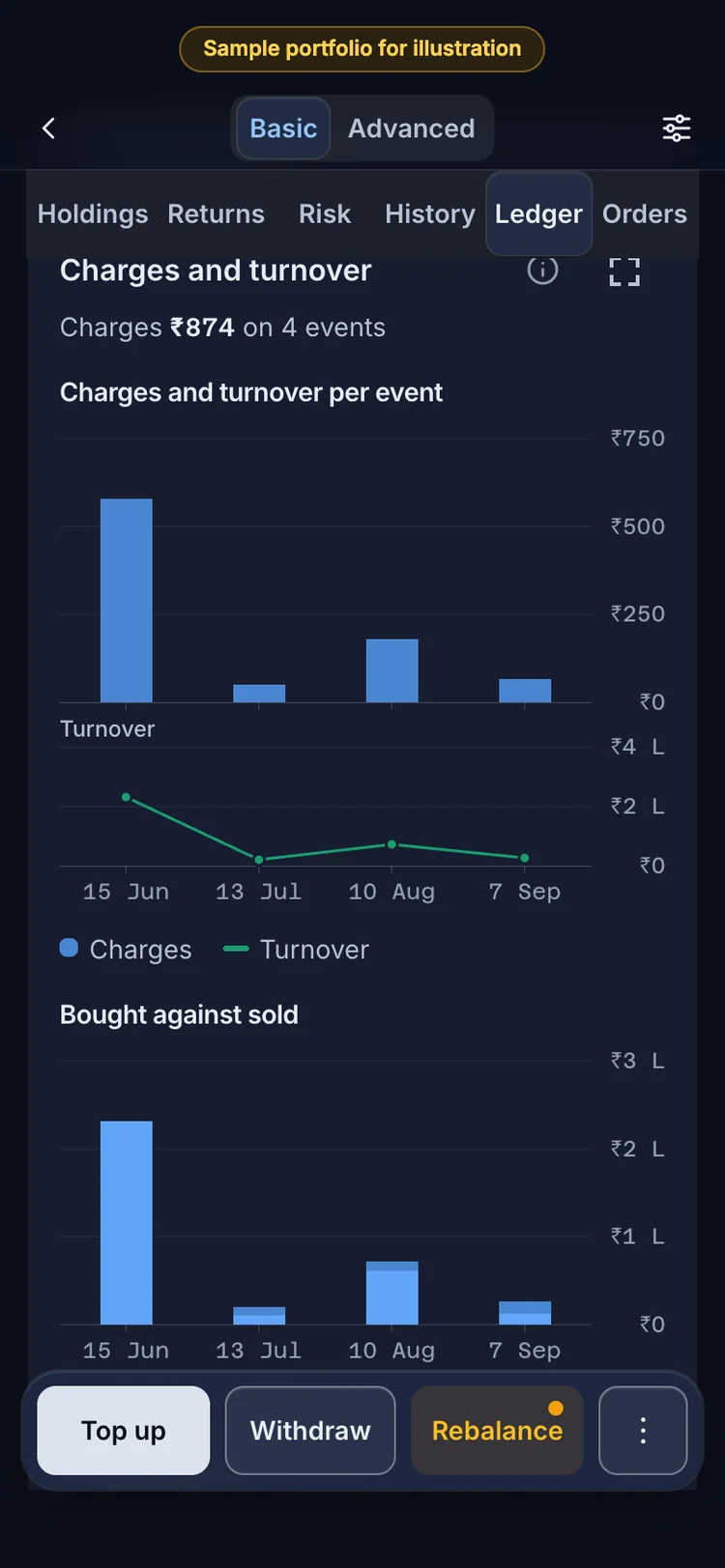
3Your own charges and turnover, event by event, on the Ledger tab. 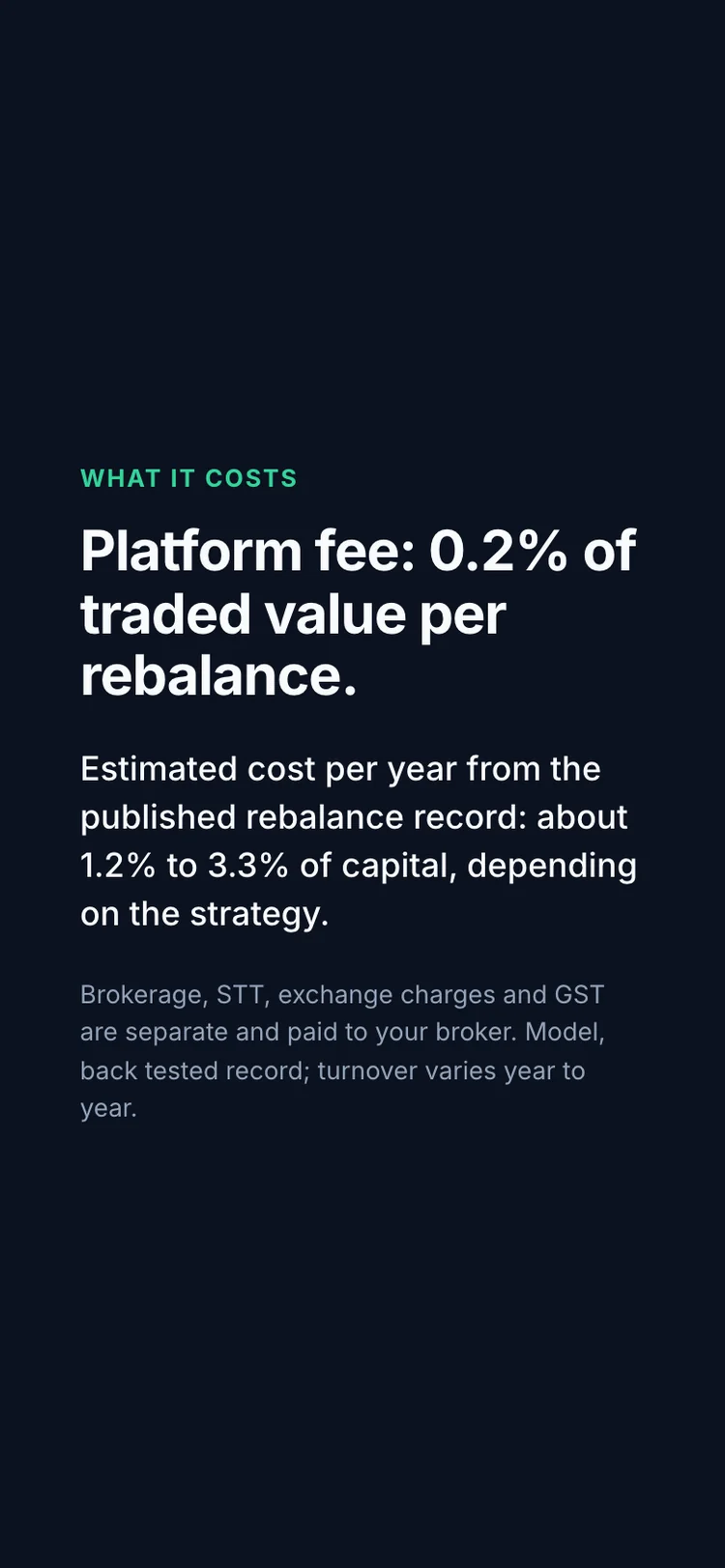
4Platform fee: 0.2% of traded value per rebalance. About 1.2% to 3.3% of capital a year in the published record, depending on the strategy.
Where it sits in RupeeCase, in words
RupeeCase publishes rule based index algos and their rebalances; the shares are bought in your own demat through your own broker when you approve each rebalance, with a fee of 0.2% of the value traded, as the pricing page sets out. It is a technology platform, not a mutual fund or a PMS; research is by QC Alpha Research, whose SEBI research analyst registration is pending. Large Mid Hybrid runs a momentum rule on the Nifty LargeMidCap 250 with a 20% debt sleeve, 41 holdings rebalanced every 2 weeks: model CAGR 33.21%, deepest fall −18.27%, as of 27 Apr 2026, after model costs.
Questions investors ask
What is a model portfolio?
A basket of securities with recommended weights, issued through a research report. SEBI's guidelines of 8 Jan 2025 define it this way for research analysts and require disclosure of methodology, horizon, update dates, risks and a benchmark.
Is a model portfolio better than a mutual fund?
Neither is better in general. A model portfolio gives you the shares and visibility; a fund gives you any ticket size, professional management and tax deferred until you redeem. Costs depend on fees and turnover.
What is the minimum investment for a PMS?
₹50 lakh, under regulation 23(2) of SEBI's Portfolio Managers Regulations, 2020, with narrow exceptions such as accredited investors.
Who owns the shares in a model portfolio?
You do. You buy them in your own demat through your own broker, and you keep them if you stop following the portfolio.
How are model portfolios taxed?
Like any shares you own: each sale is taxed at 20% if held 12 months or less and 12.5% above ₹1.25 lakh a year if held longer. Frequent rebalancing means more short term gains.
Is a PMS safer than a mutual fund?
Both are SEBI regulated. A mutual fund is pooled and heavily diversified by rule; a PMS is run for you alone and can be concentrated. Safety depends on the strategy, not on the label.