

Behaviour..10 min read
Selling the wrong half
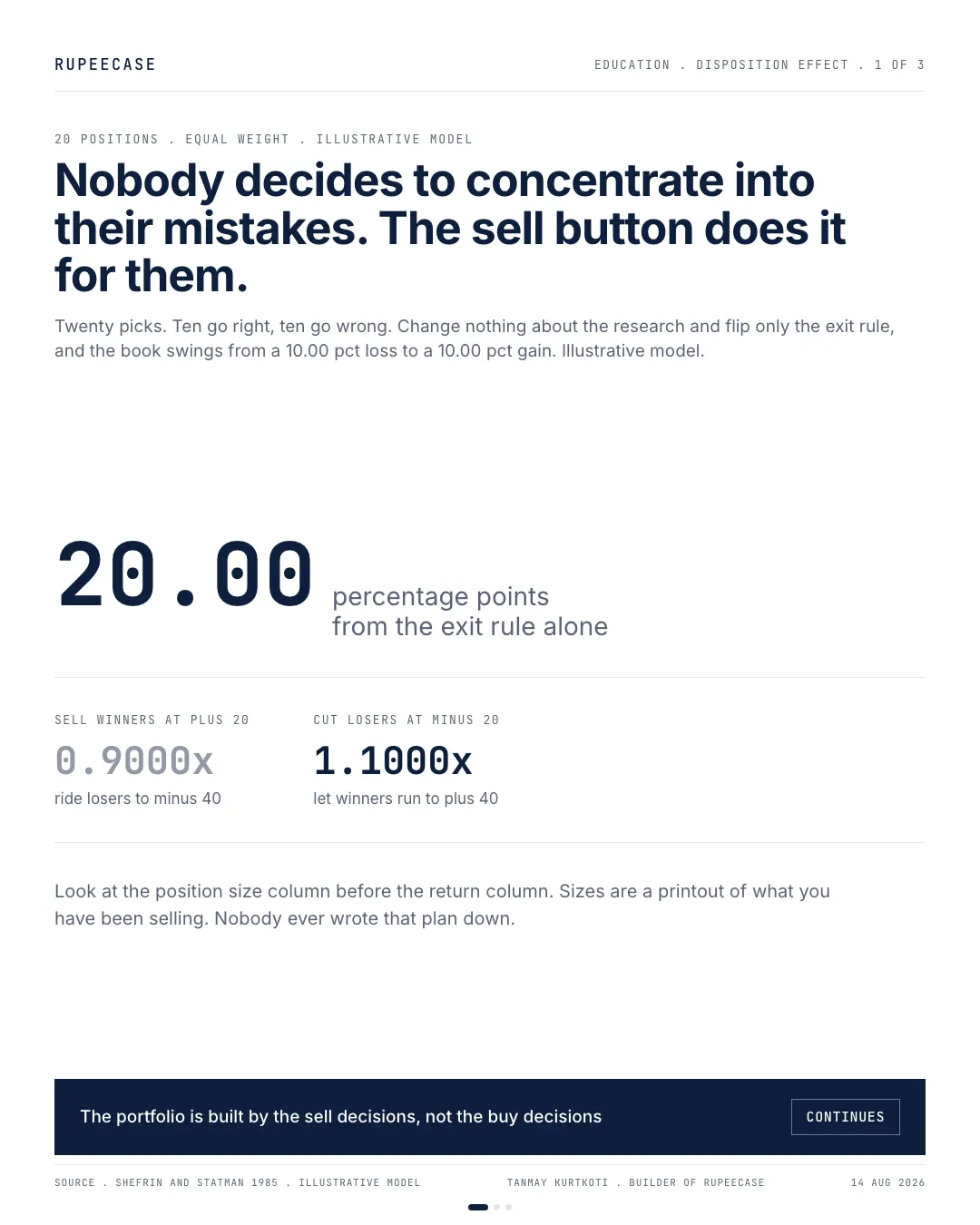
Twenty equal positions with winners sold at plus 20 and losers held to minus 40 end down 10 percent; flip the exit rule and the same picks end up 10, and doing nothing ends flat.
By Tanmay Kurtkoti, founder of QC Alpha and builder of RupeeCase
Friday evening, a friend slides his phone across the table with his holdings screen open and asks me whether the portfolio is any good.
I do not read the names first. I read the column on the right, the one with the position sizes. His three largest holdings are all deep in the red. His three smallest are all green, and two of those are up more than thirty percent.
So I ask him when he decided to put most of his money into the things that were not working.
He looks at me like I have accused him of something, which is fair, because he never decided that. Nobody sits down and writes a plan that says concentrate into the mistakes and keep the successes small.
His portfolio was not built by his buy decisions. It was built by his sell decisions, and he had never once treated those as decisions.
Every holdings screen you have ever seen is a survivor list
The buys set the starting weights. What you are looking at eight months later is the residue of everything you removed since. Sell a position and its weight in the live book goes to zero. Refuse to sell one and its weight keeps whatever the market hands it, which after a bad run is a bigger share of a smaller pile.
Run that loop for two years with a habit of taking profits quickly and sitting on losses indefinitely, and the book fills up with losses through pure mechanics. Not bad luck. Not a bad screener. Bookkeeping.
Which is why the position size column is the most honest thing on that screen. It is a printout of your exit behaviour. Unlike your buy thesis, you never wrote it down, so you have never had to defend it.
Twenty positions, one rule changed, and the gap is bigger than the picks
Here is the model, small enough on purpose that you can check it without a spreadsheet. Twenty positions, equal weight, ten of them go right and ten go wrong. Every figure below is illustrative and the numbers are round so the arithmetic stays visible.
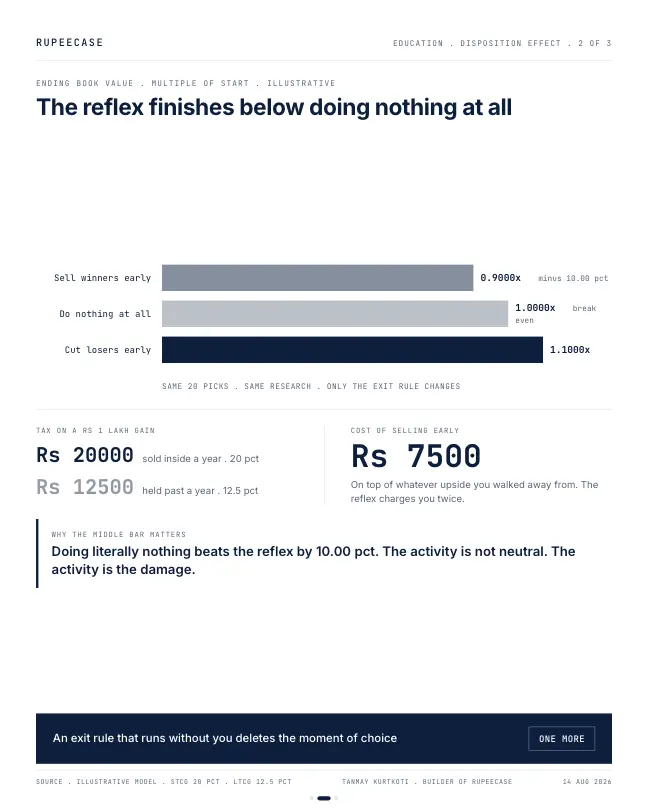
Run the reflex first. Sell each winner when it is up 20 percent. Hold each loser all the way down to minus 40 percent. That leaves ten positions at 1.20 and ten at 0.60, and the book ends at 0.9000 times where it started. A loss of 10.00 percent.
Now change exactly one thing. Not the names, not the research, not the entry prices, not the sizing. Only the exit rule. Cut each loser at minus 20 percent and let each winner run to plus 40 percent. Ten at 1.40, ten at 0.80, and the book ends at 1.1000 times. A gain of 10.00 percent.
Same twenty picks. Twenty percentage points apart.
The diagram is really about what survives. On the left the live book is nothing but the ten that went wrong, because the ten that worked were sold and turned into cash. On the right the live book is nothing but the ten that worked. That is my friend's phone screen, drawn as arithmetic instead of as a screenshot.
The tax code leans on the scale from the same side
There is a second bill attached to the reflex, and it arrives from a direction most people never connect to their sell button. Here are the two rules laid out beside each other with the arithmetic spelled out, plus a third row I will come back to in a minute, and a column for what the tax office takes on the way past.
| Exit rule | The ten that worked | The ten that did not | Book ends at | Tax on a Rs 1 lakh gain |
|---|---|---|---|---|
| Sell winners at plus 20, ride losers to minus 40 | 1.20 each, sold | 0.60 each, held | 0.9000x, minus 10.00 pct | Rs 20,000 at 20 pct short term |
| No exit rule at all, hold everything | 1.40 each, held | 0.60 each, held | 1.0000x, flat | nothing until you sell |
| Cut losers at minus 20, let winners run to plus 40 | 1.40 each, held | 0.80 each, sold | 1.1000x, plus 10.00 pct | Rs 12,500 at 12.5 pct long term |
The last column is the part people skip. Booking a Rs 1 lakh gain before the one year mark costs Rs 20,000 at the 20 percent short term rate. Hold the same position past a year and the identical gain costs Rs 12,500 at 12.5 percent. Selling the winner early hands over an extra Rs 7,500 on top of whatever upside you walked away from. The reflex charges you twice and lets you feel disciplined about it.
The number in the middle row is the one that stopped me
I put that middle row in expecting it to be a throwaway control. It turned out to be the finding.
No exit rule at all. Buy twenty, touch nothing, let the winners run their full plus 40 and let the losers fall their full minus 40. Ten at 1.40 and ten at 0.60 averages to exactly 1.0000. Flat. Every rupee you started with, still there, having done nothing for two years.
Look at the middle bar and then at the one above it. Doing literally nothing beats the reflex by 10.00 percentage points. The disposition portfolio is not merely worse than a good exit rule, it is worse than having no exit rule whatsoever. All that activity, every satisfying green sell confirmation, and the outcome sits below what you would have collected by forgetting your password for two years. That is the part I keep coming back to. The effort is not neutral. It is the damage.
Shefrin and Statman named this in 1985 and the name does most of the work
Hersh Shefrin and Meir Statman published a paper in the Journal of Finance in 1985 titled "The Disposition to Sell Winners Too Early and Ride Losers Too Long", and gave the pattern its name. The mechanism they reached for is prospect theory. A realised loss hurts more than an equivalent unrealised one, because realising it is what makes it feel real.
That last clause carries everything. While you have not sold, the red number on the screen is a rumour. Press sell and it becomes a fact with your name on it, dated, in a statement, ready to be shown to a spouse. So people do not hold losers because they genuinely expect a recovery. They hold them to keep the loss in the rumour state.
Notice what that implies about the winner. Selling it does the opposite job. It converts a paper gain into a fact you can be proud of, immediately, on demand. The sell button is being used as a mood regulator, and the risk you actually carry drifts to wherever that mood leaves it.
This is the case for a dumb exit rule over a clever one
If the loss comes from the moment of choice rather than the quality of the choice, then a better exit rule is not the fix. An exit rule that runs without you is the fix. Not because a mechanical rule picks better, it obviously does not, but because it deletes the instant at which the reflex gets to vote. A fixed rebalancing calendar is not a clever idea. It is a way of not being in the room.
Push it one level further and ask what happens when a large share of holders behaves this way at once. Supply keeps appearing into strength, because everyone is taking profits. Supply keeps withholding into weakness, because nobody wants to make the loss real. Prices then under react in both directions, and a trend that ought to resolve in a week takes months. That is a fair part of why price momentum has stayed measurable for as long as anyone has looked. The reflex is not only expensive for you. It is the raw material for whoever is on the other side.
Where this argument falls apart
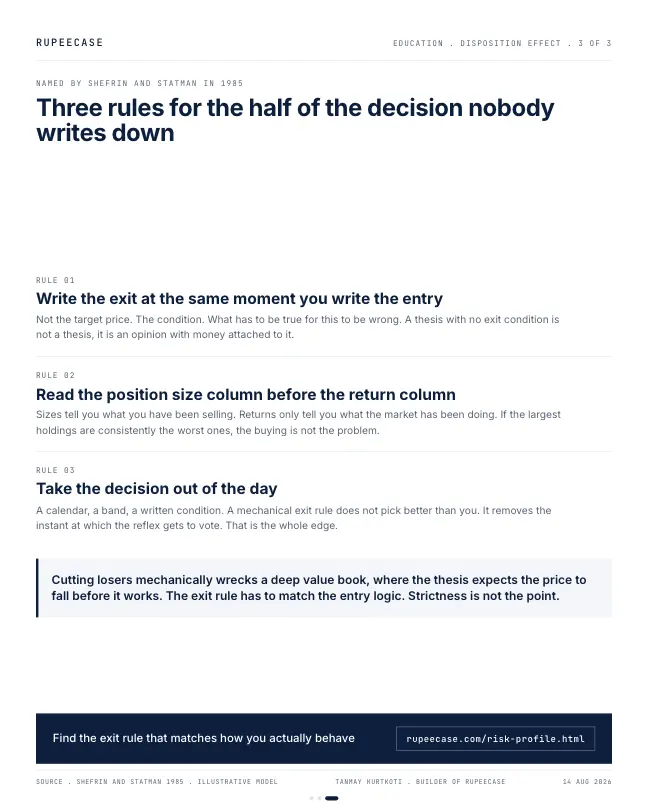
The counter case is specific and it is not a hedge. Cutting losers mechanically destroys a deep value approach, because in deep value the thesis explicitly expects the price to fall further before it works. Buying something you believe is worth 100 at a price of 70 and then selling it at 56 because a rule said minus 20 means you sold the exact thing you came for. The rule that saves a momentum book wrecks a value one. What matters is not that your exit rule is strict, it is that the exit rule matches the entry logic. If you cannot state which one you are running, you are running neither.
Second, the model assumes clean fills at those levels. Real books gap through stops, and real positions are not ten neat winners and ten neat losers in equal weight.
And the falsification. If a review of your own closed trades showed your realised winners had, on average, kept rising after you sold, the reflex is real and it is costing you. If they stalled or turned, it is not, and this whole argument does not apply to you.
Three rules I would actually give him
Write the exit down at the same moment you write the entry. Not the target price, the condition. What has to be true for this to be wrong. A thesis with no exit condition is not a thesis, it is an opinion with money attached.
Read the position size column before the return column. Sizes tell you what you have been selling. Returns only tell you what the market has been doing. If your largest holdings are consistently your worst ones, the problem is not the screener you use to buy, it is the process you never built for selling.
Take the decision out of the day. Whether that is a calendar, a band, a written condition or a rebalance rule, the point is the same. Move the sell from a moment when you are feeling something to a moment when you are not.
He asked me which of his holdings he should sell. Wrong question, and the one everybody asks. The interesting question is which ones he already sold, and whether he can name a single reason for any of them that was not simply that they were green at the time.
The portfolio on that screen is not a set of picks. It is a record of the decisions he did not know he was making.
Questions readers ask
What is the short answer?
Twenty equal positions with winners sold at plus 20 and losers held to minus 40 end down 10 percent; flip the exit rule and the same picks end up 10, and doing nothing ends flat.
Where can I learn behaviour properly?
In the free RupeeCase Learn library: Behaviour, learn it free, no sign up needed. Modules come with quizzes, calculators and a path test.
Is this note investment advice?
No. It is an educational note by Tanmay Kurtkoti. RupeeCase is a technology platform, not a fund, a PMS or a SEBI registered investment adviser.
The cards
3 cards. Swipe, or tap to open.
Explore next
Learn it properly, then see it applied.
Related
- Confirmation bias: research or hopeLord, Ross and Lepper's 1979 study showed mixed evidence hardens both sides, and cutting at minus 15 instead of holding through minus 40 ends Rs 3.51 lakh ahead on Rs 10 lakh.Behaviour . . 7 min
- The disposition effectOdean found investors 1.5 times more likely to sell a winner than a loser, and the winners they sold beat the losers they kept by 3.4 points over the next year.Behaviour . . 8 min
- Risk tolerance is a moodGuiso, Sapienza and Zingales found risk aversion rose sharply after 2008 on fear rather than wealth, so ask the drawdown question in rupees, not percentages.Behaviour . . 5 min
Educational content only. Figures are illustrative and computed on historical or representative data for teaching purposes, not investment advice. Past performance does not guarantee future returns. Sourced from NSE, BSE, SEBI, AMFI and RBI public data.