

Behaviour..10 min read
The default decides more than the advice does
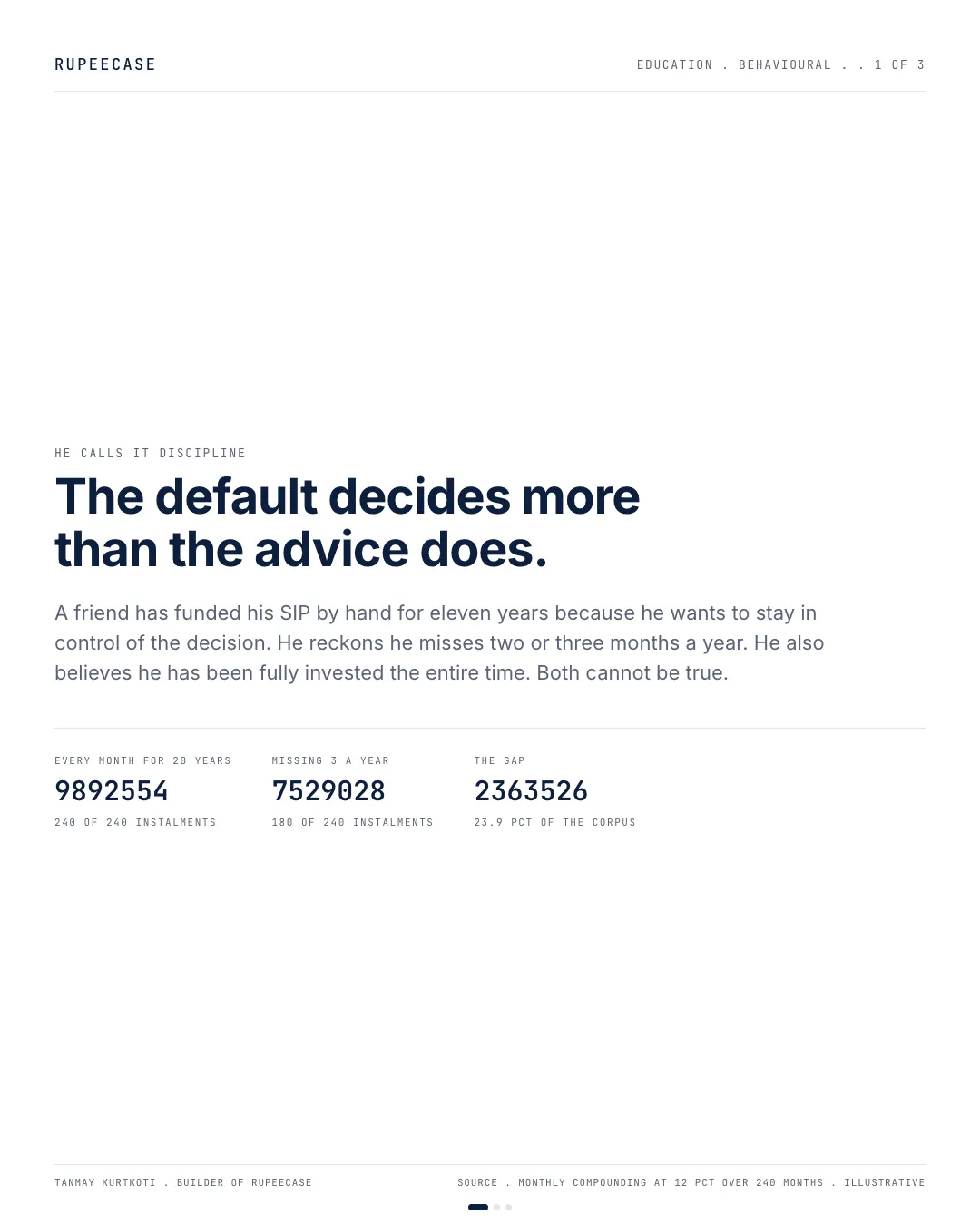
Missing three instalments a year on a Rs 10,000 SIP cuts a twenty year corpus by 23.9 percent, and a skip in month one costs 9.7 times a skip in month 229.
By Tanmay Kurtkoti, founder of QC Alpha and builder of RupeeCase
A friend of mine has run his own SIP manually for eleven years. Not because he does not know about auto debit. Because he wants to "stay in control of the decision."
Every month, on or around the 5th, he opens the app and puts the money in. He is proud of this. He describes it as discipline.
I asked him last month how many he had missed. He thought about it and said maybe two or three a year. Bad months, travel, a wedding, once when a bonus was late and he wanted to see the bank balance settle first.
Two or three a year, for eleven years, and he genuinely believes he has been fully invested the entire time.
Twenty five percent of the instalments, a quarter of the outcome
Run it. Ten thousand a month, twelve percent annual, twenty years.
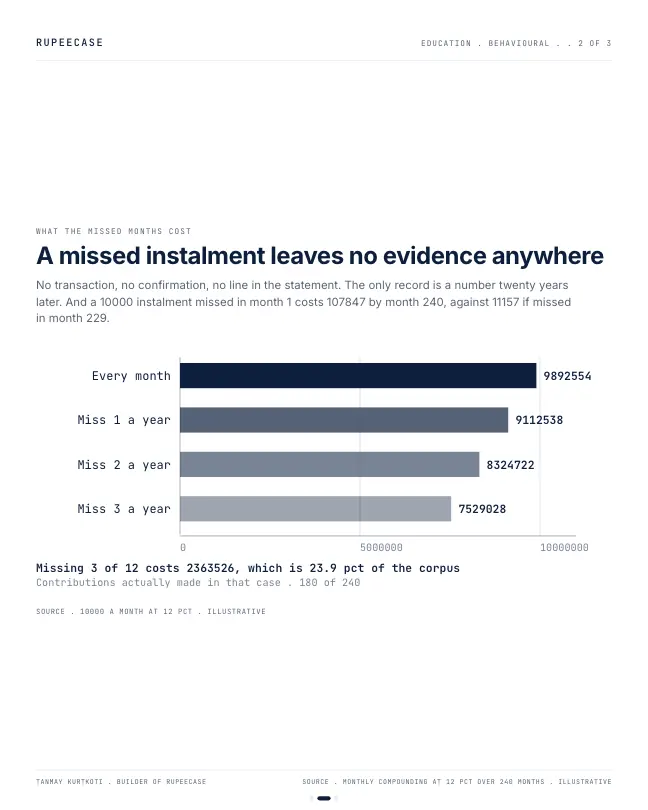
Every single month: 98,92,554.
Miss three a year, which is exactly what he described: 75,29,028.
Two three six three five two six rupees short. Twenty three point nine percent of the corpus, gone, on a plan he describes as disciplined.
Notice something in that chart. He skipped twenty five percent of the instalments and lost 23.9 percent of the corpus, which sounds like a fair trade until you remember he thinks he skipped almost none.
The gap between what he did and what he believes he did is the whole story.
Nobody remembers the month they did not act. There is no transaction, no confirmation, no entry in the statement. A missed instalment leaves no evidence anywhere except in a number twenty years later.
The months you skip are not random, and that is worse
Look at the reasons he gave me. Travel. A wedding. A late bonus. A month he wanted to watch the balance settle.
Those are not random months. Those are months when money felt tight or attention was elsewhere, which in aggregate correlates with exactly the periods when markets are unsettled and everybody feels like waiting. The skipped instalment is systematically more likely to land near a low than near a high, which means the manual investor is running a small, unintentional, reverse timing strategy.
And the arithmetic punishes early skips brutally.
| What gets missed | Cost at month 240 |
|---|---|
| One 10,000 instalment in month 1 | 1,07,847 |
| One 10,000 instalment in month 229 | 11,157 |
| Ratio | 9.7 times |
The same ten thousand rupees, missed at the start instead of near the end, costs 9.7 times as much. Which means the years when a young investor is least established, most likely to have an irregular income and most likely to skip, are precisely the years where skipping is most expensive.
What he thought he was postponing
Last October he had the app open at his kitchen table and the screen had been red for about three weeks. He said he would put it in once things settled.
He thought he was postponing ten thousand rupees.
Divide the model instead. Sixty skips cost 23,63,526 in that illustrative run, so each one is worth roughly 39,392 of final corpus. The miss one and miss two cases give 39,001 and 39,196. A skip costs about four times the instalment no matter how many you take.
That evening was not a ten thousand rupee decision. It was a thirty nine thousand rupee decision, made in the tone of a man rescheduling a haircut.
The form field that decided more than the advice
Here is the part that annoys me about the way we talk about this.
We spend enormous energy on which fund, which category, large cap or flexi cap, direct or regular. Real energy, real debate, real value. And then the outcome gets decided by whether a single checkbox on a registration form was ticked eleven years ago.
Thaler and Sunstein have a whole framework for this and I do not need to relitigate it here. The short version is that whatever happens when a person does nothing is what happens most of the time, and designing that default well produces more behaviour change than any amount of persuasion.
The hardest evidence I know of predates the framework. Brigitte Madrian and Dennis Shea studied one large American employer that flipped its retirement plan from opt in to opt out, published in the Quarterly Journal of Economics in 2001. None of the economics changed. Participation was significantly higher anyway, and a large share of those enrolled automatically stayed on both the default contribution rate and the default fund, a combination almost nobody under the old system had picked for themselves.
That second finding is the uncomfortable one. People did not merely tolerate the default. They read it as advice.
My friend did not need better information. He had excellent information. He needed one fewer decision, repeated 240 times.
The sentence that costs the most money in Indian personal finance
My friend has a phrase he uses without noticing. He says he invests "when there is spare money."
Sit with that for a second, because it describes a system, and the system has a defect in it.
Spare money is a residual. It is what is left after everything else has taken its share, which means it is the last claim on the account and every other claim gets served first. A residual is not a plan. It is the absence of one, dressed as flexibility.
Reverse the order and nothing else about his life changes. The instalment leaves on the 3rd, the rest of the month happens around it, and consumption becomes the residual instead. Same income, same expenses, same person. What changed is which claim gets paid first, and that single reordering is what makes the 240 of 240 outcome possible at all.
There is a second effect that compounds it. When funding is a monthly decision, the amount is also a monthly decision, and amounts decided monthly do not rise. My friend has been putting in ten thousand for eleven years. His income is not what it was eleven years ago. A mandate with an annual step up instruction attached would have grown the contribution with his salary without him thinking about it once, and the gap between a flat contribution and a rising one over two decades is not small.
He is running an eleven year old number through a system that asks him to reconsider it every thirty days, and the answer he gives is always the same one he gave in 2015.
The decision you make once is the one worth agonising over
Push that a step further than is comfortable.
If the default does most of the work, the highest value decision in an investing life is not a judgement call at all. It is plumbing. Mandate or no mandate, which date, what amount, whether a step up instruction is attached. Four choices, made once, in about twenty minutes, on a form.
Now count where the attention goes. Hours on which fund. More hours on direct against regular. Evenings lost to star ratings and expense ratios and last year's category table. Then thirty distracted seconds on the screen that decides whether the money arrives at all for the next 240 months.
Attention gets spent in almost perfect inverse proportion to impact.
Fund choice still matters, but a dull index fund funded 240 of 240 times beats a good one funded 180 times, and the model above says by roughly how much. Rules written once and left to run is the whole idea behind the methodology pages.
Then it turns unpleasant. If defaults dominate outcomes, whoever designs the form has more influence on your result than whoever picks your fund, and that is a distribution problem rather than a research one. The person deciding which box arrives pre ticked contributes more to your corpus than the person writing the commentary you sat down to read.
The part where I argue against myself
Automating is not costless and there are people for whom my friend's approach is correct.
Take a designer I know who bills project by project. Some months three invoices clear. Some months none do, and the payment promised for March turns up in June. Her average income would carry a ten thousand mandate without noticing. Her worst month would struggle with two.
Put a fixed mandate on that account and watch the mechanism run. The debit lands on a morning the balance is short. Her bank charges her for the failure and it is recorded at the other end too, so it is not a missed instalment, it is a missed instalment plus a fee plus a mark against her. Twice and she is having a conversation with her bank she never wanted. Three times and it gets cancelled, by her or by them.
Now she is funding by hand exactly like my friend, except she is also carrying the memory of it failing. The default that quietly protects a salaried investor has actively punished her, by the same mechanism that helped him: it acted while she was not there to stop it.
So the fix is not to abandon the default. It is to set it at her floor rather than her average.
The bigger objection is that a default is a form of influence, and whoever sets it has power over you. A default equity allocation that is wrong for your horizon compounds a wrong decision with the same efficiency it would compound a right one. Lifecycle defaults in retirement products are the obvious example: excellent for the median saver, and wrong at both tails. Automating a bad allocation is worse than deciding a good one manually, and if you are not sure which one you have, the risk profile wizard is the cheapest way to find out before you make it automatic.
And I would be dishonest if I did not say that the twelve percent above is an assumption. Change it to eight percent and the rupee gap shrinks a lot. What does not change is the proportion, because the proportion is set by the missed instalments, not by the return.
What would change my mind is easy to state. Show me a real sample of manual funders whose ten year completion rate clears 95 percent, with the skipped months showing no clustering around market falls, and this argument collapses, because all of it rests on people missing more than they think and missing at the wrong moments.
Three rules
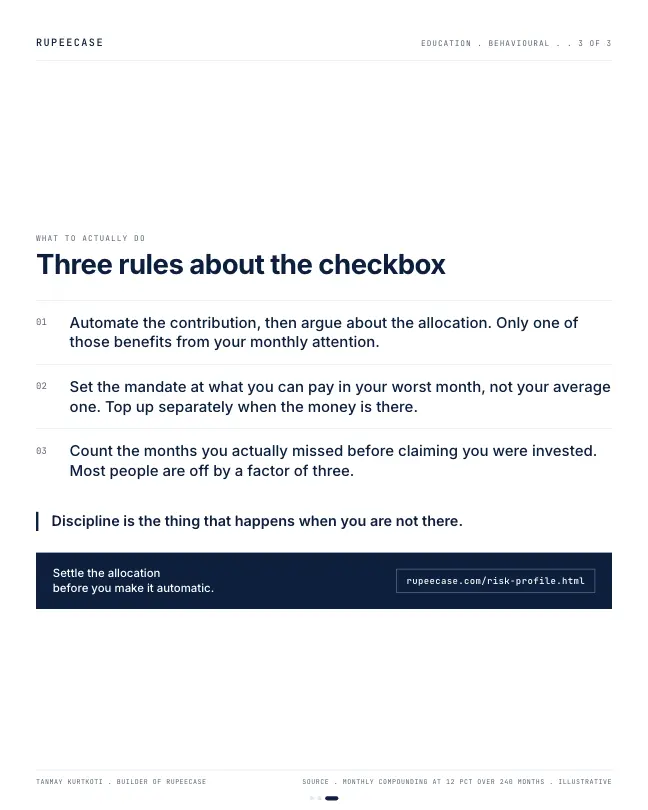
Automate the contribution, then argue about the allocation. Those are separate decisions and only one of them benefits from your monthly attention. Getting the second one right is what the learn paths are for.
Set the mandate at an amount you can pay in your worst month, not your average one. A mandate you never have to cancel beats a bigger one you cancel in year three. Top up separately when the money is there.
Count the months you missed before you claim you were invested. Most people are off by a factor of three, in the same direction, and the number is sitting in the transaction history where nobody looks.
My friend still thinks manual funding is discipline.
Discipline is the thing that happens when you are not there.
Questions readers ask
What is the short answer?
Missing three instalments a year on a Rs 10,000 SIP cuts a twenty year corpus by 23.9 percent, and a skip in month one costs 9.7 times a skip in month 229.
Where can I learn behaviour properly?
In the free RupeeCase Learn library: Behaviour, learn it free, no sign up needed. Modules come with quizzes, calculators and a path test.
Is this note investment advice?
No. It is an educational note by Tanmay Kurtkoti. RupeeCase is a technology platform, not a fund, a PMS or a SEBI registered investment adviser.
The cards
3 cards. Swipe, or tap to open.
Explore next
Learn it properly, then see it applied.
Related
- Ten days that matteredRs 10 lakh in the Nifty 50 TRI from July 1999 grew to Rs 2.84 crore, or Rs 96 lakh without the 15 best days, seven of which sat within two weeks of the ten worst.Behaviour . . 8 min
- The behaviour gap: fund return vs investor returnIndian equity funds returned 19.1 percent a year from 2003 to 2022 while the rupees investors actually put in earned 13.8, and SIP investors earned 15.2.Behaviour . . 5 min
- Pausing a SIP in a downturn is the most expensive instinctOn identical money and the same exit, the investor who kept buying through a 40 percent fall ended with 329 more units and Rs 39,471 more than the one who paused.Behaviour . . 5 min
Educational content only. Figures are illustrative and computed on historical or representative data for teaching purposes, not investment advice. Past performance does not guarantee future returns. Sourced from NSE, BSE, SEBI, AMFI and RBI public data.