

Behaviour..10 min read
A stop loss is not a floor. It is a request.
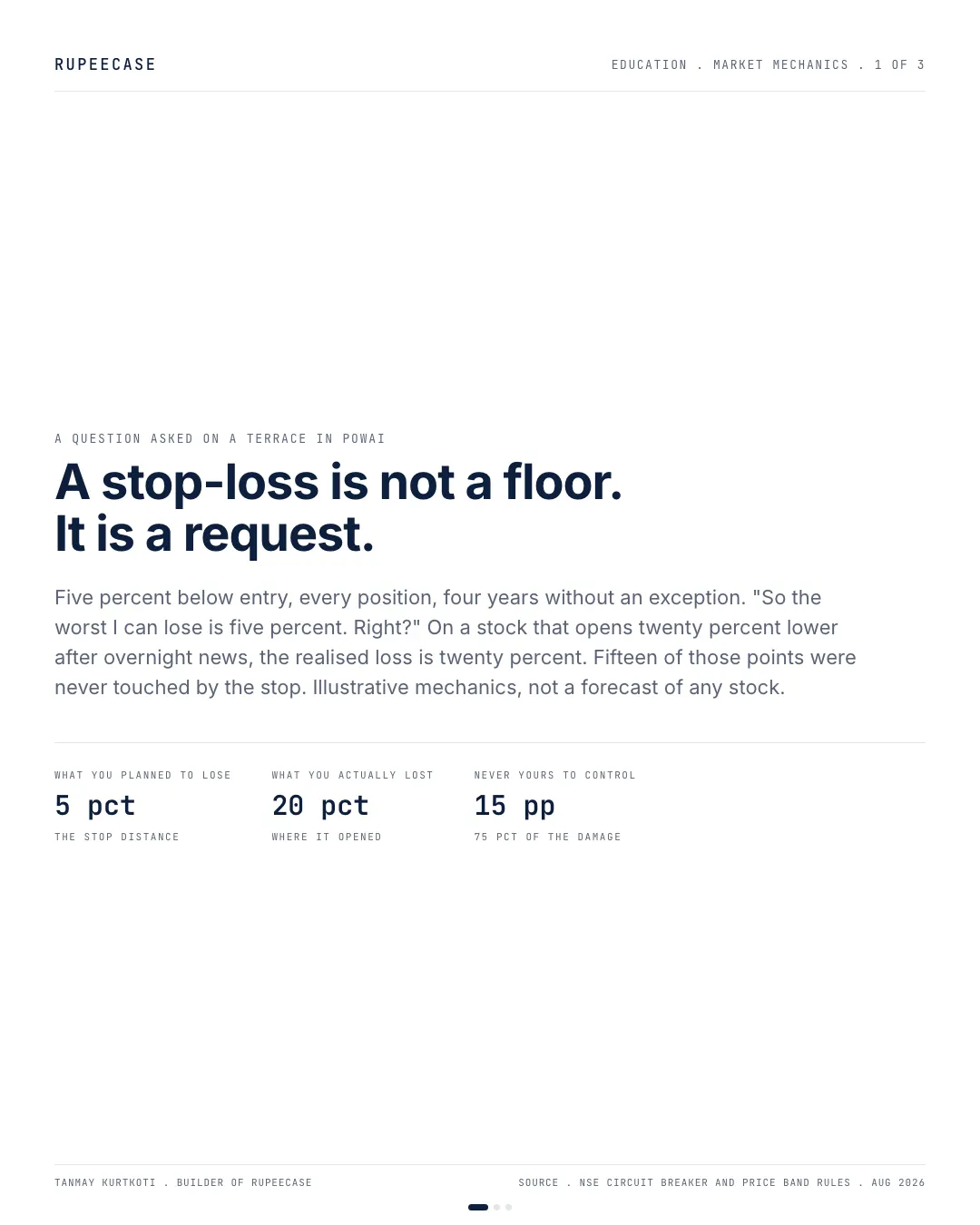
A stop is a trigger plus whatever fill exists, and in a 20 percent gap a 5 percent stop left 75 percent of the damage uncontrolled while circuit rules queued the exit.
By Tanmay Kurtkoti, founder of QC Alpha and builder of RupeeCase
Tuesday evening, a terrace in Powai, the sort of party where two people find out what you do for a living and it stops being a party. A man I had met once before is explaining his risk management to me over a paper plate of kebabs.
Every position, stop-loss five percent below entry. Four years of it, no exceptions.
"So the worst I can lose is five percent," he says. "Right?"
I said something vague and let the conversation move on, because nobody wants to be the person who ruins a terrace. Then I went home and did the arithmetic, which takes about three minutes and does not come out at five percent.
A stop-loss is not a floor under your position. It is a request to sell at the next available price, and on the days that matter most there is no next available price.
What that order actually says when you place it
A stop order carries two prices and most people only ever think about one of them. There is the trigger, the level at which the order wakes up. And there is the fill, which is whatever somebody happens to be willing to pay at the moment it wakes up. In a calm market those two numbers sit almost on top of each other. That is the entire reason the illusion survives for years at a time without ever being tested.
The order does not say sell my shares at this price. It says when it trades here, go find me a buyer. Nobody at the exchange has agreed in advance to be that buyer.
Zerodha's own support page puts it in the flattest possible language. Orders placed outside the price band get rejected. If the price reaches the band, your orders remain pending until the exchange relaxes the limits. Pending. Triggered and sitting there doing nothing, while the number on your screen carries on without you.
That one sentence is most of the argument, and it lives in a broker FAQ almost nobody reads. If you want the plumbing rather than the app label, start with how an order actually reaches the exchange.
I ran the arithmetic and the tighter stop came out worse
The model fits on one line. Take the loss you planned for, which is your stop distance. Take the loss you actually took, which is the size of the gap. The difference is the part of your risk that was never yours to manage.
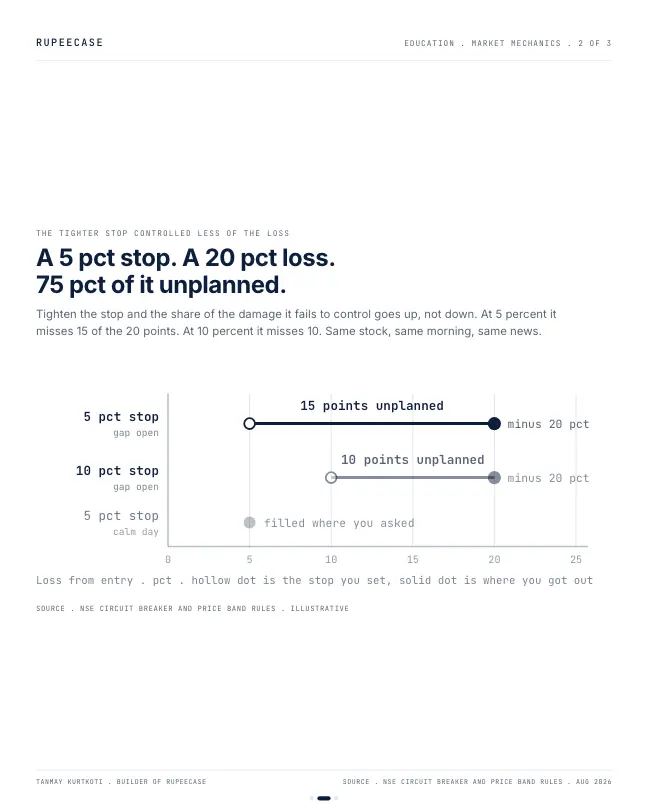
Run it on a stock that opens twenty percent lower after news lands overnight. A stop five percent below entry gives you a realised loss of twenty percent, of which fifteen percentage points were untouched by any rule of yours. A stop ten percent below gives you the same twenty percent realised, with ten points unplanned. Both cases are illustrative mechanics, not a forecast of any stock.
Look at the shares rather than the sizes. The five percent stop failed to control fifteen of the twenty points, which is seventy five percent of the damage. The ten percent stop failed to control ten of twenty, which is fifty. The tighter stop protected a smaller share of the exact loss it existed to prevent. That is not what anyone expects, and I did not expect it either until I wrote it down.
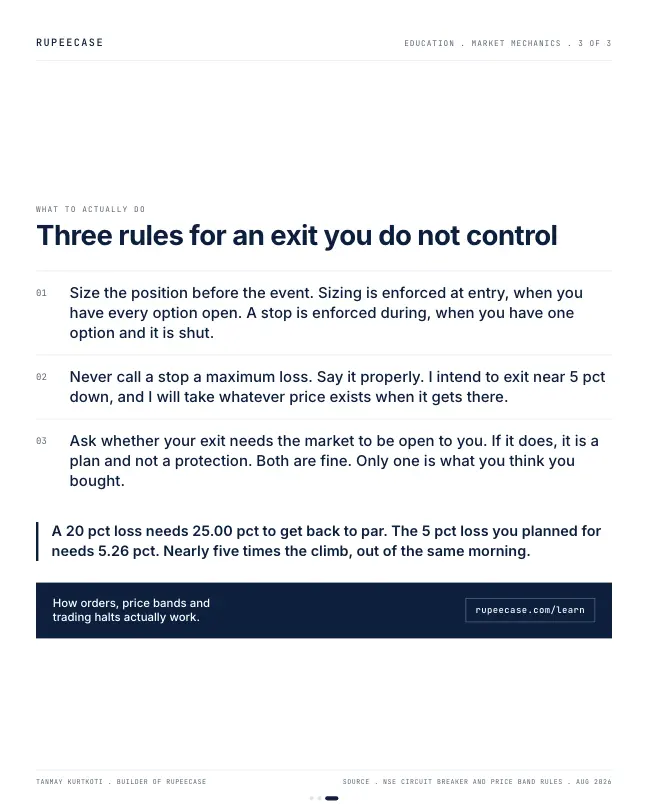
The hole is also deeper than it looks going in. A realised twenty percent loss needs a 25.00 percent gain to get back to par. A five percent loss, the one he thought he had signed up for, needs 5.26 percent. Same stock, same morning, and the climb back is nearly five times heavier.
The thing that keeps the market orderly is the thing that locks your door
Indian exchanges run a market-wide circuit breaker at three levels, ten, fifteen and twenty percent, triggered by whichever of the Sensex or the Nifty 50 is breached first. What happens next depends on the level and on the clock, and the exchange recomputes the trigger points every day from the previous close.
| Index move | When it fires | What happens to the session |
|---|---|---|
| 10 pct | Before 1:00 pm | Halt 45 minutes, then a 15 minute pre-open call auction |
| 10 pct | 1:00 pm to 2:30 pm | Halt 15 minutes, then a 15 minute pre-open call auction |
| 10 pct | At or after 2:30 pm | No halt. Trading continues |
| 15 pct | Before 1:00 pm | Halt 1 hour 45 minutes, then a 15 minute pre-open call auction |
| 15 pct | 1:00 pm to 2:00 pm | Halt 45 minutes, then a 15 minute pre-open call auction |
| 20 pct | Any time in the session | Session ends. Nothing more trades that day |
A fifteen percent move at or after 2:00 pm also ends the session, which is the row I left out to keep the table readable. Read the last line again and notice what it does to a stop order. A twenty percent move ends the day. Your instruction to sell survives the halt in perfect health and has nowhere to go.
Individual securities carry their own bands, running from two percent to twenty percent depending on the scrip. The names most people actually trade with stops, the ones with futures and options on them, do not carry a fixed daily band at all. They get a dynamic band set at ten percent of the previous close, which the exchange widens as the price approaches it, with a cooling period before the new limits open up. Your exit is queued behind a timer.
What actually happens between the news and the fill
Written as a sequence it stops sounding like bad luck and starts sounding like design, because that is what it is.
Nothing in that chain is a malfunction. Every box does its job. The exchange is protecting the market from disorderly price discovery, which is a real and useful thing to protect against, and the same wall that stops the disorder is the wall your exit is standing behind.
You did not remove the risk, you swapped it for the worse kind
This is the part that changed how I think about stops, so I will say it plainly. A stop-loss does not delete risk. It converts price risk into liquidity risk.
Price risk is the ordinary kind. It is roughly symmetric, it is diversifiable, it shows up on random Tuesdays for reasons that have nothing to do with anybody else's positioning. Liquidity risk is not like that. Liquidity risk is the risk that when you want to transact, nobody is there. And the one thing you can say with confidence about liquidity is that it disappears precisely when the largest number of people want the same side of the trade you want.
So the trade you made was this. You gave up a risk that is spread across time and across your holdings, and you took on a risk that concentrates itself into a handful of mornings.
Then go one step further and ask what happens when everybody does it. Stops cluster. They sit five and ten percent below entry, they sit under the round numbers, they sit under the same chart level everybody drew on the same chart. Those orders are not independent insurance policies. They are one large correlated sell order waiting for a trigger. When it fires, it is the thing that deepens the move, and the move is what makes the exchange halt trading, and the halt is what leaves the orders unfilled. The protection helps manufacture the event it was bought to protect against. Which instruments you own is a portfolio decision made long before any stop is placed, and comparing approaches on that basis beats comparing them on last year's numbers.
Where this argument falls apart
Stops work most of the time, and throwing them out because of the tail is its own mistake. In an ordinary liquid market, on an ordinary day, a stop does roughly what it says on the tin. The case against them is narrow and specific. It is about the small number of days that produce a disproportionate share of a lifetime's losses, and outside those days the criticism is close to irrelevant.
The counter-case is a real person, not a hedge. Someone trading index futures or the largest twenty names intraday, flat before the close, never carrying an overnight position, is living in a different market from the one I have described. Continuous two-way flow, a band that never binds, fills within a tick or two of the trigger. For that trader the gap I have modelled is a story about somebody else's portfolio, and a stop is a perfectly sound tool.
Which gives a clean test. If you pull your own trade log and your stopped-out trades have historically filled within a percentage point or so of the trigger price, then the instruments you trade are liquid enough that this whole concern is theoretical for you, and you should ignore me.
What I do not know is how often this actually bites the average Indian retail portfolio. I have the mechanism cold. I do not have a clean study of realised slippage on retail stop orders across a full cycle, and anyone who tells you they do should be asked for the file.
Three rules I would give the man on the terrace
Size the position before the event, not during it. Position sizing is enforced at entry, when the market is open, when you have every option available and no pressure at all. A stop-loss is enforced during the event, when you have one option and it is not available. Only the first one still works when the market is shut to you. If you cannot survive the whole position going to a number you would find absurd, the position is too big, and no order type fixes that. A rules-based framework sizes first and argues later.
Never state a stop as a maximum loss. Say it out loud as what it is. "I intend to exit around five percent down, and my actual exit will be wherever the market is when it gets there." That sentence is longer and much less comforting, which is the point.
Check whether your exit depends on the market being open to you. If it does, it is a plan and not a protection. Plans are fine. Protections are what you tell yourself before a party, and then somebody does the arithmetic on a Tuesday night.
He was not wrong to use stops. He was wrong about what he owned. He thought he had bought a floor. What he actually bought was a place in a queue, and the queue is longest on the one morning he needs it to be short.
Questions readers ask
What is the short answer?
A stop is a trigger plus whatever fill exists, and in a 20 percent gap a 5 percent stop left 75 percent of the damage uncontrolled while circuit rules queued the exit.
Where can I learn behaviour properly?
In the free RupeeCase Learn library: Behaviour, learn it free, no sign up needed. Modules come with quizzes, calculators and a path test.
Is this note investment advice?
No. It is an educational note by Tanmay Kurtkoti. RupeeCase is a technology platform, not a fund, a PMS or a SEBI registered investment adviser.
The cards
3 cards. Swipe, or tap to open.
Explore next
Learn it properly, then see it applied.
Related
- Stops set by feel, not by mathA 10 percent trailing stop on an ordinary large cap gets hit four to six times a year by normal weather, and each forced round trip costs about 0.30 percent.Behaviour . . 6 min
- The default decides more than the advice doesMissing three instalments a year on a Rs 10,000 SIP cuts a twenty year corpus by 23.9 percent, and a skip in month one costs 9.7 times a skip in month 229.Behaviour . . 10 min
- Selling the wrong halfTwenty equal positions with winners sold at plus 20 and losers held to minus 40 end down 10 percent; flip the exit rule and the same picks end up 10, and doing nothing ends flat.Behaviour . . 10 min
Educational content only. Figures are illustrative and computed on historical or representative data for teaching purposes, not investment advice. Past performance does not guarantee future returns. Sourced from NSE, BSE, SEBI, AMFI and RBI public data.