



Who this is for
RBI defines a non-resident Indian (NRI) as a person resident outside India who is a citizen of India; an Overseas Citizen of India (OCI) cardholder resident abroad is covered as a person of Indian origin, and the share purchase rules treat NRIs and OCIs together.
Read one more paragraph, 44 words
If you have just moved abroad, tell your bank and broker: RBI says an existing resident account should be designated as an NRO account. This guide covers listed shares bought on the exchange. Mutual funds, IPOs, F&O and property have their own rules.
The two RBI routes
Money can go back abroad
- Pay by inward remittance or from a repatriable account such as NRE
- Each investor below 10% of a company
- All NRIs and OCIs together at most 24%
- Proceeds, net of tax, remitted or credited to a repatriable account
Treated like a resident's investment
- Pay from NRE, FCNR(B) or NRO
- No investment limit
- Proceeds credited only to NRO
- Money leaves only within the NRO remittance limit
Repatriation basis (Annex 3). RBI's Master Direction permits an NRI or OCI to buy and sell equity of a listed Indian company on a recognised exchange. Each individual's holding must be less than 10% of the company's paid-up equity on a fully diluted basis, and the total held by all such individuals must not exceed 24%.
Read 2 more paragraphs, 137 words
Payment comes from an inward remittance through banking channels or a repatriable account designated for these investments, and sale proceeds net of tax can be remitted abroad or credited to that account. Banks commonly call this designated arrangement a portfolio investment or PIS account.
Non-repatriation basis (Annex 4). An NRI or OCI may buy capital instruments of any company, on or off the exchange, without a limit, and the investment is treated as domestic, at par with residents. The money can come from NRE, FCNR(B) or NRO accounts, but the sale proceeds go only to the investor's NRO account, and the amount invested and its gains cannot be repatriated under this route. The same annex bars investments in Nidhi companies and in companies in agriculture, plantations, real estate business, farm houses or transferable development rights.
The accounts behind each route
| Account | Currency | Can the money go abroad? | Typical use for shares |
|---|---|---|---|
| NRE (Non-Resident External) | Rupees | Yes, it is a repatriable account | Buying on the repatriation basis |
| NRO (Non-Resident Ordinary) | Rupees | Current income yes; other balances up to USD 1 million a financial year | Income earned in India, and proceeds of non-repatriation sales |
| FCNR(B) | Foreign currency deposit | Yes | A source of funds, not a trading account |
each NRI or OCI must stay below, of a company's paid-up equity, repatriation basis
RBI Master Direction, Annex 3
the most all NRIs and OCIs together may hold, repatriation basis
RBI Master Direction, Annex 3
a financial year that can be remitted from NRO balances and asset sale proceeds
RBI FAQ on non-resident accounts
on long term listed equity gains above ₹1.25 lakh a year, plus surcharge and cess
Income-tax Act, 2025, section 198
The 24% is about the company, not about you: it is shared by every NRI and OCI holding on the repatriation basis, so a company can run out of room even if your own holding is tiny. For a diversified portfolio of large listed companies this rarely matters; it can for small companies with concentrated ownership. The module on SEBI's framework covers who regulates which part of the chain.
The tax on an NRI's share gains
Capital gains on listed Indian shares are taxed in India whether you are resident or not, at the same special rates:
- Tax deducted at source
- No basic exemption against these gains
- Tax treaties
Read 2 more paragraphs and 2 lists, 286 words
- Short term (held 12 months or less): 20% under section 196 of the Income-tax Act, 2025 (section 111A of the 1961 Act).
- Long term (held more than 12 months): 12.5% on gains above ₹1.25 lakh in the tax year under section 198 (section 112A).
- Surcharge where income crosses the thresholds, capped at 15% on these gains, and 4% cess.
Three differences from a resident matter in practice:
- Tax deducted at source. Tax on a non-resident's capital gains is deducted when the sale is settled, under section 393(2) (section 195 of the 1961 Act), at the rates in force. A resident's share sales carry no such deduction.
- No basic exemption against these gains. A resident with low income can set the unused basic exemption against short and long term equity gains; sections 196(2) and 198(3) give that only to residents. A non-resident pays the special rate from the first rupee above the ₹1.25 lakh long term exemption.
- Tax treaties. India's double taxation agreements, under section 159 (section 90 of the 1961 Act), can give a lower rate or a credit in your country of residence, if you hold a tax residency certificate. Check the treaty with your own country.
Losses work the same way as for residents: a short term loss can be set against short or long term gains, a long term loss only against long term gains, and both carry forward for eight tax years if the return is filed on time. Because tax is deducted at source on each gain, filing a return is how an NRI sets losses against gains and claims back any excess deduction. The capital gains tax guide works through the rules in rupees.
Currency: the return you actually get
An NRI who brings money from abroad earns the rupee return plus or minus the change in the exchange rate. A rupee that weakens during your holding cuts the return in your home currency; one that strengthens adds to it.
Read one more paragraph, 31 words
The module on the rupee and FII flows explains what moves the exchange rate, and the note a record low rupee redistributes shows who gains and who loses when it falls.
How to start, step by step
- Pick the routerepatriation if you may want the money back abroad, non-repatriation if it is Indian income that will stay in India.
- Open the bank accountsan NRE account for remitted money and an NRO account for Indian income; your bank designates the account linked to share purchases.
- Open an NRI trading and demat accountwith a broker that offers NRI accounts linked to that bank account, completing the KYC the broker asks for.
- Fund itremit money from abroad into NRE, or use NRO balances for the non-repatriation route.
- Buy on the exchangedelivery trades in listed shares, paid from the account designated for the route you chose.
- Keep the tax recordsthe contract notes, the tax deducted on each sale, and a tax residency certificate if you rely on a treaty; file a return in India when gains or refunds arise.
A few practical points. Many brokers run NRI accounts through a partner bank, so the choice of bank and broker is linked; the broker guide lists what to compare. And the demat safety guide applies unchanged: shares sit in your own demat at NSDL or CDSL whichever route you use.
How this shows up in RupeeCase

1You log in with your own broker account, here 5paisa. 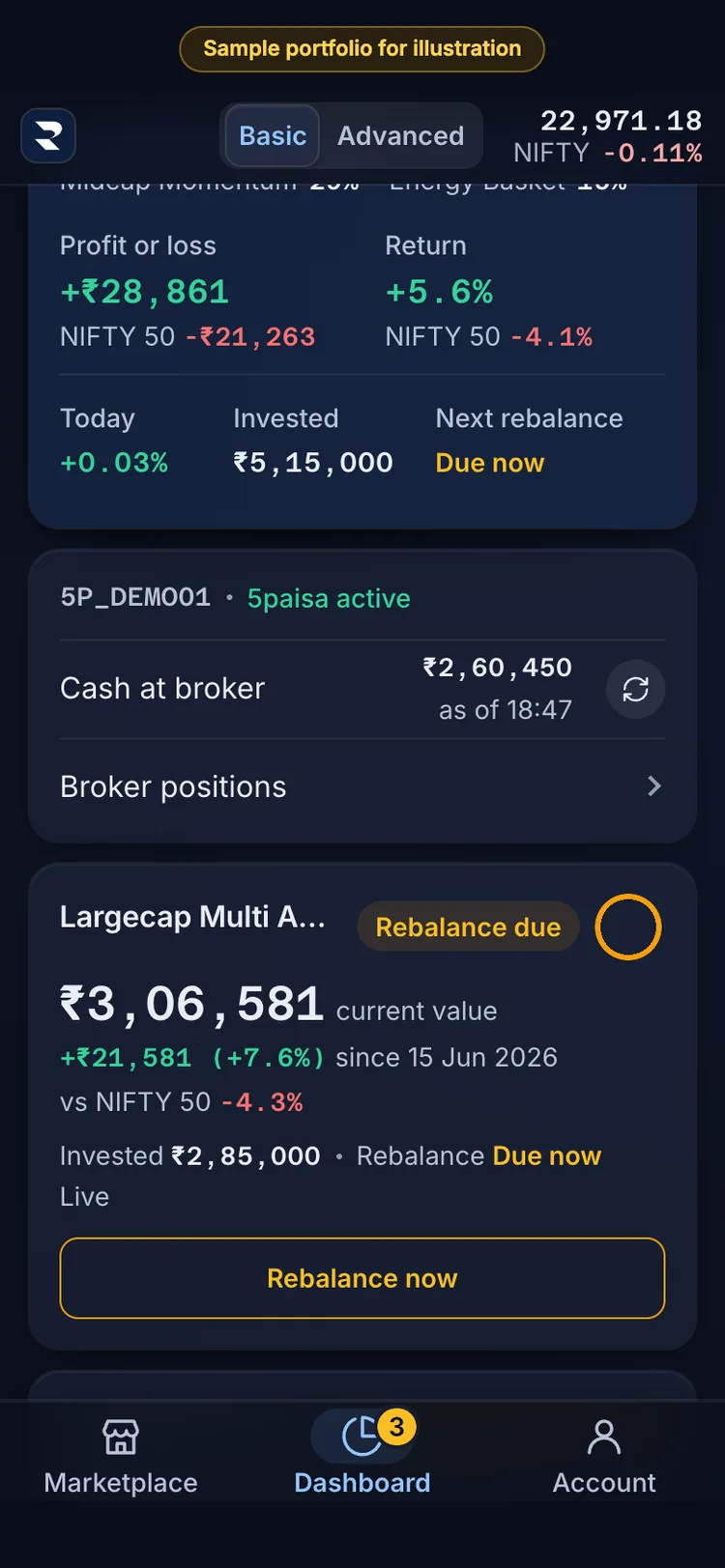
2Fetch reads the cash in your own broker account. RupeeCase never holds it. 
3Live orders go to your own broker, and only after you accept the consent text. 
4RupeeCase never holds your money: orders go to your own broker account.
Where it sits in RupeeCase, in words
RupeeCase rules run in the investor's own broker and demat account, so the RBI route, the bank accounts and the tax deducted at source are set by that account. Whether a given NRI account can connect depends on the broker. Large Midcap runs a momentum rule on the Nifty LargeMidCap 250, 40 holdings rebalanced every 2 weeks: model CAGR 37.83%, deepest fall −19.31%, as of 27 Apr 2026. Every rebalance sale in an NRI account is a taxable sale under the rules above.
Questions investors ask
Can an NRI invest in the Indian stock market?
Yes. NRIs and OCIs can buy and sell listed shares on NSE and BSE through an Indian broker, on the repatriation or non-repatriation basis set out in RBI's Master Direction on Foreign Investment.
What is the difference between repatriation and non-repatriation investment?
On the repatriation basis the money comes from abroad or a repatriable account and the proceeds, net of tax, can go back abroad; holdings are limited to below 10% of a company each and 24% for all NRIs and OCIs together. On the non-repatriation basis there is no limit, but proceeds go only to an NRO account.
Should an NRI use an NRE or NRO account for shares?
NRE suits money brought from abroad that you may want to send back. NRO holds income earned in India and receives the proceeds of non-repatriation sales; RBI allows up to USD 1 million a financial year to be remitted from NRO balances and asset sale proceeds.
How are NRIs taxed on Indian share gains?
At the same rates as residents: 20% on short term gains and 12.5% on long term gains above ₹1.25 lakh a year, plus surcharge and cess. Tax is deducted at source on the gain, and the unused basic exemption cannot be used against these gains.
Is TDS deducted when an NRI sells shares?
Yes. Tax on a non-resident's capital gains is deducted at source at the rates in force, under section 393(2) of the Income-tax Act, 2025 (section 195 of the 1961 Act). Filing a return settles the final tax and any refund.
Can an OCI cardholder invest in Indian shares?
Yes. RBI's Master Direction treats NRIs and OCIs together for purchases of listed equity on the exchange, on both the repatriation and non-repatriation basis.