



Start with what ₹10,000 a month can do
₹10,000 a month is ₹1.2 lakh a year. It is enough to build a real portfolio in a few years and too little to spread across a dozen products. The common mistake at this size is not picking the wrong fund; it is owning seven funds that hold the same shares, or stopping the SIP in the first bad year.
The SIP's value fell below the money put in during early 2020, reached about ₹21 lakh at the end of 2025 against ₹11.1 lakh put in, and was ₹18.73 lakh on 12 Oct 2026 against ₹12 lakh.
Nifty 50 price index, NSE daily closes; ₹10,000 at the first close of each month, Oct 2016 to Sep 2026, valued at each month end. Before costs, dividends and tax. Past returns.
value on 12 Oct 2026 of ₹12 lakh put in over ten years, 8.57% XIRR
Nifty 50, NSE closes
value on 2 Jan 2026, the record close, of ₹11.1 lakh put in to Dec 2025
Nifty 50, NSE closes
below the money put in at the end of Mar 2020, the low point of the ten years
Nifty 50, NSE closes
with the SIP raised 10% each year: ₹19.12 lakh put in
Nifty 50, NSE closes
Read 2 more paragraphs, 142 words
Here is what one plain choice, the Nifty 50, did with ₹10,000 at the start of every month for the ten years from Oct 2016 to Sep 2026. The figures use the price index, so an index fund that collects dividends would have done slightly better before its fee.
Three readings of the same SIP show why the end date matters. Valued at the January 2026 record, it had compounded at about 13% a year. Valued on 12 Oct 2026, after the Nifty fell 15% from that record, 8.57%. Over the last five years alone, Oct 2021 to Sep 2026, ₹6 lakh had become ₹6.45 lakh, 2.8% a year; over the last three, ₹3.6 lakh was worth ₹3.41 lakh. Equity SIPs are lumpy. The how long to stay invested guide shows why a ten year horizon is the one that has worked.
The order of steps
- Build an emergency fund firstseveral months of expenses in a savings deposit or liquid fund, before any equity. The emergency fund calculator sizes it.
- Count what you already holdEPF, PPF and deposits are debt. If your salary already sends money into EPF, your portfolio is not all equity even if your SIP is.
- Start a low cost coreone diversified fund, such as a Nifty 50 or broader index fund, takes the larger part of the ₹10,000. One fund is enough at this size.
- Set the date and the debita few days after your income lands; the best SIP date guide shows the date itself does not matter.
- Raise it every yearby a fixed amount or percentage, ideally when your income rises. The step up SIP calculator shows the effect.
- Add anything narrower latera second equity strategy, a sector or a rule based basket, only once the core is in place and the amount reaches its minimum.
- Review once a yearrebalance if the mix has drifted, check the tax position before 31 March, and otherwise leave it alone.
The steps are the same ones the first salary guide walks through for a new earner. The point of the order is that each step protects the next: the emergency fund keeps you from selling equity to pay a bill, and the core keeps a narrow bet from being your whole portfolio.
One way the ₹10,000 can look
- Index fund SIP, the core₹6,000
- Debt: PPF or a debt fund₹2,000
- Pot for a second strategy₹2,000
An illustration of the method, not a recommendation. The split depends on your goals, what you already hold in EPF and deposits, and the fall you can sit through.
The proportions are less important than keeping the core large and the rest simple. Someone with a large EPF balance may put all ₹10,000 into equity; someone saving for a house deposit in two years should keep that money out of equity entirely. The equity by age guide explains how to set the share.
Why the step up beats every other lever
Over the ten years, raising the SIP by 10% every October took the monthly amount from ₹10,000 to about ₹23,600 and the total put in to ₹19.12 lakh. It ended at ₹27.18 lakh against ₹18.73 lakh for the flat SIP.
Read one more paragraph, 67 words
The XIRR was lower, 7.93% against 8.57%, because more money went in during the weak final years, but the rupees at the end were 45% more. Income usually rises over a career; a SIP that does not rise with it shrinks as a share of what you earn. The note the lever you control and the note on lifestyle creep make the same point from two sides.
Mistakes that cost more than any fund choice
- Too many funds
- Equity before the emergency fund
- Stopping in the first fall
- Chasing last year's winner
- Checking it daily
Read one more paragraph and a list, 236 words
- Too many funds. Five large cap funds at ₹2,000 each hold mostly the same 50 to 100 companies and five sets of fees. One diversified core does the same job.
- Equity before the emergency fund. A job loss or a hospital bill in a falling market forces a sale at the worst price. The note on the emergency fund vehicle covers where that money should sit.
- Stopping in the first fall. The ten year SIP above was below the money put in from March to May 2020, three and a half years in. The instalments of April and May 2020 bought the Nifty at levels it has not closed below since.
- Chasing last year's winner. Moving the ₹10,000 to whatever topped last year's tables means buying what has already risen. Sector and theme funds that led one year have often lagged the next.
- Checking it daily. At this size the daily swings are a few hundred rupees and mean nothing; the how often to check your portfolio guide shows why fewer looks lead to better decisions.
Tax barely touches a portfolio this size in its early years. Long term gains on listed equity and equity funds are taxed at 12.5% only above ₹1.25 lakh a year, and a SIP that is not sold is not taxed at all. The tax question becomes real later, when you rebalance or sell; the capital gains tax guide covers it.
Where a rule based strategy fits
A RupeeCase strategy buys whole shares at set weights, so each has a minimum that moves with the prices of its holdings. As of 8 Aug 2026, the lowest were ₹22,000 for 5Paisa Focused Alpha 5 and ₹80,000 for Midcap Smallcap; at ₹10,000 a month, the first takes about three months of saving and the second about eight.
Read one more paragraph, 76 words
They are not starter products: Focused Alpha 5 holds five stocks and is in the highest risk band. That is why step 6 comes after the core. The note the first crore is the slowest shows why the early years feel slow, and the how much money to start investing guide covers minimums and whole shares in detail, and the module on building your first strategy explains what a rule needs before you rely on it.
How this shows up in RupeeCase
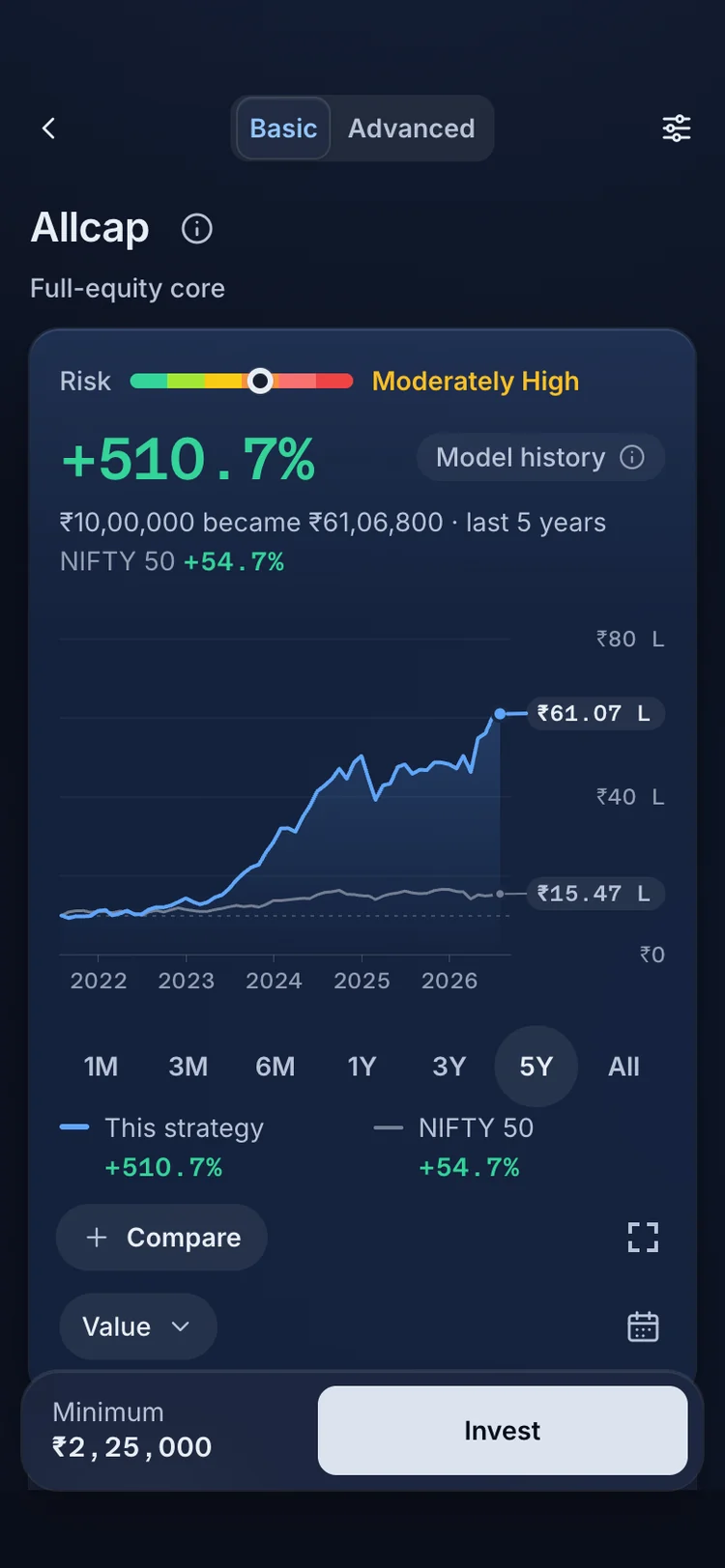
1Each strategy page shows its model history and the Invest bar with the minimum. 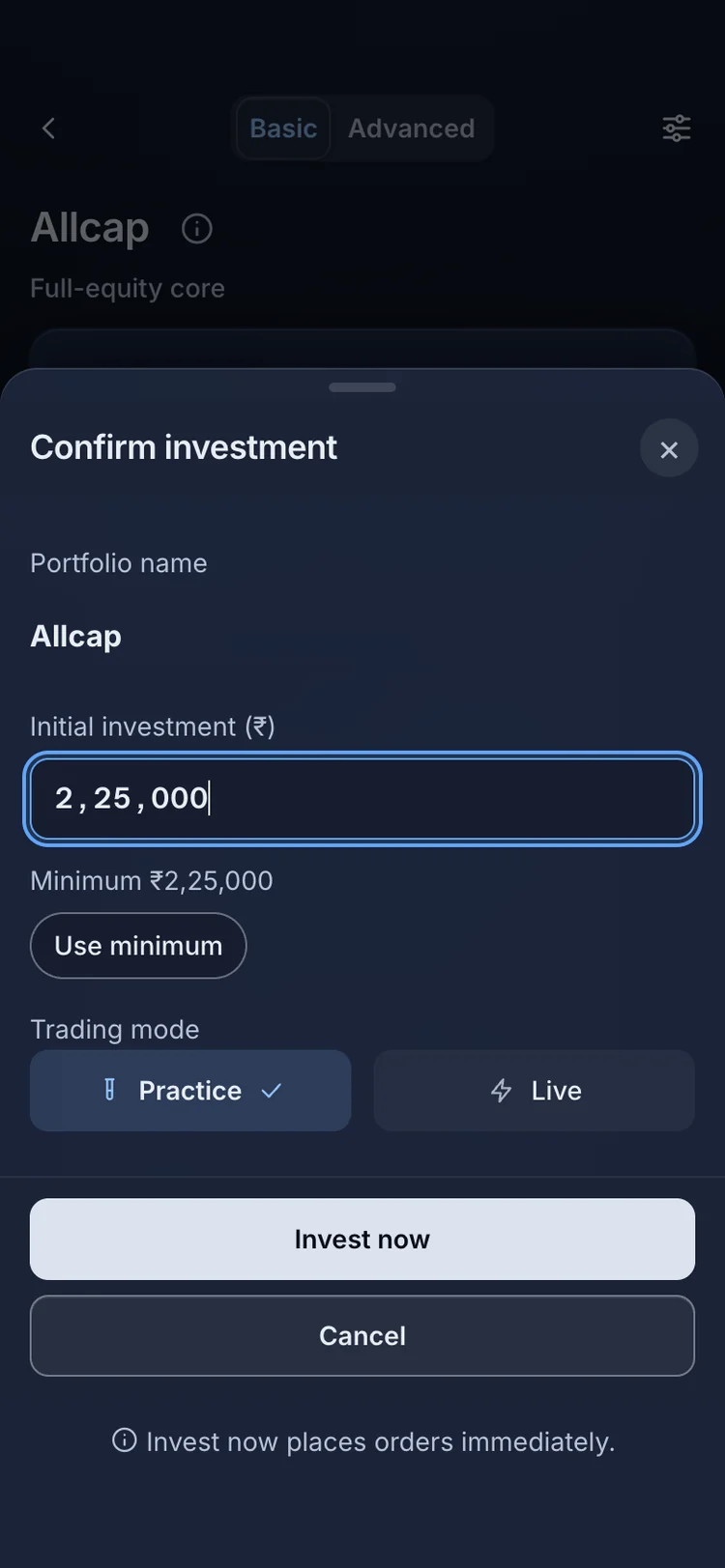
2The sheet opens with the minimum as the amount; Use minimum puts it back. 
3Practice follows the strategy with no real broker order. 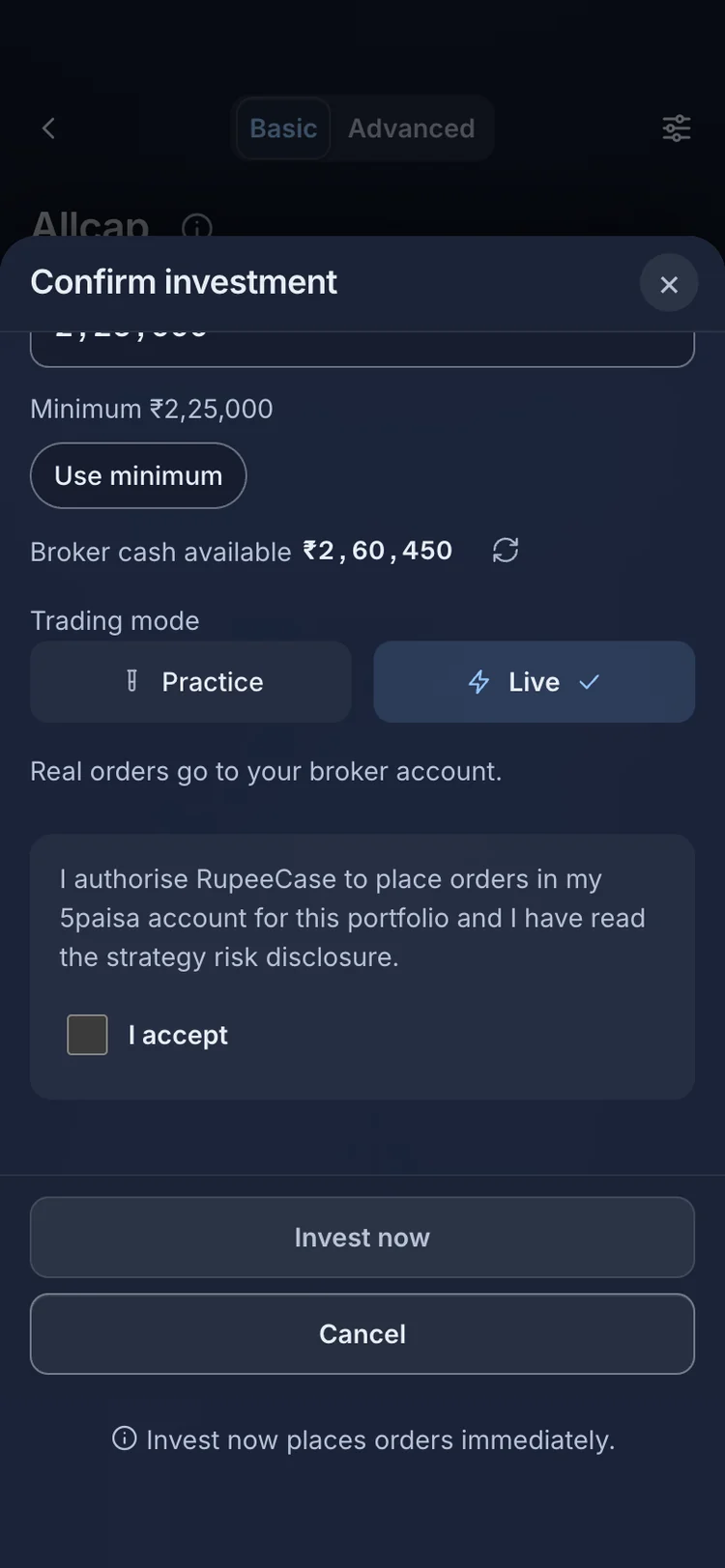
4Live shows your broker cash and asks for your consent before any order.
Where it sits in RupeeCase, in words
Strategies with a debt and gold sleeve put the mix inside one rule, which suits a small portfolio that cannot hold many funds. Large Cap Multi Asset holds 22 positions in large companies, debt and gold, rebalanced every 4 weeks, with a minimum of ₹1,25,000 as of 8 Aug 2026, about 13 months of ₹10,000: model CAGR 24.36%, deepest fall −20.96%, as of 27 Apr 2026.
Questions investors ask
How should I invest ₹10,000 per month?
A common order is an emergency fund first, then a diversified low cost equity core such as an index fund, then a yearly increase, and anything narrower later. The split depends on your goals and what you already hold. This guide is education, not advice for your situation.
What will ₹10,000 a month become in 10 years?
In the Nifty 50 price index from Oct 2016 to Sep 2026, ₹12 lakh put in was worth ₹18.73 lakh on 12 Oct 2026, an 8.57% XIRR, and ₹21.08 lakh at the January 2026 record. Past results are not a forecast.
Is ₹10,000 a month enough to start investing?
Yes. It buys an index fund or several whole shares every month. What it cannot do well is spread across many products, so one or two is usually enough at the start.
Should I put all ₹10,000 in one fund?
At this size one diversified fund already spreads each instalment across 50 or more companies. Several funds in the same category often hold the same shares and add little.
How much should I increase my SIP every year?
Many investors raise it with their income, often 5% to 10% a year. Over the ten years to Sep 2026, a 10% yearly step up turned ₹19.12 lakh into ₹27.18 lakh in the Nifty 50.
What if the market falls right after I start?
Then each month's ₹10,000 buys more units. The ten year SIP above was 17.2% below the money put in at the end of Mar 2020 and 88% above it by the end of 2025. Stopping in the fall is what turned such dips into losses.
Should I choose an index fund or a rule based strategy with ₹10,000 a month?
They do different jobs. An index fund takes any amount and gives a broad, cheap core from the first month. A rule based strategy needs a minimum in whole shares and is narrower. Many investors build the core first and add a narrower strategy once the amount allows.