




Three products, three jobs
ELSS, PPF and NPS are usually compared as "tax saving investments", but they are built for different purposes, and the lock-in says most about each.
- ELSS (Equity Linked Savings Scheme)
- PPF (Public Provident Fund)
- NPS (National Pension System)
Read one more paragraph and a list, 155 words
- ELSS (Equity Linked Savings Scheme) is an equity mutual fund. SEBI requires it to hold at least 80% in equity, and its units carry a statutory lock-in of three years. Its value moves with the stock market.
- PPF (Public Provident Fund) is a government savings scheme run through post offices and banks under the PPF Scheme, 2019. The interest rate is set by the government each quarter. The balance does not fall with markets.
- NPS (National Pension System) is a retirement account regulated by PFRDA. Contributions are invested in equity, corporate bonds and government securities, in a mix you choose, and most of the money is meant to stay until 60.
So the question is less "which earns most" and more "for how long can this money be locked, and how much market risk can it carry". The note NPS, PPF, ELSS: the order matters more than the rate works one case in rupees.
₹100 in Large Mid Multi Asset became about ₹471 in the model
Side by side
| ELSS | PPF | NPS (Tier I, non government) | |
|---|---|---|---|
| Regulator or rule | SEBI, mutual fund | PPF Scheme, 2019 | PFRDA |
| Invests in | At least 80% equity | Government scheme, rate set each quarter | Equity, bonds and government securities |
| Lock-in | 3 years from each purchase | 15 years from the end of the year of opening | Until 60, with exceptions |
| Yearly limit | No limit on investing | ₹500 to ₹1.5 lakh a year | No cap on contributions |
| Deduction, old regime | Within ₹1.5 lakh (s.123) | Within ₹1.5 lakh (s.123) | Within ₹1.5 lakh, plus ₹50,000 (s.124(3)) |
| Deduction, new regime | None | None | Employer contribution only (s.124) |
| Tax at exit | Equity gains, 12.5% above ₹1.25 lakh | Tax free | 60% of corpus tax free; rest at slab |
Lock-in and liquidity
| Years before the money is fully free, investing at age 30 | Years |
|---|---|
| ELSS | 3 |
| PPF | 15 |
| NPS | 30 |
Years: the highest is NPS at 30
ELSS
Each purchase is locked for three years from allotment. With a monthly SIP, every instalment has its own three year clock, so the last instalment of a year becomes free three years after it was made. After the lock-in, units can be sold on any business day like any other fund. There is no requirement to sell at the end of three years.
PPF
The account matures 15 years after the end of the financial year in which it was opened. Before that, money can come out in three ways under the PPF Scheme, 2019:
- Partial withdrawal
- Loan
- Premature closure
Read one more paragraph and a list, 110 words
- Partial withdrawal: once a year, after five years from the end of the year of opening, up to 50% of the lower of the balance at the end of the fourth preceding year or of the preceding year.
- Loan: from the end of the first year to the end of the fifth, up to 25% of the balance at the end of the second preceding year, repaid within 36 months.
- Premature closure: after five years, only for a life threatening illness, higher education or a change of residency, with interest cut by 1%.
At maturity the account can be extended in blocks of five years, with or without fresh deposits.
NPS
At normal exit, at 60 or on superannuation, a non government subscriber may take up to 80% of the corpus as a lump sum and must use at least 20% to buy an annuity, under the PFRDA exit regulations as amended on 16 Dec 2025. A corpus of up to ₹8 lakh can be taken entirely as a lump sum.
- Partial withdrawal
- Premature exit
one yearly limit shared by ELSS, PPF, your own NPS contribution and the rest of section 123
Income-tax Act, 2025, old regime
extra deduction for your own NPS contribution, on top of the ₹1.5 lakh
Section 124(3), old regime
of salary, the employer NPS contribution deductible in the new regime
Section 124(2), from FY 2024-25
Read one more paragraph and a list, 65 words
Before 60, two routes exist:
- Partial withdrawal: after three years in NPS, up to 25% of your own contributions, at most four times before 60, at least four years apart.
- Premature exit: at least 80% of the corpus must buy an annuity and up to 20% can be taken as a lump sum; a corpus of up to ₹5 lakh can be withdrawn in full.
Large Mid Multi Asset fell at most 16.9% below its model high, month end to month end
Tax when you invest: old regime against new
The old regime
In the old regime, ELSS, PPF deposits and your own NPS contribution are all deductible under section 123 of the Income-tax Act, 2025, read with Schedule XV (section 80C of the 1961 Act), within one combined limit of ₹1.5 lakh a year.
Read 2 more paragraphs, 64 words
The same limit also covers EPF contributions, life insurance premiums, home loan principal and children's tuition fees, so for many salaried people part of it is already used before any of these three.
NPS has a further ₹50,000 under section 124(3) (formerly 80CCD(1B)), which sits outside the ₹1.5 lakh. That makes up to ₹2 lakh of deductions possible from these products together.
The new regime
The new regime has been the default since FY 2023-24, and section 202 of the Income-tax Act, 2025 keeps it as the default unless you opt out. It denies the deductions under sections 123 and 124(3). ELSS, PPF and your own NPS contributions give no tax benefit when you invest.
Read 2 more paragraphs, 77 words
One deduction survives: the employer's contribution to your NPS account. Under section 124, it is deductible up to 14% of salary in the new regime, and up to 10% in the old regime for a non government employer (14% for central and state government employers).
Whether the old regime is worth choosing depends on all your deductions together, not on these three alone. The module on tax efficient portfolio construction compares the two regimes on a salary.
Tax at exit
ELSS at exit
ELSS is an equity oriented fund, so a sale is a capital gain. Because of the three year lock-in, any sale is of units held for more than 12 months: the gain is long term, taxed at 12.5% on equity gains above ₹1.25 lakh a year in total (section 198 of the Income-tax Act, 2025, formerly 112A), for transfers from 23 Jul 2024.
Read one more paragraph, 39 words
The ₹1.25 lakh is shared with all your other listed equity and equity fund gains. The capital gains guide covers the rules in full. An IDCW payout from an ELSS is taxed at your slab rate, like a dividend.
PPF at exit
PPF interest is exempt (Schedule II of the Income-tax Act, 2025, formerly section 10(11)), and so is the payment at maturity. In the old regime, deposits are also deductible, which is why PPF is often described as exempt at all three stages.
NPS at exit
The tax at exit is the most layered of the three:
- Lump sum at normal exit
- Annuity
- Partial withdrawals
MythNPS, PPF and ELSS all save tax for everyone.
FactOnly in the old regime. In the new regime, the default since FY 2023-24, none of them gives a deduction when you invest, except the employer's contribution to NPS.
Read one more paragraph and a list, 112 words
- Lump sum at normal exit: exempt up to 60% of the corpus (Schedule II). PFRDA now allows a lump sum of up to 80%; the part above 60% is not covered by the exemption and is taxed at your slab rate.
- Annuity: the money used to buy the annuity is not taxed when it is used, but the pension it pays is income in each year it is received, taxed at your slab rate.
- Partial withdrawals: exempt up to 25% of your own contributions (Schedule III).
So of the three, NPS is the only one where a large part of the final money can be taxed as income for years after retirement.
Checks to work through before choosing
- Pick the regime firstadd up every deduction you have; if the new regime is cheaper, the deductions here are worth nothing at entry.
- Check what is left of ₹1.5 lakhEPF, insurance premiums, home loan principal and school fees use the same limit.
- Match the lock-in to the goalthree years, fifteen years and age 60 suit different needs.
- Decide the market riskELSS is equity, PPF is a fixed government rate, NPS is a mix you choose.
- Look at the exitequity gains tax, tax free maturity, or a partly taxable lump sum and a taxable pension.
How this shows up in RupeeCase
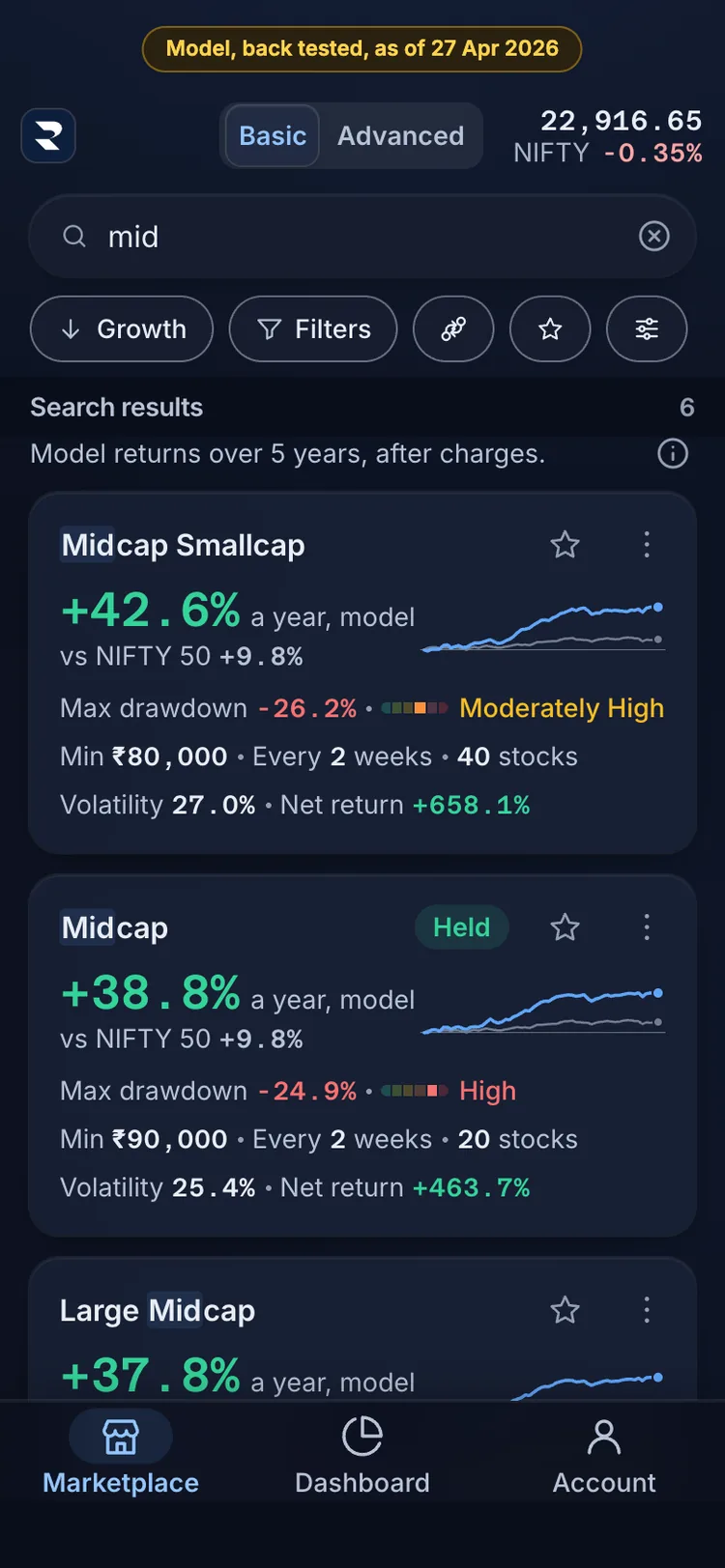
1Search finds strategies by name, theme or type: here, mid. 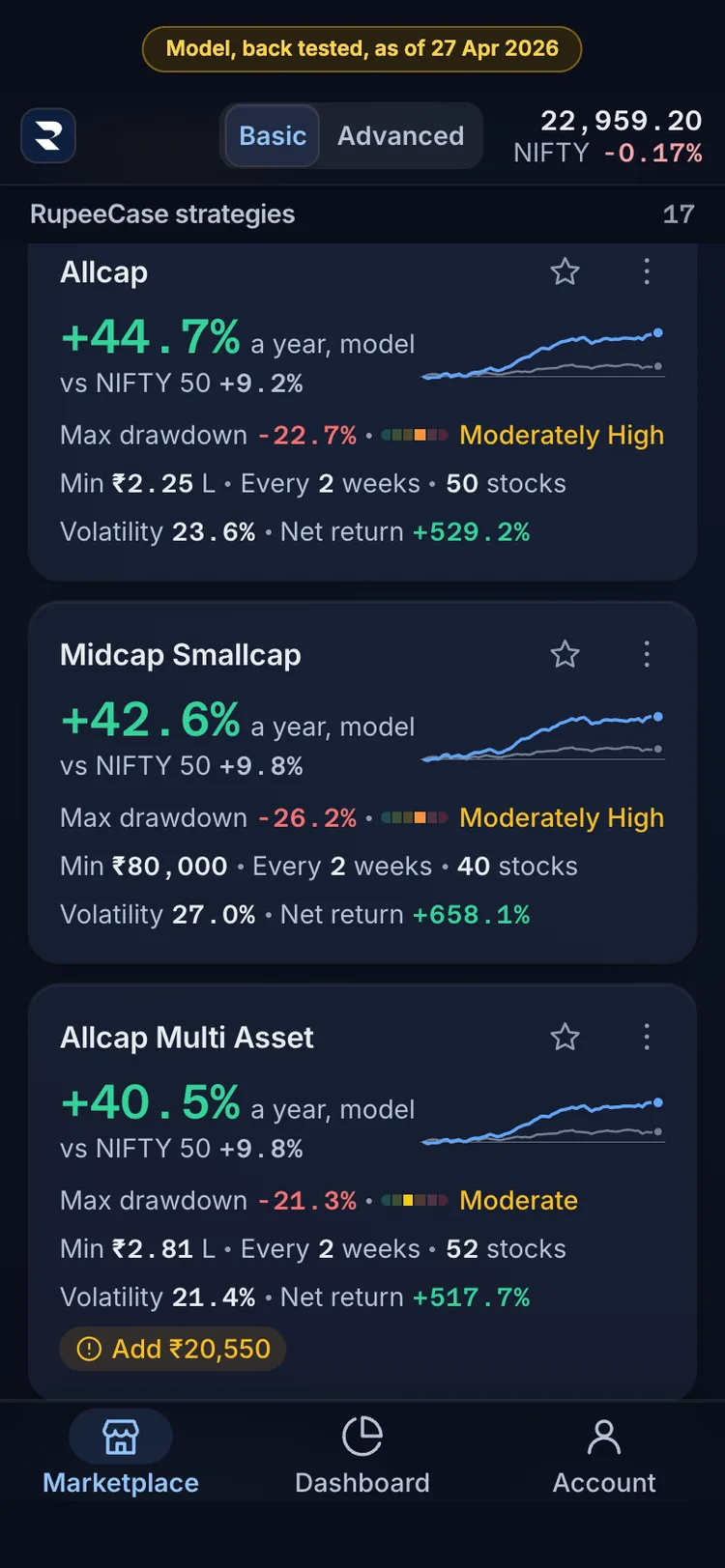
2Each card: growth per year beside the NIFTY 50, max drawdown, risk band, minimum, rebalance and stocks. 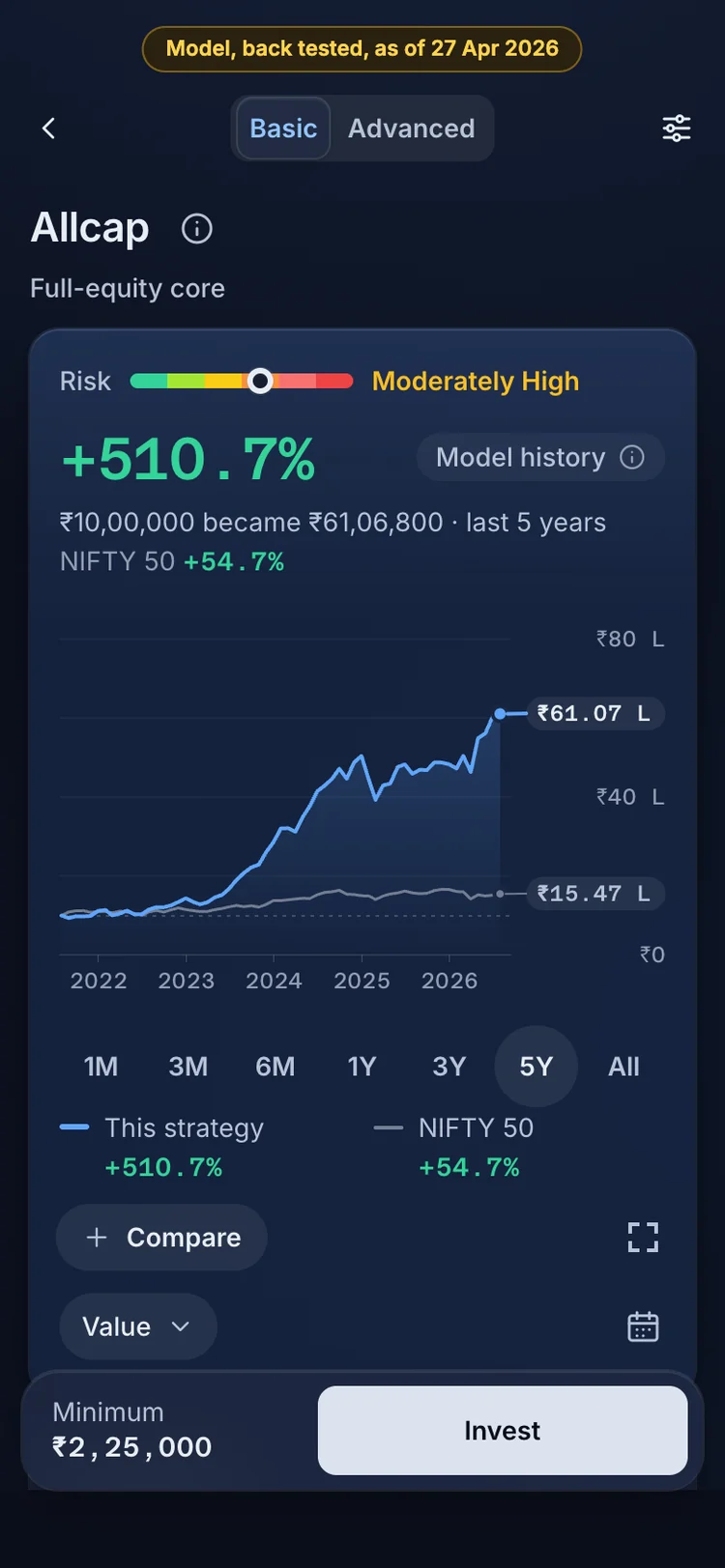
3The strategy page: model history after charges, the NIFTY 50 beside it, and the risk band. 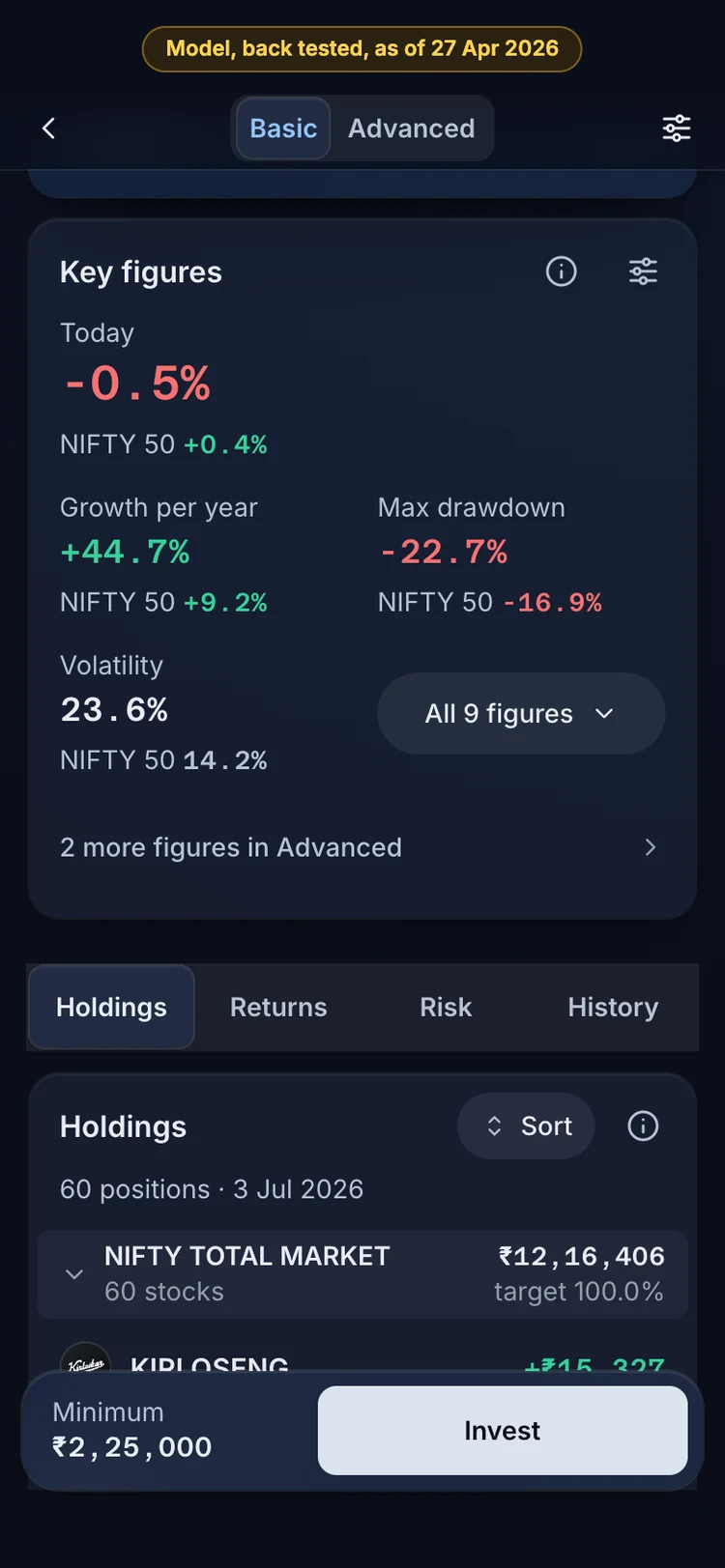
4Key figures: today, growth per year and max drawdown, each beside the NIFTY 50. 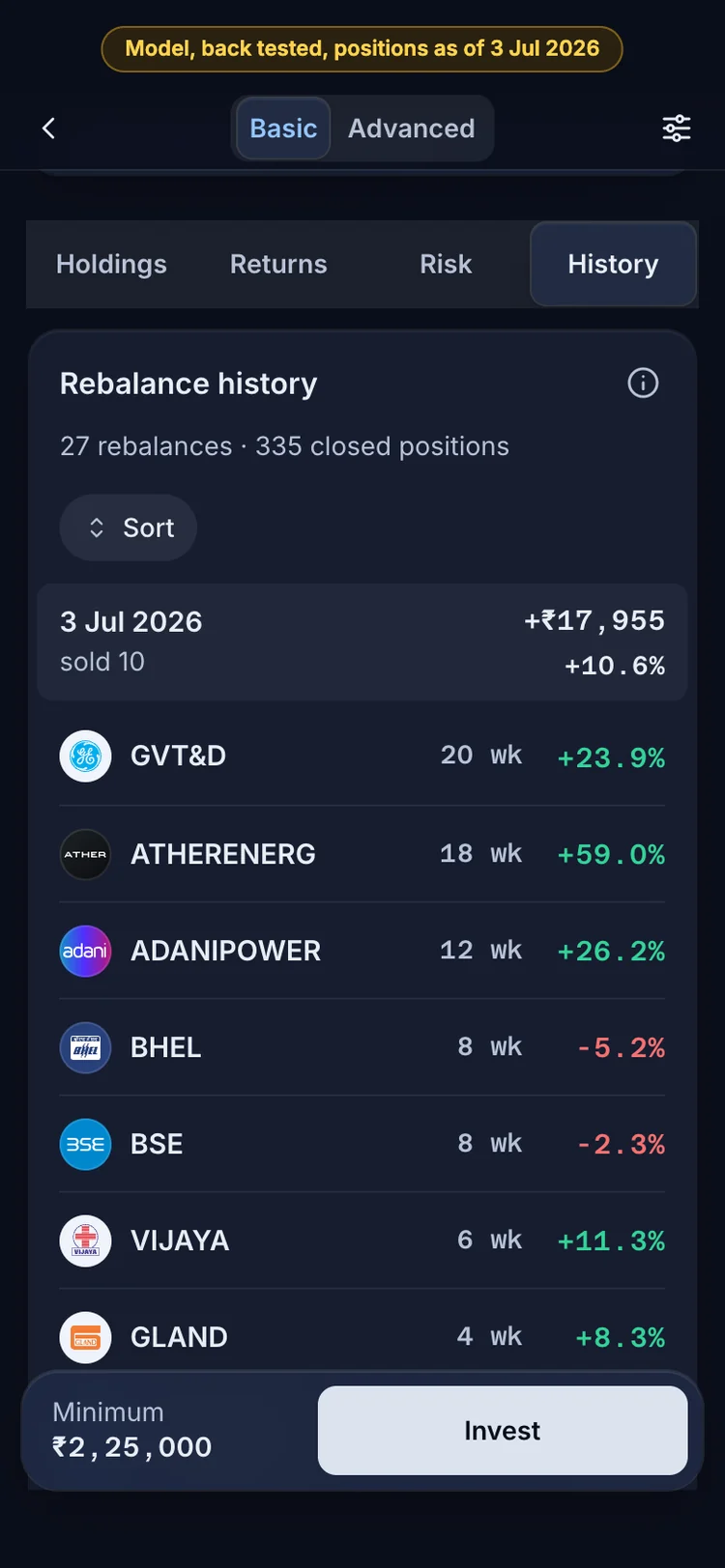
5The History tab: every rebalance in the model record, with the stocks sold and how each did.
Where it sits in RupeeCase, in words
A RupeeCase strategy is not a tax saving product: there is no lock-in and no deduction, and gains are taxed as listed equity gains when shares are sold in your own demat. It sits alongside these three, not in place of them. Large Mid Multi Asset holds 42 positions with equity, debt and gold, rebalanced every 2 weeks: model CAGR 34.33%, deepest fall −17.60%, as of 27 Apr 2026. The retirement calculator shows how a long lock-in like NPS or PPF fits a retirement target.
Questions investors ask
What is the lock-in for ELSS, PPF and NPS?
ELSS: three years from each purchase. PPF: 15 years from the end of the financial year of opening, with partial withdrawals after five years. NPS: until 60 for normal exit, with partial withdrawals of up to 25% of own contributions after three years.
Can I claim ELSS, PPF and NPS in the new tax regime?
No deduction is allowed for ELSS, PPF or your own NPS contributions in the new regime. The employer's contribution to NPS is deductible up to 14% of salary under section 124 of the Income-tax Act, 2025.
Is the NPS maturity amount tax free?
Partly. A lump sum of up to 60% of the corpus is exempt. PFRDA allows up to 80% as a lump sum for non government subscribers; the part above 60% is taxed at your slab rate, and the annuity pension is taxed as income each year.
Is the 80C limit still ₹1.5 lakh?
Yes. From 1 Apr 2026 the deduction is under section 123 of the Income-tax Act, 2025, read with Schedule XV, with the same ₹1.5 lakh limit, in the old regime only.
How is ELSS taxed when I redeem?
As a long term gain on an equity fund, since every unit is held for over 12 months: 12.5% on total equity gains above ₹1.25 lakh in the year. IDCW payouts are taxed at your slab rate.
Can I withdraw from PPF before 15 years?
Yes, partly: from the sixth year, once a year, up to half of a defined balance. Premature closure is allowed after five years only for serious illness, higher education or a change of residency, with interest reduced by 1%.