




What an emergency fund is for
An emergency fund pays for what a monthly budget cannot absorb: a gap between jobs, a hospital deposit, an urgent repair. Its value is that it stops a short term problem from forcing a long term decision, such as selling shares in a falling market or taking a high interest loan.
Read one more paragraph, 61 words
That job sets the rules: quick access, no fall in value when markets fall, and simple enough to reach under stress. Return comes after those three. The note Emergency fund: six months is the rule, the vehicle leaks makes the same point from the other direction: the size is the easy half, the vehicle is where most of the cost hides.
₹100 in Large Cap Multi Asset became about ₹315 in the model
How big should an emergency fund be?
There is no rule in law or regulation for the size. It is a personal calculation in two parts: the monthly amount, and the number of months.
The monthly amount
Use essential expenses, not income: rent or the home loan instalment, groceries, utilities, school fees, insurance premiums, loan repayments and transport. Take the average of the last three to six months of bank and card statements rather than a budget estimate. Discretionary spending that would stop in an emergency can be left out.
The number of months
The months reflect how long a disruption could last and how exposed you are to it:
- Income stability
- Dependents
- Insurance
- Other liquid money
Read a list, 98 words
- Income stability. A salaried job in a large organisation and a variable business or freelance income are different risks. The less predictable the income, the more months people usually hold.
- Dependents. A single earner supporting a family carries more risk than a two income household with no dependents.
- Insurance. Health insurance changes how much a medical emergency costs out of pocket. Without it, the fund has to cover more.
- Other liquid money. Money already in short term deposits for a known goal is not the emergency fund, but it is a second line if the first runs out.
A worked example, for illustration
A household spends ₹60,000 a month on essentials. It decides on six months, so the target is ₹3.6 lakh. These are made up figures for illustration; the emergency fund calculator runs the same sum on your own numbers.
Where to keep an emergency fund
Four places are commonly used. They differ in how fast the money arrives, what protects it and how the income is taxed.
| Savings account | Sweep in FD | Liquid fund | Arbitrage fund | |
|---|---|---|---|---|
| What it holds | Bank deposit | Bank fixed deposit linked to savings | Debt and money market securities up to 91 days | At least 65% equity, hedged, plus debt |
| Access | Same day | Same day, the deposit breaks when the savings balance runs short | Next business day; instant access up to ₹50,000 | A few business days |
| Protection | DICGC up to ₹5 lakh per bank | DICGC up to ₹5 lakh per bank | No insurance; SEBI regulated | No insurance; SEBI regulated |
| Value can fall | No | No | Rarely, by a small amount | Yes, over short periods |
| Tax on income | Slab rate | Slab rate | Slab rate (units bought from 1 Apr 2023) | Equity fund rates |
Savings account
The simplest place, and the fastest. Interest is added to income and taxed at your slab rate. In the old regime, up to ₹10,000 a year of savings account interest is deductible for those under 60 (section 153 of the Income-tax Act, 2025, formerly 80TTA). At 60 or over, up to ₹50,000 of interest on any deposit, fixed deposits included, is deductible instead (formerly 80TTB). Neither deduction is available in the new regime.
Sweep in fixed deposit
A sweep links a savings account to a fixed deposit. Balances above a set level move into the deposit and earn the deposit rate; when the savings balance runs short, the bank breaks part of the deposit.
DICGC cover per depositor per bank, principal and interest together, since 4 Feb 2020
RBI, 4 Feb 2020
the longest maturity a liquid fund may hold
SEBI scheme categories
instant access limit in a liquid or overnight fund, or 90% of the holding if lower, per day
SEBI master circular, 20 Mar 2026
Read one more paragraph, 58 words
The terms, including any penalty for early breaking, are set by each bank, so they need reading. Interest is taxed at your slab rate as income from other sources. Banks deduct TDS once interest from one bank passes ₹50,000 in a year, or ₹1 lakh for a senior citizen, under the thresholds in force from 1 Apr 2025.
Why the ₹5 lakh line matters
DICGC insurance covers savings, fixed, current and recurring deposits, but all your accounts in the same capacity at one bank are added together under a single ₹5 lakh limit. An emergency fund larger than that, held at one bank, is partly uninsured. Spreading it across two banks keeps each part inside the cover.
Liquid fund
A liquid fund is a debt mutual fund that may hold only debt and money market securities maturing within 91 days, under SEBI's scheme categories. Short maturities keep the price steady, though a liquid fund is not a deposit and its value can dip if a security it holds is downgraded.
| Day of exit | Exit load |
|---|---|
| Day 1 | 0.0070% |
| Day 2 | 0.0065% |
| Day 3 | 0.0060% |
| Day 4 | 0.0055% |
| Day 5 | 0.0050% |
| Day 6 | 0.0045% |
| Day 7 onwards | 0.0000% |
Exit load: the highest is Day 1 at 0.0070%
Read 3 more paragraphs, 136 words
Redemption normally reaches your bank on the next business day. SEBI's instant access facility lets a resident individual withdraw up to ₹50,000, or 90% of the holding if that is lower, per scheme per day, online, from liquid and overnight funds that offer it. Exit loads apply only in the first six days:
On ₹1 lakh redeemed on day 1, the load is ₹7.
Tax. Gains on units of a fund with more than 65% in debt and money market instruments, bought on or after 1 Apr 2023, are treated as short term however long they are held (section 76 of the Income-tax Act, 2025, formerly 50AA). They are added to income and taxed at your slab rate, with no indexation. Unlike bank interest, the tax falls only when units are sold, not every year.
Arbitrage fund
An arbitrage fund buys shares and sells the matching futures, earning the gap between the two prices. SEBI requires at least 65% of its assets in equity and equity related instruments. Because the equity positions are hedged, the return behaves more like a short term debt return than a share return, but it can be negative over a few days or weeks, and redemption takes longer than a liquid fund.
Read one more paragraph, 77 words
Tax. Holding at least 65% in listed domestic equity makes it an equity oriented fund. Gains on units held for 12 months or less are taxed at 20%; after 12 months, gains above ₹1.25 lakh a year are taxed at 12.5%, for transfers from 23 Jul 2024. In a high slab, that difference is the main reason people consider arbitrage funds for the part of the fund they are unlikely to need in the first few weeks.
Large Cap Multi Asset fell at most 18.2% below its model high, month end to month end
Splitting the fund into layers
Many households split the fund by how fast each part might be needed, rather than choosing one place. A common shape, described here as an illustration and not a recommendation:
- First layer, same day
- Second layer, same day or next day
- Third layer, a few days
MythAn emergency fund in an equity fund earns more, so it is the better place for it.
FactEmergencies often arrive with market falls, such as a layoff in a downturn. Money that may be needed in a month has to be in something whose value does not fall with the market. Equity is for money that can wait years.
Read one more paragraph and a list, 90 words
- First layer, same day: about a month of expenses in the savings account, for the first bills.
- Second layer, same day or next day: a sweep in deposit or a liquid fund, for the bigger bills that arrive over the following weeks.
- Third layer, a few days: the part least likely to be touched, in a liquid fund or, for those in a high slab, partly in an arbitrage fund.
The layers line up the time each part takes to arrive with the time it is likely to be needed.
Building and keeping the fund
- Count the essentialsaverage three to six months of statements for the expenses that would continue in an emergency.
- Pick the monthsweigh income stability, dependents and insurance cover.
- Choose the layersdecide how much sits in the savings account, how much in a sweep deposit or liquid fund, and whether any part goes to an arbitrage fund.
- Check the coverkeep bank deposits within ₹5 lakh per bank for DICGC insurance, and note which parts are mutual funds with no insurance.
- Refill after usewhen the fund is drawn, rebuilding it comes before new long term investing.
- Review once a yearexpenses, family and job change, and the fund's size moves with them.
How this shows up in RupeeCase
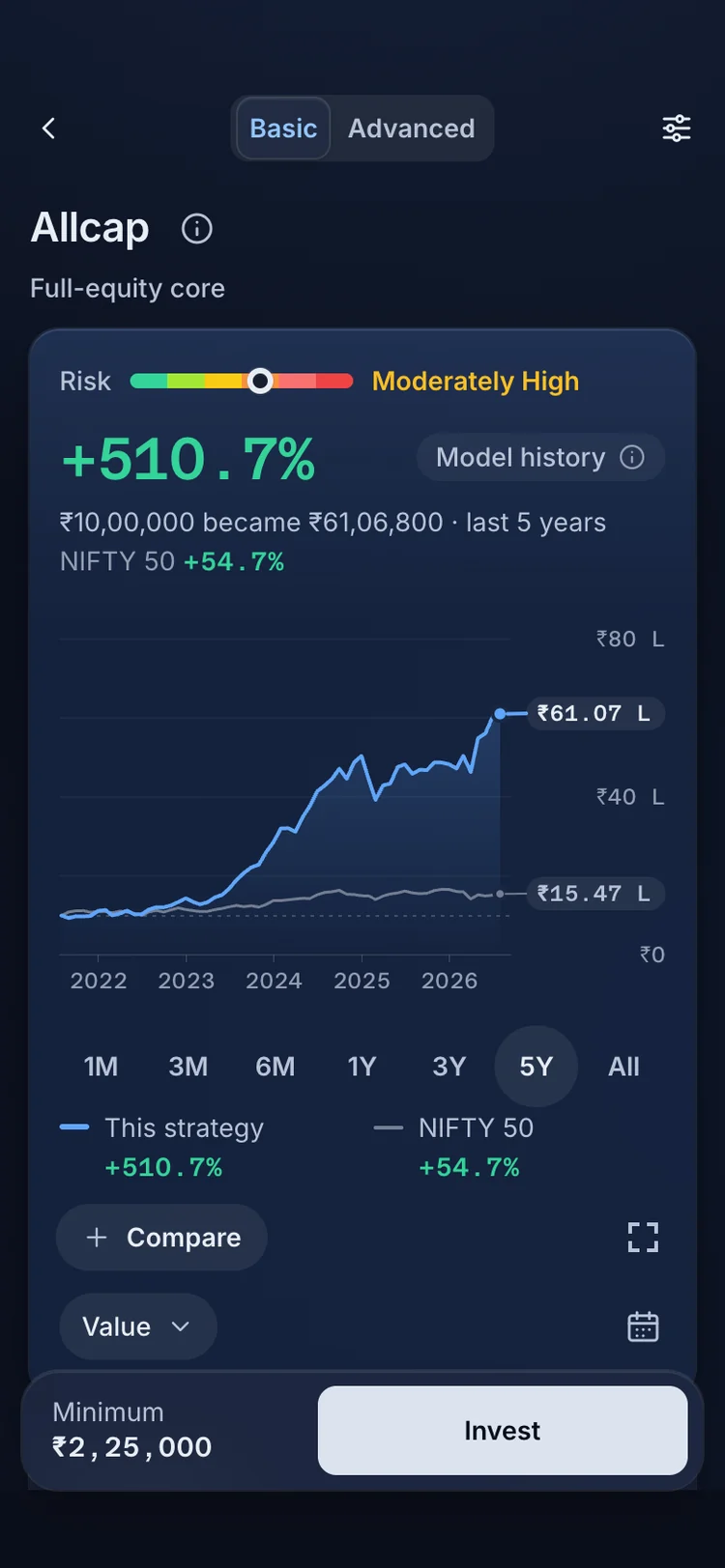
1Each strategy page shows its model history and the Invest bar with the minimum. 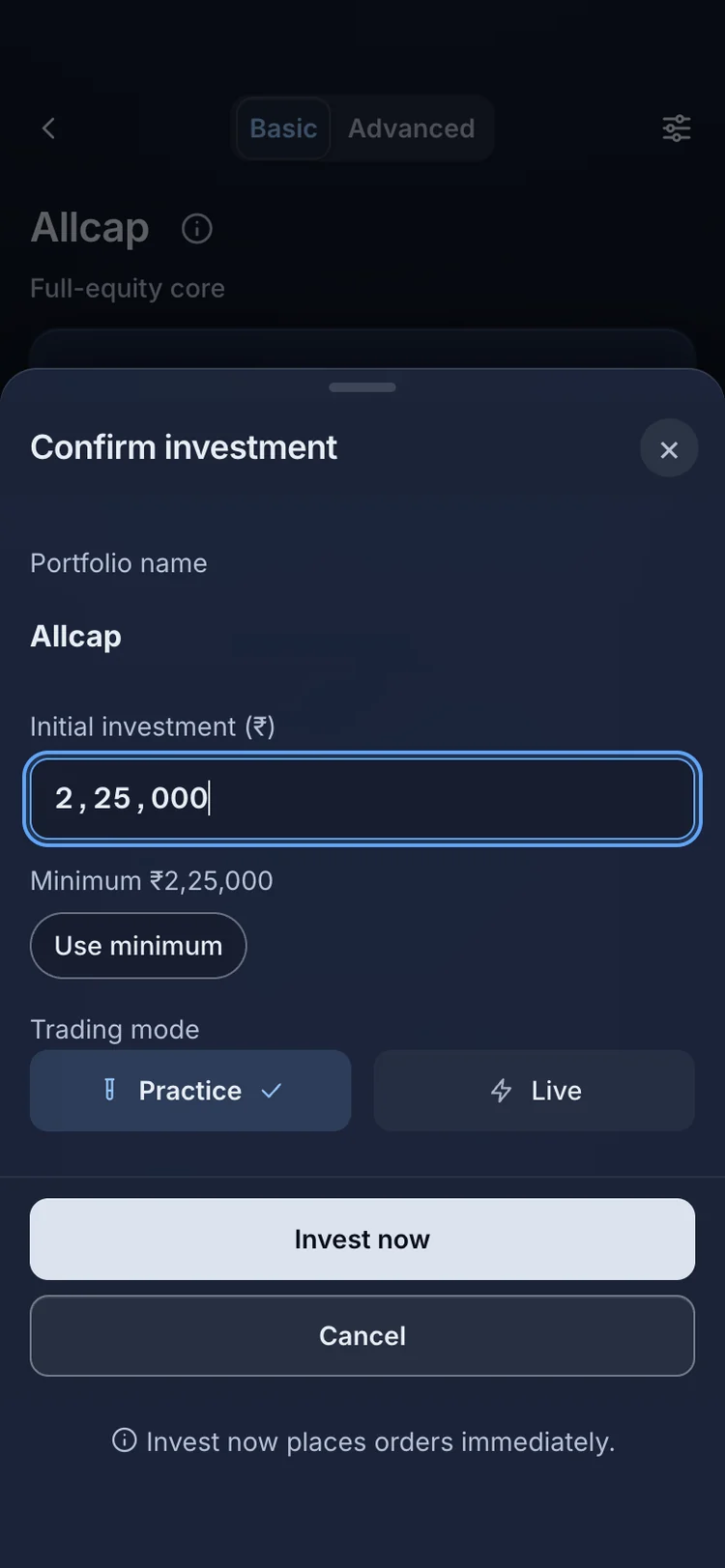
2The sheet opens with the minimum as the amount; Use minimum puts it back. 
3Practice follows the strategy with no real broker order. 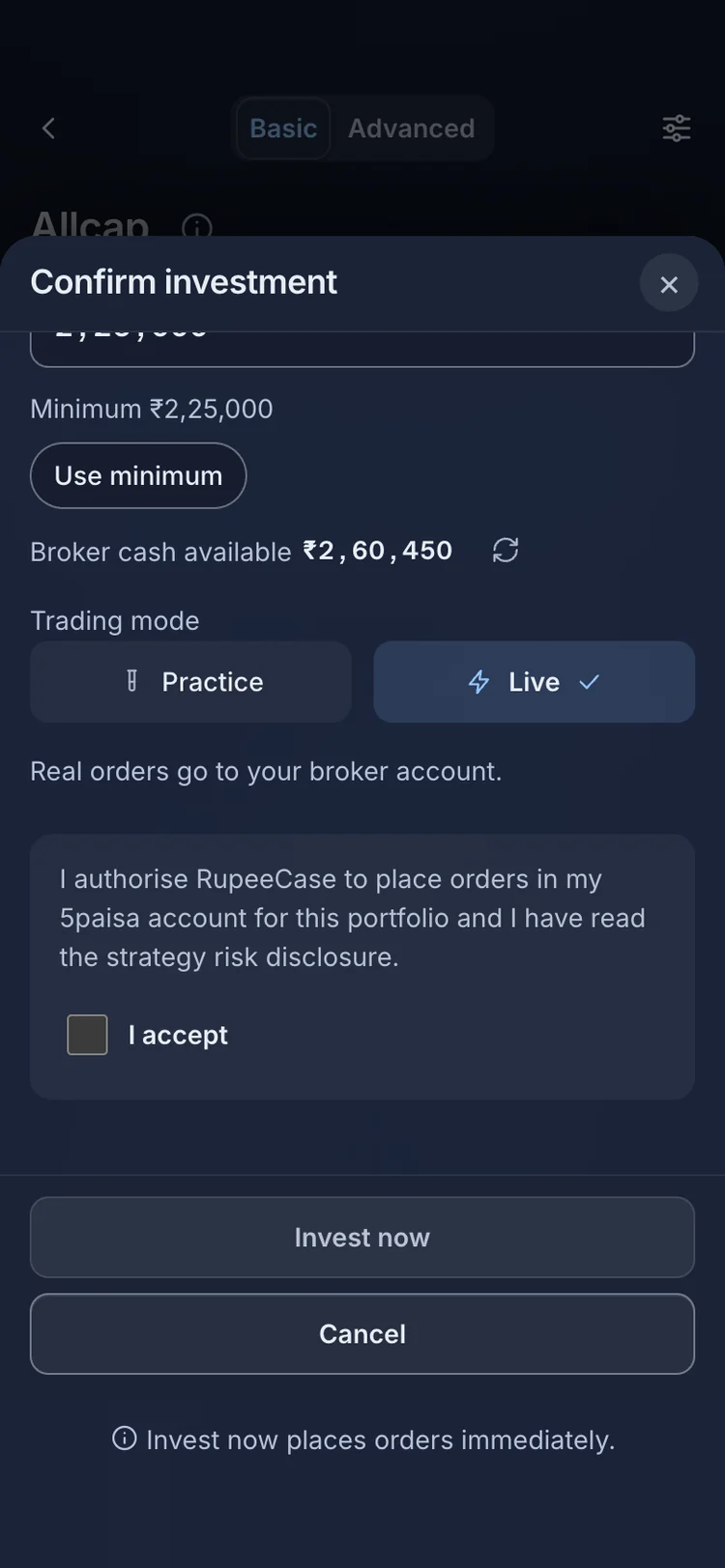
4Live shows your broker cash and asks for your consent before any order.
Where it sits in RupeeCase, in words
RupeeCase strategies are for money that can stay invested for years, after the emergency fund is in place; they are not a place to keep it. The getting started guide on how much to start with begins with the same step. Large Cap Multi Asset holds 22 positions in large companies with a debt and gold sleeve, rebalanced every 4 weeks: model CAGR 24.36%, deepest fall −20.96%, as of 27 Apr 2026. A fall of that size is exactly what an emergency fund is meant to be kept away from. The emergency fund calculator works out the target from your own expenses.
Questions investors ask
How much should an emergency fund be in India?
There is no official figure. It is your essential monthly expenses multiplied by a number of months that reflects your income stability, dependents and insurance. Households with variable income or a single earner usually hold more months than those with two steady salaries.
Is a liquid fund safe for an emergency fund?
A liquid fund holds only securities maturing within 91 days, so its value is usually steady, and money normally arrives the next business day. It is not a bank deposit: there is no DICGC insurance, and its value can dip if a holding is downgraded.
How is a liquid fund taxed?
Gains on liquid fund units bought on or after 1 Apr 2023 are treated as short term at any holding period and taxed at your slab rate, under section 76 of the Income-tax Act, 2025 (section 50AA of the 1961 Act). Tax is due only when units are sold.
Is an arbitrage fund better than a liquid fund for tax?
For someone in a high slab, arbitrage fund gains are taxed at 20% within 12 months and 12.5% above ₹1.25 lakh after that, which can be lower than slab rate tax on a liquid fund. In exchange, the value can fall over short periods and redemption takes longer.
Is my emergency fund in a bank fully insured?
Up to ₹5 lakh per depositor per bank, principal and interest together, by DICGC. All your deposits in the same capacity at one bank count towards one limit, so amounts above ₹5 lakh at a single bank are uninsured.
Do I pay tax on savings account interest?
Yes, at your slab rate. In the old regime, up to ₹10,000 a year of savings account interest is deductible, or up to ₹50,000 of all deposit interest for a senior citizen. The new regime allows neither deduction.