



What is smallcase, in its own words?
smallcase describes itself as a platform for readymade model portfolios of stocks, ETFs and mutual funds, managed by SEBI registered experts, with the stocks and ETFs staying in your existing demat account. You can also build your own basket. Every product, it says, can be sold at any time, with no lock in.
Read 2 more paragraphs, 103 words
I start with that because a fair comparison has to start from what the product actually is, not from a competitor's summary of it. smallcase is not a fund and not a PMS. It is a layer between you, a broker and a manager. The manager publishes a basket and its updates; your broker places the orders; you hold the shares.
That design has real strengths. Your money never pools with anyone else's. You can see each holding. You can leave whenever you like. Most of the routes in this guide share those strengths, which is why the differences sit in the details.
₹100 in each model, Jul 2021 to Jul 2026
What are the smallcase alternatives in India?
There are five practical routes for someone who wants a ready basket of Indian stocks rather than picking each share alone.
- Another smallcaseA different manager, theme or fee on the same platform.
- Index fund or ETFUnits of a pooled scheme that tracks an index; the fund trades for you.
- Your own basketA list you design and rebalance yourself in your demat.
- PMSA SEBI registered portfolio manager runs an account in your name, from ₹50 lakh.
- Rules based index algoA published rule, rerun on a fixed calendar, orders through your own broker.
Read one more paragraph, 43 words
Each of these is a real choice, not a straw man. Which one fits depends on how much you want to decide yourself, how much you have to start with, and whether you care more about low cost or about a particular method.
Who decides each change?
This is the question I would ask first, because everything else follows from it.
A manager publishes changes
- Changes when the manager decides
- The method is described by the manager
- You review and apply each update
- Fee set by the manager, if any
A fixed rule reruns on a calendar
- Changes only on the published dates
- The same screen every time
- You approve each rebalance
- 0.2% of traded value, per rebalance
Read 4 more paragraphs, 229 words
On smallcase, the manager decides. When a manager changes a basket, you get a rebalance update by email, push or in app alert. smallcase's own help note is explicit that updates are not applied automatically: you review the changes and apply them, and an update you miss stays open until the next one arrives or you skip it. If you skip, your holdings can drift away from the manager's basket and your return can differ from the one the smallcase shows.
In an index fund, the fund decides by the index rule, and you never see the trades. In your own basket, you decide everything, including when to skip. In a PMS, the portfolio manager decides, usually without asking you each time if the mandate is discretionary.
On RupeeCase, a written rule decides. Each index algo reruns its screen on a fixed calendar, from every week to every four weeks. The platform shows the names going in and out, you approve the rebalance, and your broker places the orders. The rule does not change between rebalances, and every past list is published in the rebalance record.
Neither model is better in every case. A thoughtful manager can react to things a rule never sees. A rule cannot panic, cannot get bored, and cannot quietly change its mind after a bad quarter. Pick the failure you would rather live with.
Allcap fell at most 22.1% below its model high, month end to month end
What does each route cost?
Costs are where comparisons usually go wrong, because each route charges on a different base. Here is what each publishes.
| Route | What is charged | On what |
|---|---|---|
| smallcase, platform | ₹100 plus GST per buy or invest more, capped at 1.5% of the order; ₹10 plus GST per SIP order | Each lump sum or SIP order |
| smallcase, rebalance or exit | No platform fee | Nothing |
| smallcase, fee based baskets | A subscription set by the manager, flat or linked to the amount | Each billing period |
| Index fund or ETF | Total expense ratio, within SEBI limits (0.90% base cap for index funds) | Your whole holding, every day |
| PMS | Set in the agreement: fixed, profit share or both | Your whole account |
| RupeeCase | 0.2% of traded value per rebalance; nothing when nothing trades | Only the part that trades |
Read 2 more paragraphs, 140 words
A charge on trades, like RupeeCase's, is cheap for a slow rule and expensive for a fast one. In the published rebalance record, the platform fee came to about 2.2% of capital a year for Allcap, which rotates every two weeks, and 1.2% for Focused Largecap 20, which rotates every four. A free smallcase you rarely rebalance can cost less than either. A fee based smallcase adds its subscription on top of the platform fee. An index fund's expense ratio can be lower still, and lower again in its direct plan: the guide on direct vs regular plans shows the gap.
So the honest answer is that no route is cheapest for everyone. Work out the yearly rupees for your amount on each route, using the fee calculator for the RupeeCase side and each provider's own page for the rest.
How are rules based index algos built?
This is the part I can describe from the inside. Every RupeeCase strategy is a rule with five parts: a universe, a screen, a count, a weight and a calendar. Take Allcap: its universe is the Nifty Total Market, it filters out shares priced above ₹5,000, ranks the rest by momentum, holds the top 50 in equal weight, and reruns every 2 weeks.
- UniverseA published NSE index, such as the Nifty Total Market or the LargeMidcap 250.
- ScreenThe same score every time, for example price momentum.
- CountA fixed number of names: 5 to 50.
- WeightEqual weight, so no single name dominates.
- CalendarEvery week to every four weeks, on dates known in advance.
Read one more paragraph, 65 words
Because the rule is fixed, its history can be rebuilt on past NSE data. That is what the model figures are: back tests, after estimated costs, not client returns. Allcap's model shows a CAGR of 44.70% and a deepest fall of −22.72% as of 27 Apr 2026. A back test shows how a rule would have behaved; it does not promise how it will behave.
What can you see before you invest?
Transparency is often claimed and rarely compared. These are the questions I would put to any basket, on any platform:
- The method
- Every past change
- Model or live
- Costs inside the figures
- The bad stretch
MythA basket that shows its holdings every day is fully transparent.
FactHoldings tell you what you own today. Transparency is the rule that produced them, every past change with its date, and returns shown after costs.
Read one more paragraph and a list, 159 words
- The method. Is the selection rule written down precisely enough that you could check a rebalance yourself?
- Every past change. Can you see each past list of holdings with its date, not just today's list?
- Model or live. Are the figures a back test, a live record, or a mix? Each figure should carry its date and its label.
- Costs inside the figures. Are returns shown before or after brokerage, taxes and the platform fee?
- The bad stretch. Is the deepest fall shown as clearly as the best year?
On smallcase, each basket page shows a methodology section, the manager, the minimum amount and whether access is free. SEBI's research analyst guidelines of 8 Jan 2025 also require a model portfolio published by a research analyst to disclose its method, horizon, review frequency, risks and benchmark. On RupeeCase, the rule, the rebalance record back to May 2021 and the model drawdown sit on each strategy page and its factsheet.
What are the minimums?
smallcase shows a minimum amount on each basket's page; it depends on the share prices and weights inside, and it ranges from a few hundred rupees on some baskets to lakhs on others. An index fund can start with a few hundred rupees through a SIP. A PMS needs ₹50 lakh. Your own basket needs enough to buy each stock in whole shares.
Read one more paragraph, 63 words
RupeeCase minimums work the same way as a basket's: one whole share of every holding at recent prices. They run from ₹22,000 for 5Paisa Focused Alpha 5 to ₹4,75,912 for Dynamic Asset Allocator, as of 8 Aug 2026. Allcap's is ₹2,25,000. A low minimum is not a reason to choose a strategy; the five stock rule is the most concentrated on the lineup.
Common mistake: comparing a back test with a live record
The most common unfair comparison in this space is a back tested curve next to a live basket's returns. A back test has no missed updates, no late orders and no investor who skipped the rebalance after a bad month.
Read one more paragraph, 46 words
A live record has all of them. If one product shows model figures and the other shows live ones, say so in the same breath, or compare like with like. The RupeeCase Allcap against a smallcase momentum basket page labels each column for exactly this reason.
How this shows up in RupeeCase
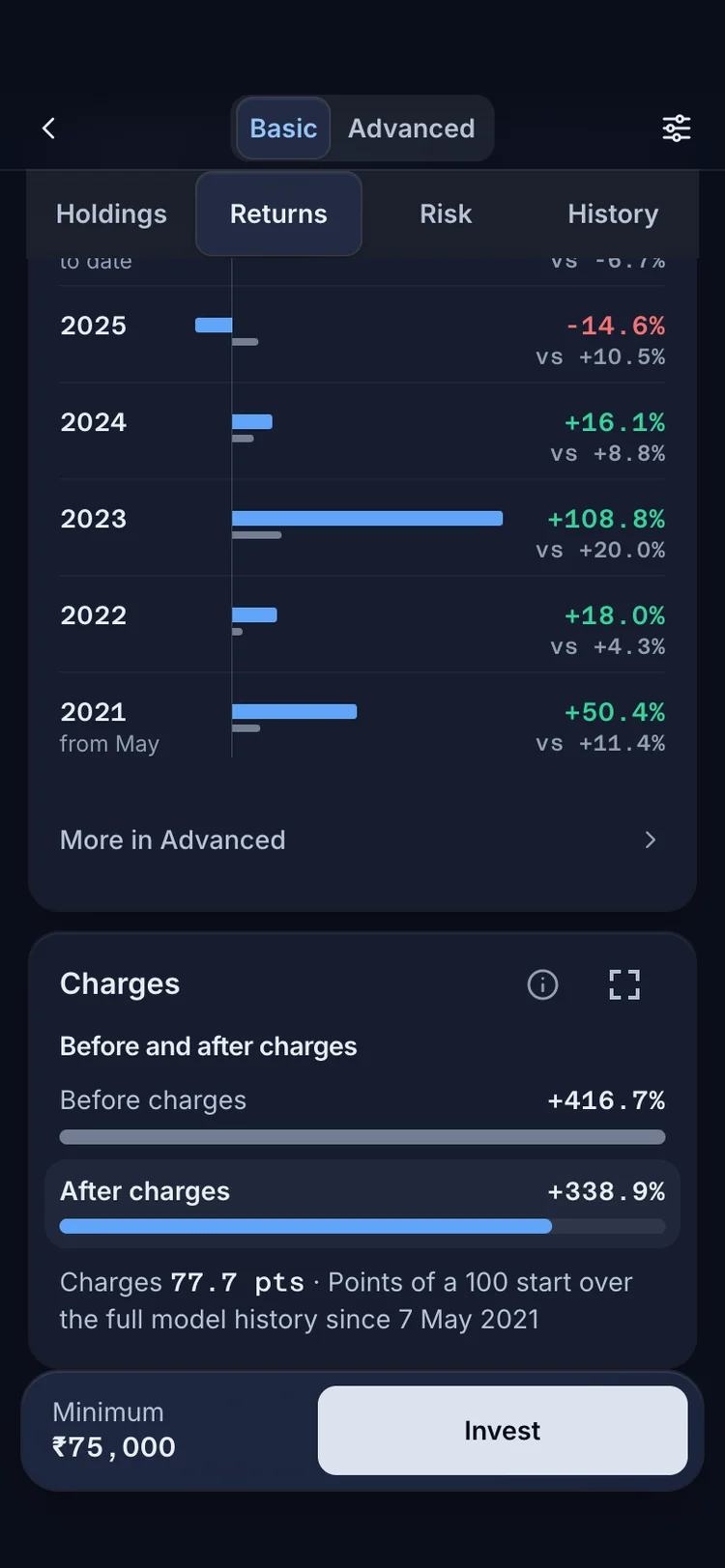
1Model returns are shown after estimated charges: brokerage, STT, exchange fees and GST. 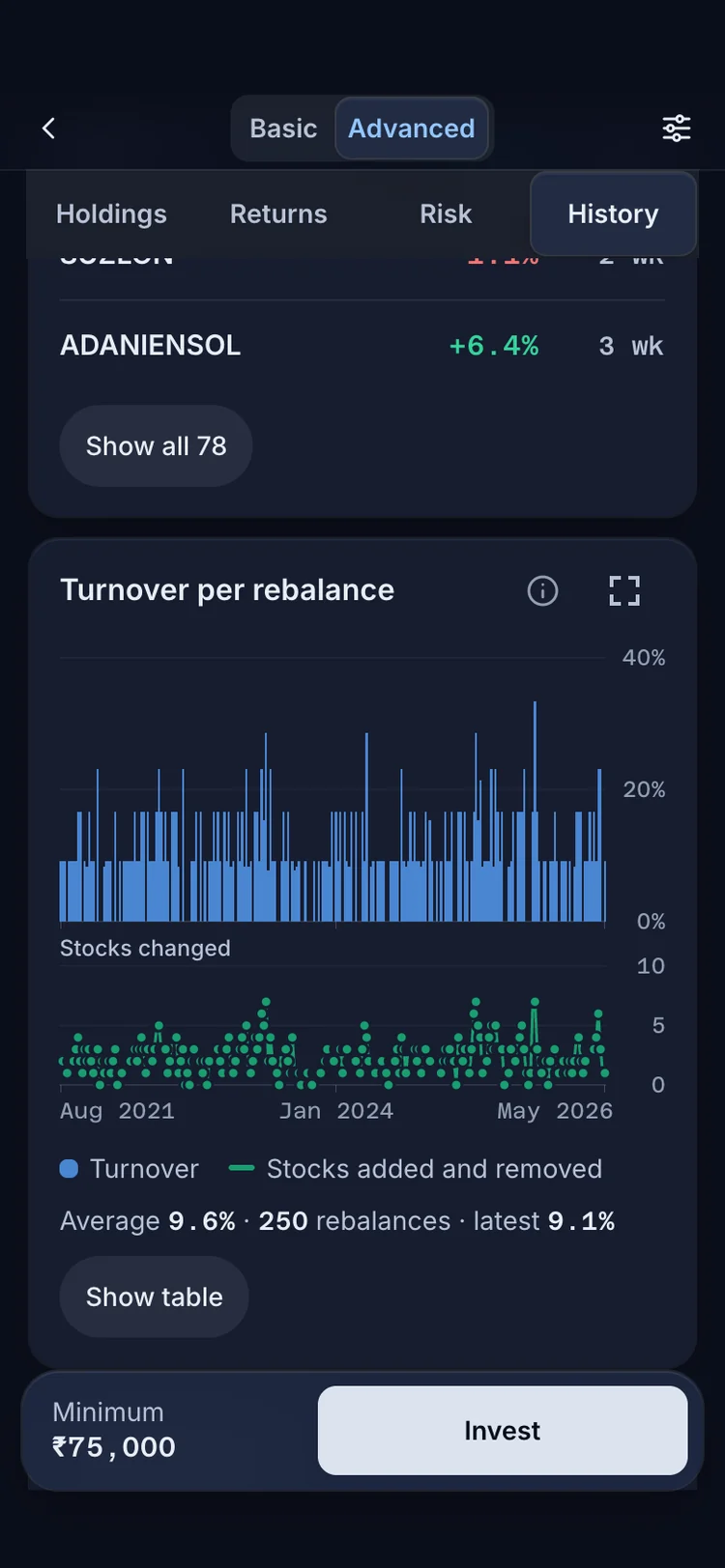
2Turnover per rebalance, from the model record: the fee is charged only on what trades. 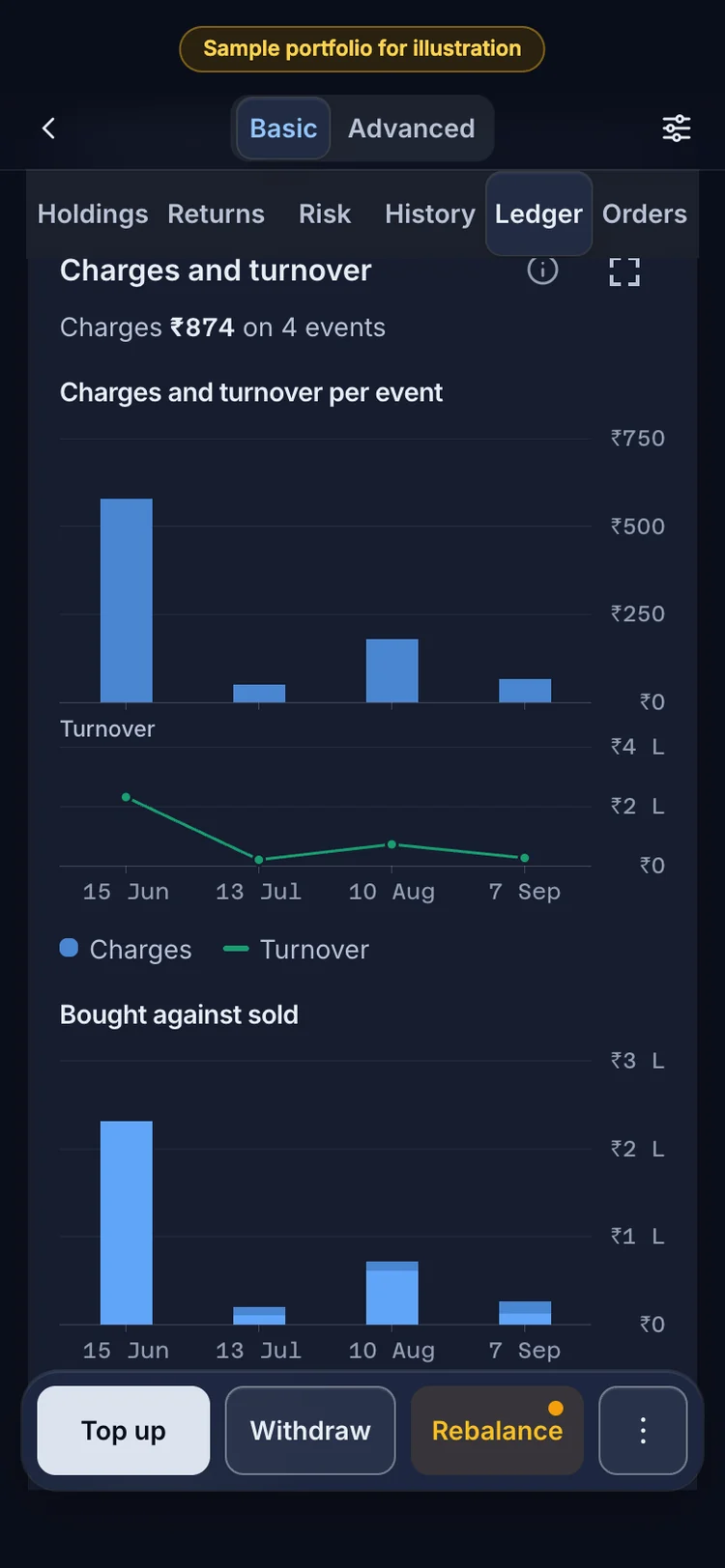
3Your own charges and turnover, event by event, on the Ledger tab. 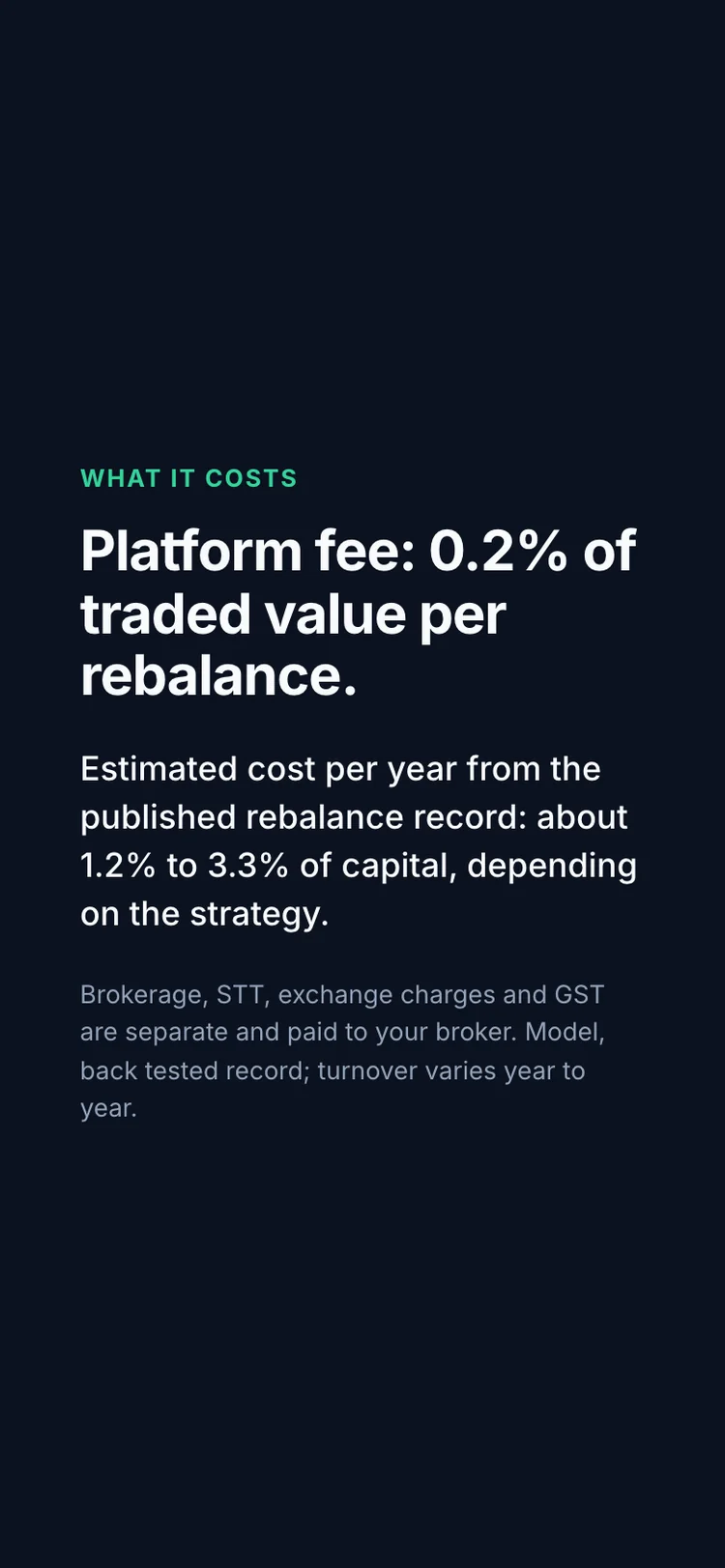
4Platform fee: 0.2% of traded value per rebalance. About 1.2% to 3.3% of capital a year in the published record, depending on the strategy.
Where it sits in RupeeCase, in words
The RupeeCase lineup is 18 rules based index algos, each with its universe, count and calendar on its page. Allcap and Large Midcap are the broad momentum rules; the compare page sets them beside mutual funds, a PMS and a smallcase basket. You can follow a strategy in Practice before connecting a broker, and the pricing page shows the fee on a worked example. RupeeCase is a technology platform, not a fund, a PMS or a SEBI registered investment adviser, and nothing here is a recommendation.
Questions investors ask
What are the best smallcase alternatives?
There is no single best one. The main alternatives are index funds and ETFs, a basket you run yourself, a PMS from ₹50 lakh, and rules based index algos such as RupeeCase. Choose on who decides each change, the cost on your amount, and what you can see.
Is RupeeCase the same as smallcase?
No. Both keep the shares in your own demat. smallcase hosts baskets made by many managers and by users. RupeeCase runs its own 18 fixed rules on a calendar and charges 0.2% of traded value per rebalance.
Does smallcase rebalance automatically?
No. smallcase says rebalance updates are not applied automatically. You get an alert, review the changes and apply them; a missed update stays open until the next one or until you skip it.
What fees does smallcase charge?
Per its fees page of 15 Jan 2026: ₹100 plus GST per lump sum buy, capped at 1.5% of the order, ₹10 plus GST per SIP order, nothing on rebalance or exit, and a manager's subscription on fee based baskets. Broker and statutory charges are extra.
Is a smallcase better than a mutual fund?
Neither is better for everyone. A fund gives you units and trades for you; a basket gives you the shares and leaves each update to you. Tax, costs and effort differ, and the right one depends on how hands on you want to be.
Are model portfolios regulated by SEBI?
Model portfolios published by SEBI registered research analysts fall under SEBI's guidelines for research analysts of 8 Jan 2025, which require disclosure of method, horizon, review frequency, risks and benchmark.