



What is the difference between direct and regular plans?
Every open ended scheme in India comes in two plans. The regular plan is the one you buy through a distributor: a bank, a broker, a relationship manager or an independent mutual fund distributor. The direct plan is the one you buy without a distributor, from the fund house's site, its app, or a platform that routes orders as direct.
Bought through a distributor
- Same portfolio and manager
- Expense ratio includes commission
- Lower NAV than the direct plan
- Service from the distributor, if any
Bought from the fund house
- Same portfolio and manager
- No distributor commission
- Lower expense ratio, higher NAV
- You make every decision yourself
Read 2 more paragraphs, 113 words
Inside, they are the same fund. The money from both plans is invested in one portfolio, by one fund manager, with one objective and one asset allocation. What differs is the expense charged to each plan. The regular plan carries the commission the fund house pays the distributor; the direct plan does not.
Because expenses are taken out of the plan's assets every day, the two NAVs drift apart from the day the plans start. A direct plan NAV is higher than the regular plan NAV of the same scheme, and the gap grows each year. It is not a sign of better management. It is the same return with less taken out.
₹100 in each model, Jul 2021 to Jul 2026
Why do direct plans exist?
Before 2013, nearly every rupee in a fund paid for distribution whether or not a distributor was involved. SEBI's circular CIR/IMD/DF/21/2012 of 13 Sep 2012 changed that.
- SEBI's circular on direct plans
A separate plan for investments not routed through a distributor, with no commission and a lower expense ratio.
- Direct plans launch
Fund houses start a direct plan in their open ended schemes, with its own NAV.
- New Mutual Funds Regulations notified
SEBI (Mutual Funds) Regulations, 2026 replace the 1996 regulations.
- Base expense ratio in force
The cap now applies to the base expense ratio; brokerage, transaction costs and statutory levies are shown separately.
Read one more paragraph, 40 words
It required fund houses to offer a separate plan for direct investments, meaning investments not routed through a distributor, in both existing and new schemes, with a lower expense ratio that excludes distribution expenses and commission, and a separate NAV.
What does the expense ratio include now?
Since 1 Apr 2026, under the SEBI (Mutual Funds) Regulations, 2026, the total expense ratio of a scheme has four parts:
- Base expense ratio (BER)
- Brokerage cost
- Transaction cost
- Statutory levies
Read one more paragraph and a list, 137 words
- Base expense ratio (BER): the fund house's management fee and running costs, and, in a regular plan, the distribution commission. This is the part SEBI caps.
- Brokerage cost: up to 0.06% of trade value in the cash market and 0.02% in derivatives, outside the base cap.
- Transaction cost: exchange and clearing charges on the fund's trades.
- Statutory levies: GST and other levies, on actuals.
The caps on the base expense ratio fall as a scheme grows. For an open ended equity scheme, regulation 66(7) allows up to 2.10% on the first ₹500 crore of daily net assets, sliding to 0.95% on assets above the last slab; an index fund or ETF is capped at 0.90%. The cap is a ceiling for the scheme. Each plan's own figure is disclosed separately, and the direct plan's is lower.
Nifty 50 Equal Weight fell at most 15.7% below its model high, month end to month end
How big is the gap in practice?
Here is one fund house's own disclosure, chosen only because it is public and recent enough to be dated. These are not recommendations.
| Scheme, 31 Aug 2026 | Regular plan TER | Direct plan TER | Gap |
|---|---|---|---|
| Parag Parikh Flexi Cap Fund | 1.30% | 0.69% | 0.61% |
| Parag Parikh ELSS Tax Saver Fund | 1.83% | 0.65% | 1.18% |
| Parag Parikh Large Cap Fund | 0.76% | 0.36% | 0.40% |
Read one more paragraph, 56 words
The gap is not one number for the industry. It depends on the scheme, its size and the commission the fund house pays. To see any scheme's current figures, use the TER page on the AMFI site, which lists each plan's base expense ratio and other costs month by month, or the fund house's own disclosure.
What does the gap cost over time?
A gap of a fraction of a percent looks small because it is quoted per year. It is charged on the whole holding, every year, and it compounds.
Read one more paragraph, 61 words
At a 10% return before costs for 15 years, ₹10 lakh grows to about ₹34.9 lakh in the regular plan and about ₹38.0 lakh in the direct plan, on the default figures. The difference, about ₹3.1 lakh, is the price of the distribution over those years. Change the inputs to your own fund; the shape of the answer stays the same.
Is a regular plan ever worth it?
Yes, when you actually get something for the commission. A distributor in India is registered with AMFI, holds an ARN and must pass the NISM Series V-A certification. A good one helps you choose a mix, sets up the SIPs, keeps the paperwork straight, and, most valuably, talks you out of selling in a crash.
- Your statement
- What you got this year
- The alternative
MythThe direct plan has a higher NAV, so it is the better fund.
FactBoth plans hold the same portfolio. The direct plan's NAV is higher only because less has been taken out in expenses since the plans began.
Read one more paragraph and a list, 87 words
The trouble is the case where the fund was sold once and nothing followed. Three checks I would make:
- Your statement. The consolidated account statement shows the commission paid to your distributor across your schemes. Regulation 34 of the 2026 regulations requires it. Read the figure in rupees.
- What you got this year. A review, a rebalance, a call when the market fell? Write it down.
- The alternative. A direct plan with fee based advice, or no advice at all if you are confident doing it yourself.
How do you tell which plan you hold?
Look at the scheme name on your account statement or in the app. Every unit is held in a named plan, and the name says "Direct" or "Regular". Where a distributor is involved, the statement shows the distributor's ARN against the scheme. If you hold the same scheme in both plans, you will see two lines with two different NAVs on the same date.
Read one more paragraph, 40 words
Two quick checks while you are there: the plan option, growth or IDCW, which decides whether gains stay in the NAV or are paid out; and the purchase dates of each lot, which you will need if you ever switch.
How do you move from regular to direct?
A switch from one plan to the other is a redemption of one and a purchase of the other, even inside the same scheme. HDFC Mutual Fund's note on direct plans, for example, says units bought without a distributor can switch without an exit load, units bought through a distributor are subject to any applicable exit load, and the switch may have tax consequences.
Read one more paragraph, 67 words
For equity funds, a sale after more than 12 months is a long term capital gain, taxed at 12.5% above ₹1.25 lakh a year; within 12 months it is short term, at 20%, for sales from 23 Jul 2024. Many investors therefore move only new money to direct plans, and switch old units in stages, using the yearly long term exemption and waiting out exit load periods.
Common mistake: switching everything at once
The most expensive way to fix a regular plan is to switch it all on one day. You can trigger an exit load on recent SIP instalments and a capital gains bill that takes years of lower expenses to recover. Before switching, check each lot's purchase date, the exit load period, and the gain on each, and spread the switch out.
How this shows up in RupeeCase
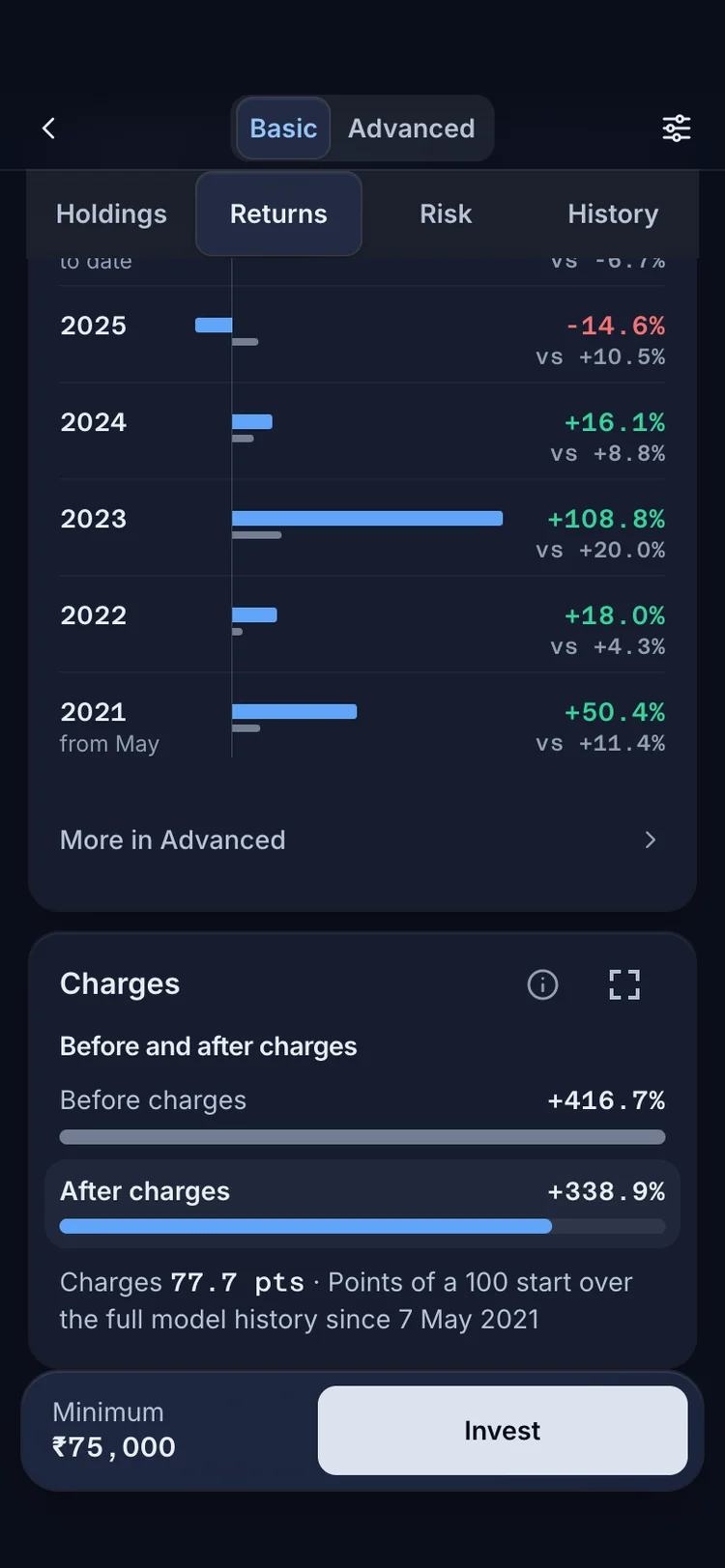
1Model returns are shown after estimated charges: brokerage, STT, exchange fees and GST. 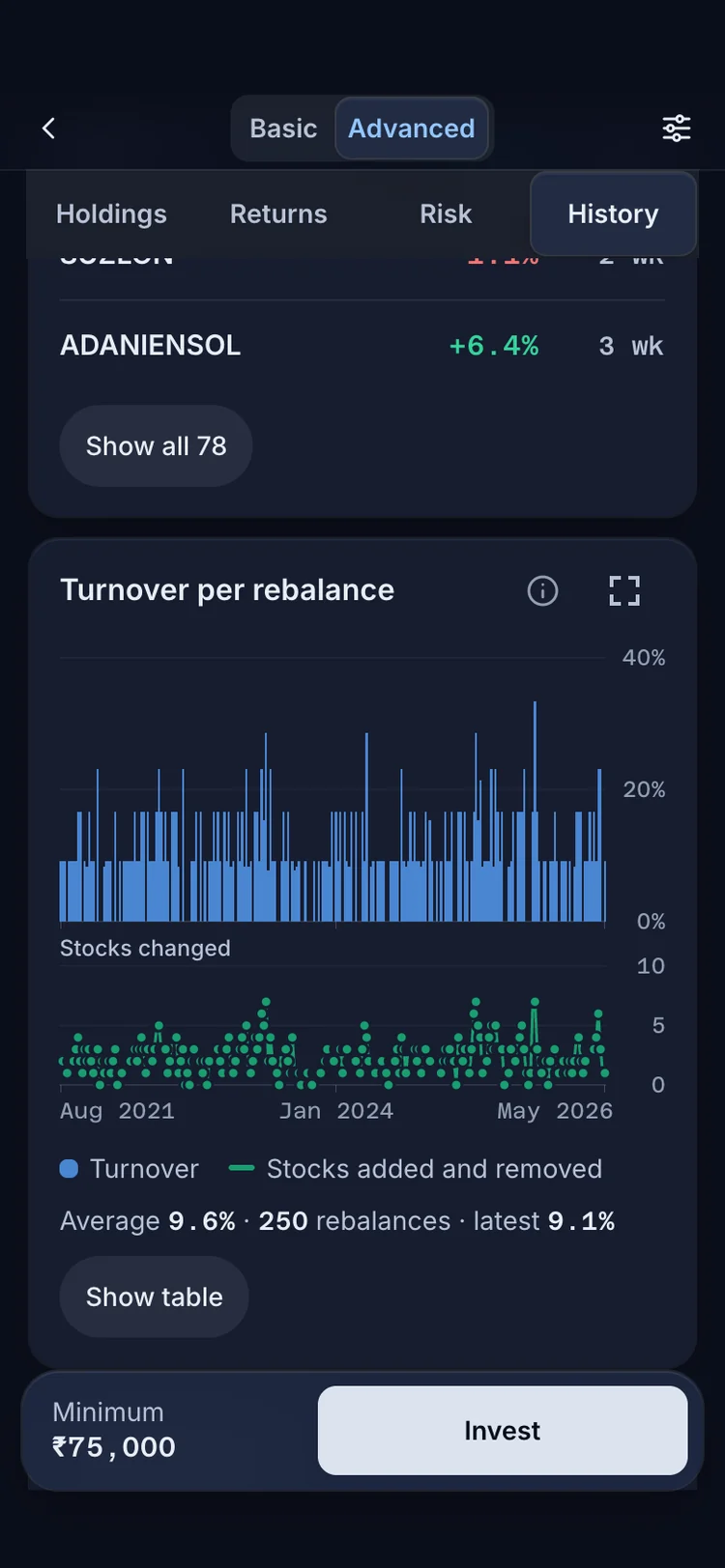
2Turnover per rebalance, from the model record: the fee is charged only on what trades. 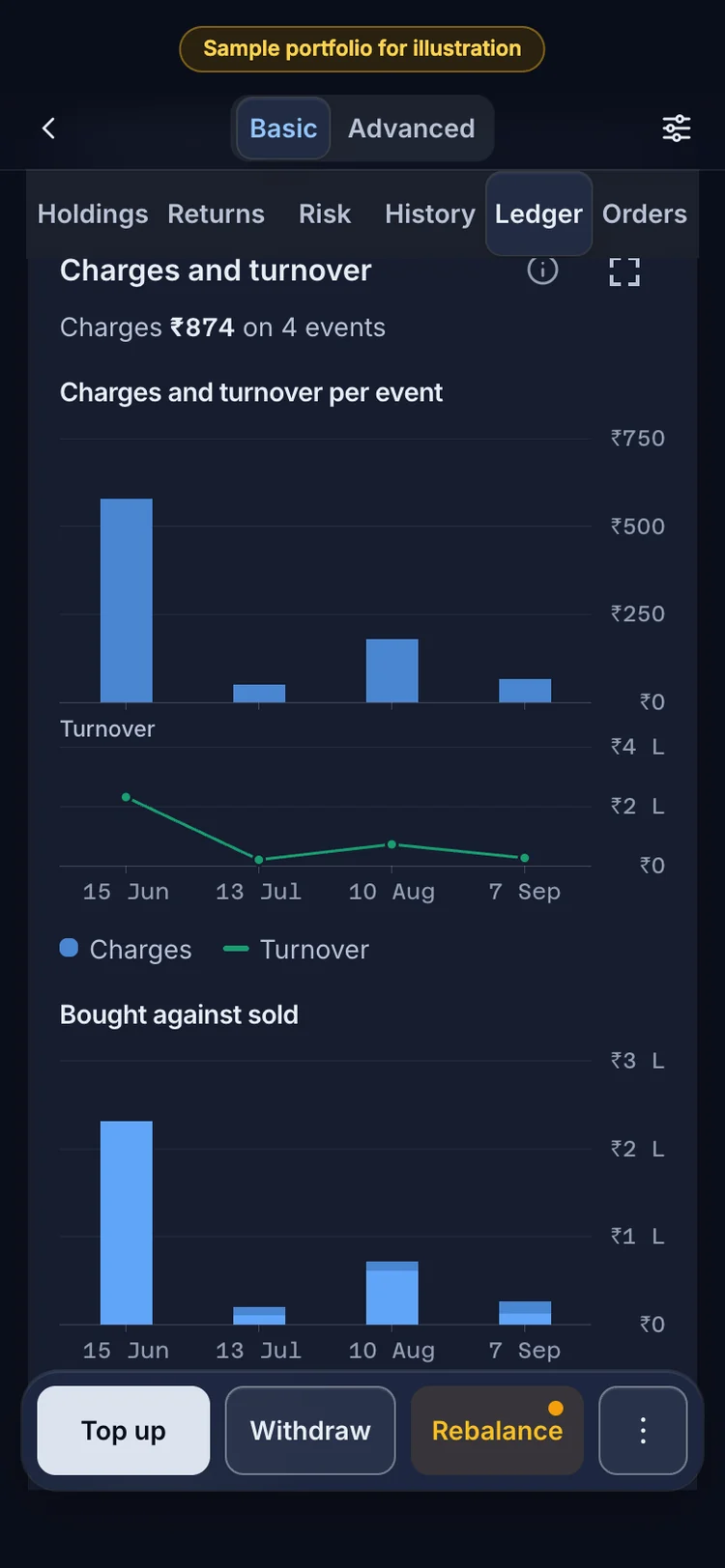
3Your own charges and turnover, event by event, on the Ledger tab. 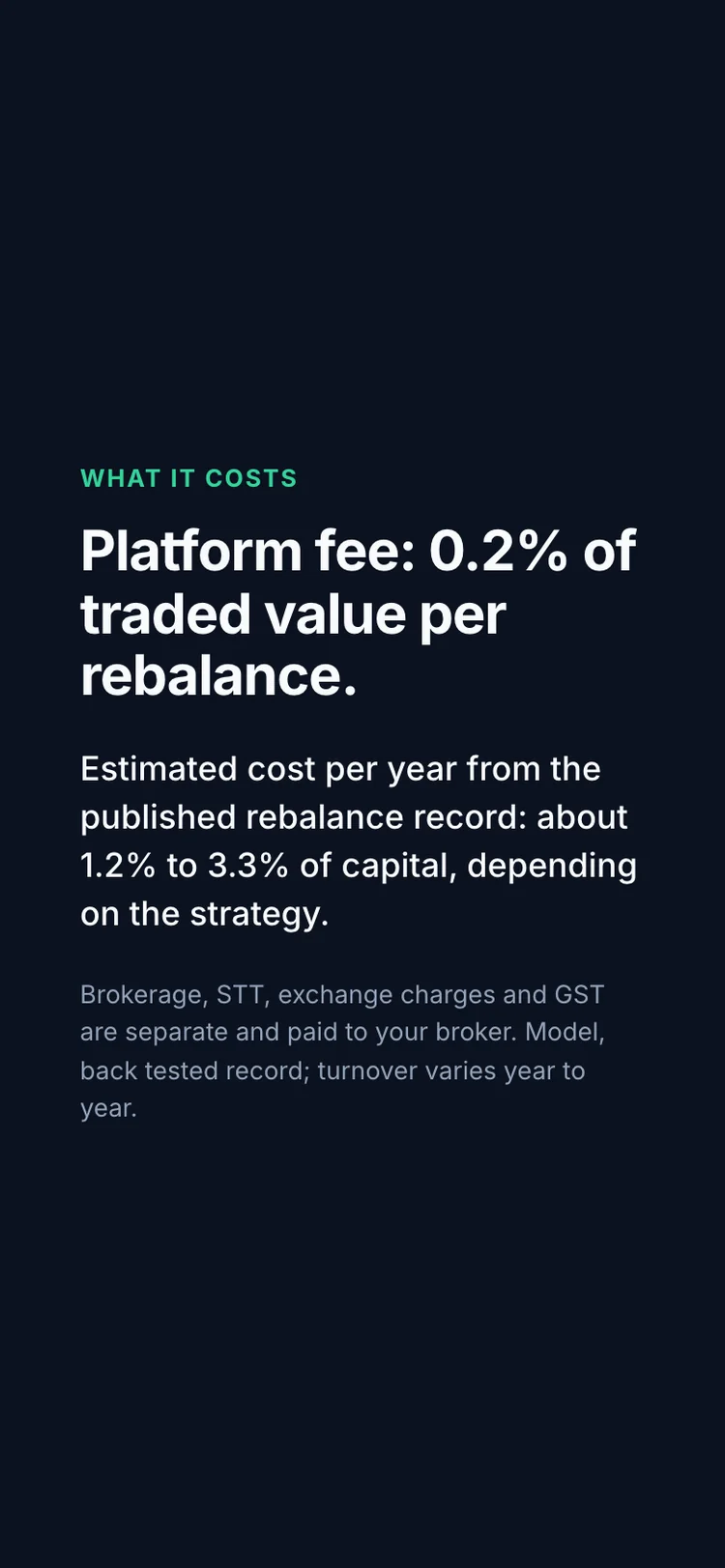
4Platform fee: 0.2% of traded value per rebalance. About 1.2% to 3.3% of capital a year in the published record, depending on the strategy.
Where it sits in RupeeCase, in words
RupeeCase is not a mutual fund and has no distributor commission. You hold the shares in your own demat, and the platform charges 0.2% of the value traded at each rebalance, nothing on the holding itself. That makes the yearly cost depend on turnover: in the published rebalance record it was under 0.1% of capital for Nifty 50 Equal Weight and 1.2% for Focused Largecap 20, more than the direct plan TERs in the table above. Nifty 50 Equal Weight's model back test shows a CAGR of 16.35% and a deepest fall of −15.71%, as of 27 Apr 2026. For other ways to hold a ready basket in your own demat, see smallcase alternatives. Compare costs in rupees on your own amount with the expense ratio calculator and the comparison against mutual funds.
Questions investors ask
What is the difference between direct and regular plans?
Both are plans of the same scheme with the same portfolio. The regular plan is bought through a distributor and its expense ratio includes the distributor's commission; the direct plan has no commission, so a lower expense ratio and a higher NAV.
Are direct plans safer than regular plans?
No. Safety is the same, because the money sits in the same portfolio. Only the expenses differ. Risk depends on what the scheme holds, not on the plan.
Why is the direct plan NAV higher?
Expenses are taken from each plan's assets every day. The direct plan has lower expenses, so less is deducted, and its NAV rises above the regular plan's over time. The underlying return is the same.
How much lower is a direct plan's expense ratio?
It varies by scheme. In one fund house's disclosure for 31 Aug 2026 the total TER gap was 0.40 to 1.18 percentage points a year across three equity schemes. Check any scheme on the AMFI TER page.
Is switching from regular to direct taxable?
Yes, it can be. A switch is treated as a sale of regular units and a purchase of direct units, so capital gains tax applies to any gain, and units bought through a distributor can carry an exit load.
Should I always choose a direct plan?
Not always. If a distributor gives you real advice and support, the commission may be worth it. If you make your own decisions, a direct plan costs less for the same portfolio. This is a description, not advice.