



What is the Nifty200 Momentum 30?
It is the most widely tracked momentum index in India, and a good one to learn from because NSE Indices publishes every step of its rule. Its methodology document for equity indices, in the edition stamped 21 Aug 2026, describes it as tracking the 30 companies within the Nifty 200 with the highest Normalized Momentum Score.
Read 2 more paragraphs, 79 words
The factsheet adds the basic facts: launch date 25 Aug 2020, base date 1 Apr 2005, base value 1,000, tilt weighted, 30 constituents, calculated in real time, rebalanced semi annually. Several fund houses run index funds and ETFs on it.
When I teach momentum, I start with this index rather than with any strategy of my own. Everything that matters about a momentum rule is visible in it: the universe, the score, the weights, the calendar and the buffer.
Which stocks are eligible?
The rule starts with three filters, in NSE's words paraphrased:
Read one more paragraph and a list, 111 words
- The stock is in the Nifty 200, or is about to enter it, at the time of the review.
- It has at least one year of listing history. A company that has gone through a scheme of arrangement needs twelve months of trading after it went ex on that event.
- It is available for trading in the derivatives segment (F&O) on the effective date.
The F&O filter is easy to overlook and it matters. It keeps the index to large, liquid names that an index fund can buy and sell in size. Stocks that drop out of the Nifty 200 also leave the momentum index at its next review.
How is the momentum score calculated?
This is the heart of the index, and the NSE methodology spells it out.
- Returns12 month and 6 month price returns, to the last trading day of the month before the rebalance.
- Risk adjustEach return divided by the stock's annualised volatility of daily log returns over one year.
- Z scoresEach ratio compared with the mean and spread of all eligible stocks.
- BlendWeighted average z score: 50% 12 month, 50% 6 month.
- Normalise1 + z when z is zero or more; 1 ÷ (1 − z) when z is negative.
| Weighted average z score | Normalized Momentum Score |
|---|---|
| 2.0 | 3.00 |
| 1.0 | 2.00 |
| 0.5 | 1.50 |
| 0.0 | 1.00 |
| −1.0 | 0.50 |
Read 4 more paragraphs, 129 words
Three details deserve a second look.
The month gap. For a rebalance in month M, the 12 month return runs from the last trading day of month M−13 to the last trading day of month M−1. So the June rebalance uses prices to the end of May, and the December one uses prices to the end of November.
Dividing by volatility. A stock that rose 40% with wild daily swings scores lower than one that rose 40% steadily. This is what keeps the index from filling up with the most erratic names in the universe.
Normalising. The z score can be negative, and a weight cannot. The formula maps every z score to a positive number: above 1 for stocks better than average, below 1 for worse.
Focused Largecap 20 fell at most 20.5% below its model high, month end to month end
How are the weights set?
Once the top 30 are picked, each weight is the stock's free float market cap multiplied by its Normalized Momentum Score. NSE calls this a factor tilt: size still matters, but momentum tilts the weight up or down.
Read 2 more paragraphs, 97 words
Then a cap applies: no stock can weigh more than the lower of 5%, or 5 times its weight in the index if the index were weighted by free float market cap alone. The capping is done at each semi annual rebalance, so between rebalances a strong stock can drift above 5%.
The result is an index that leans toward large companies with strong, steady trends, rather than an equal slice of every winner. A small company with a huge score cannot dominate, because its market cap is small and the 5 times rule holds it back.
When does it rebalance, and what is the buffer?
Twice a year, in June and December. At each one, the stocks are ranked by score and a buffer decides who moves. The 15 highest ranked are always in. An existing holding ranked below 45 always leaves. A holding ranked 16 to 45 is not forced out, which spares the index from selling a stock that slipped a few places.
- Ranks 1 to 15Always in the index at the rebalance, new or existing.
- Ranks 16 to 45An existing holding in this band is not forced out.
- Below rank 45An existing holding is always removed.
Read one more paragraph, 50 words
Outside the calendar, NSE rebalances only for events: a constituent leaving the Nifty 200 after a corporate action, a suspension, and similar cases. Each quarter the index is also checked against SEBI's portfolio concentration norms for ETFs and index funds of 10 Jan 2019, and corrected if it breaches them.
How has it behaved?
Momentum rewards patience and punishes it in turns. Two windows from NSE's daily index files, both ending at least 30 days before this guide was written, show both sides.
Rebased to 100 at the end of Oct 2024, the Nifty200 Momentum 30 fell to about 77 by the end of Feb 2025 and stood near 91 at the end of Aug 2026; the Nifty 50 ended near 100.
Month end closes of the price indices, NSE daily index files, Oct 2024 to 31 Aug 2026, rebased to 100. Price indices leave out dividends.
| Price index, NSE daily files | 12 months to 31 Aug 2026 | 31 Oct 2024 to 31 Aug 2026 |
|---|---|---|
| Nifty200 Momentum 30, return | 5.78% | −9.17% |
| Nifty 50, return | −1.42% | −0.52% |
| Nifty200 Momentum 30, deepest fall | −15.98% | −26.55% |
| Nifty 50, deepest fall | −15.18% | −15.18% |
| Nifty200 Momentum 30, volatility a year | 17.92% | 18.72% |
| Nifty 50, volatility a year | 13.13% | 13.31% |
Read one more paragraph, 76 words
The two columns tell different stories about the same index. Over the latest year it led the Nifty 50. Measured from the end of Oct 2024, it was still behind, because the fall into Feb 2025 was so deep. That is the core trade of momentum: long stretches of leadership, broken by sharp reversals when the market's leaders change. With a semi annual calendar, the index can hold last year's winners for months into a turn.
How does it compare with RupeeCase's momentum rules?
The RupeeCase index algos use the same family of idea with different settings. The differences are in the universe, the number of names, the weights and, above all, the calendar.
| Nifty200 Momentum 30 | Focused Largecap 20 | Large Midcap | |
|---|---|---|---|
| Universe | Nifty 200, in F&O | Nifty 100 | Nifty LargeMidcap 250 |
| Names | 30 | 20 | 40 |
| Weights | Market cap times score, capped at 5% | Equal | Equal |
| Rebalance | June and December | Every 4 weeks | Every 2 weeks |
| Record shown | Index, NSE | Model, back tested | Model, back tested |
Read one more paragraph, 67 words
Faster rebalancing reacts sooner when leadership changes and costs more in trading. Focused Largecap 20's model back test shows a CAGR of 26.29%, a deepest fall of −23.56% and a Sharpe ratio of 1.20; Large Midcap's shows 37.83%, −19.31% and 1.69, all model figures as of 27 Apr 2026. These are back tests, not client returns, and they are not directly comparable with an index's published history.
Common mistake: treating 2005 to 2020 as a live record
The index's history starts on 1 Apr 2005, but it launched on 25 Aug 2020. Fifteen years of that history are NSE's calculation of what the rule would have held. That is useful for studying the rule and it is the stretch nobody could invest in. When you compare a momentum index fund with anything, use the years since launch, and use total return figures where you can, since the price index leaves out dividends.
How this shows up in RupeeCase
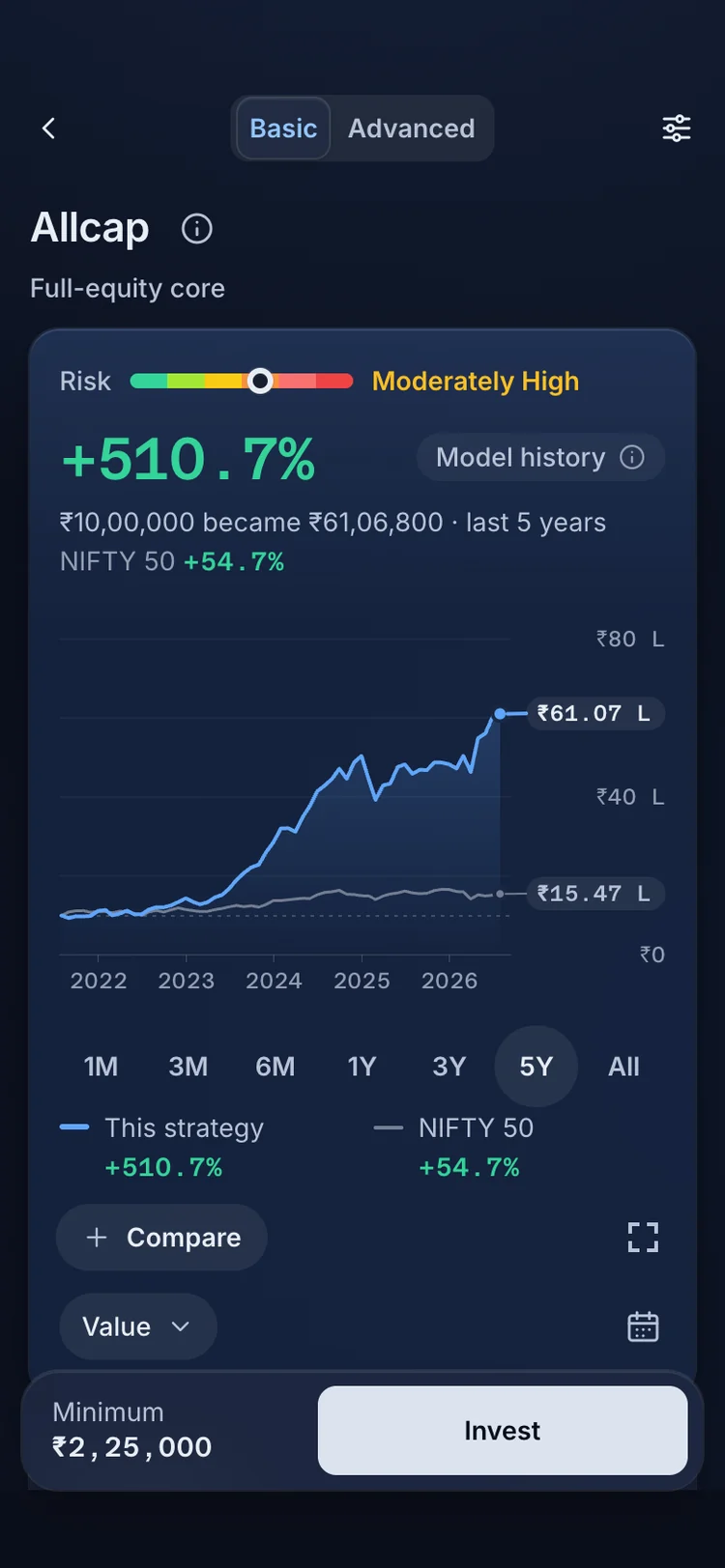
1Each strategy page shows its model history and the Invest bar with the minimum. 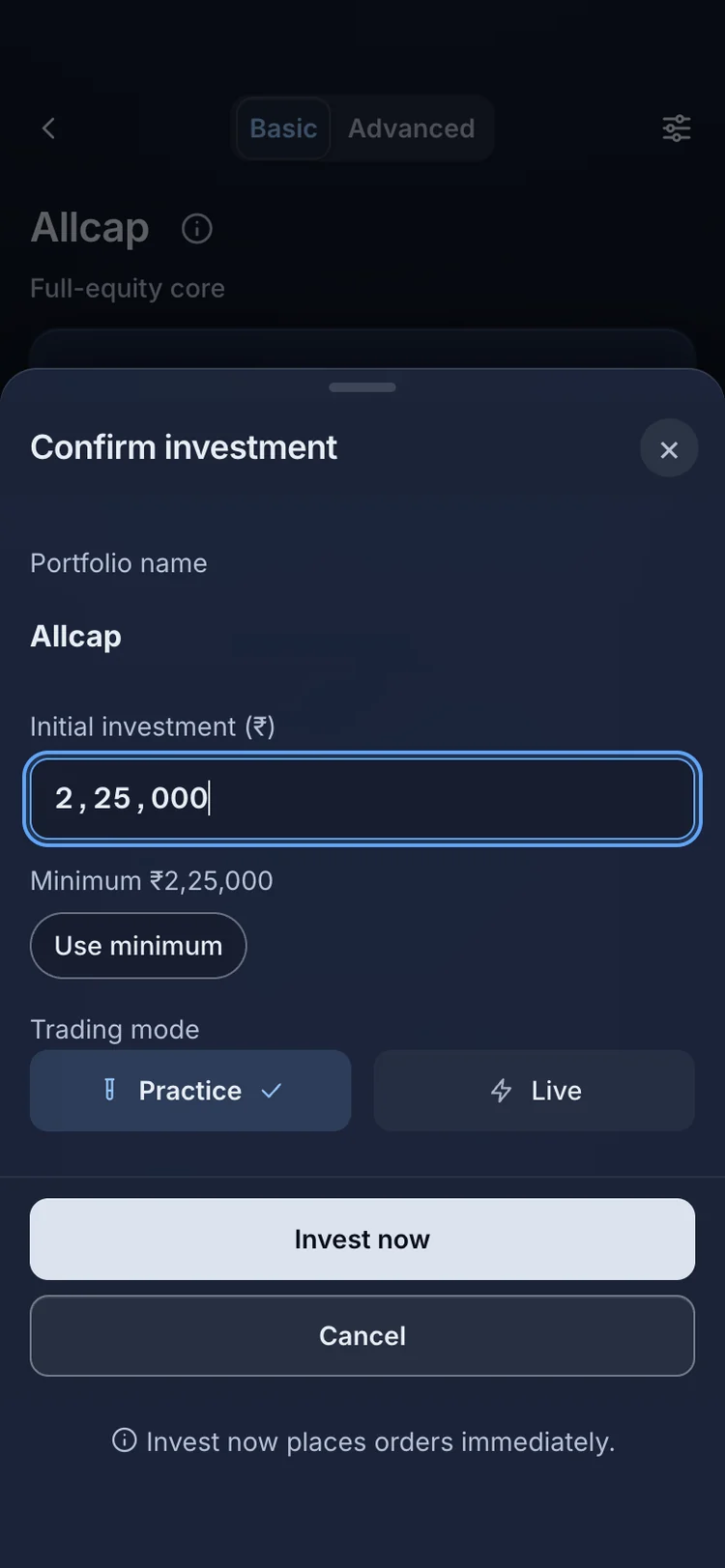
2The sheet opens with the minimum as the amount; Use minimum puts it back. 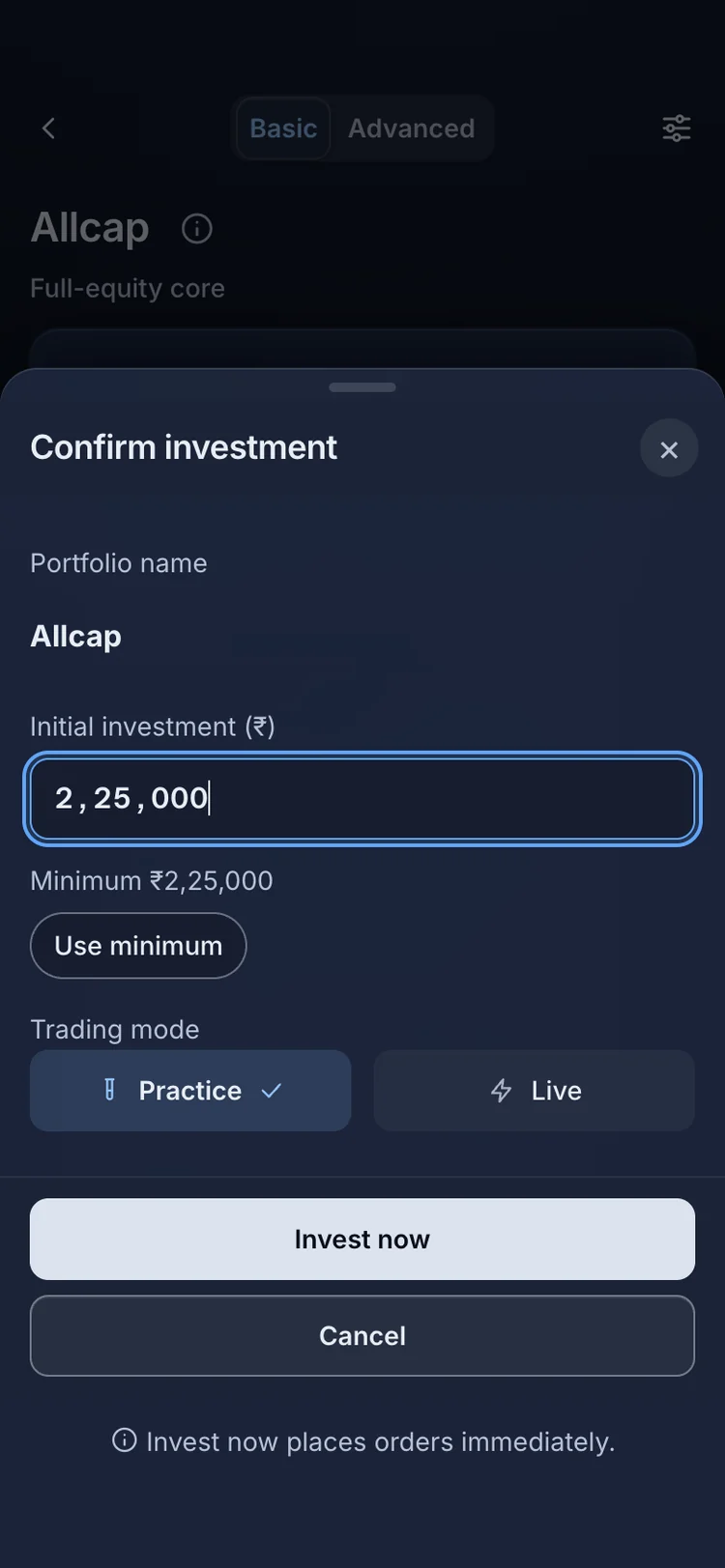
3Practice follows the strategy with no real broker order. 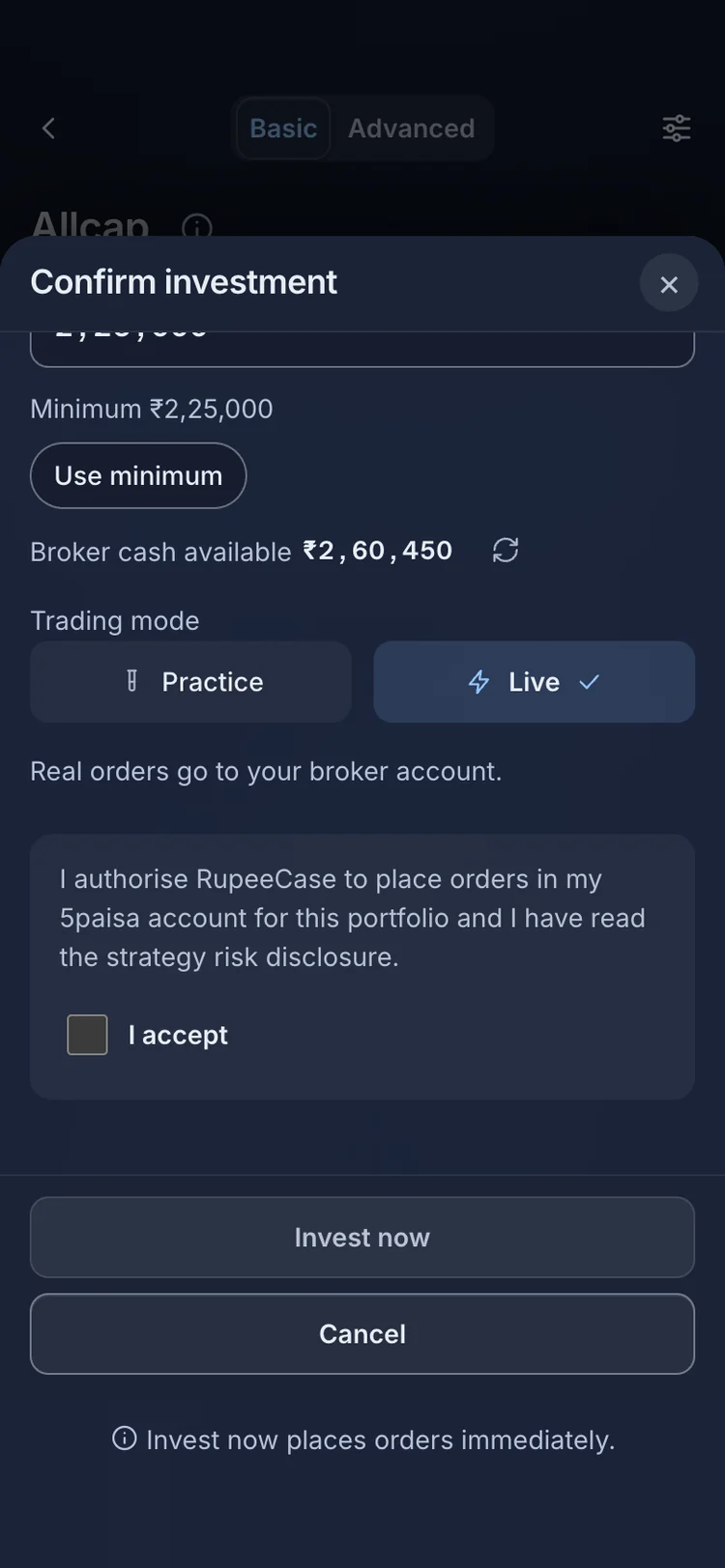
4Live shows your broker cash and asks for your consent before any order.
Where it sits in RupeeCase, in words
Focused Largecap 20 is the closest RupeeCase rule in spirit: 20 names from the Nifty 100, equal weight, rebalanced every 4 weeks. Large Midcap widens the universe to the LargeMidcap 250 and holds 40. Both publish every rebalance, and the strategy pages let you put NSE indices on the same chart. The minimum for Focused Largecap 20 is ₹1,00,000 as of 8 Aug 2026. The score uses prices only; flows such as FII and DII buying play no part in it. If you are weighing ready baskets more broadly, the guide to smallcase alternatives sets the routes side by side. The learn module on the momentum factor covers why the effect exists and when it fails.
Questions investors ask
What is the Nifty200 Momentum 30 index?
An NSE strategy index of the 30 Nifty 200 stocks with the highest Normalized Momentum Score, based on 6 and 12 month price returns adjusted for volatility. It launched on 25 Aug 2020 and rebalances in June and December.
How often is the Nifty200 Momentum 30 rebalanced?
Twice a year, in June and December. It uses prices to the end of the month before. Stocks leaving the Nifty 200 exit at the review, and there is a quarterly check against SEBI's concentration norms for index funds.
How is the momentum score calculated?
Each stock's 12 month and 6 month price returns are divided by its annualised volatility, converted to z scores against the eligible stocks, averaged 50:50, and normalised so every score is positive.
What is the maximum weight of a stock in the index?
The lower of 5% or 5 times its weight in a pure free float market cap version. The cap is applied at each semi annual rebalance, so a stock can drift above it between rebalances.
Is the Nifty200 Momentum 30 risky?
It is more volatile than the Nifty 50. In NSE's daily files it fell 22.7% from the end of Oct 2024 to the end of Feb 2025, against 8.6% for the Nifty 50, and its volatility over the year to 31 Aug 2026 was 17.92% against 13.13%.
How is it different from a RupeeCase momentum strategy?
The index holds 30 Nifty 200 stocks weighted by market cap times score and rebalances twice a year. RupeeCase rules use other universes, equal weights and calendars of two to four weeks, and their figures are model back tests.