



The four ways to own gold, side by side
| Gold ETF | Sovereign Gold Bond | Digital gold | Coins and bars | |
|---|---|---|---|---|
| What you own | Units of a fund that holds gold | A government bond priced in gold | A claim on gold held by a seller's vault | The metal |
| Regulated by | SEBI (mutual fund rules) | Issued by RBI for the Government | Not SEBI | Not SEBI |
| Where it sits | Your demat | Your demat or RBI's books | The app's account | Your locker |
| Yearly cost | The fund's expense ratio | None; pays 2.5% a year interest | Built into buy and sell prices | Storage, insurance, making charges |
| Long term after | More than 12 months | More than 12 months if bought on the exchange | More than 24 months | More than 24 months |
The gold ETF is the simplest of the four for most demat holders: it trades like a share and costs brokerage and the fund's expense ratio. The module on gold, commodities and international investing covers how gold is priced, and the note read the door before the metal compares the routes on cost.
What gold has done since 2012
a year for Gold BeES, end Feb 2012 to 12 Oct 2026
NSE closing prices, split adjusted
a year for the Nifty 50 price index, same dates
NSE daily index files
Gold BeES in calendar 2025, its best year in the record
NSE closing prices
from the 29 Jan 2026 close of ₹146.53 to 12 Oct 2026
NSE closing prices
Over the whole period gold and the Nifty 50 ended close together, by very different paths. Gold peaked at the end of Nov 2012, fell 24.38% to the end of Jul 2015 on month end prices, and did not close a month above that 2012 level again until Jul 2019, almost seven years later.
Rebased to 100 at the end of Feb 2012, Gold BeES was below 100 from 2013 to 2019 and ended near 441 on 12 Oct 2026; the Nifty 50 rose most years and ended near 415.
Month end closes from NSE: Gold BeES (GOLDBEES, pre 19 Dec 2019 prices divided by 100 for the 1 to 100 unit split) and the Nifty 50 price index, which leaves out dividends of about 1% a year. Feb 2012 to 12 Oct 2026. Past returns.
Read one more paragraph, 45 words
From 2019 to 2025 it rose in six of seven calendar years, including 27.00% in 2020 and 71.81% in 2025. In 2026 it was up 10.11% to 12 Oct, after a sharp fall of about 19% in three sessions from 29 Jan to 2 Feb.
Gold in the years the Nifty fell
The main case for gold in a portfolio is not its return; it is that it has tended to move differently from Indian shares. Monthly returns of Gold BeES and the Nifty 50 from 2012 to 2026 had a correlation of −0.10, close to none. In the 12 months when the Nifty fell more than 5%, gold rose in 8 and averaged +1.5%, while the Nifty averaged −8.1%.
| Asset | 2013 | 2014 | 2015 | 2016 | 2017 | 2018 | 2019 | 2020 | 2021 | 2022 | 2023 | 2024 | 2025 |
|---|---|---|---|---|---|---|---|---|---|---|---|---|---|
| Gold BeES | -6.4 | -9.3 | -7.5 | 12.5 | 2.4 | 6.7 | 23.0 | 27.0 | -5.2 | 12.8 | 14.7 | 19.4 | 71.8 |
| Nifty 50 | 6.8 | 31.4 | -4.1 | 3.0 | 28.7 | 3.2 | 12.0 | 14.9 | 24.1 | 4.3 | 20.0 | 8.8 | 10.5 |
Year end closes, NSE. Gold BeES split adjusted; Nifty 50 price index. 2026 to 12 Oct: gold +10.1%, Nifty 50 −14.4%. Past returns.
Read one more paragraph, 72 words
From 14 Jan to 23 Mar 2020 the Nifty 50 fell 38.44% and Gold BeES rose 0.78%. From 26 Sep 2024 to 4 Mar 2025 the Nifty fell 15.77% and gold rose 13.56%. From 2 Jan to 12 Oct 2026 the Nifty fell 15.06% and gold rose 8.42%. Only once in 13 calendar years, 2015, did both fall. That is a record, not a law: gold fell in 2013, 2014 and 2015.
Gold ETFs: what to check before you buy
A gold ETF holds physical gold in a vault, valued daily, and its units trade on the exchange through the day. Three things separate one from another:
- Liquidity
- Price against NAV
- Expense ratio
Read one more paragraph and a list, 171 words
- Liquidity. In the year to 12 Oct 2026, Gold BeES traded a median of about ₹361 crore a day on NSE. Several newer gold ETFs traded under ₹1 crore a day. Thin trading means wider gaps between buy and sell prices.
- Price against NAV. On 1 Feb 2026, a Sunday Budget session, Gold BeES traded at ₹122.31 while its published NAV still carried Friday's gold price of ₹135.86: the price had moved with the news, the NAV had not yet. On 21 Jan 2026 it closed 6.26% above NAV. On a normal day the gap was about 0.2%. The ETF tracking error and liquidity guide explains why.
- Expense ratio. It comes out of the NAV every day; compare it across funds tracking the same gold price.
Gold mutual funds (fund of funds that buy a gold ETF) let you invest by SIP without a demat account, at the cost of a second layer of expenses. Their units are not listed, so they need more than 24 months to be long term.
Sovereign Gold Bonds: the best record, and the catch
An SGB is a government bond priced in grams of gold. It paid 2.5% a year on the issue price, credited every six months, and is redeemed after eight years at the average gold price of the three business days before redemption.
MythAny SGB bought on the exchange is tax free when it matures.
FactFrom 1 Apr 2026 the exemption covers only an investor who subscribed at original issue and held until redemption. A bond bought on the exchange is taxed on the gain.
- No new issues
- Tax on exchange purchases
- The interest is taxable
- Early exit
Read 2 more paragraphs and a list, 198 words
The record is strong. SGB 2018-19 Series I was issued at ₹3,114 a gram (₹3,064 online) and redeemed on 4 May 2026 at ₹14,901: 4.79 times the issue price, 21.61% a year before the interest. Gold BeES over a similar window, 30 Apr 2018 to 4 May 2026, returned 20.35% a year.
The catches, all from primary sources:
- No new issues. RBI has notified no SGB tranche since the 2023-24 Series IV of February 2024. The only way in now is to buy an existing bond on NSE or BSE, where many series trade thinly and often away from the gold price.
- Tax on exchange purchases. The Finance Act 2026 limited the redemption exemption (section 70(1)(x) of the Income-tax Act, 2025, formerly section 47(viic)) to original subscribers who hold to maturity. A buyer on the exchange pays capital gains tax at redemption: 12.5% on the gain if held more than 12 months.
- The interest is taxable at your slab rate every year, with no tax deducted at source, so it has to be shown in your return.
- Early exit through RBI is allowed only after the fifth year, on interest payment dates.
Digital gold and physical gold
Digital gold is sold by apps and payment platforms as a fraction of a gram held in a vault. SEBI's press release of 8 Nov 2025 says such products "operate entirely outside the purview of SEBI", may carry counterparty and operational risks, and that none of the securities market's investor protection applies to them.
Read 2 more paragraphs, 76 words
The note gold free twin shows what a portfolio looks like with and without a gold sleeve.
Coins and bars carry making charges, purity checks and storage. Both digital and physical gold are capital assets other than listed securities: held more than 24 months, the gain is taxed at 12.5% without indexation (section 197 of the 2025 Act, formerly section 112); held for less, it is added to your income and taxed at your slab rate.
How much gold has helped a portfolio
To see what a gold sleeve did on Indian data, I mixed the Nifty 50 with Gold BeES and reset the mix every December, from the end of Dec 2012 to 12 Oct 2026, on month end prices.
| Nifty 50 and Gold BeES | CAGR | Worst month end fall |
|---|---|---|
| 100 and 0 | 10.15% | −29.34% |
| 90 and 10 | 10.44% | −25.32% |
| 80 and 20 | 10.68% | −21.29% |
| 70 and 30 | 10.87% | −17.31% |
Read one more paragraph, 77 words
More gold gave both a higher return and a shallower fall in this window. The return part owes most to gold's run from 2019 to 2025; from 2013 to 2018 the same sleeve was a drag. The steadier lesson is the second column: a 10% to 20% gold share took several points off the worst fall. The multi asset guide adds debt to the picture, and the asset allocation calculator shows a mix for your own numbers.
How this shows up in RupeeCase
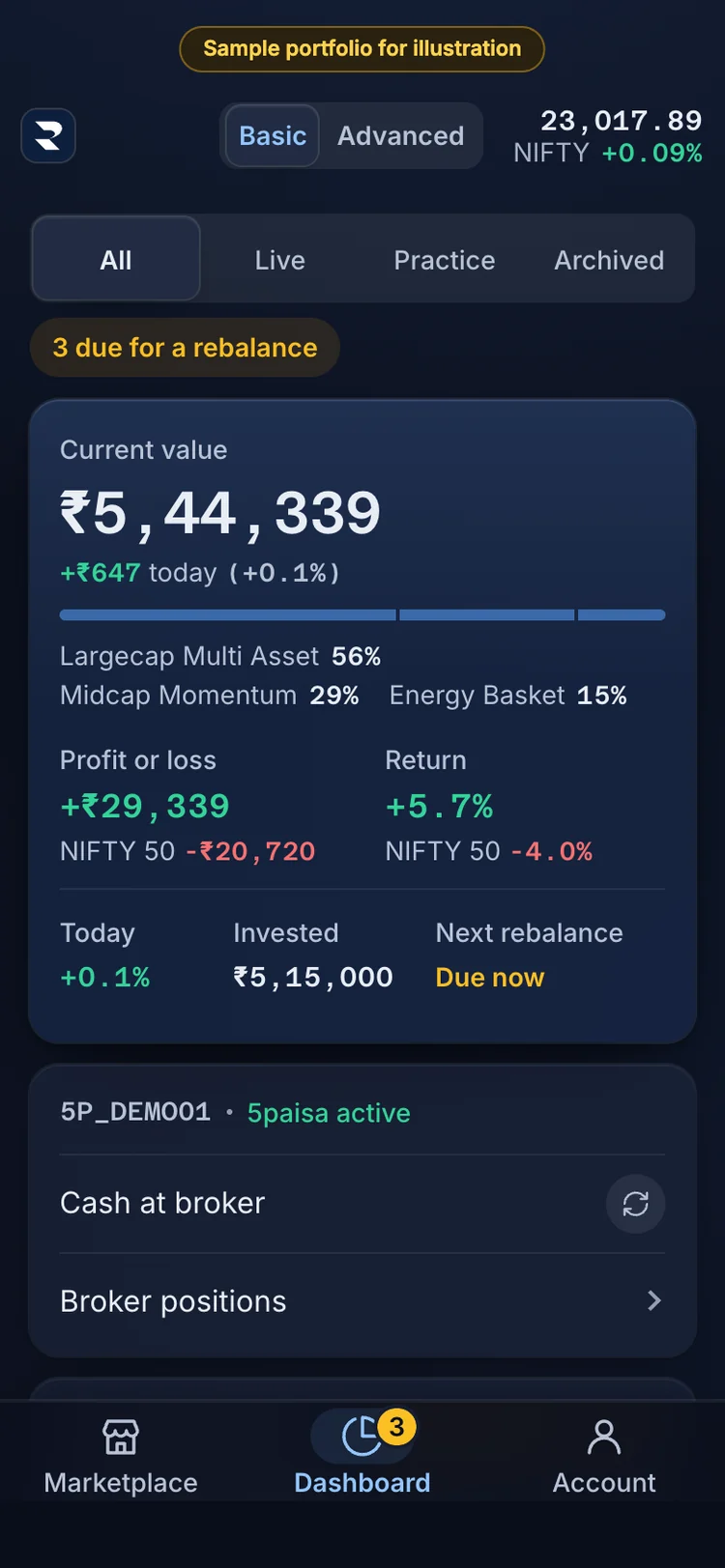
1A due rebalance shows on the Dashboard and as a badge on the tab bar. 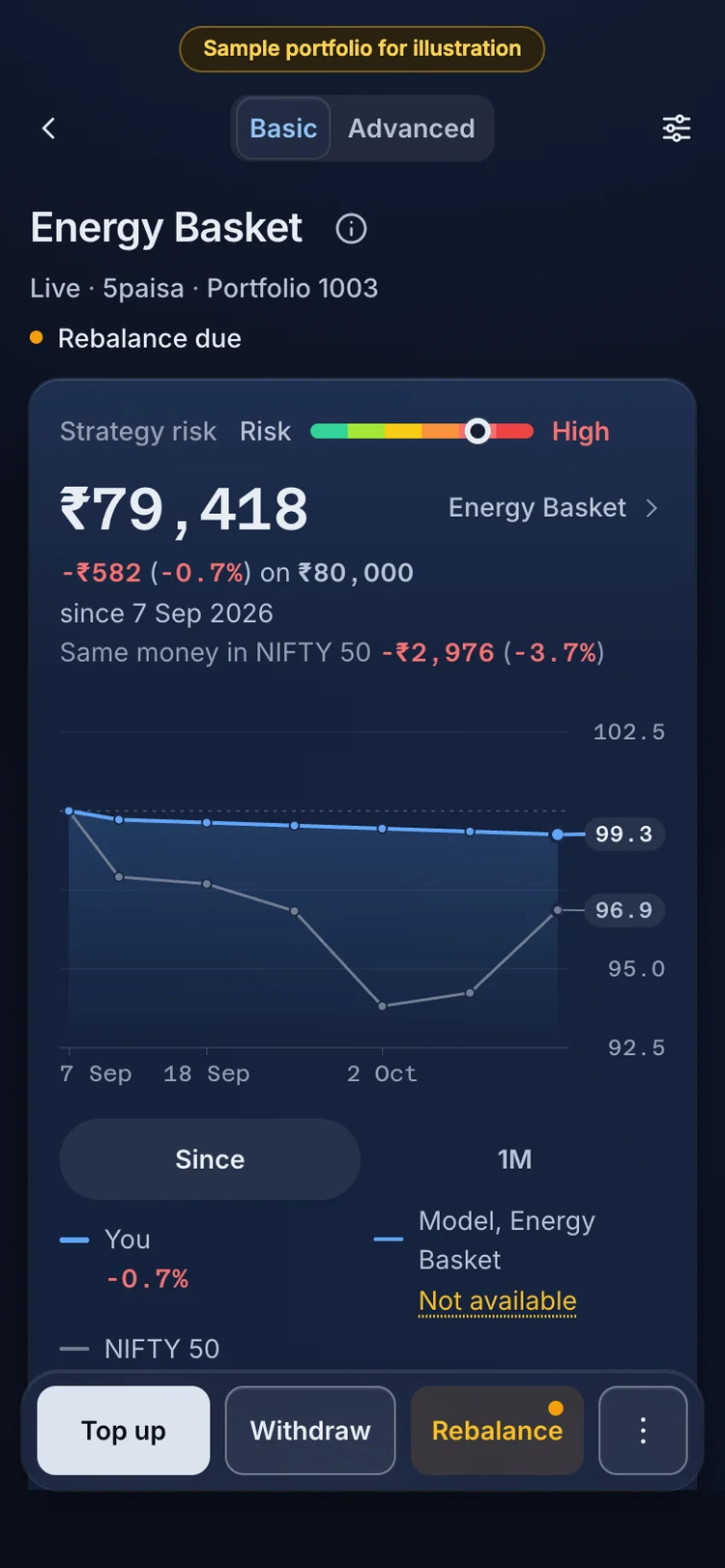
2The portfolio says a rebalance is due. 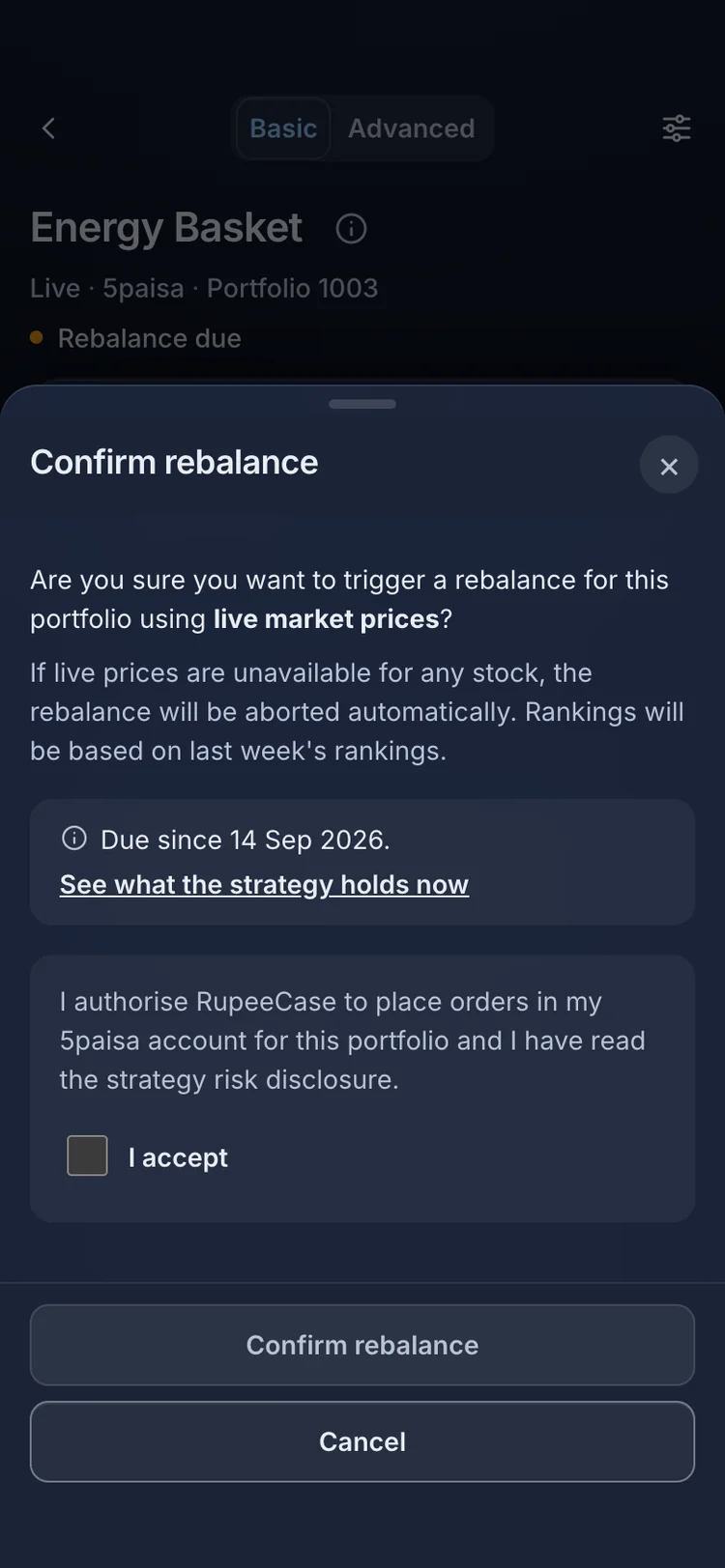
3Confirm rebalance says when it fell due and asks for your consent. 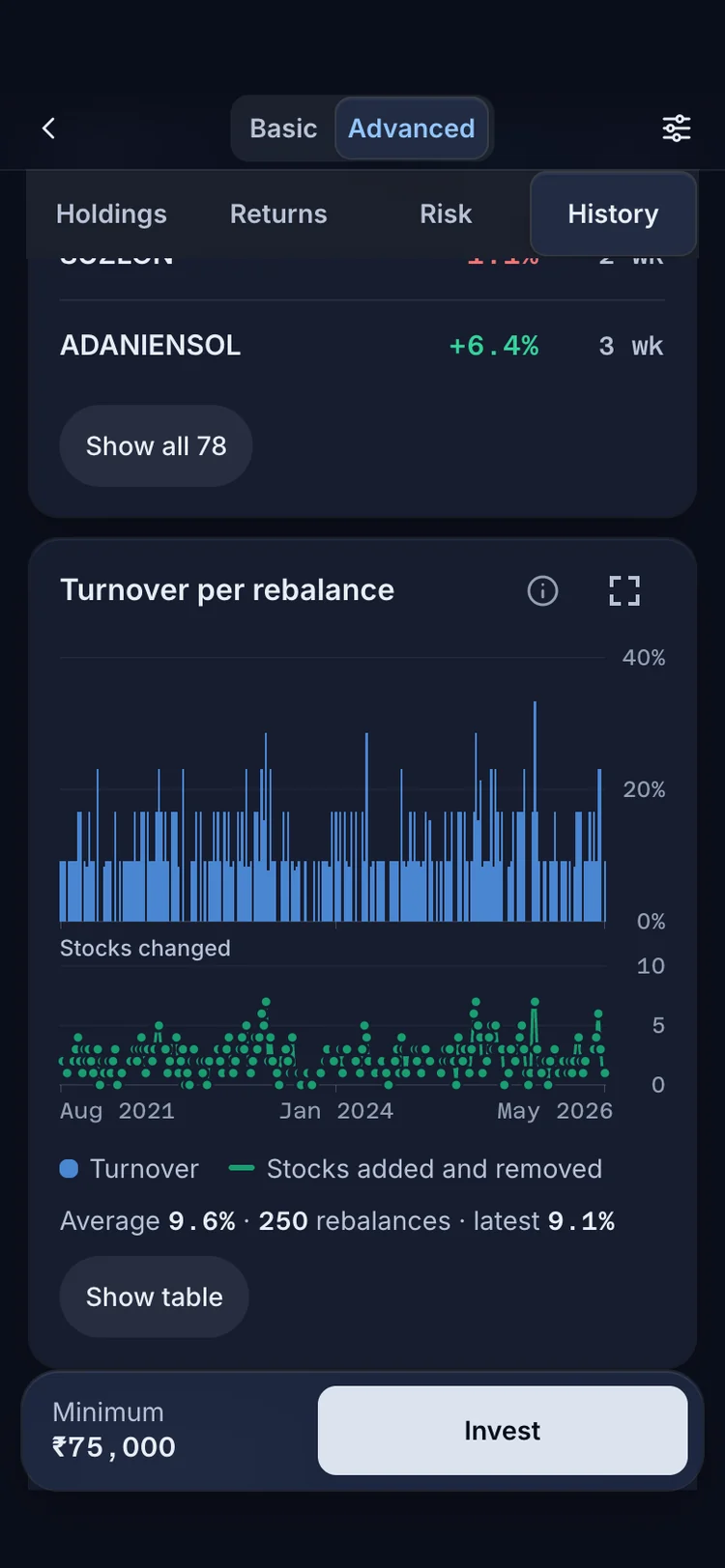
4The strategy’s History tab records the turnover at every rebalance in the model record. 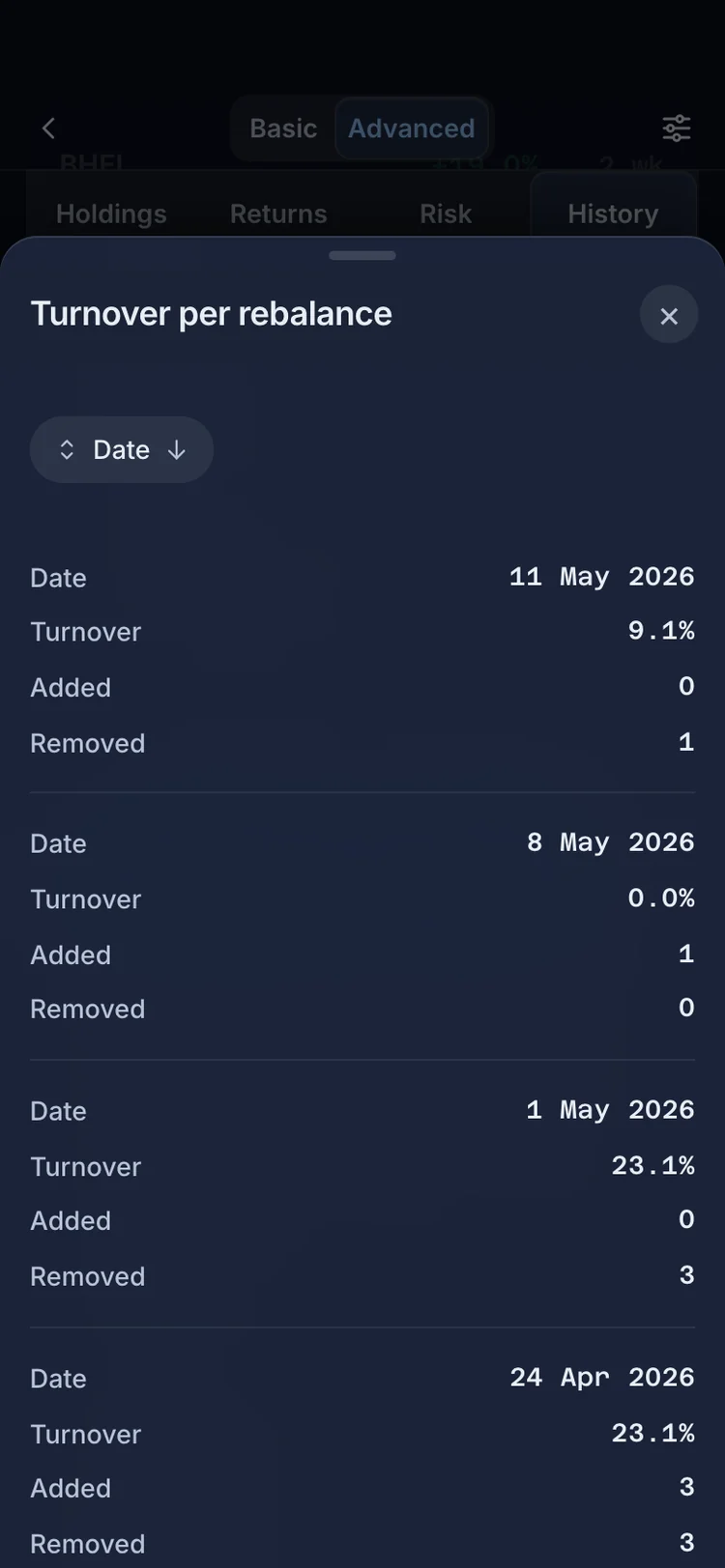
5Every rebalance in the model record: the date, the turnover and the stocks added and removed.
Where it sits in RupeeCase, in words
Some RupeeCase rules carry their own gold and debt sleeve, so the mix is set inside the strategy and reset at each rebalance rather than by hand. Allcap Multi Asset runs a momentum rule across the whole market with that sleeve, 52 holdings rebalanced every 2 weeks: model CAGR 40.47%, deepest fall −21.32%, as of 27 Apr 2026. The note why adding gold can improve an all equity book explains the maths.
Questions investors ask
Which is the best way to invest in gold in India?
For most investors with a demat account, a liquid gold ETF is the simplest: regulated, priced daily, no storage. SGBs had the best tax treatment, but no new ones have been issued since February 2024. Digital gold is outside SEBI's protection.
Is gold ETF better than SGB?
An SGB bought at issue and held to maturity paid 2.5% interest and no tax on redemption. A gold ETF pays no interest and carries an expense ratio, but trades every day. Bought on the exchange now, an SGB is taxed on redemption and may trade thinly.
Is digital gold safe?
SEBI said on 8 Nov 2025 that digital gold is not a security or a commodity derivative, operates outside its purview, and carries counterparty and operational risks. None of the securities market's investor protection applies.
How is gold ETF taxed from 2026-27?
Units held more than 12 months: 12.5% on the gain, without indexation. Held 12 months or less: added to income and taxed at your slab rate. Add 4% cess.
Are new Sovereign Gold Bonds being issued?
No tranche has been issued since 2023-24 Series IV in February 2024, according to RBI's SGB notices. Existing bonds can be bought on NSE and BSE.
How much of my portfolio should be in gold?
There is no single answer. From 2012 to 2026, a 10% to 20% gold share alongside the Nifty 50 took several points off the worst fall. This guide is education, not advice for your situation.