



A home is two things at once: a place to live and a leveraged bet on one street. Renting covers only the first. Owning covers both, and charges for both. The honest comparison is a price comparison: what each route costs per month, what each leaves you holding after a number of years, and what has to be true about prices and rents for the two to meet. This is education, not advice on your purchase.
5By the end you can
- Add up what a purchase costs on day one: down payment, stamp duty and registration as a state rule, and what the lender will not finance.
- Work an EMI by hand, split year one into interest and principal, and see why principal is a saving and interest is a cost.
- Compute the break even rent for a flat, and the horizon after which owning leaves more than renting under stated inputs.
- Read the home loan tax rules under the Income-tax Act, 2025: what the old regime allows and what the new regime removes.
- Name the protections the RERA Act gives a buyer of an under construction flat, with the section for each.

The question is a price, not a feeling
People ask whether renting is dead money. It is not a useful question. Interest on a home loan is also money that does not come back, and so are maintenance, property tax and the stamp duty paid on day one. What you want to know is which route leaves you with more, once every rupee is counted on both sides.
Read 2 more paragraphs, 113 words
The renter pays rent and keeps the rest. That rest is the point. The down payment, the stamp duty and the gap between the EMI and the rent all stay in the renter's hands, where they can earn something. The owner turns that same money into a flat and takes its price gain, which can be positive or negative. So the comparison has two columns: what the flat gains in price, and what the same money would have earned elsewhere.
Everything below uses one running example: an ₹80 lakh flat in Delhi, 20 percent down, a 20 year loan. They are my illustrative inputs. Change them in the calculators and the answer moves.
What it costs on day one: down payment, stamp duty, registration
The loan does not cover the whole bill. A lender finances part of the price, and the rest, plus the taxes on the transfer, comes from your savings. Stamp duty and registration are state subjects. Each state sets its own rate, its own concessions and its own surcharges, so one state is only an example of how the arithmetic goes.
| Item, ₹80 lakh flat | Man buyer | Woman buyer |
|---|---|---|
| Stamp duty | ₹4,80,000 | ₹3,20,000 |
| Registration, 1% plus ₹100 | ₹80,100 | ₹80,100 |
| Total transfer cost | ₹5,60,100 | ₹4,00,100 |
| Down payment at 20% | ₹16,00,000 | ₹16,00,000 |
| Cash needed on day one | ₹21,60,100 | ₹20,00,100 |
Illustration. Delhi rates as read on 31 Oct 2026, assuming the price paid is above the circle rate. Brokerage, society transfer charges, interiors and any GST on an under construction flat come on top and are not included.
Man buyer: the largest is Cash needed on day one at ₹21,60,100
Read 3 more paragraphs, 226 words
Delhi, as the Revenue Department's pages read on 31 Oct 2026: stamp duty on a sale deed is 6% of the consideration or the circle rate, whichever is higher, if the buyer is a man, and 4% if the buyer is a woman. The registration fee is 1% of the value plus ₹100 as a pasting charge. I have read only Delhi's pages for this module. Another state means another table, and the rate on the day of your deed is the one that counts.
The transfer cost is gone the moment the deed is registered. It never shows up in the price of the flat. A flat that rises 3.6% in a year, ₹2.88 lakh on ₹80 lakh, pays back only about half of the ₹5.6 lakh the man buyer put into stamp duty and registration. It is why short holding periods lose.
The Income-tax Act, 2025 does give some of it back to those on the old regime. Schedule XV, which lists what qualifies for the ₹1.5 lakh deduction in section 123, includes stamp duty, registration fee and other expenses of the transfer, in the year they are paid. It sits in the same ₹1.5 lakh as EPF contributions and the other items on that list, so for many salaried people it is already used up. The section on tax below returns to this.
The EMI, by hand
A home loan is repaid in equal monthly instalments. Interest is charged each month on the balance still owed. Early instalments are mostly interest; late ones are mostly principal. The formula comes from setting the present value of all instalments equal to the loan.
n = years x 12
EMI = L x i x (1+i)^n
/ ((1+i)^n - 1)
| Yearly rate | EMI | Paid over 20 years | Interest alone |
|---|---|---|---|
| 8.0% | ₹53,532 | ₹1.28 crore | ₹64.5 lakh |
| 8.5% | ₹55,541 | ₹1.33 crore | ₹69.3 lakh |
| 9.0% | ₹57,582 | ₹1.38 crore | ₹74.2 lakh |
The term this section turns on: EMI
Illustration on a ₹64 lakh loan, 20 years, monthly reducing balance. Half a percentage point on the rate is about ₹2,000 a month and ₹5 lakh over the loan.
Read 3 more paragraphs, 266 words
Work it for L = ₹64,00,000, r = 8.5%, 20 years. The rate is my assumption. The RBI's Monetary Policy Committee raised the policy repo rate by 25 basis points to 5.50% on 7 Oct 2026 (RBI press release, Monetary Policy Statement 2026-27), and what a lender charges on a home loan sits above that and depends on the lender, the loan and the borrower. Read your own sanction letter for the real rate.
Now split year one. Interest in month one is ₹64,00,000 x 0.0070833 = ₹45,333; principal is ₹55,541 minus that, ₹10,208. Each month the balance falls a little and the interest falls with it. Summed over the twelve months, year one pays ₹5,39,114 in interest and only ₹1,27,375 in principal. After 5 years ₹56,40,140 is still owed, after 10 years ₹44,79,605, after 15 years ₹27,07,119. Exactly 30 percent of the loan is repaid by year 10, yet about 68 percent of the total interest, ₹47.4 lakh of ₹69.3 lakh, has been paid by then.
Two rules help the borrower. The RBI's Pre-payment Charges on Loans Directions, 2025, dated 2 Jul 2025, say a regulated lender shall not levy pre-payment charges on floating rate loans granted to individuals for purposes other than business, with no minimum lock-in, and they apply to loans sanctioned or renewed on or after 1 Jan 2026. A loan sanctioned earlier is under the older rules, so check the date of your own sanction. Second, because year one is mostly interest, a part payment early in the loan cuts far more interest than the same rupees would late in it.
Running costs, and what rents and prices have done
An owner also pays maintenance to the society, property tax to the local body, repairs, and eventually a repaint. I use 1% of the flat's value a year as an input for these costs. It is an assumption, not a sourced figure, and real buildings vary widely. The renter pays none of these directly, since the landlord's costs are inside the rent.
For the two growth rates the arithmetic needs, I use official series, and I say what each measures.
- Prices. The RBI's All-India House Price Index for Q1 2026-27, released on 24 Aug 2026, stood at 117.5 on a 2022-23 base, covering eighteen cities from transaction data supplied by registration authorities. It showed annual growth of 3.6% in Q1 2026-27, the same as in Q1 of the previous year. That is an average over eighteen cities, not your street.
- Rents. In MoSPI's CPI press release of 12 Oct 2026 (base 2024=100), the sub-class actual rental payments made for housing carries an index of 104.15 for September 2026 and year on year inflation of 2.37%, combined sector, provisional. The same release has all-India CPI inflation at 5.54%. Rents in the basket rose far slower than prices overall.

Read one more paragraph, 93 words
What I could not find is an official rental yield for Indian cities. The RBI's index tracks prices, not rents, and I found no RBI or other official series for rent as a share of price. The yields quoted by property portals come from asking rents and listings, with methods that differ, so I do not use them. Instead the examples below set the rent as an input, ₹25,000 a month on an ₹80 lakh flat, which is 3.75% a year. Put in the rent actually quoted for a similar flat near you.
Opportunity cost and the break even rent
The cleanest way to compare is the user cost of housing, an old idea from housing economics. Poterba (1984) set owning up as holding an asset and treated the cost of using the house for a year as the interest and opportunity cost on its value, plus upkeep and tax, less the price gain. Himmelberg, Mayer and Sinai (2005) used the same framework to ask when prices look high against rents. The arithmetic below is the simple version of that idea.
+ upkeep and tax
+ return given up on cash
- price gain
Break even rent = cost / 12
| Line, year one | Amount | How |
|---|---|---|
| Loan interest | ₹5,39,114 | Year one of the EMI table |
| Upkeep and tax | ₹80,000 | 1% of ₹80 lakh |
| Return given up | ₹1,51,200 | 7% of ₹21.6 lakh cash |
| Price gain | minus ₹2,88,000 | 3.6% of ₹80 lakh |
| Net cost of owning | ₹4,82,314 | ₹40,193 a month |
Illustration. The 7% is an assumed after tax return on the cash if it were invested elsewhere. For reference only: the Department of Posts leaflet of 7 Oct 2024 lists the Public Provident Fund at 7.1%, and the Department of Economic Affairs memoranda of 30 Mar, 30 Jun and 30 Sep 2026 each leave small savings rates unchanged from the quarter before.
₹100 in Dynamic Asset Allocator became about ₹388 in the model
Read 2 more paragraphs, 110 words
Worked for the ₹80 lakh flat at 3.6% price growth, the RBI index figure above:
The net cost is ₹4.82 lakh, about 6.0% of the price. A renter in a comparable flat breaks even only if the rent is ₹40,193 a month, or 6.0% of the price a year. If the rent is ₹25,000 a month, owning costs ₹15,193 a month more, on these inputs. The price gain is the swing item. At 7% price growth the gain is ₹5.6 lakh, the net cost falls to ₹2,10,314, and the break even rent drops to ₹17,526 a month, 2.6% of the price. That is below the ₹25,000 rent, and owning wins.
The break even horizon
Year one is the worst year for an owner, since the transfer cost has just been paid and interest is at its highest. The next question is how long the two routes take to meet. For that I run both sides month by month for twenty years.
- The renter starts with the owner's cash, ₹21.6 lakh, in an account earning 7% a year after tax.
- Each month the owner pays the EMI and upkeep. The renter pays the rent, ₹25,000 at the start, rising 2.37% a year (the MoSPI rent figure above), and invests the difference.
- The owner's wealth in any year is the flat's value, less 2% selling costs, less the loan still owed.
| Price growth a year | Owner at year 10 | Renter at year 10 | Owner catches up |
|---|---|---|---|
| 3.6% | ₹66.9 lakh | ₹103.7 lakh | Not within 20 years |
| 5.0% | ₹82.9 lakh | ₹104.4 lakh | Not within 20 years |
| 6.5% | ₹102.4 lakh | ₹105.3 lakh | Year 15 |
| 7.0% | ₹109.4 lakh | ₹105.7 lakh | Year 8 |
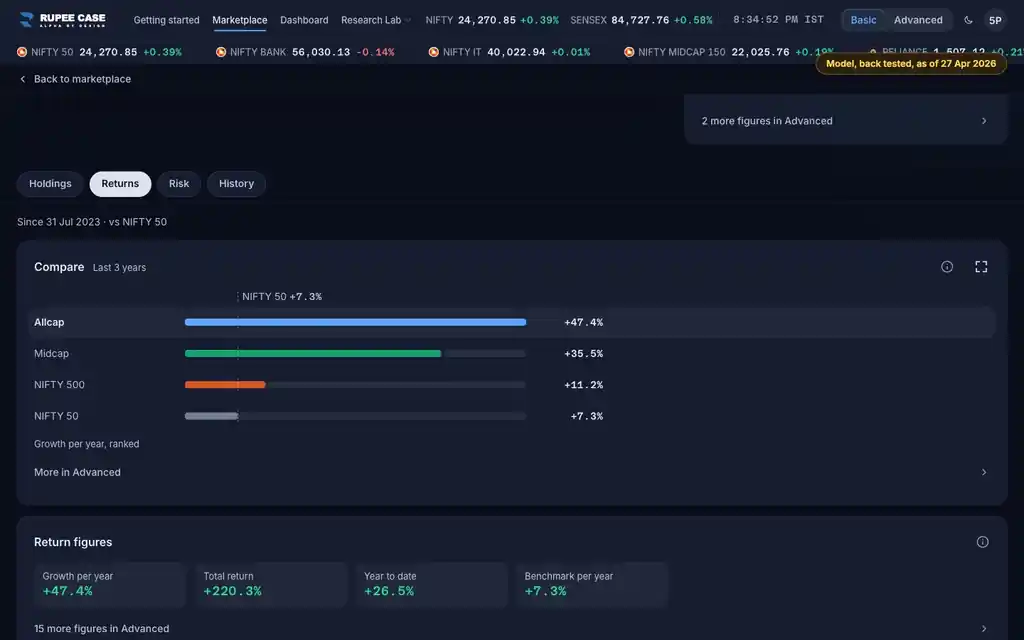
Illustration: ₹80 lakh flat, 20% down, 8.5% loan for 20 years, rent ₹25,000 rising 2.37% a year, 7% return on invested money, 2% selling cost, 7% transfer cost. Before income tax and without any home loan tax deduction.
Read 3 more paragraphs, 299 words
Read it as a map of what has to be true. At the RBI index's 3.6%, a flat on these inputs does not catch a disciplined renter inside twenty years. At 7%, which is almost double the index's latest annual growth, it does so in year 8. The answer is hostage to a number that nobody knows in advance. It is also hostage to the renter's discipline: this table assumes every spare rupee is invested every month. A renter who spends the difference has not earned the 7%, and the owner's loan works as a forced saving plan that the renter does not have. That is a real argument for owning, and it is behavioural, not a return.
Three things move the break even quickly. A lower rate: with an 8% loan and 7% price growth the crossover is year 6 instead of 8. A higher rent: at ₹30,000 against ₹80 lakh and 7% growth, the owner catches up in year 5. And the holding period: a sale inside five years lets the transfer cost and selling cost swallow most of any gain.
On tax at exit: a house is a long term asset after more than 24 months (section 2(101) of the Income-tax Act, 2025, which applies the shorter 12 month test only to listed securities and some funds). Long term gains are taxed at 12.5% (section 197(1)). For a resident individual or HUF who acquired land or a building before 23 Jul 2024, section 197(3) ignores any excess of that tax over what it would have been at 20% with indexed costs, so such an owner pays the lower of the two. A flat bought after that date gets no indexation. None of this is in the table above, so the owner's column is a little high.
Home loan tax rules, old regime and new
The Income-tax Act, 2025 came into force on 1 Apr 2026 (section 1(3)), so FY 2026-27 income is computed under it. Section numbers changed; the ideas are the ones people know as section 24(b) and section 80C. I read the Act as published in the Gazette on 21 Aug 2025. The Finance Act 2026 may have amended it, and I did not read that.
| Item | Old regime | New regime (section 202) |
|---|---|---|
| Interest, self occupied home | Up to ₹2,00,000 (section 22(2)(a)) | None (section 202(2)(a)(v)) |
| Interest, let out home | Allowed in full; a loss can be set off against other income up to ₹2,00,000 (section 109(1)(b)) | Allowed, but a loss cannot be set off against other income |
| Principal and stamp duty | Within the ₹1.5 lakh limit (section 123, Schedule XV) | None: Chapter VIII deductions barred except a few named ones |
Income-tax Act, 2025, as published 21 Aug 2025. Sections 21(6), 22, 123, 202 and Schedule XV. Finance Act 2026 changes not read.
Read 4 more paragraphs, 384 words
The ₹2,00,000 limit has conditions: the home must be acquired or constructed with borrowed capital, construction must be complete within five years from the end of the tax year in which the capital was borrowed, and the lender must furnish a certificate of the interest. Otherwise the limit is ₹30,000 (section 22(2)(b)). The limit is a total for all self occupied homes, not per home (section 22(5)), and the Act counts two homes as self occupied at the owner's choice (section 21(7)(a)). If you let a home out, it leaves that group and its interest has no cap, and the 30% deduction on its annual value (section 22(1)(a)) applies alongside.
Schedule XV, paragraph 3, counts repayment of a home loan from a bank, the National Housing Bank, an employer and certain other lenders as qualifying payments for the ₹1.5 lakh in section 123, together with stamp duty, registration fee and other expenses of the transfer. Paragraph 5 of the Schedule then treats the deduction as income again if the home is transferred within five years from the end of the tax year in which possession is obtained.
The arithmetic on the example. Interest in year one is ₹5.39 lakh, but only ₹2 lakh is deductible. At a 30% slab rate plus 4% cess, a 31.2% marginal rate, that is ₹62,400 a year, ₹5,200 a month. The 30% slab rate is what section 202 of the Act, as published, applies above ₹24,00,000 of total income; the 4% cess comes from the annual Finance Act, which I did not read. Subtract ₹62,400 from the ₹4,82,314 net cost and it falls to ₹4,19,914, ₹34,993 a month. The principal ₹1,27,375 may use part of the ₹1.5 lakh in section 123, which cuts a further ₹39,741 at that rate if the limit is free.
Look at what that does to the table in the previous section. The tax saving is worth about ₹5,000 a month on the old regime, which is real but does not turn 3.6% price growth into a win. It also exists only if the owner is on the old regime and in a high slab. Someone on the new regime has none of it. Whether a given taxpayer is better off on the old regime is a separate calculation that this module does not make.
RERA basics for buyers
Buying a flat that is still being built carries a risk that renting does not: the builder may not finish. The Real Estate (Regulation and Development) Act, 2016 (Act 16 of 2016, assent 25 Mar 2016) was passed for that risk. These are its main protections, with the sections I read in the Gazette text.
Two terms to hold on to from 20.7
- Registration first (section 3). A promoter may not advertise, market, book or offer a project for sale in a planning area without registering it with the state's Real Estate Regulatory Authority. Projects on land up to 500 square metres or with up to eight apartments are exempt (section 3(2)(a)), and a state can lower that threshold.
- A separate account (section 4(2)(l)(D)). The promoter must deposit 70% of the money from allottees in a separate account at a scheduled bank, used only for construction and land cost, and withdraw it in proportion to the project's completion, certified by an engineer, an architect and a chartered accountant.
- A limit on advances (section 13(1)). A promoter may not take more than 10% of the cost as an advance or application fee without first entering a written, registered agreement for sale.
- Plans cannot drift (section 14). After the sanctioned plans and specifications are disclosed, the promoter may not make additions or alterations without the buyer's consent, and for the common areas without the written consent of at least two thirds of the allottees.
- Defects (section 14(3)). A structural or workmanship defect brought to the promoter's notice within five years of handing over possession must be rectified without charge within thirty days. If not, the buyer is entitled to compensation.
- Delay (section 18). If the promoter fails to complete or give possession by the agreed date, the buyer who wants to withdraw can demand the money back with interest at the prescribed rate, plus compensation. A buyer who stays in gets interest for every month of delay until possession. The rate is set by each state's rules.
- Carpet area (section 2(k)). Area is defined as the net usable floor area, excluding external walls, service shafts, exclusive balcony or verandah and exclusive open terrace, but including internal partition walls. That is the number to compare across offers, not the "saleable" area.
- A forum (sections 31 and 71). Any aggrieved person may file a complaint with the Authority or the adjudicating officer. Compensation claims about sections 12, 14, 18 and 19 go to the adjudicating officer, who is to dispose of them within sixty days of receiving the application, or record the reasons in writing.
Where this section sits in module 20.7
Read one more paragraph, 80 words
The buyer also has duties. Under section 19(6) and (7), an allottee must pay on time what the agreement for sale sets, and interest is due on late payments at the prescribed rate. RERA lowers the risk; it does not remove it. A registered project can still be late, and a refund through an authority takes time. Check the project's registration number on the state Authority's website before paying any booking amount, and read the agreement against the sections above.
Where the comparison goes wrong
- Comparing the EMI with the rent. The EMI includes principal, which is saving, and leaves out upkeep, tax and the return on the down payment. A rent of ₹25,000 against an EMI of ₹55,541 looks like a loss of ₹30,541. The real gap is the net cost, ₹15,193 on the inputs above.
- Using one city's boom as the price growth. The RBI index averages eighteen cities at 3.6%. A single micro market can be far above or below that, and that is exactly the bet an owner is making.
- Assuming the renter invests the difference. If the difference is spent, the comparison tips towards owning for reasons that are about behaviour.
- Counting the tax benefit as free. It is available only on the old regime and only up to the limits above, and the principal deduction competes with other items in section 123.
- Stretching the loan. A larger loan raises the interest line and the risk that a fall in income forces a sale at a poor price. The emergency fund in Module 4.6 comes before a down payment.
- Forgetting the exit. Selling costs, the long term gain tax and the 24 month test do not show up in a monthly comparison, and they decide the result for a short stay.
How this fits with the rest of the path
A home is the largest holding for many families, and it cannot be sold in part to meet a bill. Module 4.6 leaves the home you live in out of the equity, debt and gold mix for that reason. The down payment is a goal with a date, so it is sized in future rupees, as Module 20.8 shows. The Learn emergency fund calculator and real return calculator help check the cash and the return assumptions used above.
Key takeaways
- Compare the net cost of owning with the rent: loan interest, upkeep and tax, and the return given up on cash, less the price gain. Principal repaid is saving, not cost.
- On an ₹80 lakh Delhi flat, a man's transfer cost is ₹5,60,100 (6% stamp duty, 1% registration, ₹100). A woman's is ₹4,00,100 at 4% stamp duty. Rates are a state rule and are dated 31 Oct 2026.
- An EMI of ₹55,541 on ₹64 lakh at an assumed 8.5% for 20 years pays ₹69.3 lakh of interest; year one pays ₹5.39 lakh of interest and ₹1.27 lakh of principal.
- At the RBI index's 3.6% price growth, owning costs about ₹40,193 a month in year one, against ₹25,000 of rent. At 7% growth it costs ₹17,526 a month. The break even moves from never to year 8.
- The Income-tax Act, 2025 allows up to ₹2,00,000 of self occupied home loan interest (section 22(2)(a)) and principal and stamp duty within ₹1.5 lakh (section 123) on the old regime. The new regime (section 202) removes both.
- RERA gives a buyer a registered project, a 70% separate account, a 10% cap on advances, five years of defect cover and a refund with interest for delay. Check the state's rules for the rate.

Questions readers ask
Is rent dead money?
Rent is a cost, and so are loan interest, upkeep, property tax and stamp duty. What stays with the owner is the principal repaid and the price change. The comparison is between two sets of costs and two sets of assets, which is why the net cost above is the useful number.
Does the tax deduction make owning better?
It lowers the cost on the old regime by up to ₹62,400 a year at a 31.2% marginal rate on ₹2 lakh of interest, and more if the principal fits in the ₹1.5 lakh of section 123. On the example that is about ₹5,000 a month. It does not exist on the new regime, and it is small against a swing in the price.
What does RERA not cover?
It does not fix the price, does not remove the risk of delay and does not replace reading the agreement. The Act exempts small projects of up to eight apartments or 500 square metres, and the rate of interest on a refund is set by each state's rules.
Rules and figures in this module were last verified on 31 Oct 2026. Tax and regulatory rules change; check the source before acting.