



Most money trouble comes from the order, not from a missing product. Take ₹40,000 left on a credit card at an assumed 3% a month. That is ₹1,200 a month in interest, and it compounds to 42.6% a year. No equity sleeve earns that without risk, so every rupee that goes into shares while the card balance stands is arithmetic working against the saver. This last module of the path puts the earlier nine in a sequence, runs the sequence on three households in rupees, shows where index investing and systematic strategies sit as one part of the plan, and ends with a yearly review and a recap. It is education, not advice for your money.
5By the end you can
- Put seven money jobs in order and state the test, in rupees, for each.
- Read a household balance sheet and an annual plan for three life stages.
- Work the arithmetic behind each step: months of cover, the cost of a debt, a cover gap, a goal's monthly saving, a retirement corpus.
- Say where index investing and systematic strategies fit, with RupeeCase's price and minimum stated as facts.
- Run a yearly review, and see how modules 20.1 to 20.10 connect.

The order of operations
The order is a rule about what goes first when money is short. You can work on several steps at once. But when ₹10,000 can go to only one place, the sequence says where.
- Cash flowKnow what is left each month.
- Emergency fundMonths of essential costs, within reach.
- InsuranceCover the loss that would end the plan.
- Costly debtClear what costs more than any return.
- Tax efficientUse the savings the regime rewards.
- GoalsAn amount and a year for each.
- Long termThe rest, for the years ahead.
| Step | The test, in rupees | The failure it prevents |
|---|---|---|
| 1 Cash flow | Left over = take-home pay minus all spending | A plan built on a surplus that does not exist |
| 2 Emergency fund | Months = fund divided by monthly essential costs | Selling equity in a bad month |
| 3 Insurance | Gap = needs minus assets minus existing cover | One claim wiping out the savings |
| 4 Costly debt | Interest on ₹1 lakh a year, against the return you assume | Paying 36% while earning 8% |
| 5 Tax efficient | Deduction times your marginal rate | Saving for a deduction you cannot use |
| 6 Goals | Future cost, then the monthly saving | School fees in the retirement pot |
| 7 Long term | Mix chosen by horizon, not by last year's return | Risking money that is needed soon |
The order I follow, and the same one module 4.6 uses for the mix. Strategies come in at step 7.
Read one more paragraph, 76 words
The order bends where the arithmetic says it does. A saver with a 36% card balance and no fund at all is in a trap whichever step goes first: a small starter cushion stops the next bill from landing on the card again, and the card then takes the next rupee. The sequence is a default for scarce money, and the tests in the table are how a household checks where it stands against each step.
2 terms this section turns on
Step 1: the first number
Left over is take-home pay minus all spending. The trap is the single month. A ₹1,08,000 insurance premium paid in March makes March look like a deficit and the other eleven months look rich. Spread it as ₹9,000 a month, do the same for school fees, festival spending and a yearly holiday, and average three months of statements. The figure that comes out is the one every later step draws on. If it is negative, the plan has a different first step: where the money goes.
The arithmetic behind each step
Step 2: months of cover
Count only the costs that continue if income stops: rent or EMI, groceries, school fees, premiums. Months of cover is the fund divided by those costs. A common rule of thumb is 3 to 6 months, more for variable income or dependants (module 4.6). With ₹1,20,000 in a savings account and ₹45,000 of essential costs a month, the fund lasts 2.7 months. Six months would be ₹2,70,000. The emergency fund calculator does the same sum.
Step 3: the cover gap
Insurance arithmetic asks what the household would need if the earner were gone, and what it already has. The earner's income is the asset being insured, so the sum is a present value of the costs the family would still carry.
Need = PV + loan + goal
Gap = Need - assets - cover
C = yearly cost, n = years
r = assumed real discount rate
Step 4: the cost of a debt
Put every debt on one scale: the interest it costs on ₹1 lakh in a year. Then set it beside the return you assume for the money, remembering that a loan's cost is certain and a return is not.
| Debt (assumed rate) | Interest on ₹1 lakh a year | Against an assumed 8% |
|---|---|---|
| Card balance, 3% a month | ₹42,576 compounded | 5.3 times as much |
| Personal loan, 14% | ₹14,000 | 1.75 times as much |
| Home loan, 8.5% | ₹8,500 | About the same |
Rates are assumptions for the arithmetic. The 8% is an assumed pre tax return, not a forecast. Card: 1.03 to the power 12, minus 1.
Read one more paragraph, 57 words
The card goes first on this scale, with no judgement needed. The home loan is the hard one, because its cost and the assumed return are close. Prepaying earns the loan rate with certainty. Investing earns an assumed rate with risk. Many people do some of each. The scale shows the trade off. It does not choose.
₹100 in Dynamic Asset Allocator became about ₹388 in the model
Step 5: the tax step
A deduction saves its amount times your marginal rate, before cess and any rebate. These are the rates of tax for individuals in tax year 2026-27, section 202 of the Income-tax Act, 2025, as set out in the memorandum to the Finance Bill, 2026, which proposed no change.
| Total income | Rate |
|---|---|
| Up to ₹4 lakh | Nil |
| ₹4 lakh to ₹8 lakh | 5% |
| ₹8 lakh to ₹12 lakh | 10% |
| ₹12 lakh to ₹16 lakh | 15% |
| ₹16 lakh to ₹20 lakh | 20% |
| ₹20 lakh to ₹24 lakh | 25% |
| Above ₹24 lakh | 30% |
Memorandum explaining the Finance Bill, 2026, rates for tax year 2026-27. Surcharge, cess and the rebate are not shown. Whether a given saving carries a deduction depends on the regime chosen; the earlier modules of this path compare them.
Read one more paragraph, 44 words
The arithmetic: a ₹1,50,000 deduction saves ₹45,000 at a 30% marginal rate, ₹15,000 at 10%, and nothing at the nil slab. A saving that carries a deduction you cannot use is just a saving, to be judged by its own rate and lock in.
Step 6: goals in future rupees
Module 4.6 works the example used below. ₹40 lakh in today's money, due in 12 years, costs ₹40 lakh times 1.06 to the power 12, which is ₹80.5 lakh, at 6% inflation. Saving monthly at an assumed 8% a year needs about ₹33,466. For reference, the RBI's inflation target is 4% within a band of 2% to 6%, renewed on 25 Mar 2026 for 1 Apr 2026 to 31 Mar 2031, and the August 2026 CPI print was 4.82% (provisional, MoSPI, 14 Sep 2026). The goal planner runs it for any goal.

Step 7: the long term sleeve, sized by the fall
The mix comes from the horizon and from the fall in rupees the household can watch without selling (module 4.6). Here is the size of a fall. In the 2020 crash, the Nifty 50 closed at 12,362.30 on 14 Jan 2020 and at 7,610.25 on 23 Mar 2020, down 38.44% (NSE closes). The same percentage on a sleeve of ₹14 lakh in equity funds is ₹5.4 lakh off. On ₹58 lakh it is ₹22.3 lakh off. A single index is not a whole portfolio, so this is the scale of the number, not a forecast. The test is not whether the loss can be borne on paper, but whether the money is needed before the recovery, which the first six steps are built to rule out.
Three households in rupees
All three are made up. Their inputs are labelled and chosen so the arithmetic can be checked, not to describe anyone. Take-home pay is after tax and the employee's EPF share. Debt returns follow the rates in force: the EPF Central Board of Trustees proposed 8.25% for 2025-26 on 2 Mar 2026 (Ministry of Labour release), and PPF stays at 7.1% for 1 Oct to 31 Dec 2026, unchanged through every quarter since 2025-26 (Department of Economic Affairs, office memorandum of 30 Sep 2026, which keeps the second quarter's rates).
Household A: 27, single, renting
| Cash flow | Per month | Per year |
|---|---|---|
| Take-home pay | ₹85,000 | ₹10,20,000 |
| Rent | ₹25,000 | ₹3,00,000 |
| Food, transport, bills | ₹20,000 | ₹2,40,000 |
| Other spending | ₹18,000 | ₹2,16,000 |
| Left over | ₹22,000 | ₹2,64,000 |
Per month: the largest is Take-home pay at ₹85,000
The balance sheet: savings and liquid fund ₹1,20,000, EPF ₹2,40,000, an equity index fund ₹80,000, so assets of ₹4,40,000. The card balance is ₹40,000. Net worth is ₹4,00,000, and equity is 18% of the assets. Essential costs are ₹45,000 a month, so the fund covers 2.7 months.
| Step | This year | Why here |
|---|---|---|
| 4 Clear the card | ₹40,000 | Saves ₹1,200 a month |
| 3 Health cover | ₹12,000 | An assumed yearly premium; no one depends on the income, so the term cover need is nil |
| 2 Emergency fund | ₹1,50,000 | Reaches ₹2,70,000, six months |
| 7 Long term sleeve | ₹62,000 | What is left, 23.5% of the year |
The ₹2,64,000 is used in full. In year two, with the card and the fund done, ₹2,52,000 is free for goals and the long term sleeve.
Household B: 38, one earner, a home loan
One earner, a spouse who cares for a child of 5, and a home loan of ₹48 lakh at an assumed 8.5% with 18 years left, which makes the EMI ₹43,462.
| Cash flow | Per month | Per year |
|---|---|---|
| Take-home pay | ₹2,40,000 | ₹28,80,000 |
| Home loan EMI | ₹43,462 | ₹5,21,544 |
| Running costs | ₹62,000 | ₹7,44,000 |
| School and activities | ₹14,000 | ₹1,68,000 |
| Insurance premiums | ₹9,000 | ₹1,08,000 |
| Other spending | ₹40,000 | ₹4,80,000 |
| Left over | ₹71,538 | ₹8,58,456 |
Two terms to hold on to from 20.11
| Step | This year | Why here |
|---|---|---|
| 2 Emergency fund | ₹1,70,772 | Six months of essentials |
| 6 Education goal | ₹4,01,592 | ₹33,466 a month for 12 months |
| 7 Long term sleeve | ₹2,86,092 | ₹23,841 a month, for retirement |
₹8,58,456 in all. The home loan is not in the table: whether to prepay is the trade off shown under step 4.
Read 2 more paragraphs, 164 words
The balance sheet: savings ₹6,00,000, EPF ₹28,00,000, PPF ₹9,00,000, equity funds ₹14,00,000, gold ₹2,00,000 and the home at an assumed market value of ₹85,00,000, so assets of ₹1,44,00,000 against the loan of ₹48,00,000: net worth ₹96,00,000. Of the ₹59 lakh in financial assets, 23.7% is equity, 72.9% is savings, EPF and PPF, and 3.4% is gold. Essential costs, the EMI included, are ₹1,28,462 a month, so ₹6 lakh is 4.7 months. The gap to six months is ₹1,70,772.
The cover gap, from the calculator above: costs of ₹76,000 a month for 15 years at an assumed real 2% have a present value of ₹1.17 crore. Add the loan and ₹40 lakh of goal money and the need is ₹2.05 crore. Against ₹31 lakh of usable assets and an assumed ₹1 crore of existing term cover, the gap is ₹74.2 lakh. EPF is left out as retirement money. The education goal is the ₹40 lakh, 12 years away, from the step above: ₹33,466 a month.
Household C: 58, two years from retiring
Couple, one earner, house owned with no loan, children independent. Essential costs of ₹90,000 a month, or ₹10.8 lakh a year in today's money.
| Cash flow | Per month | Per year |
|---|---|---|
| Take-home pay | ₹1,60,000 | ₹19,20,000 |
| Essential costs | ₹90,000 | ₹10,80,000 |
| Other spending | ₹30,000 | ₹3,60,000 |
| Left over | ₹40,000 | ₹4,80,000 |
/ (r - g)
C1 = first year spending
g = growth of spending
r = return, n = years
Where this section sits in module 20.11
| Step | This year | Why here |
|---|---|---|
| 2 Emergency fund | ₹10 lakh held | 11.1 months of essentials |
| 3 Insurance | Health cover | No dependants, so term need is nil; check what health cover continues after leaving a job |
| 6 Goal | ₹11.9 lakh a year at 60 | The spending the corpus must fund |
| 7 Long term | ₹4.8 lakh left over | Added to the mix already held |
Module 20.10 matters most here: nominations, joint holding and a will, before the income stops.
Read 3 more paragraphs, 213 words
The financial assets: EPF ₹62 lakh, PPF ₹34 lakh, NPS ₹38 lakh, equity funds ₹58 lakh, fixed deposits ₹30 lakh, gold ₹12 lakh and savings ₹10 lakh, ₹2.44 crore in all. Equity is 23.8% of it, gold 4.9%, the NPS 15.6%, and the rest, 55.7%, is savings, deposits, EPF and PPF. Each of those has its own withdrawal rules, which earlier modules cover.
The question flips. For A and B it is how much to save. For C it is how much the corpus can pay out, and for how long.
With 30 years at 7% and spending growing 5%, the corpus is ₹2.57 crore, and the first year's ₹11.9 lakh is 4.63% of it. Two more years of saving ₹4.8 lakh a year at 7% takes the ₹2.44 crore to ₹2.89 crore at 60, which is ₹31.6 lakh above the need. The cushion is small beside the assumptions. At 25 years the need falls to ₹2.24 crore, and a lower return lifts it. The first three years of spending, ₹37.5 lakh with the 5% growth, are held in savings, deposits, EPF and PPF, which together are ₹1.36 crore. That is the buffer module 4.6 describes: a few years of spending in debt, so a fall in equity does not force a sale.
Reading across the three
| Household | Left over a year | Net worth | First rupee goes to |
|---|---|---|---|
| A, 27 | ₹2,64,000 | ₹4,00,000 | A card at 3% a month |
| B, 38 | ₹8,58,456 | ₹96,00,000 | A fund 1.3 months short, then a goal with a date |
| C, 58 | ₹4,80,000 | ₹2,44,00,000 | Spending for 30 years |
Illustrations. C's net worth counts financial assets only, and not the house the couple live in.
The same seven steps give three different plans. For A the long term sleeve is a small last line. For B it is smaller than the goal money, and the biggest number in the plan is the cover gap. For C the goal is the corpus itself. The steps do not change. The numbers that fill them, and so the order in which they bite, change with the life stage.
Where index investing and systematic strategies fit
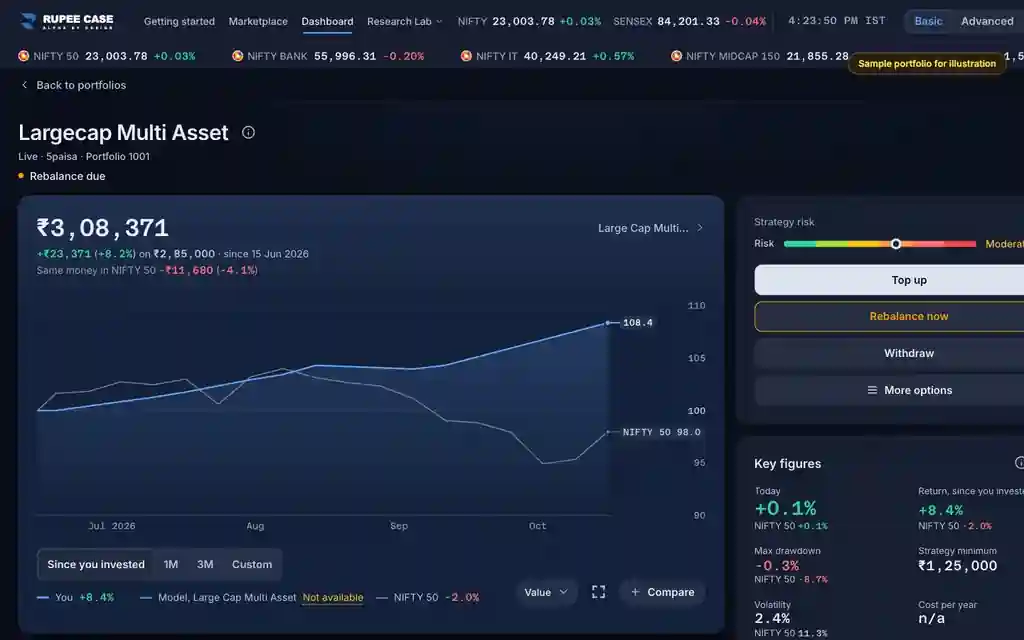
Look back at the three plans. The long term sleeve, step 7, is what is left after the first six: ₹62,000 in the first year for A, ₹2,86,092 for B, and an existing ₹58 lakh of equity funds for C. A plan says how much sits there and for how long. It does not say what holds the money. A rules based index is one thing that can, and so is a diversified fund, and a plan can hold more than one.
- Horizon. Is the money needed in under five years? Module 4.6's ceilings put equity at 40% or less for a goal 3 to 5 years out.
- The fall in rupees. The sleeve times the worst fall on the strategy's model record, as in step 7, against the months of spending held in debt.
- The minimum. A ₹62,000 sleeve is 4.8 times the lowest minimum of ₹13,000, and each strategy's own published minimum decides what fits.
- Cost. The fee below, plus the broker's charges and the tax on each sale.
- Overlap. EPF, PPF and any equity funds already held, counted first, as module 4.6 counts them.
Read 4 more paragraphs, 269 words
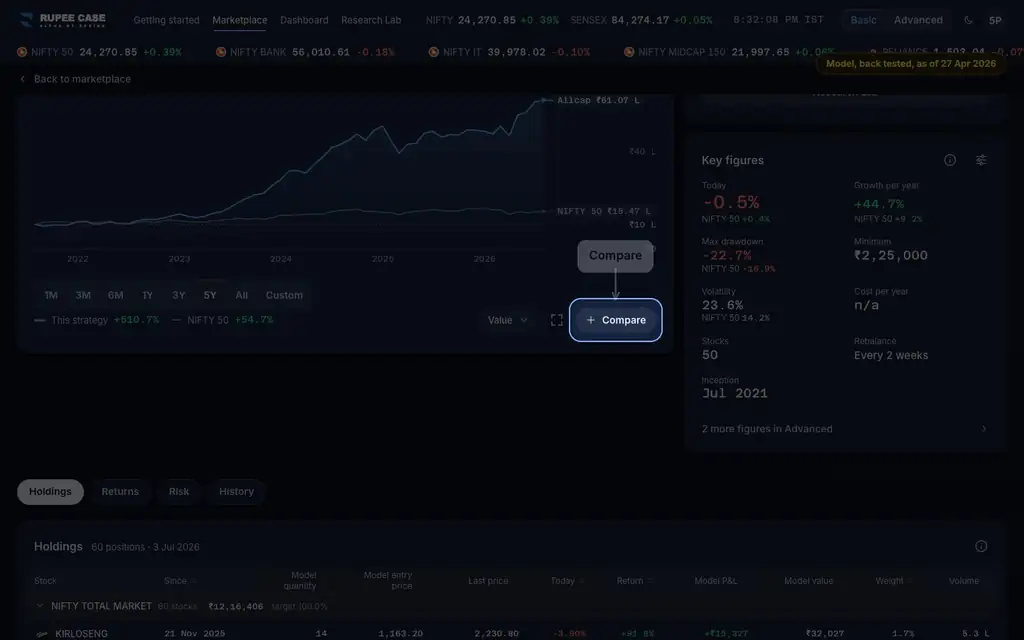
RupeeCase is a technology platform for the second question. It offers 15 retail strategies, each a rule for choosing and weighting stocks, rebalanced on published dates, with the shares held in the investor's own demat account at their own broker. Some are all equity. Some, such as Allcap Multi Asset and Dynamic Asset Allocator, carry their own debt and gold sleeves. The marketplace and strategy pages show model figures, back tested and dated; the Dashboard shows the actual investment from the date it was made. Module 4.6 explains the tiers and the riskometer step each strategy carries, and the risk profile lists the ones within a stated band.
The terms are facts of the product, not a reason to use it. For the 15 retail strategies, the minimum investment is from ₹13,000, set per strategy, and the fee is 0.2% of traded value per rebalance, charged only on the value that trades, with no subscription, AUM fee or profit share. Brokerage and statutory charges go through the investor's own broker. Institutions and family offices are served on tailored terms, from US$1 million, priced to each requirement.
A plan turns that into questions a strategy page can answer, one at a time:
On the plans above, the same ₹62,000 sleeve for A, or ₹2,86,092 for B, costs 0.78% of the sleeve a year at those settings. That sits beside the cost of any other holding, and beside the tax on its sales. Whether a strategy belongs in the sleeve depends on the horizon, the risk the household can hold, and the rest of the plan. Nothing here says it must.
The annual review
A plan is a set of numbers that go stale. Once a year, and after any event, re-run it.
| When | Check | Why |
|---|---|---|
| Each month | Read the consolidated account statement | It is the record if an app disagrees (module 1.6) |
| Each April | Tax regime and the year's savings plan | Rates are set for the tax year |
| Each quarter | Small savings rate for the quarter | The Department of Economic Affairs notifies it every quarter |
| Around March | The EPF rate proposed for the year | The trustees proposed 2025-26's on 2 Mar 2026; notification follows |
| One fixed date | Net worth, left over, months of cover, mix against target | Drift shows up here (module 4.3) |
| One fixed date | Cover gap, goals in future rupees, nominations, will | Life moves; the arithmetic must follow |
| After an event | Marriage, birth, job, loan, a death | Each one changes at least three lines above |
How this shows up in RupeeCase
The risk profile scores capacity and tolerance and lists the strategies within your band. The minimum investment tutorial shows where each strategy's minimum sits. The app does not move money between your strategies and your other holdings, so the split in a plan like those above is yours to check, for example once a year. Pricing and the fee calculator are on the pricing page.

Questions readers ask
Do I need all seven steps before I invest anything?
No. The order says where the next rupee goes when money is short. A household with a funded emergency account and no costly debt can work on steps 5 to 7 together. The tests in the table show where each step stands.
Is a home loan costly debt?
At an assumed 8.5% it costs ₹8,500 a year on ₹1 lakh, close to the 8% return assumed in the examples. Prepaying earns that rate with certainty, and investing earns an assumed rate with risk. The comparison is arithmetic on your own rates, and many households split the money.
Why are the examples made up?
Because the point is the method, and the inputs can then be checked and changed. Every rate in them is either an assumption, marked as one, or a published rate with its date and source.
Key takeaways
- The order is a rule for scarce money: cash flow, emergency fund, insurance, costly debt, tax efficient savings, goals, then the long term sleeve.
- A 3% a month card balance costs ₹42,576 a year on ₹1 lakh, 5.3 times an assumed 8% return.
- Cover gap, corpus and goal saving are present value sums; every input is an assumption and says so.
- The long term sleeve is what is left, and index investing or a systematic strategy is one way to fill it.
- For the 15 retail strategies, the fee is 0.2% of traded value per rebalance and the minimum is from ₹13,000.
- Review once a year and after each life event, nominations and will included.
Recap: modules 20.1 to 20.10
The ten modules of this path map onto the seven steps. Each takes a step, or a piece of one, to the depth a plan needs, from the first rupee of cash flow to the last paperwork of an estate.
- 20.1 Cash flow and the emergency fund: the left over figure and the months of cover that every later step uses (steps 1 and 2).
- 20.2 Insurance first: term and health cover, and how much life cover two methods give (step 3).
- 20.3 Debt and credit: the cost of each loan on one scale (step 4).
- 20.4 EPF, VPF and PPF: the rates, limits and tax of the two provident funds, the debt ballast of a plan (steps 5 and 7).
- 20.5 NPS: the pension account, its charges, its exit rules and its tax in both regimes (step 5).
- 20.6 Old versus new tax regime: which savings carry a deduction, and what each regime costs (step 5).
- 20.7 Buy or rent a home: the price of the decision, and the largest debt on most balance sheets (steps 4 and 6).
- 20.8 Goal planning: a goal as an amount, a date and a price level, with the monthly saving (step 6).
- 20.9 Retirement: the same maths for the longest goal, a corpus for spending that grows (steps 6 and 7).
- 20.10 Nominees, wills and estate: who receives it all, and the documents a family needs.

Read one more paragraph, 53 words
Read in order, they are one page: what comes in, what is protected, what is owed, what is saved and where, what it is for, and who it passes to. Strategies sit on the last line of that page, and the page is only as good as the date you last re-ran it.
Rules and figures in this module were last verified on 3 Nov 2026. Tax and regulatory rules change; check the source before acting.