



You own two stocks. Stock A, bought at ₹2,400, is now ₹2,800, up 16.7%. Stock B, bought at ₹600, is now ₹480, down 20%. You need cash. Which one do you sell? Most people sell A, the winner, and keep B, the loser. It feels like prudence: take the profit, give the other one time. It is the disposition effect, the tendency to sell winners too early and ride losers too long, and it is one of the best documented habits in retail investing.
I want to be clear about why it matters. It is not that selling a winner is always wrong. It is that the decision is being made by the purchase price, a number that tells you nothing about what either stock does next. When I build rules for a portfolio, the first thing I take out is any reference to what we paid.
of available gains were sold, against 9.8% of available losses
Odean, 10,000 accounts, 1987 to 1993
how much more readily winners were sold than losers
Odean, Journal of Finance, 1998
percentage points by which winners sold beat losers kept over the next year
Odean, 1998, returns over the market
3By the end you can
- Measure your own disposition effect with PGR and PLR from a year of statements.
- Compare the tax of selling a winner and a loser in tax year 2026-27.
- Replace the buy price with the "would I buy it today" test in every sell decision.
3 terms this section turns on
The economics of the disposition effect
Hersh Shefrin and Meir Statman named the effect in 1985 in a paper titled "The Disposition to Sell Winners Too Early and Ride Losers Too Long". Terrance Odean tested it in 1998 on the trading records of 10,000 accounts at a large discount broker between 1987 and 1993. His measure is simple and you can apply it to yourself.
- PGR, proportion of gains realised: on each day you sell something, count the holdings in profit that you sold, and divide by all holdings in profit, sold or not.
- PLR, proportion of losses realised: the same for holdings at a loss.
Share of available gains and losses that investors actually sold, Odean's 10,000 accounts.
- Gains sold, Jan to Nov0.152
- Losses sold, Jan to Nov0.094
- Gains sold, December0.108
- Losses sold, December0.128
Odean (1998), Are Investors Reluctant to Realize Their Losses? Journal of Finance 53(5), Table I. US data, 1987 to 1993. India's tax year ends in March.
- You sell your best performers. Stocks that have risen often have improving earnings. Selling them to lock in gains exits the businesses that are working.
- You keep your worst performers. Stocks that have fallen often have a reason. Holding them to avoid booking the loss keeps capital tied up in businesses that are not working.
- You pay more tax than needed. Selling winners realises gains now. Keeping losers delays losses you could have set off. It is close to the exact opposite of efficient tax management.

Read 2 more paragraphs, 130 words
For the full year, Odean found a PGR of 0.148 and a PLR of 0.098. Investors were about 1.5 times as likely to sell a stock that was up as one that was down. The one exception was December, the last month of the US tax year, when PLR rose to 0.128 and PGR fell to 0.108. People sold losers when the tax benefit was right in front of them, and went back to the old habit the rest of the year.
Then he checked what happened next. Over the following year, the winners investors sold beat the losers they kept by about 3.4 percentage points, measured against the market. The habit was not just emotionally driven. It was also wrong on returns. The consequences add up in three places:
The psychological drivers of the disposition effect
The disposition effect is loss aversion (module 8.2) plus mental accounting, applied one holding at a time.
- Separate accountsEach holding lives in its own mental account, judged against its own buy price.
- A winner sits in the gain zoneHere people are risk averse. The sure profit feels better than the chance of more.
- A loser sits in the loss zoneHere people are risk seeking. Waiting for a recovery feels better than a sure loss.
- ResultGains get sold, losses get held, one decision at a time, for years.
Regret adds to it. Selling a loser means admitting a mistake. Selling a winner lets you feel smart. Neither feeling tells you anything about the next twelve months.
The link to momentum
The disposition effect may be one reason momentum works as a factor. If many investors sell winners early, good news gets into the price slowly, because the selling holds the price back. If they hold losers, bad news also gets in slowly. Prices then drift in the direction of the news for months. Grinblatt and Han showed in 2005 that stocks with more unrealised gains among their holders tend to have stronger subsequent returns, consistent with this story. Odean's own finding, that sold winners kept outperforming, matches Jegadeesh and Titman's 1993 evidence of momentum over horizons up to about a year.
₹100 in Allcap became about ₹424 in the model
Worked example, the "would I buy it today" test
Go back to the two stocks, with ₹5 lakh in each when you bought. A is now worth ₹5,83,333, B is worth ₹4,00,000. You need ₹1 lakh in February 2027, both were bought seven months earlier, and you have no other gains or losses this year.
| Sell ₹1 lakh of A (the winner) | Sell ₹1 lakh of B (the loser) | |
|---|---|---|
| Gain or loss realised | ₹14,286 short term gain | ₹25,000 short term loss |
| Tax effect this year at 20% | ₹2,857 tax to pay | ₹0 tax; the ₹25,000 loss can be carried forward up to 8 years if you file on time |
| Question that should decide it | If you held both in cash today, would you buy A at ₹2,800 and B at ₹480, in these sizes? | |
Result: the tax arithmetic favours selling the loser by ₹2,857 here, and the return evidence leans the same way on average. But the deciding question is the last row. If B's reason for being in the portfolio is intact and A's is not, sell A. The purchase price must not be the reason either way.
What would you do?
Stock A is up 16.7%, Stock B is down 20%. Both businesses look the same as when you bought them. You need ₹1 lakh.
- Sell A and lock in the profit
You pay ₹2,857 of short term tax now. In Odean's data, winners sold went on to beat losers kept by about 3.4 points over the next year.
- Sell from whichever fails the "would I buy it today" test, and if both pass, sell B for the tax loss
The decision rests on the future, not the buy price. Selling B books a ₹25,000 loss you can set off.
- Sell neither, borrow instead
Avoiding the decision is the disposition effect in its purest form: no sale feels like no mistake.
Illustrative numbers. Tax at the 20% short term rate on listed equity, before cess. Return evidence: Odean (1998), US data, an average not a promise.
Tax loss harvesting, turning the disposition effect on its head
Tax loss harvesting means deliberately booking losses to set them off against gains. It is the disposition effect turned around. The rules for listed equity in tax year 2026-27, the first year under the Income-tax Act, 2025, with rates unchanged by the 2026 Budget:
- Short term (held 12 months or less): gains taxed at 20%. Short term losses can be set off against short term or long term gains.
- Long term (more than 12 months): gains above ₹1.25 lakh a year taxed at 12.5%. Long term losses can be set off only against long term gains.
- Carry forward: unused capital losses can be carried forward for 8 tax years, if the return is filed by the due date (section 111 of the new Act, in place of section 74).
MythYou never go broke booking a profit.
FactYou can steadily underperform by booking profits. Sell the winners and keep the losers for a few years, and the portfolio ends up holding mostly what is not working.
Two terms to hold on to from 8.5
Read one more paragraph, 87 words
The habit to build: in February or early March, before the Indian tax year ends on 31 March, list every holding with an unrealised loss. Ask the "would I buy it today" question of each. Those that fail get sold, and the loss does work for you. The flip side is booking long term gains up to the ₹1.25 lakh exemption each year, which some investors do to reset their cost. Costs and the rules on how often you trade apply; Module 11.3 covers both in detail.
Common mistakes
Mistake: setting a profit target from your buy price ("I will sell at 20% up") and no exit at all for losses. That is the disposition effect written down as a rule. If you write exits, write them on the reason for owning the stock, for winners and losers alike.
- Waiting for break even. The price you paid is a fact about your past, not about the stock's future.
- Selling the best holding to fund a purchase. Fund it from the weakest holding by today's test, not the most profitable one.
- Missing the March window. Losses booked in April count for the next tax year.
- Harvesting a loss and forgetting the exposure. If you still want the exposure, decide in advance how you will hold it after the sale.
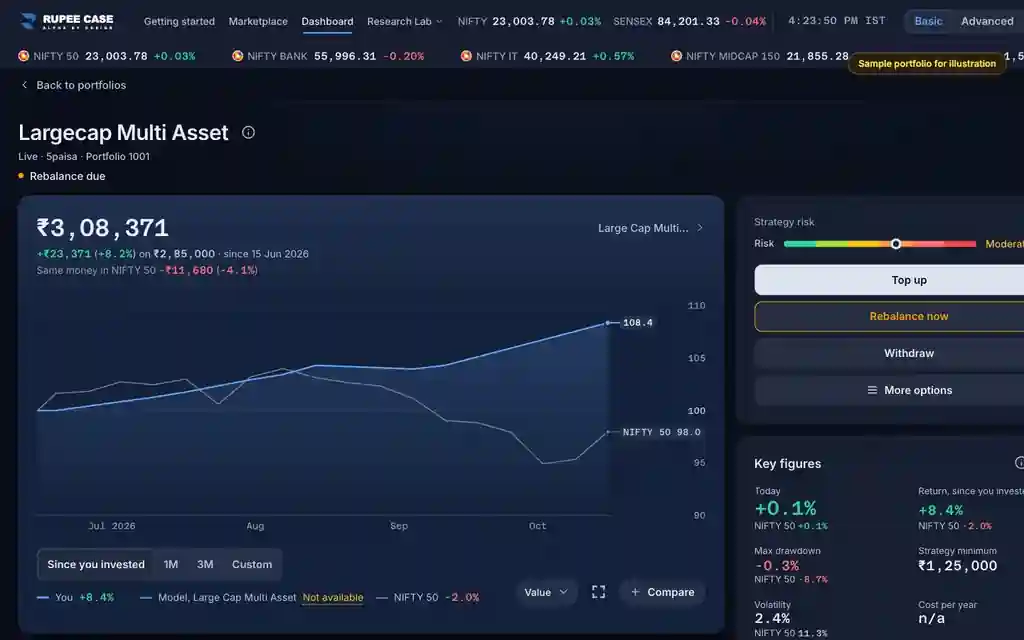
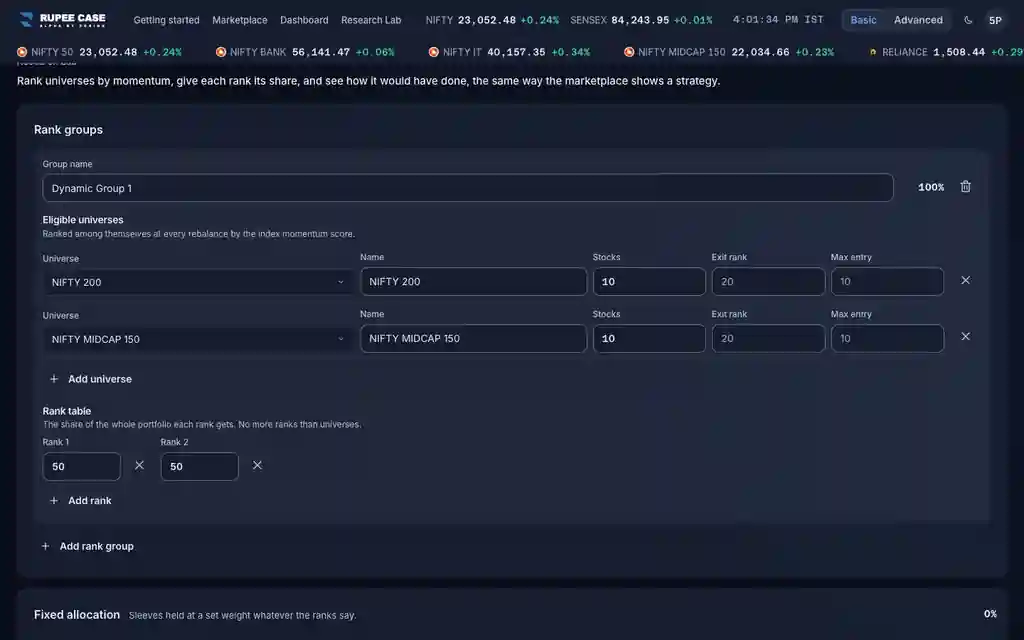
RupeeCase strategies rebalance on factor signals, not on gain or loss. A stock that has risen but still ranks well on momentum and quality stays. A stock that has fallen and ranks poorly goes, whatever the paper loss. The model does not know anyone's purchase price. The exit rank and strength filters tutorial shows the sell rule, and Withdraw shows that a partial withdrawal sells the same share of every holding, winners and losers alike. Every model rebalance, with names in and out, is published on the rebalance history page, and the strategies are on strategies. Figures there are model, back tested.

Key takeaways
- The disposition effect: sell winners early, hold losers long.
- Odean: winners sold about 1.5 times as readily as losers, PGR 0.148 against PLR 0.098.
- The buy price says nothing about what a stock does next.
- Short term losses set off against any capital gain; long term losses only against long term gains.
- Check unrealised losses before 31 March, with the "would I buy it today" test.
Questions readers ask
Is there Indian evidence for the disposition effect?
SEBI's F&O data shows its fingerprint: in FY26 the average loss of loss makers, ₹1.47 lakh, was 21% larger than the average profit of profit makers, ₹1.22 lakh. Small gains taken quickly and losses left to run produce exactly that shape.
Does this mean I should never book profits?
No. Book profits when the reason for owning the stock has gone, when a position has grown too large for your rules, or when you rebalance to target weights. Just do not book them because the number is green.
Is selling a loser and buying it back the same day allowed for tax?
Indian law has no specific wash sale rule for listed shares today, but tax authorities can question transactions done only to avoid tax, and frequent buying and selling can change how your income is classified. Check with a tax professional before doing it at scale; Path 11 covers the rules.
Where this section sits in module 8.5