




On 31 March 2026 India had 22.5 crore demat accounts, 12.2 crore of them unique. In FY26 SEBI's complaint system took in 61,788 complaints, and one in three was about a stock broker. When real money goes wrong, the cause is rarely a model. It is a login handed over, a nominee form left blank, a payment sent to the wrong account.
demat accounts at the two depositories
SEBI annual report, 31 Mar 2026
unique demat accounts, duplicates removed
SEBI annual report, 31 Mar 2026
complaints on SCORES, SEBI's complaint system, in FY26
SEBI annual report, FY26, table 8.2
of them against stock brokers, the largest group
SEBI annual report, FY26, table 8.4
This module is the plumbing: who holds what, how money moves, what you can switch on, and which scams to know. Every rule carries its SEBI circular and date, because several changed.
3By the end you can
- Say what your trading, demat and bank accounts each do, and what KYC, nomination and BSDA rules apply from 1 Sep 2026.
- Check a payee with an @valid UPI ID and SEBI Check before you pay.
- Spot an account handler or a tip channel, and know where to complain.
3 terms this section turns on
Three accounts, one KYC
A trading account at a broker places your orders, a demat account at a depository participant holds the shares in your name, and your bank account settles the money. Module 1.1 covers why the shares stay yours. KYC joins the three, and you do it once: PAN is the single identifier, and a validated record travels to the next broker or fund house.
Read 3 more paragraphs, 162 words
Under SEBI's KYC master circular of 12 Oct 2023, your PAN has to be operative. A KYC registration agency checks PAN, name, address, mobile and email, and a record it verifies against official databases is validated. A record it cannot verify stops you transacting until it is fixed.
Use your own mobile number and email, confirmed by OTP. A broker must upload a separate number for each client, except for family at your written request: spouse, dependent children and dependent parents.
If you hold one demat account worth up to ₹10 lakh, you can have a Basic Services Demat Account, BSDA. Its annual maintenance charge is capped at nil up to ₹4 lakh and ₹100 from ₹4 lakh to ₹10 lakh (SEBI, 28 Jun 2024, in force from 1 Sep 2024). Since 31 Mar 2026 your participant rechecks every quarter and needs your active consent to keep you on a regular account (SEBI, 24 Dec 2025).
Nominees: the rule changed, so check the date
SEBI's revamp of 10 Jan 2025 set the limit at 10 nominees. The clause sat in a later phase, SEBI moved its start date three times, and the circular of 29 May 2026 replaced everything: up to 3 nominees per demat account or fund folio, from 1 Sep 2026.
- Up to 10 nominees
The revamp names 10 as the limit, from 1 Mar 2025.
- Three phases
The 10 nominee clause moves to 1 Sep 2025.
- Deferred
That phase moves to 15 Dec 2025.
- Deferred again
No date. It waits to be notified.
- A new circular
Up to 3 nominees. Earlier nomination circulars are superseded.
- In force
Nominate or opt out, on new and existing accounts.
Read 2 more paragraphs, 96 words
Only the nominee's name and relationship are mandatory, plus a date of birth for a minor. Contact details, share, an identifier and a guardian are optional. With no share given, the assets split equally. You can change a nomination as often as you like.
On a new single holder account you must nominate or sign an opt out declaration. It says your legal heirs may then need extra court documents, and that unclaimed holdings can pass to the Investor Education and Protection Fund. Joint accounts may skip it, and all holders must agree to any change.
Paying in and getting paid
Three rules decide what happens to your money. A running account lets a broker keep your balance only on your signed permission, and you can revoke it. A UPI block keeps the money in your bank until the clearing corporation debits it. And an @valid UPI ID tells you the payee is a registered intermediary.
- You blockApprove a block in your UPI app. The money stays in your bank.
- You tradeOrders run as usual. The block counts as collateral.
- Pay inThe clearing corporation debits only what you owe.
- Pay outSale money goes to your bank, shares to your demat.
- ReleaseAsk your broker to release the rest.
Read 3 more paragraphs, 217 words
Running account first. Unless you agree otherwise, a broker settles your funds within 24 hours of a payout. A running account lets it keep a balance and settle monthly or quarterly. You must sign it yourself, not through a power of attorney. Funds you ask for must reach you within one working day, and after 30 calendar days without a trade the whole credit balance comes back at the next monthly settlement (SEBI master circular for stock brokers, 17 Jun 2025).
UPI block is optional, and it has no running account. SEBI's circular of 23 Jun 2023 lets you trade without sending money to the broker. Since 1 Feb 2025 the larger brokers must offer either UPI block or a 3 in 1 account (SEBI, 11 Nov 2024).
The payee check comes from SEBI's circular of 11 Jun 2025. Since 1 Oct 2025 brokers and fund houses have UPI IDs that end in @valid plus a bank name, with a suffix such as .brk for a broker or .mf for a mutual fund. The pay screen shows a thumbs up inside a green triangle. That is the tell: SEBI says its absence warns that the payee may be unauthorised. Check any account number and IFSC code, or UPI ID, on SEBI Check.
Watching your accounts
Your accounts talk back if you let them. The exchange texts and emails you the day's trades by the end of each trading day. A broker must keep proof of every order you place. One consolidated statement shows what you hold. And if something looks wrong, a voluntary freeze blocks online access to the trading account.
Complaints against trading members, received by the exchanges, FY26
- Service related9,159
- Unauthorised trades4,389
- Others3,869
- Payout not received1,302
- Brokerage and charges1,189
SEBI annual report 2025-26, table 8.6, year to 31 Mar 2026. In FY25 unauthorised trades were 5,348 of 24,950.
Watching your accounts: the figures
Read 3 more paragraphs, 134 words
Alerts go to the numbers you confirmed. Your broker must also text and email you when it settles a running account. If a trade is disputed, it has to produce proof of the order: a recording, a log or a signed slip.
Once a month, read the CAS. Under SEBI's circular of 14 Feb 2025, a Consolidated Account Statement is emailed by the 12th day after any month in which a demat account or fund folio of yours had a transaction. With none, you get one in April and October. If the app and the CAS disagree, the CAS is the record.
Since 1 Jul 2024 brokers must offer a voluntary freeze, with a policy on how to ask, how fast it acts and how access returns (SEBI, 12 Jan 2024).
Scams that look like help
SEBI keeps warning about the same scripts: an unsolicited invite to a "VIP" or "free trading course" chat group, a profile posing as an expert or a celebrity, fake testimonials, an app offering an "institutional trading account" or "IPOs at a discount", and the "account handler", who takes your trading login, keys in trades and shares profits but not losses. Handlers are not registered with SEBI.
MythAn account handler only trades my account, so my money stays safe in my own name.
FactSEBI says handlers take your login, key in trades and share profits but not losses. They are not registered, so SCORES and the exchange grievance route are closed to you.
₹ crore reported by citizens, all kinds of online financial fraud
- 2021551
- 20222,290
- 20237,465
- 202422,848
- 202522,495
Ministry of Home Affairs, reply in Parliament, 11 Feb 2026, calendar years 2021 to 2025. Data is dynamic and self reported.
Read 2 more paragraphs, 100 words
With an unregistered entity you get no SCORES, no exchange grievance process and no SMART ODR (SEBI, 11 Apr 2025). The scripts are in SEBI's notes of 21 May 2025, 22 Aug 2025 and 26 Feb 2026.
The derivatives module Red flags in F&O walks through the same scripts for options tips. SEBI's own checks are short. Is the entity on its list of registered intermediaries, and the app on its list of trading apps? Does the payee pass SEBI Check? Does a service call come from the 1600 series (SEBI, 11 Apr 2025)?
Tips and pump and dump
A pump and dump talks a stock up so that insiders can sell into the buying. In an adjudication order of 30 Jul 2026, SEBI fined four people ₹10 lakh to ₹20 lakh each for posting misleading stock tips on messaging channels on 31 Jan and 1 Feb 2022. The messages the order records claimed at least 40 to 50% in 5 to 7 days. This is how that stock closed.
The stock closed at ₹36.35 on 1 Feb 2022 and at ₹17.55 on 28 Feb, 51.7% lower.
Daily closes, 27 Jan to 28 Feb 2022, from the table in SEBI's adjudication order of 30 Jul 2026 (an NSE listed stock). It fined those who posted the tips; it did not find that those accused of selling into the rise did so. A past case, not a forecast.
Borrowed money: MTF and pledge
A margin trading facility, MTF, is a loan from your broker for part of a purchase. You pay interest on the borrowed part, and the shares bought with it are pledged to the broker. Only liquid Group I stocks and equity ETFs qualify: traded on at least 80% of days in six months, with an impact cost of 1% or less (SEBI master circular, 17 Jun 2025). The broker marks the position to market daily and may sell if you miss a margin call.
Read 2 more paragraphs, 127 words
From the same circular: losses in connection with MTF are not covered by the exchange's Investor Protection Fund, and only corporate brokers with a net worth of at least ₹3 crore may offer it. SEBI floated changes in a paper of 18 Jun 2026, so check the current text. Borrowed money raises the loss as much as the gain.
A pledge is not a transfer. Shares offered as margin are pledged in the depository system and you confirm with an OTP. The broker gets a lien, not ownership: SEBI prohibits moving them into the broker's own account as margin. The DDPI, which replaced the old power of attorney for settlement and margin pledge, is optional, and a broker may not deny service if you decline it.

Key takeaways
- One KYC, validated once, travels with your PAN to the next broker.
- From 1 Sep 2026 you name up to 3 nominees, or sign an opt out.
- A running account needs your signed, revocable consent; a UPI block keeps the money in your bank.
- Pay only @valid UPI IDs, and read the CAS each month.
- Account handlers are unregistered: no SCORES, no exchange route.
- MTF is a loan with interest, outside the Investor Protection Fund.
How this shows up in RupeeCase
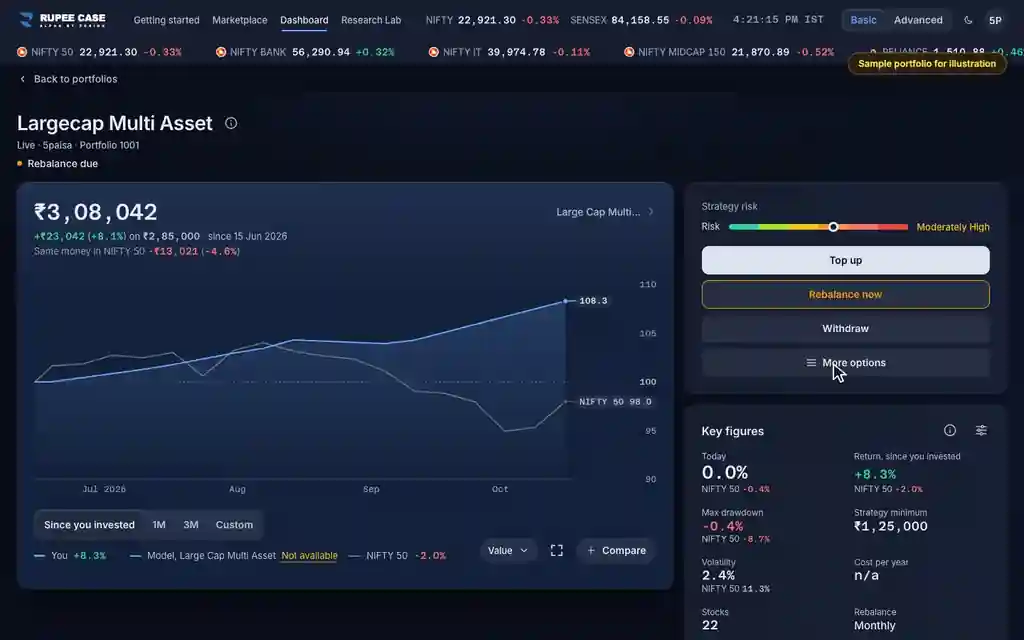
RupeeCase is a technology platform, not a fund or a PMS. It never holds your money or your shares. They stay in your own demat, with your own broker, and a withdrawal leaves the cash in your broker ledger.
- Sign inYou sign in at your own broker, again each trading day.
- ReadRupeeCase reads your broker cash. It never holds it.
- ConsentLive orders wait until you tick the consent text.
- OrdersThey go only to the broker you chose.
- SettleThe shares land in your demat.
The invest sheet starts on Practice, which places no order. In Live mode the app asks for consent at each investment, top up, withdrawal and rebalance. The invest sheet and Practice or Live tutorials show both.
Two terms to hold on to from 1.6
Read one more paragraph, 93 words
If your broker offers MTF, the sheets show an MTF block with its own "I accept the MTF terms" tick, and the rebalance sheet shows a margin warning. It is a loan with interest, and nothing in the app needs it. Broker positions, under More options, sets your broker's holdings beside your portfolios and marks any gap. The tutorials Broker positions: does the app hold my money or shares?, Broker positions and gaps, Cash at the broker, MTF on the invest sheet and Broker session expired show each screen.
Questions readers ask
Do I have to nominate?
On a new single holder account, from 1 Sep 2026, you either nominate or sign an opt out declaration. Existing accounts without a nomination get a twice yearly message and a pop up at login.
A broker will not fix a trade I never placed. Where do I complain?
Write to the broker first and keep the screens. Then use SCORES, where since Apr 2024 the entity must reply within 21 calendar days, and SMART ODR after that. Ask the broker for its evidence of your order.
I already paid a group. What now?
Report it at once on the national helpline 1930 or at cybercrime.gov.in. SEBI also takes details of unregistered entities on its Market Intelligence portal.
Rules and figures in this module were last verified on 19 Oct 2026. Tax and regulatory rules change; check the source before acting.